80% LTV: How Remortgaging to Release Equity Works in the UK

Yes, you can remortgage to release equity, provided you meet a lender’s affordability and loan-to-value criteria — but it means a bigger mortgage and higher monthly repayments, not free money. Before applying, check your current mortgage balance, get a realistic market valuation and confirm whether your existing deal carries early repayment charges.
TL;DR:
- Most lenders cap equity release at around 80% loan-to-value, but the actual amount you can borrow depends heavily on your income, debt, age, and credit profile.
- Additional costs include valuation, legal, arrangement, and broker fees, with early repayment charges potentially erasing any claimed benefits.
- Extending your mortgage term to make payments manageable can significantly increase total interest paid over the loan’s life, sometimes more than doubling the initial sum.
- Alternative options like lifetime mortgages, second-charge loans, or personal loans may better suit certain circumstances, especially for older homeowners or short-term needs.
- Applying for a remortgage temporarily impacts your credit score, and the released cash is tax-free unless used for investments or property purchases that trigger additional taxes.
Table of Contents
- What does it mean to remortgage to release equity?
- How much equity can you actually release?
- What will it cost you, and what’s the real long-term impact?
- Pros, cons and risks to weigh
- Alternatives to remortgaging: what else can release cash?
- How to decide and what to do next
- What an independent broker actually does for you
- Does remortgaging affect your credit score?
- Do you pay tax on money released from a remortgage?
- Comparing remortgage deals for equity release
- Where the conventional advice on this gets it wrong
- How Prosper Home Loans can help you release equity from your home
- Sources
- FAQ
What does it mean to remortgage to release equity?
Remortgaging to release equity means replacing your current mortgage with a new, larger one and taking the difference as cash. The new lender pays off what you owe on your existing deal, and whatever is left over lands in your bank account as a tax-free lump sum. It sounds simple, and mechanically it is, but the process runs through several distinct stages before any money moves.
Your equity is the gap between what your home is worth and what you still owe. If your house is valued at a substantial amount and your outstanding mortgage is considerably less, you’re sitting on some equity. A lender won’t let you release all of it, but a workable slice of it becomes available once you pass their checks, as Uswitch explains in its guide to remortgaging for equity.
Here’s how the process typically unfolds:
- Valuation. The new lender arranges a survey to confirm what your property is actually worth today, not what you paid for it or assume it’s worth now.
- Application and affordability checks. You submit income evidence, outgoings and credit history so the lender can stress-test whether you can afford the larger monthly payment.
- Legal and conveyancing work. A solicitor handles the transfer of the mortgage charge, checks the title, and deals with any conditions the lender attaches to the offer.
- Completion. Funds are released, your old mortgage is repaid in full, and the new, larger mortgage is registered against your property.
There’s a variant worth knowing about too: if you own your home outright, with no mortgage at all, taking out a new loan against it isn’t technically a remortgage. Lenders call this an unencumbered mortgage, and while the affordability tests are broadly similar, there’s no existing balance to redeem first, which can simplify the legal work slightly.
How much equity can you actually release?
Loan-to-value, or LTV, is the figure that decides your ceiling. It’s the size of your mortgage expressed as a percentage of your property’s value. The lower your LTV, the more room you generally have to borrow more against the same property.
Most mainstream lenders are comfortable taking a remortgage for equity up to around 80% LTV, according to CompareTheMarket’s guide to equity release remortgaging, though the exact ceiling shifts depending on your income, credit profile and the reason you’re borrowing. Some lenders will stretch higher for strong applicants; others pull back sharply if you’re self-employed, older, or borrowing for something they consider higher risk, such as buy-to-let deposits or business investment.
A few things shape what you’ll actually be offered:
- Income and employment type. Sub-contractors and self-employed applicants typically need two to three years of accounts or CIS vouchers, not just a payslip.
- Existing debt. Outstanding loans, credit card balances and other mortgages all count against your affordability headroom.
- Credit history. Missed payments or a low credit score can shrink both your maximum LTV and the rates you’re offered.
- Age and retirement income. Lenders will look closely at pension provision if the mortgage term runs past your planned retirement age.
Statistic to know: Lenders generally prefer to cap remortgage equity release at around 80% LTV, which is why two homeowners with identical property values can be offered very different release amounts once their income and debt profiles are factored in.
Affordability stress-testing means the lender checks you could still cope if interest rates rose, not just whether you can afford today’s rate. That’s a deliberate safeguard, and it’s the main reason a strong income on paper doesn’t always translate into the release amount a homeowner expects.
What will it cost you, and what’s the real long-term impact?
Releasing equity through a remortgage rarely comes free, and the fees you meet at the start are only half the story. The bigger cost usually sits in the interest you’ll pay over the following years.
Expect to budget for some or all of these:
- Valuation fee, charged by the lender to confirm your property’s worth.
- Arrangement fee, sometimes added to the loan itself rather than paid upfront.
- Legal or conveyancing fee, covering the solicitor work needed to register the new charge.
- Broker fee, if you use one, though many brokers are paid by the lender instead.
- Early repayment charges (ERCs), if you’re leaving your current deal before its fixed or discounted period ends.
JMW Solicitors point out that early repayment charges are one of the most commonly overlooked costs, and they can be substantial enough to wipe out the benefit of switching altogether. Always check your current mortgage offer document or read our explainer on why early repayment charges matter before assuming a switch makes sense.
The less obvious cost is what happens over the life of the loan. Say you release £30,000 and add it to a mortgage with 20 years left. Spread over two decades at a typical mortgage rate, that £30,000 can end up costing considerably more than double in total interest, depending on the rate and term you’re offered. Extending your term to keep payments manageable often makes this worse, not better, because you’re paying interest for longer even if each monthly payment feels smaller. It also chips away at what’s left for anyone inheriting the property.
Pro Tip: Run the numbers both ways before deciding, comparing the total interest cost of adding the sum to your mortgage against a shorter-term loan for the same amount. A broker or a decent mortgage calculator can model both scenarios side by side in minutes, and the difference often surprises people.
Pros, cons and risks to weigh
Releasing equity through a remortgage can solve financial issues for homeowners, but it is important to carefully consider the decision and the pros and cons.
What’s in your favour:
- Access to a tax-free lump sum without selling your home or moving.
- The chance to consolidate expensive unsecured debt into one lower-rate payment (our guide on why debt consolidation reduces monthly payments covers this in more detail).
- An opportunity to switch to a better rate at the same time as releasing funds, if your current deal has expired.
What works against you:
- Higher monthly repayments, sometimes significantly so if you’ve released a large sum.
- More total interest paid over the life of the mortgage.
- Reduced equity left for inheritance or later-life care funding.
- Negative equity risk if property values fall after you’ve borrowed against a high LTV.
- Repossession risk if repayments become unaffordable, since the loan remains secured against your home.
A practical red flag: if you’re close to retirement with modest pension income, adding to your mortgage balance can leave you stretched once your earnings drop. In that scenario, it’s worth exploring age-specific products before assuming a standard remortgage is the answer.
Alternatives to remortgaging: what else can release cash?
Remortgaging isn’t the only route to unlocking money from your home, and depending on your age, the sum you need and how long you want to borrow for, a different option might suit you better.
- Lifetime mortgages (equity release). These are aimed at homeowners typically aged 55 and over, and they work very differently from a standard remortgage. There’s usually no requirement for monthly repayments; instead, interest rolls up and the loan is repaid when you die or move into long-term care, as Saga explains in its comparison of remortgaging and lifetime mortgages. That flexibility comes at a cost: compound interest can erode the equity left in your estate far more than a repayment mortgage would.
- Secured second-charge loans. These sit behind your existing mortgage rather than replacing it, which means you keep your current deal’s rate intact. Interest rates on second-charge lending tend to run higher than a standard remortgage, but they can be quicker to arrange, and bridging loans exist for short-term needs where speed matters more than cost.
- Personal loans or borrowing from family. For smaller sums, a personal loan can genuinely work out cheaper overall than adding the amount to a decades-long mortgage term, purely because the borrowing period is so much shorter. The trade-off is a lower maximum loan size and, usually, a higher monthly payment relative to what you’d pay on a mortgage extension.
How to decide and what to do next
Making the right call starts with paperwork, not guesswork. Lenders will typically want to see your current mortgage statement, recent payslips or pension statements, evidence of your outgoings, and proof of identity and address before they’ll give you a meaningful indication of what you could release.
Before you commit to anything, it’s worth arming yourself with a specific set of questions to put to a broker, lender or solicitor:
- What’s my estimated maximum LTV, and how much could that release in cash?
- What would my new monthly payment look like, and how does that compare with stress-tested rates?
- Are there any early repayment charges on my current deal, and how much would they cost me?
- What are all the fees involved, added up in one place, not scattered across separate quotes?
- How long is completion likely to take from application to funds in my account?
Pro Tip: Ask for a written breakdown of every fee before you commit to an application. Lenders sometimes quote a headline arrangement fee but bury valuation or legal costs elsewhere, and seeing them side by side stops nasty surprises at completion.
On timescale, a straightforward remortgage for equity release typically takes several weeks from application to completion, though CompareTheMarket notes it can stretch to a couple of months where valuations, legal searches or more complex income evidence slow things down. Instructing a conveyancer early, and using a broker to run comparisons across the whole market simultaneously, tends to shave real time off that process.
What an independent broker actually does for you
Assessing whether remortgaging to release equity makes sense for a specific household means looking beyond the headline rate. We look at your whole financial picture: current balance, realistic valuation, income type, and whether any early repayment charges on your existing deal would eat into the benefit of switching at all.
A whole-of-market broker searches across lenders rather than pushing you toward one product range, which matters because appetite for releasing equity varies sharply between lenders depending on your circumstances. Here’s what that process typically involves for us:
- Reviewing your current mortgage terms and flagging any ERCs before you apply anywhere.
- Comparing lenders’ LTV and affordability appetite against your actual income type, including self-employed and CIS voucher income.
- Coordinating with your chosen conveyancer so legal work and lender conditions move in step, not in sequence.
- Estimating realistic fees upfront so there are no surprises at completion.
Our articles on topics like remortgaging with a debt management plan reflect the kind of complex cases we handle regularly, where standard high-street criteria don’t automatically apply.
Does remortgaging affect your credit score?
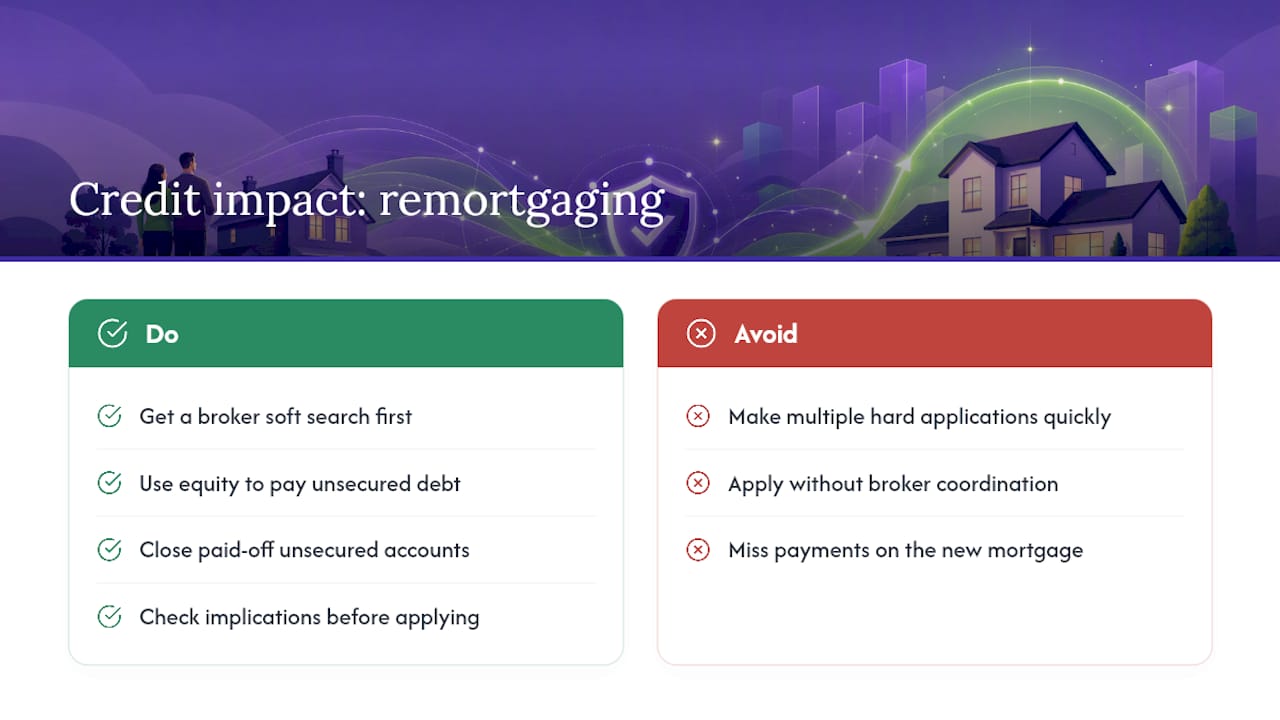
Applying for a remortgage does affect your credit file, though usually only modestly and temporarily. Each formal application triggers a hard credit search, which leaves a mark on your file and can cause a small, short-term dip in your score.
Where things get more serious is if you apply to multiple lenders in quick succession without a broker coordinating the search. Several hard searches in a short window can look, to a credit scoring system, like financial distress, even if you’re simply shopping around for the best deal. This is one reason a broker’s initial “soft search” comparison across lenders, which doesn’t leave a footprint, is genuinely useful before you commit to a formal application.
Once your new, larger mortgage is in place, it will show on your credit file as a new secured credit agreement, and your overall credit utilisation may shift depending on how the released funds are used. If you use some of the equity to clear credit cards or a car loan, closing those accounts can actually improve your credit profile over time, because it lowers your overall unsecured debt exposure. Missing a payment on the new, larger mortgage, however, does more damage to your score than missing one on a smaller loan, simply because the amount at stake is bigger and lenders treat secured mortgage arrears seriously.
Do you pay tax on money released from a remortgage?
The lump sum you release by remortgaging is not classed as income, so it isn’t subject to income tax. Because you’re borrowing against your own property rather than earning or selling it, HM Revenue and Customs doesn’t treat the released cash as taxable in the way a salary or rental income would be.
Where tax can enter the picture is in how you use the money, not in receiving it. If you release equity to buy a second property, for instance, that new property could be liable for the higher rate of stamp duty land tax that applies to additional homes, and any future sale of it could trigger capital gains tax if it isn’t your main residence. Releasing equity to invest in a buy-to-let, similarly, brings that property into the normal tax treatment for rental income and eventual disposal.
If the equity is used simply for home improvements, debt consolidation or everyday costs against your own main residence, there’s no separate tax event to worry about. It’s worth checking your specific plans with an accountant if you’re releasing a substantial sum for investment purposes, since the tax treatment depends entirely on what the money goes towards rather than the remortgage itself.
Comparing remortgage deals for equity release
Choosing the right deal means comparing more than just the headline interest rate, which is where a lot of homeowners get caught out.
Start by listing your non-negotiables: the amount you need to release, whether you want a fixed or tracker rate, and how long you want the new term to run. Our comparison of fixed versus tracker mortgages is worth reading before you decide, since the right product type depends heavily on how much certainty you want over your monthly payment.
From there, compare deals on total cost over your likely holding period, not just the initial rate. A slightly higher rate with no arrangement fee can beat a cheaper rate loaded with charges, particularly if you’re not planning to stay on the deal for its full term. Check each lender’s maximum LTV against the amount you actually want to release, since some lenders cap equity release lower than their standard remortgage LTV even when the headline rate looks attractive.
Finally, weigh the exit terms as carefully as the entry ones. Ask whether the deal has early repayment charges, how long they last, and whether the product allows any overpayments without penalty, in case your circumstances improve and you want to pay the balance down faster than planned.
Where the conventional advice on this gets it wrong
Most guides on remortgaging to release equity treat it as a spreadsheet exercise: work out your LTV, compare rates, pick the cheapest deal. That misses the point for a lot of homeowners. The real decision isn’t which lender offers the lowest rate. It’s whether adding years of interest to your mortgage is a sensible trade for the problem you’re actually trying to solve.
Homeowners chasing a fixed sum for, say, a kitchen extension or clearing a credit card, sometimes default to remortgaging because it’s the option they’ve heard of, without comparing it against a shorter personal loan that could cost less overall despite a higher monthly payment. The maths favours the shorter loan more often than people assume, particularly for sums under about £15,000.
What should come first isn’t rate shopping. It’s an honest look at how long you’ll be paying for this money, and whether that timeframe matches what you’re spending it on. Borrowing over 20 years for a car that won’t last five is the mismatch worth spotting before you sign anything.
— Paul
How Prosper Home Loans can help you release equity from your home
There are independent, whole-of-market advisors covering Hastings, Eastbourne, Hailsham and Bexhill-on-Sea who search across lenders rather than steering you toward a single panel, and check for early repayment charges and legal costs before you submit an application.

Getting started is straightforward. We begin with a review of your current mortgage and circumstances, give you a realistic indication of what you could feasibly release, and set out the fees involved before you commit to anything formal. From there, we coordinate with your conveyancer so the legal and lender steps run in parallel rather than causing delays. Whether you’re self-employed, working through CIS vouchers, or simply want a second opinion on whether remortgaging beats the alternatives for your situation, get in touch through Prosper Home Loans to book your initial review.
Sources
Check recent local sale prices with Land Registry price-paid data before requesting a valuation. For consumer protections and adviser rules, see FSCS guidance. For a wider comparison of remortgaging versus lifetime mortgages, see Aviva’s equity release knowledge centre.
This article is general information, not a substitute for advice from a qualified financial advisor. Consult a qualified financial professional about your own circumstances before acting on anything here.
- Remortgaging to release equity | Saga
- Misunderstandings about remortgaging to release equity - JMW Solicitors
- Remortgage To Release Equity | Uswitch
- Remortgaging to release equity from your home | CompareTheMarket
FAQ
Can you release equity by remortgaging?
Yes. You take out a new, larger mortgage than your existing one, and the difference is paid to you as a tax-free lump sum, subject to meeting the lender’s LTV and affordability criteria.
What does Martin Lewis think about equity release?
Martin Lewis’s MoneySavingExpert generally urges caution with lifetime mortgages specifically, given the impact of rolled-up interest on inheritance, and recommends speaking to an independent adviser and exploring standard remortgaging or downsizing first where those options are viable.
What is the typical cost of equity release in the UK?
Costs vary by provider and loan size, but expect to budget for valuation, legal and arrangement fees regardless of whether you choose a lifetime mortgage or a standard remortgage for equity, alongside any early repayment charges on your existing deal.
Who is the best company to go to for equity release in the UK?
Rather than a single “best” provider, most homeowners are better served by an independent, whole-of-market broker who can compare lenders against their specific circumstances.
Recommended
