What is a debt management plan? A UK guide

A debt management plan (DMP) is an informal agreement between you and your unsecured creditors to repay what you owe through a single, affordable monthly payment. According to GOV.UK, you can set one up yourself, through a free charity such as StepChange, Citizens Advice, or National Debtline, or via a commercial company authorised by the FCA. Because a DMP is informal, creditors are not legally obliged to accept it.
Key facts to hold in mind from the outset:
- A DMP covers unsecured debts only (credit cards, personal loans, overdrafts) — not mortgages, rent, or council tax.
- Creditors do not have to agree, and they can still add interest or take recovery action unless they explicitly agree otherwise.
- Free charity providers operate under the same FCA standards as paid companies and pass more of your payment directly to creditors.
Table of Contents
- How does a debt management plan work in practice?
- Who does a DMP actually help, and who should look elsewhere?
- Pros and cons to weigh before starting a DMP
- How a DMP affects your credit file, mortgage prospects, and assets
- Typical fees, timelines, and what a DMP actually costs
- How do the main alternatives compare?
- How to set up a DMP: a practical checklist
- Essential cautions before remortgaging to consolidate
- Key takeaways
- An adviser’s honest view on DMPs and remortgaging
- Considering a debt consolidation remortgage? Here is how Prosperhomeloans can help
- Useful sources for further reading
How does a debt management plan work in practice?
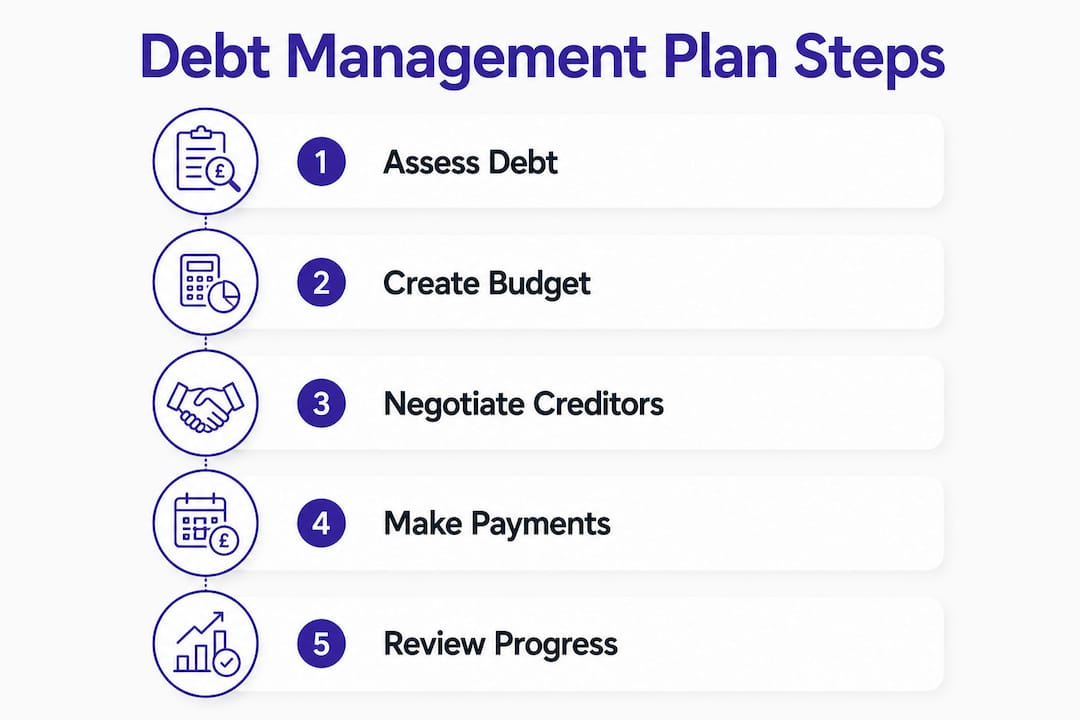
A DMP converts multiple monthly payments into one affordable contribution based on what you can genuinely afford after essential costs. National Debtline explains that a DMP provider distributes this single payment proportionally across your creditors, and that the arrangement does not usually reduce the principal you owe.
The typical sequence runs as follows:
- Assess your budget: List all income and essential outgoings to calculate a realistic surplus.
- Agree a monthly payment: Your provider uses this surplus to propose a payment plan.
- Provider contacts creditors: Each creditor is asked to accept reduced payments and, ideally, to freeze interest and charges.
- Funds are distributed: Your monthly payment is split proportionally among participating creditors.
- Regular reviews: The plan is revisited, usually every 6–12 months, to reflect changes in your circumstances.
The word “informal” matters here. Citizens Advice confirms that creditors retain the right to add interest or pursue action unless they have explicitly agreed otherwise in writing.
Pro Tip: Always request written confirmation from each creditor that they have agreed to freeze interest and charges. A verbal assurance is not enough — keep every letter and email.
Who does a DMP actually help, and who should look elsewhere?
A DMP works best for people with only unsecured debts, a stable income, and a modest monthly surplus after essential bills. It suits those who want to manage payments without taking on new borrowing or entering a formal legal process.
A DMP is likely a good fit if you:
- Have multiple unsecured debts you cannot meet at full contractual payments.
- Can commit to a reduced but consistent monthly payment over time.
- Prefer an informal arrangement and want help negotiating with several creditors at once.
- Have no immediate need for legal protection from creditor action.
Consider a different route if you:
- Have significant priority debts (mortgage arrears, council tax, energy bills) — a DMP does not cover these.
- Face imminent legal action requiring formal protection, such as a county court judgment.
- Are a homeowner considering consolidating unsecured debt into a remortgage without first taking independent mortgage advice.
- Have debts so large that repayment within a reasonable timeframe is unrealistic.
For a quick self-assessment, ask yourself: Do I have priority debts? Can I sustain a monthly payment? Do I understand how a DMP will affect my credit file and future mortgage options? If you are unsure, contact StepChange, Citizens Advice, or MoneyHelper before making any decision.
Pros and cons to weigh before starting a DMP
The principal benefit of a DMP is simplified budgeting through a single payment and centralised creditor negotiations. The principal risk is its informal status: creditors can still add interest, and the plan may run longer and cost more than you expect.
Advantages:
- One affordable monthly payment replaces multiple separate ones.
- Access to free, regulated charity support (StepChange, National Debtline, Citizens Advice).
- No credit approval required — accessible regardless of your credit profile.
- Creditors may agree to freeze interest, directing your full payment toward reducing balances.
Disadvantages:
- Creditors are not bound to freeze interest or stop recovery action.
- A DMP registers on your credit file and remains visible to lenders for six years.
- Commercial providers charge fees, reducing the share of each payment that reaches creditors.
- The plan does not reduce the principal you owe unless creditors specifically agree to write off a portion.
Citizens Advice is clear that you do not need to pay for a DMP. Free providers operate under the same FCA framework as paid companies and typically return more of your monthly payment to creditors.
How a DMP affects your credit file, mortgage prospects, and assets
A DMP is visible to lenders and can make standard mortgage approval significantly harder for several years. The DMP marker, along with any underlying defaults, stays on your credit file for six years from the date it was registered.
- Credit file: Lenders see that you are repaying debts at a reduced level under a negotiated arrangement, not at original contracted terms.
- Mortgage eligibility: A DMP marker and the defaults that led to it are a significant barrier to mainstream mortgage lending. Lenders often require a longer period of clean credit history, a larger deposit, or specialist underwriting even after a DMP is settled.
- Remortgaging: Lenders focus on the underlying defaults more than the DMP label itself. Remortgaging shortly after completing a DMP is often difficult without a specialist lender.
- Your assets: A DMP covers unsecured debts only. It does not place a charge on your home. However, converting unsecured debt into a remortgage or secured loan does put your property at risk if repayments fail.
Pro Tip: Once your DMP is complete, register on the electoral roll, keep all accounts in good standing, and allow time before applying for a mortgage. Seek independent regulated mortgage advice before approaching any lender.
Typical fees, timelines, and what a DMP actually costs
The length and total cost of a DMP vary considerably depending on the total debt, the monthly payment, whether interest is frozen, and whether you use a free or paid provider.

| Element | Free charity provider | Commercial DMP provider |
|---|---|---|
| Who administers | StepChange, National Debtline, Citizens Advice | FCA-authorised commercial firm |
| Set-up fee | None | May apply |
| Ongoing fees | None | Monthly administration charge |
| Interest freeze | Negotiated with creditors | Negotiated with creditors |
| Effect on total repaid | More of each payment reaches creditors | Fees reduce the share reaching creditors |
| Typical duration | Months to several years, depending on debt size | Same, but fees can extend the timeline |
Free charity providers pass your full monthly payment to creditors. A commercial provider’s fees come out of that same payment, which means creditors receive less each month and the plan runs longer. The FCA’s regulatory framework applies to all authorised DMP firms, but it does not cap fees.
How do the main alternatives compare?
Alternatives are more appropriate when you need a legally binding arrangement, immediate creditor protection, or access to affordable new borrowing. StepChange distinguishes clearly between DMPs (which manage existing payments) and consolidation (which creates new credit to repay old debts).
| Alternative | Legal status | Binds creditors? | Risk to home | Typical use case |
|---|---|---|---|---|
| DMP | Informal | No | None (unsecured only) | Manageable unsecured debts, stable income |
| IVA | Formal (statutory) | Yes, if approved | Possible equity release clause | Larger debts, needs legal protection |
| Debt Relief Order | Formal (statutory) | Yes | Not suitable if you own property | Low income, low assets, debts under threshold |
| Bankruptcy | Formal (statutory) | Yes | Home may be at risk | Debts cannot be repaid; last resort |
| Consolidation loan | New credit agreement | N/A | Risk if secured against property | Good credit profile, lower rate available |
| Remortgage to consolidate | Secured borrowing | N/A | Direct risk to home | Last resort; requires independent mortgage advice |
Before remortgaging to consolidate unsecured debts, always seek independent mortgage advice. Converting unsecured debt into secured borrowing is a significant step that places your home at direct risk if repayments fail.
How to set up a DMP: a practical checklist
Preparing an accurate budget and a full creditor list is the single most important first step. Everything else follows from knowing exactly what you owe and what you can realistically afford.
- List all unsecured debts — creditor name, balance, interest rate, and minimum payment.
- Prepare a detailed monthly budget — income minus all essential outgoings to find your true surplus.
- Contact a free charity first — StepChange, National Debtline, or Citizens Advice before approaching a commercial provider.
- Choose a provider — if using a commercial company, verify FCA authorisation on the Financial Services Register.
- Request written confirmation from each creditor that they have agreed to the revised payment terms and any interest freeze.
- Set review points every 6–12 months to update your budget and payment level.
Questions to ask a commercial DMP provider:
- Are you authorised by the FCA? What is your registration number?
- What are your full fees (set-up and monthly)?
- How is my monthly payment allocated between creditors?
- What happens if a creditor refuses to participate?
- What is your cancellation policy, and will I receive written confirmation of all creditor agreements?
Essential cautions before remortgaging to consolidate
Remortgaging to consolidate unsecured debts replaces obligations that carry no risk to your home with a debt secured against it. If repayments fail, your home is at risk. Industry advisers treat this as a last resort for exactly that reason.
- Total interest cost: Spreading unsecured debt over a longer mortgage term often increases the total interest paid, even at a lower rate.
- Rate risk: If interest rates rise, monthly payments on a larger mortgage increase.
- Lender restrictions: A recent DMP history limits access to mainstream lenders and may require a larger deposit or a specialist lender.
- Affordability stress-test: Model repayments at higher interest-rate scenarios before committing.
Pro Tip: Before approaching any lender, get multiple remortgage quotes and ask each one explicitly how they treat recent DMP history. The difference between lenders on this point can be significant.
Practical steps: obtain independent regulated mortgage advice, confirm in writing how each lender treats DMP history, and calculate whether consolidation genuinely reduces your long-term cost once fees and the extended term are factored in.
Key takeaways
A DMP is an informal, unsecured-debt arrangement that simplifies repayment but does not legally bind creditors or protect your home — and it leaves a mark on your credit file for six years.
| Point | Details |
|---|---|
| DMP is informal | Creditors are not legally bound to freeze interest or stop recovery action. |
| Free advice first | StepChange, National Debtline, and Citizens Advice offer free, FCA-standard DMP support. |
| Credit file impact | A DMP marker remains visible to lenders for six years and affects mortgage eligibility. |
| Remortgage is a last resort | Converting unsecured debt to secured borrowing puts your home at risk; always take independent advice first. |
| Prosperhomeloans can help | If you are considering a debt consolidation remortgage or secured loan, Prosperhomeloans offers independent mortgage advice to find the right lender for your situation. |
An adviser’s honest view on DMPs and remortgaging
The conventional wisdom is that a DMP is a stepping stone to financial recovery, and for many households it genuinely is. Where we see clients go wrong is in treating it as a fast track to a remortgage. A DMP stabilises your monthly outgoings, but the defaults that preceded it are what lenders scrutinise most closely. Clearing a DMP does not reset your credit file — it simply adds a completion date to a record that remains visible for six years.
The clients who remortgage successfully after a DMP are those who waited, rebuilt their credit profile methodically, saved a larger deposit, and came to us with documented evidence of on-time payments over an extended period. Rushing to consolidate into a remortgage before that groundwork is done usually results in a higher rate, a specialist lender, and a mortgage that costs more over its lifetime than the original unsecured debts would have.
Our practical advice: use a DMP to stabilise, use the time to rebuild, and seek independent mortgage advice before you approach a single lender. The order of those steps matters more than most people realise.
Considering a debt consolidation remortgage? Here is how Prosperhomeloans can help
Sorting out a remortgage when your credit history includes a DMP is not straightforward, and the wrong lender choice at the wrong moment can make things harder. Prosperhomeloans offers independent mortgage and protection advice specifically for clients in this position, including those with DMP history, defaults, or complex income situations.

We search across the market, run a full affordability analysis, and access specialist lenders who understand DMP backgrounds. We also help you stress-test repayment scenarios before you commit, so you know the real long-term cost of consolidating. Before taking that step, we always recommend getting free regulated debt advice from StepChange, Citizens Advice, or MoneyHelper to confirm that a secured consolidation is the right route for your circumstances.
When you are ready to explore your remortgage options, speak to our team at Prosperhomeloans for an initial discussion with no obligation.
This article is general information, not financial or legal advice. Always confirm your options with a qualified adviser or the relevant primary source for your own situation.
Useful sources for further reading
- GOV.UK — Debt Management Plans: The official UK government explanation of what a DMP is, who can set one up, and what creditors can and cannot do. Start here for the legal framework.
- StepChange Debt Charity: Free, regulated debt advice and DMP setup. StepChange is one of the UK’s largest debt charities and charges no fees.
- Citizens Advice — How to get a DMP: Step-by-step guidance on setting up a DMP, understanding fees, and choosing between free and paid providers.
- National Debtline: Free telephone and online debt advice, including detailed DMP guidance for England and Wales.
- MoneyHelper: Government-backed money guidance service covering all debt relief options, budgeting tools, and signposting to regulated advisers.
- FCA Glossary — Debt Management Plan: The regulatory definition of a DMP and the FCA’s expectations for authorised firms. Use the Financial Services Register to verify any commercial provider.
