Remortgage with a DMP: your practical options explained

Remortgaging while on a debt management plan is possible, but it takes the right route and the right timing. Product transfers with your existing lender are usually the easiest path, while switching to a new lender often needs a specialist and a larger deposit. Expect stricter affordability checks and higher rates than a mainstream deal, and read on for the specifics before you apply.
TL;DR:
- A product transfer with your current lender is the easiest remortgage option while on a DMP because it often avoids a full affordability check.
- A full remortgage with a new lender requires a credit check, income verification, and at least 12 months of consistent DMP conduct for specialist lenders to consider.
- Your borrowing potential decreases by about £40 to £60 for every £1 of monthly DMP payment, impacting the maximum loan-to-value and rates offered.
- Completing your DMP improves your borrowing chances, but defaults remain on your credit file for up to six years, affecting lending options.
- Timing depends on how long you’ve been on the DMP, when defaults occurred, and when your current deal expires, with waiting at least 12 months of clean conduct boosting approval chances.
Table of Contents
- Can I remortgage while on a DMP or after completing one?
- How lenders view a DMP and what they check on an application
- When to apply: timing, waiting and what improves your chances
- Practical routes: product transfer, specialist remortgage and consolidation risks
- Step-by-step: prepare your remortgage application with a DMP
- Prosper Home Loans perspective and practical client examples
- What actually matters when you’re remortgaging with a DMP
- How Prosper Home Loans can help: confidential review and next steps
- Sources
Can I remortgage while on a DMP or after completing one?
The honest answer depends on which type of remortgage you mean. A product transfer, where you switch to a new deal with your current lender, is typically the most accessible option for someone in a debt management plan, because many lenders will process it without a full affordability review or fresh credit search, provided your borrowing amount and mortgage term stay the same.
A full remortgage to a brand new lender is a different matter. This is treated as a completely fresh application, which means a credit check, income verification, and an affordability assessment that will factor in your DMP payment as an ongoing commitment. Mainstream lenders tend to decline these applications while a DMP is active, but specialist lenders will sometimes consider them once certain conditions are met.
We typically see specialist lenders look for:
- At least 12 months of clean, on-time DMP conduct, ideally longer
- A deposit at least around the mid-teens percentage of the property value, with higher deposits making approval easier
- No missed mortgage payments, ever, alongside the DMP
- Evidence that any defaults linked to the DMP are settled or well on their way to being cleared
If you’ve already completed your DMP, your position improves, though not as dramatically as most people hope. The monthly payment disappears from affordability sums, but the defaults that led to the DMP stay on your credit file for up to six years from when they were recorded. Lenders will still see them.
How lenders view a DMP and what they check on an application
Underwriters assess a DMP application on two separate fronts, and both matter. The first is the underlying adverse history: the defaults, missed payments, or County Court Judgments that caused you to need a DMP in the first place. The second is the DMP payment itself, which lenders treat as a fixed monthly outgoing in exactly the same way they’d treat a car finance agreement or a personal loan.

Pro Tip: Ask your DMP provider for a written statement showing your payment history in full. A single, clean document is far more persuasive to an underwriter than a stack of individual bank statements they have to cross-reference themselves.
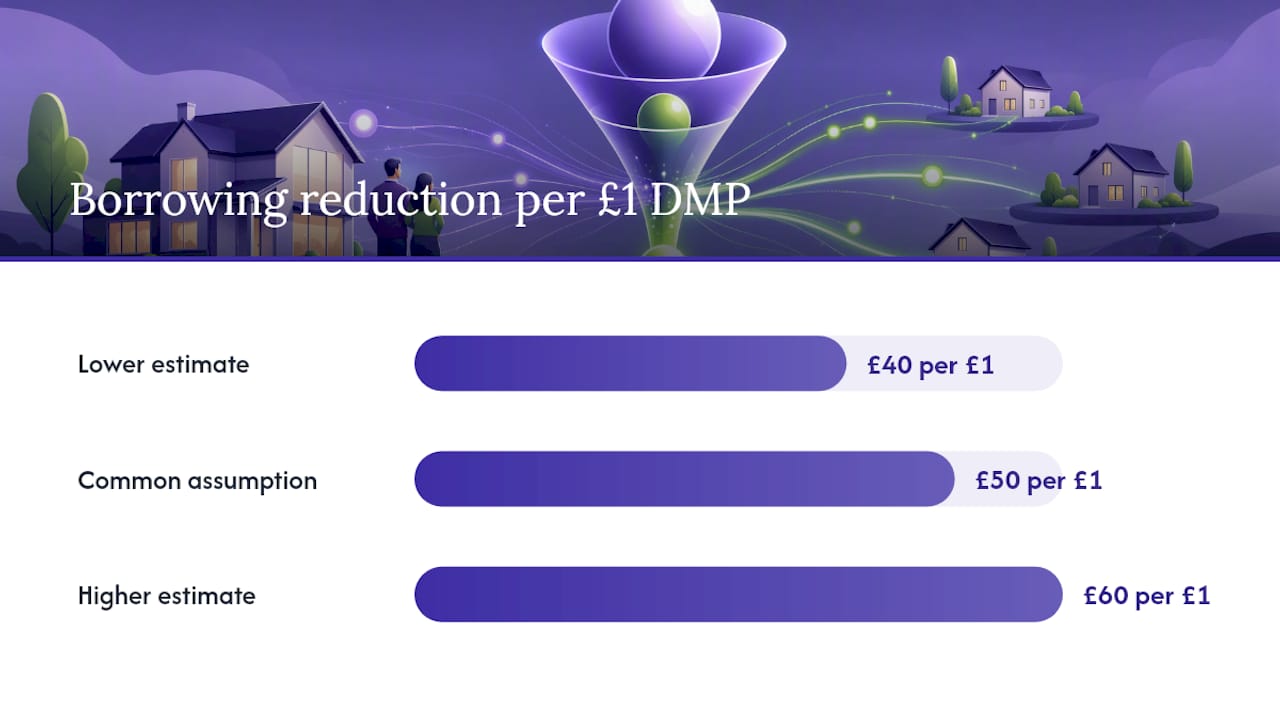
As a rough rule of thumb, lenders reduce your maximum borrowing by roughly £40 to £60 for every £1 of monthly committed payment, depending on their own stress-testing assumptions. A monthly DMP payment reduces what you’re able to borrow by a significant amount, depending on the lender’s assumptions.
Lenders generally group adverse credit into tiers, and where you sit affects both your maximum loan-to-value and your rate:
- Light adverse (a single old default, now settled) — closer to mainstream rates, higher LTV available
- Moderate adverse (an active DMP, multiple historic defaults) — specialist lenders only, lower LTV, higher rate
- Heavy adverse (recent CCJs, current arrears alongside the DMP) — very limited options, expect the highest rates and lowest LTV
A DMP usually lowers your credit score, and that alone can push your pricing up even once the payment itself is affordable.
When to apply: timing, waiting and what improves your chances
Timing decisions come down to three things: how long you’ve been on the DMP, when your defaults were recorded, and when your current deal ends.
- Under 12 months into your DMP — focus on a product transfer with your existing lender rather than shopping the wider market; a new lender is unlikely to accept you yet.
- 12 months or more of clean conduct — this is the point where specialist lenders start to take applications seriously, particularly with a 15% to 25% deposit.
- DMP completed, defaults still under six years old — affordability improves because the payment drops off, but you’re still in specialist lender territory until those markers age out.
- Defaults have aged past six years — they fall off your credit file entirely, opening up mainstream lending again in most cases.
Finishing your DMP is genuinely good news for what you can borrow, since the monthly payment no longer eats into your affordability calculation. It doesn’t erase the defaults sitting on your credit file, though, and that’s the part people underestimate most often.
If your current deal is ending soon and you have reasonable equity, a product transfer now often makes more sense than waiting and risking your standard variable rate.
Practical routes: product transfer, specialist remortgage and consolidation risks
Three genuine paths exist, and they carry very different levels of difficulty and risk.
- Product transfer with your current lender. This is almost always worth trying first. Because the loan amount and term typically stay unchanged, many lenders skip the full affordability check entirely, which makes it the lowest-friction option for anyone mid-DMP.
- Specialist lender remortgage. This opens the market beyond your current provider but demands a larger deposit, clean recent conduct, and comes with a higher rate to reflect the risk the lender is taking on.
- Debt consolidation remortgage. Borrowing more to clear other unsecured debts through your mortgage does reduce monthly outgoings on paper, but it converts unsecured debt into secured debt against your home. Miss payments on that larger mortgage and repossession becomes a real risk in a way it never was with unsecured debt.
Because specialist lending criteria vary so widely and don’t always follow a simple published rate card, a whole-of-market broker is worth involving before you submit anything. Multiple formal applications to lenders who were never going to say yes leave fresh marks on your file and can actively work against you. Sequencing your approach properly, starting with your current lender, then moving to a broker-led search, protects your credit file while widening your options.
Step-by-step: prepare your remortgage application with a DMP
Getting your paperwork right before you approach anyone saves weeks and avoids a declined application sitting on your file unnecessarily.
- Gather your DMP statements showing the full payment history, plus three to six months of bank statements confirming those payments went out on time.
- Collect proof of income, whether that’s payslips, P60s, or self-assessment returns and CIS vouchers if you’re self-employed or a subcontractor.
- Pull your credit reports from all three agencies and check every default date carefully; errors happen more often than people expect.
- Confirm settled accounts are marked “satisfied” rather than simply “closed”, since this distinction matters to underwriters reviewing your file.
- Check your mortgage statement for early repayment charges before switching lenders, as these can wipe out any savings from a lower rate.
Prosper Home Loans perspective and practical client examples
We see the same pattern repeatedly: homeowners assume a DMP rules out remortgaging entirely, when in practice a product transfer or a well-prepared specialist application often gets a result…
An initial call usually uncovers your default dates, DMP conduct history, and current equity within minutes, and we’ll typically ask for your credit reports and DMP statements first…
What actually matters when you’re remortgaging with a DMP
The conventional advice on this topic spends too long explaining why lenders are cautious and not nearly enough time telling readers what to actually do this month. That’s backwards for someone whose fixed rate ends in eight weeks.
Prioritise the product transfer conversation with your current lender before anything else. It’s the fastest, least invasive route, and it costs you nothing to ask. Only once that’s ruled out should you start thinking about specialist lenders, and even then, go in with your credit file already checked and your DMP conduct history already documented. Walking into a specialist application blind, hoping the underwriter will be lenient, is the single most common way we see good applications turned into declines.
The other point worth being blunt about: a debt consolidation remortgage is not a shortcut out of financial pressure. It can lower your monthly outgoings, but it moves the risk onto your home. That trade-off deserves more scrutiny than it usually gets.
— Paul
How Prosper Home Loans can help: confidential review and next steps
Prosper Home Loans runs a whole-of-market search across mainstream and specialist lenders, so you’re not stuck relying on whichever provider happens to advertise the loudest. We work with adverse-credit cases regularly, including active and completed DMPs, and we handle the application legwork so you’re not submitting to lenders who were never going to say yes.

For an initial review, have your DMP statements, recent bank statements, and a rough idea of your property’s current value ready. That first conversation is confidential and carries no obligation. If you’re weighing up a product transfer against a full remortgage, or you’re unsure whether your DMP conduct is strong enough yet for a specialist lender, get in touch with Prosper Home Loans and we’ll talk you through what’s realistically available.
Sources
- Can You Get a Mortgage With a Debt Management Plan? | National Debtline
- Mortgages With a Debt Management Plan (2026)
- Debt management plans explained | Citizens Advice
This article is general information, not a substitute for advice from a qualified financial advisor. Consult a qualified financial professional about your own circumstances before acting on anything here.
Recommended
