Whole of market broker explained: what it means for you

A whole of market broker is an adviser who searches across the relevant mortgage market rather than restricting recommendations to a single lender or a limited panel. In the UK, this means the adviser considers products from a wide range of lenders, including high-street banks, building societies, and specialist providers, to find the most suitable deal for your circumstances. The Financial Conduct Authority (FCA) does not mandate the label “whole of market,” but it does require firms to disclose their scope of service clearly, fairly, and without misleading consumers. Mortgage Conduct of Business rules (MCOB) underpin those disclosure obligations. At Prosperhomeloans, we operate as independent mortgage and protection advisers, which means our recommendations are not tied to any single lender or restricted panel.
A few things to know upfront:
- “Whole of market” is a description of scope, not a regulated title, so the label alone does not guarantee unlimited access to every lender.
- The FCA requires written disclosure of how an adviser’s service is scoped, including any limitations on the products or lenders they consider.
- Panel size varies significantly between firms; a broker may legitimately describe themselves as whole of market while still excluding certain specialist lenders.
- Regulated mortgage advice is governed by MCOB, which sets suitability and disclosure standards for all advised sales.
Pro Tip: Ask any broker to confirm in writing how many lenders are on their panel and whether any product types are excluded before you share personal financial details.
Table of Contents
- What “whole of market” means in practice for UK borrowers
- How whole of market differs from restricted and tied brokers
- When does whole-of-market access matter most for you?
- What “whole of market” does not mean — and where the label gets misused
- How to check a broker before you commit
- When a different route might suit you better
- Key takeaways
- Why impartial, well-documented advice is worth more than a label
- How Prosperhomeloans can help you find the right mortgage
- Useful sources and further reading
What “whole of market” means in practice for UK borrowers
The phrase describes the scope of an adviser’s search, not a fixed list of lenders. When a broker assesses your case, they identify the “relevant market” based on your borrower profile and the product type you need. A straightforward residential purchase for a salaried applicant with a clean credit history draws from a different pool of lenders than a buy-to-let application from a self-employed contractor with variable income.
Panels matter here. Even a whole of market broker typically works through a panel of lenders they have agreements with, rather than approaching every lender in the UK individually. The distinction is that a whole of market broker’s panel is intended to cover the mainstream market comprehensively, whereas a restricted broker’s panel is deliberately narrowed. In practice, this means:
- Mainstream residential lenders are almost always covered.
- Specialist lenders for adverse credit, complex income, or niche property types may or may not be included.
- Broker-exclusive products, which are not available directly to consumers, are often accessible only through an adviser with the relevant lender relationship.
MCOB and the FCA’s policy on mortgage advice require that any personalised recommendation on a regulated mortgage contract constitutes regulated advice, bringing the interaction within the full suitability framework. General information about mortgage products does not carry the same obligations, which is why the distinction between advice and information matters when you are comparing your options.
“The FCA requires firms to disclose their scope of service clearly and not mislead consumers about the range of products they consider. Labels such as ‘whole of market’ are not mandated, but the underlying disclosure obligation is firm.” — FCA scope of service guidance
PERG 4.6 of the FCA Handbook sets out precisely when a firm crosses from providing general information into giving regulated advice, and that boundary is what triggers MCOB’s full suitability requirements.
How whole of market differs from restricted and tied brokers
Understanding the difference between broker types helps you spot marketing spin and choose the right adviser for your situation.
A tied broker works exclusively with one lender. A multi-tied or restricted broker works with a defined list of lenders, which may be two or twenty, but the list is fixed. A whole of market broker searches across the relevant market for your product type, though as noted above, their panel still has practical limits. Equifax UK’s consumer guide on mortgage brokers describes the distinction clearly: tied brokers offer products from one or a small number of lenders, while whole of market brokers look at the widest range, though they may still not cover every single option.
| Broker type | Lender range | Typical fee model | Specialist case suitability | Conflict of interest risk |
|---|---|---|---|---|
| Whole of market | Broad panel, relevant market | Lender commission and/or client fee | High | Low to moderate |
| Restricted / multi-tied | Fixed panel of selected lenders | Lender commission | Moderate | Moderate |
| Tied | Single lender only | Lender commission | Low | High |
The label “independent” has historically implied unlimited range, but the FCA’s focus is on clear disclosure rather than enforcing specific labels. What matters is whether the firm tells you, in plain language, which lenders and product types it considers and which it does not. A broker who describes themselves as whole of market but cannot tell you how many lenders are on their panel, or who deflects when you ask about specialist products, is not giving you the transparency the FCA expects.
Key points to keep in mind when comparing broker types:
- Tied brokers are often bank or building society advisers sitting in branch; they can only recommend their employer’s products.
- Restricted brokers may have strong relationships with their panel lenders, which can sometimes mean faster processing.
- Whole of market brokers are better placed to find solutions for non-standard cases, but you should still ask about specialist lender coverage explicitly.
When does whole-of-market access matter most for you?
For many borrowers with straightforward circumstances, a restricted broker with a solid panel will find a competitive deal without difficulty. The real value of whole of market access shows up when your case sits outside the standard template.
Borrower profiles where broader market reach makes a material difference:
- Self-employed and contractors: Lenders assess income differently, and some use net profit while others accept gross contract day rates. Access to a wider lender pool increases the chance of finding a lender whose criteria match your income structure.
- Adverse credit: County court judgements, defaults, or missed payments narrow the field considerably. Specialist lenders who consider recent adverse credit are often absent from restricted panels.
- Buy-to-let investors: Rental yield calculations, portfolio landlord rules, and limited company structures vary significantly between lenders. A joint mortgage with friends or a multi-applicant buy-to-let arrangement adds further complexity that benefits from a broader search.
- Foreign nationals and overseas applicants: Visa type, residency status, and income currency all affect eligibility, and only a subset of lenders will consider these cases at all.
- Large loans and specialist lending: Bridging finance, development loans, and commercial mortgages sit in a distinct part of the market where lender relationships and specialist knowledge matter as much as panel breadth.
- Non-standard income: If you receive lodger income or other non-standard income sources alongside your salary, lender treatment varies widely.
When a smaller panel is usually acceptable:
- You are a salaried employee with a clean credit history and a standard residential purchase.
- Your loan-to-value is below 75% and you have a substantial deposit.
- You have an existing lender relationship and are remortgaging a straightforward property.
- You have already compared the market yourself and want an adviser to handle the application process with a known lender.
What “whole of market” does not mean — and where the label gets misused
The label is not regulated, which means any broker can use it without meeting a defined standard. This creates a gap between what the phrase implies and what it actually delivers in some cases.
Common ways the label gets stretched:
- A firm describes itself as whole of market but works from a panel that excludes niche lenders for adverse credit, new-build properties, or non-standard construction types.
- The panel covers mainstream residential products comprehensively but has no relationships with specialist buy-to-let or commercial lenders.
- The broker’s “whole of market” claim applies to one product type (standard residential) but not to the product you actually need.
MoneySupermarket’s mortgage advice guidance notes that whole of market advisers offer a wider range of products but advises consumers to check suitability for specific product types such as buy-to-let or interest-only. Specialist lending, in particular, often sits outside standard panels entirely and needs explicit discussion before you assume it is covered.
What to ask for in writing:
- The number of lenders on the broker’s panel for your product type.
- Whether any product categories are excluded from their scope of service.
- Confirmation of whether they have relationships with specialist lenders relevant to your case.
Pro Tip: If a broker cannot give you a clear, written answer about their panel size and excluded product types, treat that as a signal to ask more questions before proceeding.
How to check a broker before you commit
Verifying a broker takes less than ten minutes and protects you from dealing with an unauthorised firm.
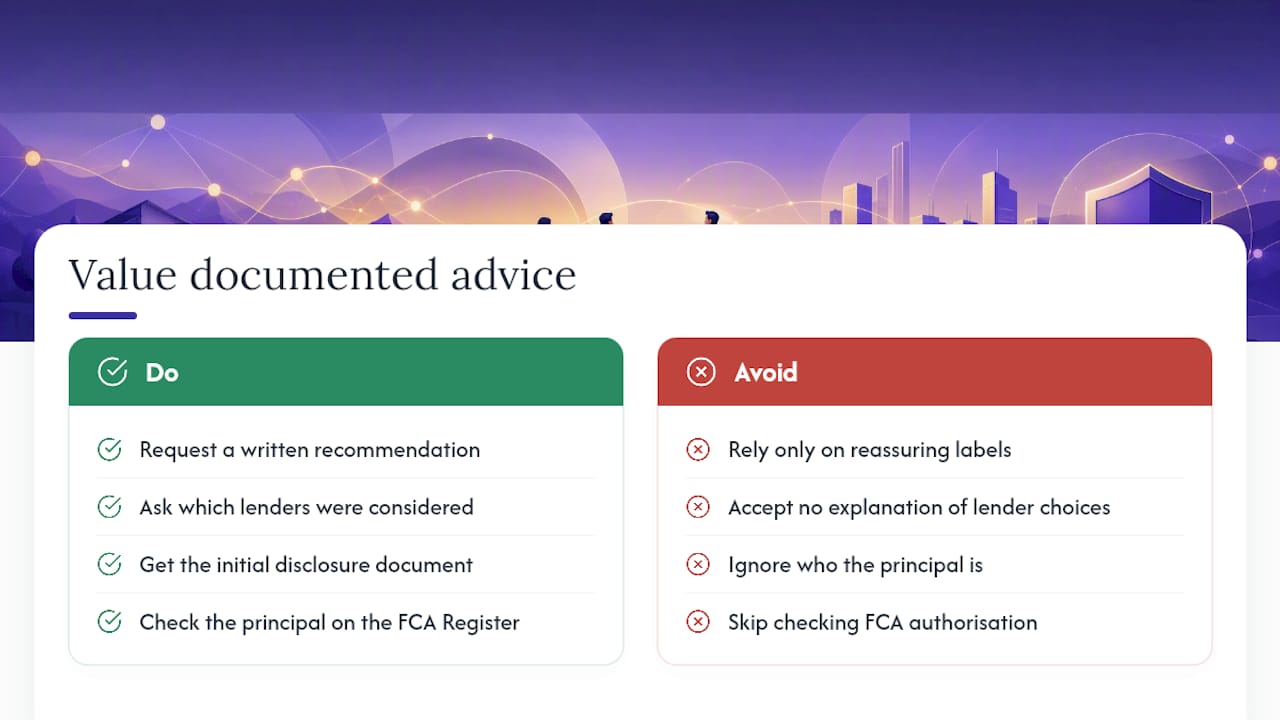
- Search the FCA Register. Go to the FCA Register and search by the firm’s name or reference number. Confirm the firm is authorised or listed as an appointed representative (AR). If the broker is an AR, the principal firm responsible for their supervision will be listed; check that the principal is also authorised.
- Confirm the adviser’s qualifications. Ask whether the individual adviser holds the Certificate in Mortgage Advice and Practice (CeMAP) or an equivalent qualification. MoneyHelper’s guidance on choosing a mortgage recommends checking both FCA authorisation and adviser qualifications before proceeding.
- Ask whether the firm is directly authorised or an AR. An AR operates under a principal firm’s permissions. The principal is responsible for supervision, so you should know who that is and confirm they are properly authorised on the FCA Register.
- Request written confirmation of panel coverage. Ask for the number of lenders on the panel for your product type and whether any categories are excluded. A reputable broker will provide this without hesitation.
- Ask for examples of lenders considered for your case. A broker who has genuinely searched the market should be able to name lenders they considered and explain why they were or were not suitable.
- Request the initial disclosure document. This document sets out the broker’s scope of service, how they are paid, and any limitations on the products they consider. The FCA requires this to be provided before advice is given.
- Ask for a written recommendation summary. After advice is given, you should receive a written explanation of why the recommended product is suitable for your circumstances.
Questions to ask about fees and conflicts:
- Do you receive different commission rates from different lenders on your panel?
- Do you charge a client fee in addition to lender commission?
- Are there any referral fees for products you recommend alongside the mortgage?
Pro Tip: Red flags include a broker who cannot name their principal firm, refuses to provide written panel disclosure, or pressures you to decide before you have seen the initial disclosure document. Note the date and content of any verbal answers you receive.
When a different route might suit you better
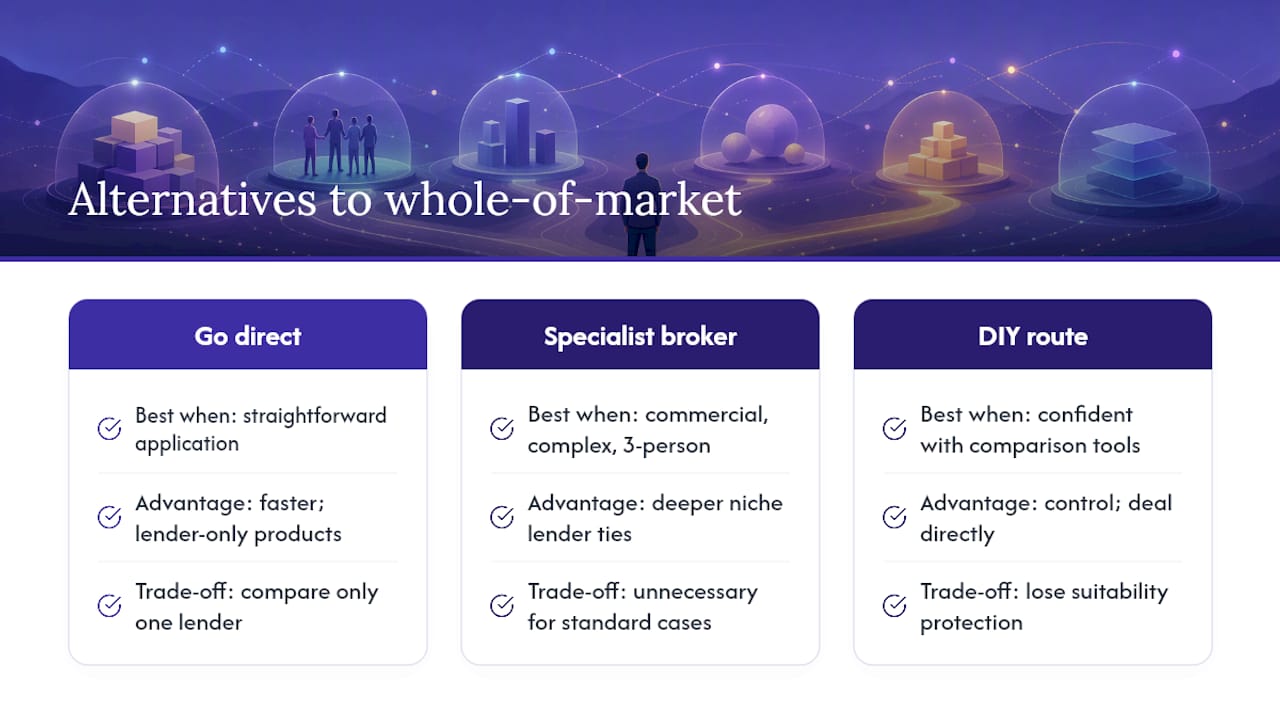
Whole of market broking is not always the right choice. Three alternatives are worth considering depending on your situation.
Going direct to a lender works well when your application is straightforward, you have a strong credit profile, and you already know which lender you want to use. Direct applications can sometimes be faster, and some lenders offer products that are not available through brokers. The trade-off is that you are comparing only that lender’s range.
Using a specialist broker makes sense when your case sits in a genuinely niche area: commercial property, complex development finance, or a three-person mortgage arrangement where standard residential criteria do not apply. Specialist brokers often have deeper lender relationships in their niche than a generalist whole of market firm.
The DIY route suits borrowers who are comfortable using comparison tools, understand mortgage criteria, and are willing to deal with lenders directly. The risk is missing broker-exclusive products and losing the suitability protection that regulated advice provides.
Key takeaways
A whole of market broker searches the relevant mortgage market for your circumstances rather than limiting recommendations to a single lender or fixed panel, but the label is not regulated and panel coverage varies between firms.
| Point | Details |
|---|---|
| Definition | A whole of market broker searches the relevant mortgage market, not just a single lender or fixed panel. |
| Label is not regulated | The FCA requires clear scope disclosure, not use of the “whole of market” label; always ask for written confirmation. |
| When it matters most | Complex income, adverse credit, buy-to-let, foreign national status, and specialist lending all benefit from broader market access. |
| Verification steps | Check the FCA Register, confirm CeMAP qualification, and request written panel disclosure before proceeding. |
| Prosperhomeloans | Prosperhomeloans operates as an independent adviser, providing written recommendations and covering a wide range of borrower types including self-employed, contractors, and property investors. |
Why impartial, well-documented advice is worth more than a label
The conversation around whole of market broking tends to focus on panel size, and panel size does matter. But in our experience at Prosperhomeloans, the more important question is whether the adviser can document their reasoning. A broker who searched 90 lenders and chose the right one for your circumstances, with a written explanation of why, is worth more than one who claims to search the whole market but cannot tell you which lenders they considered or why they were ruled out.
The FCA’s disclosure requirements exist precisely because labels can be stretched. “Whole of market,” “independent,” and “impartial” are all phrases that sound reassuring but carry no automatic guarantee of quality. What protects you is the paper trail: the initial disclosure document, the written recommendation, and the adviser’s willingness to answer direct questions about their panel and their fees.
We also think the appointed representative route deserves more scrutiny from consumers than it typically gets. Many smaller brokers operate as ARs of a principal firm, which is a perfectly legitimate arrangement, but it means the principal carries supervisory responsibility. If something goes wrong, knowing who the principal is and whether they are properly authorised matters. The FCA Register makes this straightforward to check, and there is no good reason not to do it.
How Prosperhomeloans can help you find the right mortgage
Prosperhomeloans works with a wide range of borrowers across the UK, including first-time buyers, self-employed applicants, contractors, foreign nationals, NHS workers, and property investors seeking buy-to-let, remortgage, bridging, or development finance. We provide written recommendations that explain why a product is suitable for your circumstances, and we disclose our scope of service and fee arrangements clearly before any advice is given.

If you want to verify our FCA status, check the FCA Register using our firm name before we speak. When you are ready to take the next step, you can arrange a no-obligation conversation with our team, request written confirmation of our panel coverage, or simply ask us the questions this article has outlined. We are here to make the process straightforward, not to add to the paperwork.
Useful sources and further reading
- Scope of service/disclosure Questions Answers — FCA
- MoneyHelper: Getting independent mortgage advice / choosing a mortgage
- Policy Statement 20/01: Mortgage advice and selling standards — FCA
- What is a mortgage broker? | Equifax UK
- Mortgage broker authorisation — FCA
- PERG 4.6 — FCA Handbook guidance on advice
- Getting independent mortgage advice — MoneySupermarket
- FCA register — Financial Conduct Authority
This article provides general information about UK mortgage brokers and is not personalised financial advice. Mortgage products and regulatory requirements can change; confirm current rules with the FCA or a qualified adviser before making decisions.
Recommended
