Early repayment charges explained: what they cost you

An early repayment charge (ERC) is a fee your lender may apply if you reduce or clear your mortgage balance during a product period, and it can run into thousands of pounds. Understanding why early repayment charges matter is the difference between a remortgage that saves you money and one that costs you more than you expected.
Here is what you need to know at a glance:
- ERCs are often stated to range from about 1% to 5% of your outstanding balance, according to consumer and comparison guides MoneyfactsCompare. On a £200,000 mortgage, that can amount to thousands of pounds.
- The charge is not a penalty in the legal sense. Under FCA MCOB rules, it must be a reasonable pre-estimate of the lender’s costs, and the maximum amount must be disclosed in your mortgage illustration and offer.
- Common triggers include full redemption, remortgaging away before the deal ends, exceeding your annual overpayment allowance, and switching product early.
- The Financial Ombudsman Service can investigate if you believe an ERC was applied incorrectly or was never properly disclosed.
One-sentence verdict: always locate the cash ERC figure on your mortgage offer, then run a break-even calculation before you overpay beyond your allowance, remortgage early, or redeem.
Key takeaways
Early repayment charges can cost thousands of pounds and directly determine whether remortgaging or overpaying saves you money or costs you more.
| Point | Details |
|---|---|
| ERC range is 1%–5% | On a £200,000 balance, that is £2,000 to — depending on the year of your deal. |
| Always get the cash figure | Request a redemption statement for your target completion date before making any decision. |
| Run the break-even calculation | Divide the cash ERC by your monthly interest saving to find how long before you recover the cost. |
| MCOB protects you | The FCA requires the maximum ERC to be disclosed in your illustration and offer, and the charge must be a reasonable pre-estimate. |
| Prosperhomeloans models the numbers | An independent broker can calculate your break-even, check porting rules, and negotiate with your lender where appropriate. |
Table of Contents
- What an ERC is and where to find it in your paperwork
- Why lenders impose early repayment charges
- When an ERC is charged and when it is not
- How lenders calculate ERCs, typical costs and a worked example
- Practical ways to avoid, reduce or work around an ERC
- How to decide whether overpaying or repaying early makes financial sense
- What to do if you disagree with a charged ERC
- Where to find the ERC amount and key timescales to watch
- When a mortgage broker can help with an ERC decision
- ERCs matter more than most borrowers realise
- How Prosperhomeloans can help you manage an ERC decision
- Sources
What an ERC is and where to find it in your paperwork
An early repayment charge is a contractual fee charged by your lender when you repay all or part of your mortgage outside the terms of your product. It is distinct from a standard exit or admin fee, which is typically a small flat charge (often £50–£200) for closing the account. The ERC is the significant one: it is calculated as a percentage of your outstanding balance and can be several thousand pounds.
Where to look:
- Mortgage illustration (ESIS): the maximum ERC must appear here before you apply.
- Mortgage offer: the formal offer document repeats the maximum ERC and the conditions under which it applies.
- Annual mortgage statement: some lenders show the current ERC band.
- Redemption statement: this is the precise cash figure your lender will charge on a specific completion date. Always request one before making any decision.
- Lender’s product literature: useful for checking overpayment allowances and porting rules.
Products that commonly carry ERCs include fixed-rate mortgages, capped-rate mortgages, and discounted variable-rate deals. Standard variable rate (SVR) mortgages and many flexible or tracker products that have moved off their initial deal period usually carry no ERC, which is one reason borrowers sometimes choose to sit on an SVR briefly rather than remortgage at the wrong moment.
Why lenders impose early repayment charges
Lenders charge ERCs because they lose the interest income they planned to receive when they funded your mortgage. When a lender agrees a fixed rate, it typically borrows money in the wholesale market at a corresponding rate for a matching term. If you repay early, the lender is left holding funding it no longer needs at the rate it committed to, creating a loss.
Under FCA MCOB 12, any ERC must be expressible as a cash value and must represent a reasonable pre-estimate of the lender’s costs. Crucially, lenders are permitted to calculate a single ERC across a tranche or portfolio of similar mortgages rather than computing the exact loss on your individual account. This is a point many borrowers find surprising: the charge is not a precise calculation of what your lender actually lost on your specific loan.
The FCA also prohibits certain calculation methods, including the Rule of 78, which front-loads interest in a way that would overstate the lender’s loss. The lender must disclose the maximum ERC in both the mortgage illustration and the formal offer, so you should never encounter an ERC that was not at least signalled in your paperwork. Understanding mortgage regulatory compliance helps clarify why these disclosure rules exist and what they protect you from.
When an ERC is charged and when it is not
Knowing the common triggers helps you spot risk points before you act. Nationwide’s guidance lists the most frequent situations:
- Full redemption during the product term: paying off the entire mortgage before the deal ends.
- Remortgaging to a new lender before the product period expires.
- Exceeding the annual overpayment allowance: most lenders permit overpayments of up to 10% of the outstanding balance per year without triggering an ERC. Going beyond that threshold usually attracts a charge on the excess.
- Switching product early: moving to a different rate with the same lender before your current deal ends.
- Partial ports and porting delays: if you port your mortgage to a new property but the new purchase completes outside the lender’s specified window, you may lose the ERC refund.
Common exceptions to note:
- Mortgages already on SVR generally carry no ERC.
- Some lenders waive the ERC in cases of genuine financial hardship.
- Porting within a lender’s specified timeframe (Nationwide, for example, specifies conditions under which an ERC may be refunded if porting completes within a set window) can avoid or recover the charge.
The 10% annual overpayment allowance is worth using deliberately. Overpaying within that limit costs nothing extra, reduces your balance, and cuts the interest you pay over the remaining term. Full redemption, however, usually attracts an ERC on the entire outstanding balance, not just the amount above the allowance.
How lenders calculate ERCs, typical costs and a worked example
ERCs are usually expressed as a percentage of the outstanding balance, and that percentage commonly decreases as you move through the product term. MoneyfactsCompare data shows the typical range is 1%–5%, with higher percentages applying in the earlier years of a deal.
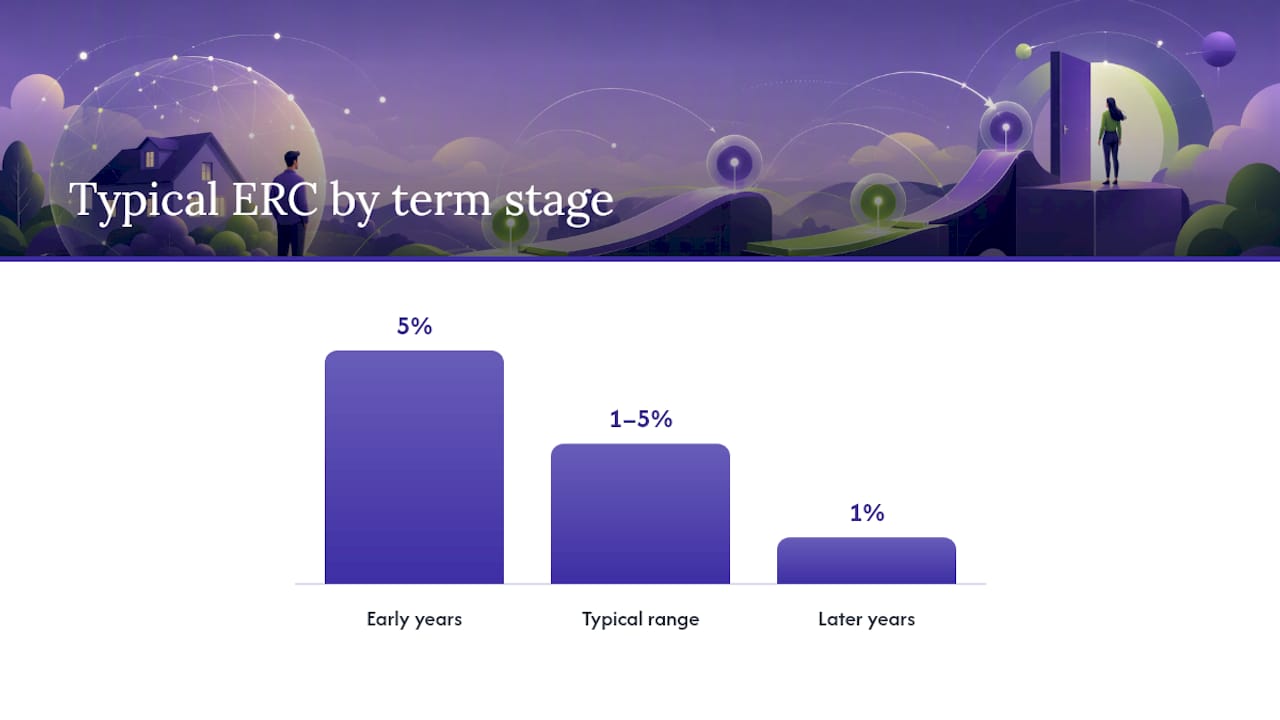
Note: these are illustrative typical bands. Your lender’s actual schedule will be in your mortgage offer.
Worked break-even example
Suppose you are two years into a five-year fix at 4.5% and your outstanding balance is £200,000. A new deal is available at 3.5%. The ERC at year two is 4%, so £8,000.
- Monthly interest saving by switching: 1% on £200,000 = £2,000 per year, or roughly £167 per month.
- Break-even period: £8,000 ÷ £167 = approximately 48 months to recover the ERC cost.
- Remaining product term: 36 months.
In this scenario, paying the ERC and switching does not break even before the current deal expires anyway. Staying put and using the 10% overpayment allowance each year is likely the better move.
Pro Tip: Always ask your lender for the precise cash ERC figure on a redemption statement for your target completion date, and confirm whether your annual overpayment allowance has been applied before the charge is calculated. The figure can differ from the headline percentage if you have already made overpayments.
When comparing deals, a mortgage deal comparison that factors in exit costs alongside the new rate gives a far more accurate picture than the headline rate alone.
Practical ways to avoid, reduce or work around an ERC
The good news is that several legitimate tactics can reduce or eliminate the charge:
- Port the mortgage: if you are moving home, porting transfers your existing deal to the new property. You keep the rate and avoid the ERC, provided the new purchase completes within your lender’s porting window. Timing is everything here.
- Time the remortgage to the deal end: MoneySuperMarket recommends planning your remortgage so it completes on or just after the product end date. Many lenders allow you to lock in a new rate up to six months ahead without triggering the ERC until completion.
- Use the overpayment allowance: making regular overpayments up to the contractual limit (typically 10% per year) reduces your balance and your future interest without any ERC.
- Negotiate a partial port: if you are upsizing, you may be able to port the existing deal on the current balance and take additional borrowing at a new rate, avoiding an ERC on the ported portion.
- Wait out the charging period: if the ERC drops to 1% in the final year and you are close to that point, waiting a few months can save thousands.
- Negotiate directly with the lender: lenders occasionally waive or reduce an ERC where there is genuine hardship, or where you are very close to the product end date. This is not guaranteed, but it is worth asking.
One option some lenders offer is adding the ERC to your new mortgage balance rather than paying it in cash. This avoids an upfront cost, but you then pay interest on the fee for the remainder of the mortgage term, making it more expensive overall. MoneyfactsCompare notes this is usually the costlier route.
How to decide whether overpaying or repaying early makes financial sense
The core question is straightforward: does the interest saving outweigh the ERC cost, and over what timeframe?
- Get the cash ERC figure from a redemption statement for your target date.
- Calculate your monthly interest saving by comparing your current rate with the new rate on the same balance.
- Divide the ERC by the monthly saving to find the break-even month. If that month falls after your current deal ends, switching early is unlikely to pay.
- Compare against saving the ERC elsewhere. If your savings account pays more than your mortgage rate, keeping the cash and overpaying gradually may beat paying the ERC to switch.
- Factor in non-financial considerations:
- If you plan to sell within 12 months, an ERC on a large balance could wipe out any rate saving.
- Buy-to-let owners should consider tax implications: mortgage interest relief rules mean the ERC cash cost and the interest saving interact differently depending on your tax position.
- Liquidity matters. Paying a large ERC in cash reduces your reserves; adding it to the mortgage preserves cash but increases total interest.
Understanding how mortgage payments break down between interest and capital at different points in the term helps you see exactly how much of each payment is affected by a rate change.
What to do if you disagree with a charged ERC
If you believe an ERC has been applied incorrectly or was never properly disclosed, follow these steps:
- Check your mortgage offer and illustration. Confirm the ERC schedule and the conditions under which it applies. If the charge does not match what was disclosed, you have grounds to complain.
- Request a written breakdown from your lender. Ask for the redemption statement and a line-by-line explanation of how the ERC was calculated, including whether your overpayment allowance was deducted first.
- Raise a formal complaint with the lender. The lender must respond within eight weeks under FCA rules.
- Escalate to the Financial Ombudsman Service if the lender’s response is unsatisfactory or the eight-week deadline passes. The Financial Ombudsman Service guidance on ERCs explains what evidence the Ombudsman will seek and what remedies are available, including a refund or compensation where the lender treated you unfairly.
One point worth knowing: the Ombudsman’s focus is on whether the lender followed its contract and MCOB rules, not on recalculating the lender’s commercial loss. In Decision DRN-3953751, the Ombudsman accepted that a lender may lawfully set ERCs across a group of similar mortgages rather than calculate individual losses, provided the method complies with MCOB and was properly disclosed. Similarly, Decision DRN-4732370 confirmed that a lender’s ERC methodology and disclosure were consistent with MCOB and did not constitute an unfair charge in that case.
Realistic remedies if your complaint succeeds: a full or partial refund of the ERC, compensation for consequential financial loss (for example, if the charge caused you to miss a purchase), or a correction if the lender misapplied its own overpayment rules.
If your complaint involves wider debt pressures, our guide on debt management plans explains other routes for consumer dispute resolution that may be relevant.
Where to find the ERC amount and key timescales to watch
| Document or source | What it shows | Key timescale |
|---|---|---|
| Mortgage illustration (ESIS) | Maximum ERC and conditions | Provided before application |
| Mortgage offer | Maximum ERC, product term, overpayment allowance | Provided at formal offer stage |
| Annual mortgage statement | Current balance; some lenders show ERC band | Issued annually |
| Redemption statement | Precise cash ERC for a specific completion date | Request from lender; valid for a set period |
| Lender’s product pages | Porting rules, overpayment allowance details | Check before any product action |
Key timescales to plan around:
- Overpayment allowance: typically resets each year (commonly 12-month rolling period from the mortgage start date or anniversary). Overpaying just before the reset date can double the effective allowance across two periods.
- Porting window: Nationwide’s guidance notes that an ERC may be refunded if porting completes within a specified timeframe. Check your lender’s specific window before exchanging contracts on a sale.
- Remortgage lock-in window: many lenders allow you to secure a new rate up to six months before your current deal ends, with completion timed to avoid the ERC.
When a mortgage broker can help with an ERC decision
A broker adds real value when the decision involves more than a straightforward rate comparison. If you are timing a port, weighing up a complex remortgage, or trying to negotiate with a lender, the numbers and the rules interact in ways that are easy to miscalculate alone.
What a broker can do:
- Obtain a precise redemption figure and model the full break-even calculation for your specific balance and target rate.
- Check your lender’s portability rules and porting window, so you do not miss a refund opportunity through poor timing.
- Identify products from across the market that permit flexible overpayments or carry lower ERCs, which matters if your circumstances are likely to change.
- Present a negotiation case to the lender where there are grounds for a waiver or reduction, particularly in hardship situations or where you are close to the product end date.
- Advise buy-to-let owners on how the ERC interacts with their tax position and rental income.
Set realistic expectations. A broker can model the numbers accurately and explore options you might miss, but an ERC waiver is not guaranteed. Broker fees vary: some charge a flat fee, others are remunerated by the lender via a procuration fee, and some do both. A good broker will be transparent about this from the outset.
ERCs matter more than most borrowers realise
The impact of early repayment charges on UK borrowers is consistently underestimated, and not just in cash terms. An ERC can also affect your ability to move quickly when a better deal appears, your flexibility if your circumstances change, and, indirectly, your financial planning if you are a buy-to-let investor managing multiple products.

There is a subtler point worth making. Most borrowers focus on the headline rate when choosing a mortgage, but the ERC schedule is equally important. A product with a marginally lower rate but a steep 5% ERC in year one is a worse deal than a slightly higher rate with a 2% ERC, if there is any realistic chance you will need to exit early. The ERC is part of the total cost of the product, not a separate risk to worry about later.
The Ombudsman decisions we have cited show that lenders generally have the rules on their side when ERCs are properly disclosed. That means your best protection is reading the offer document carefully before you sign, not after you want to leave.
How Prosperhomeloans can help you manage an ERC decision
Facing an ERC and unsure whether to pay it, port, or wait? Prosperhomeloans can give you a clear answer. As independent mortgage and protection advisers, we model your break-even calculation using the actual cash ERC figure from your redemption statement, compare it against the best available rates across the whole market, and advise on porting and remortgage timing specific to your lender’s rules.

We are transparent about how we work: we may charge a broker fee, or we may be remunerated by the lender via a procuration fee, and we will always explain which applies to your case before you proceed. Where there are grounds to negotiate a waiver or reduction with your lender, we will make that case on your behalf. For buy-to-let owners and self-employed borrowers, we factor in the wider financial picture, not just the rate.
Request a free initial review and we will check your redemption position, model the numbers, and tell you exactly where you stand.
Sources
- Early repayment charges (Financial Ombudsman Service consumer guidance)
- Early Repayment Charges (ERC): How much do they cost? (MoneyfactsCompare)
- Early Repayment Charges (Nationwide)
- Early repayment charges (MoneySuperMarket)
This article provides general information about early repayment charges and is not a substitute for professional financial advice. Mortgage rules and lender policies change; always verify current terms with your lender or a qualified adviser before acting.
Recommended
