Approved in 3–6 Weeks: Brokered UK Regulated Bridging Loans

A regulated bridging loan is a short-term secured loan, overseen by the Financial Conduct Authority (FCA), used when you or a close family member will live in the mortgaged property. It typically runs for up to 12 months, demands a clear exit strategy and full affordability checks, and suits situations like buying before you sell, breaking a chain, settling probate, or downsizing.
TL;DR:
- Borrowers must verify if someone connected to them will occupy more than 40% of the security property, as this almost always classifies the loan as regulated.
- Regulated bridging loans generally take three to six weeks to complete due to mandatory legal work and affordability checks, longer than unregulated options.
- These loans typically have lower interest rates, around 0.55% to 0.75% per month, and often require proof of a credible exit strategy such as a sale or remortgage.
- Failing to provide clear exit evidence can cause delays or application rejection, as lenders prioritize documented sale plans over verbal intentions.
- Lenders assess regulated bridging applications similarly to residential mortgages, demanding full income verification, legal valuations, and demonstrable exit plans.
Table of Contents
- Regulated bridging loan: the FCA and legal basis explained
- Who applies for a regulated bridging loan and what lenders check
- Regulated vs unregulated bridging loans: what changes for you
- Typical terms and costs for regulated bridging loans
- Applying for a regulated bridging loan: steps and timeline
- Protections and risks: FCA rules and red flags
- How brokers document exit plans for regulated bridging approval
- Why exit strategy credibility comes first
- Get regulated bridging advice that’s built around your exit
- Sources
Regulated bridging loan: the FCA and legal basis explained
Whether a bridging loan counts as regulated comes down to one legal test, not the lender’s marketing. Under the Mortgage Credit Directive (MCD), the FCA treats a bridging loan as either an MCD-exempt bridging loan or a regulated mortgage contract with a term of 12 months or less. That classification is what pulls the loan under the Mortgage Conduct of Business (MCOB) rulebook, with all the disclosure and affordability duties that follow.

The occupancy test decides most cases. If you, or a close family member such as a parent, child, or sibling, will occupy more than 40% of the secured property as a main residence, the loan is almost always regulated. Buy-to-let and pure investment bridges usually sit outside this scope because no one connected to the borrower lives there.
Edge cases exist, and they trip up more borrowers than you’d expect. Certain second-charge structures with a limited number of payments, and what the rulebook calls an exempt equitable mortgage bridging loan, can fall outside regulation even where the property is a family home. Anyone unsure should check the FCA’s PERG and MCOB references directly, or ask a broker to confirm status in writing before signing anything, because getting this wrong can leave you without the protections you assumed you had.
Who applies for a regulated bridging loan and what lenders check
Most regulated bridging borrowers fall into a handful of recognisable groups: owner-occupiers buying before their existing home sells, people breaking a stalled chain, those settling a probate property, and homeowners downsizing or funding urgent works on a main residence, as explained in this clear guide for NZ homeowners on bridging finance. Very few are speculative property investors; that market usually sits in unregulated territory.
Lenders assess these applications more like a residential mortgage than a commercial loan. Expect to provide:
- Proof of identity and address for anti-money-laundering checks
- Title deeds or Land Registry information for the security property
- An independent valuation of the property being charged
- Evidence supporting your exit strategy, such as an estate agent appraisal or a mortgage agreement in principle
- Income and affordability paperwork, including bank statements and proof of earnings or pension income
Loan-to-value (LTV), credit history, and the strength of your exit plan all interact. A lender will often accept a thinner credit file if the LTV sits comfortably low and the exit is well evidenced, but weak documentation on any one of these points tends to slow or sink an application.
Regulated vs unregulated bridging loans: what changes for you
The classification rule is simple: does someone connected to the borrower live, or intend to live, in the secured property? Get that wrong and you risk applying to the wrong lender pool entirely, according to guidance from Bridging. Beyond the legal label, the practical differences are significant.
- Speed: Unregulated bridges can complete in days; regulated ones usually take longer because of mandatory affordability and disclosure steps.
- Lender pool: Fewer lenders offer regulated bridging, since it requires FCA permissions specific to regulated mortgage contracts.
- Documentation: Regulated applications demand full income evidence and a documented exit strategy; unregulated ones often rely more heavily on asset value alone.
- Protections: Only regulated borrowers get automatic access to Financial Ombudsman Service complaints and FCA-mandated disclosures.
A landlord bridging an investment purchase will typically use unregulated finance. A homeowner buying their next family home before their current one sells needs the regulated route, no matter how much they’d prefer the faster unregulated timeline.
Typical terms and costs for regulated bridging loans
Budgeting for a regulated bridge means understanding four moving parts: rate, term, LTV, and fees. Broker data from FD Commercial puts indicative monthly rates for prime residential first-charge cases at roughly 0.55% to 0.75%, with terms capped at 12 months and LTV typically limited to 70% to 75%.
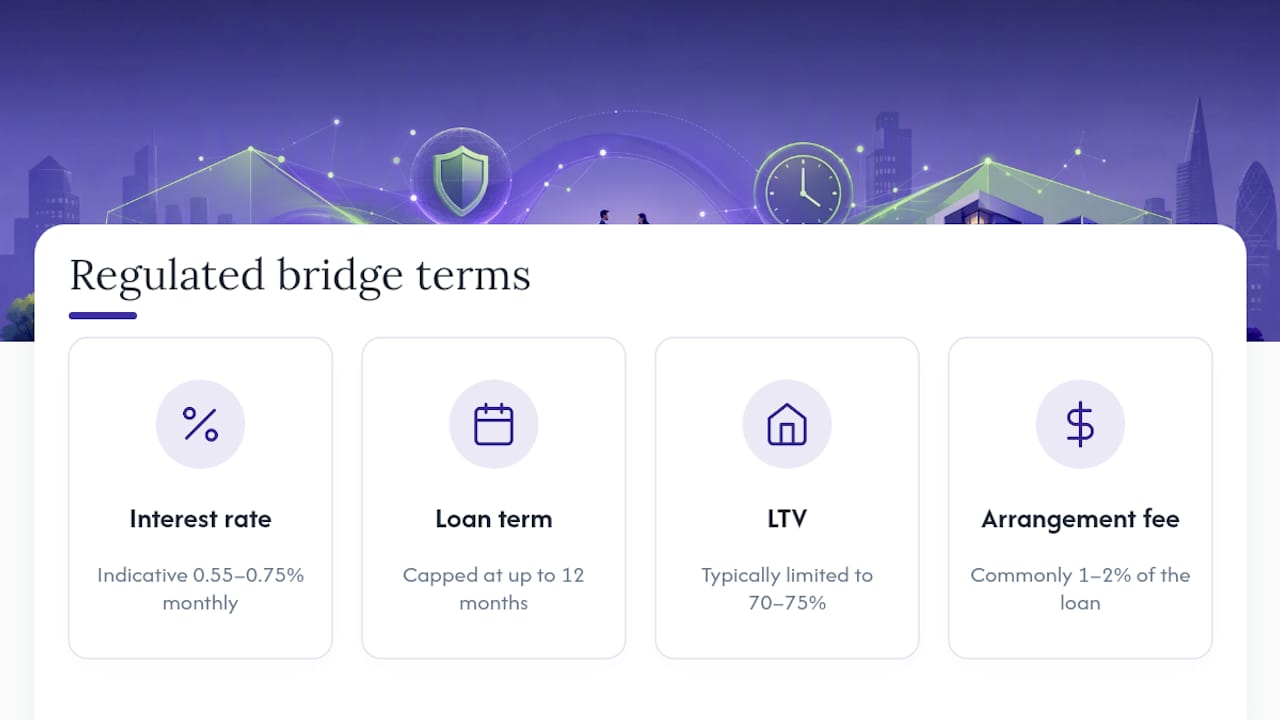
Regulated bridging often prices more competitively than unregulated finance for straightforward residential first-charge cases, because lenders can see the security and the exit route clearly, which reduces their risk pricing. On top of the headline rate, expect an arrangement fee (commonly 1% to 2% of the loan), valuation costs, and legal fees for both your solicitor and the lender’s.
Interest can be rolled up (added to the loan and repaid at redemption) or serviced monthly from income; rolled-up interest suits borrowers without spare monthly cash flow but increases the total repayment at the end. Early repayment is usually penalty-free on regulated bridges, though extensions beyond the agreed term often carry a fee or a higher rate, so it pays to understand the early repayment terms before you sign.
Applying for a regulated bridging loan: steps and timeline
A regulated bridge takes longer than its unregulated cousin, and three to six weeks from application to completion is normal rather than a sign something has gone wrong. That timeline reflects the affordability checks and legal work MCOB requires, not lender inefficiency.
- Initial assessment. A broker or lender reviews your circumstances, the security property, and your proposed exit.
- Exit strategy evidence. You provide documentation, an agreed sale price with a solicitor confirming instruction, or a mortgage offer in principle for a remortgage exit.
- Valuation and underwriting. The lender instructs a surveyor and reviews affordability alongside your credit history.
- Legal work and offer. Solicitors handle conveyancing while the lender issues a formal offer subject to conditions.
- Completion. Funds release once legal charges are registered.
Lenders regard credible exits as evidenced ones: a solicitor-confirmed sale plan or an agreed remortgage carries far more weight than a verbal intention to sell, a point FCA data on approved applications reinforces indirectly through the sector’s underwriting practices.
Pro Tip: Gather your exit evidence before you apply, not after the lender asks. A sale agreement or agreement in principle sitting ready to submit can shave a week or more off your timeline.
Protections and risks: FCA rules and red flags
Regulated status means the FCA requires proper affordability assessment, full cost disclosure, and a genuine understanding check before completion. If something goes wrong, you have access to the Financial Ombudsman Service, free of charge, something unregulated borrowers cannot rely on.
The main risks remain real regardless of regulation: repossession if you cannot repay, interest costs compounding faster than expected on rolled-up products, and extension penalties if your exit slips. Watch for contracts with vague extension terms, unclear early repayment conditions, or valuation fees payable before any offer is confirmed. If a lender pressures you to sign before you’ve had proper time to review terms, or your exit plan looks shaky, pause and take independent advice rather than proceeding.
How brokers document exit plans for regulated bridging approval
Getting a regulated bridge approved quickly comes down to how convincingly the exit is presented. Brokers typically strengthen an application with valuation evidence that supports the intended sale price, a documented sale timeline, or a guaranteed remortgage offer secured in advance rather than promised verbally.
Where underwriting resistance appears, practical fixes usually include:
- Reducing the requested LTV to lower lender risk
- Offering additional security across another property
- Shortening the term to match a firmer, nearer-term exit date
A broker will typically prepare a document pack, valuation reports, proof of exit, income evidence, upfront, reducing the back-and-forth that causes most delays in regulated bridging applications.
Why exit strategy credibility comes first
Most delays we see trace back to one thing: an exit plan that sounds reasonable but isn’t evidenced. A verbal “I’ll sell it” doesn’t satisfy underwriters; a solicitor-confirmed sale does. We’d rather tell a client to wait four weeks and strengthen their exit than rush an application that stalls at underwriting. Sometimes the honest advice is that bridging isn’t the right tool at all.
— Paul
Get regulated bridging advice that’s built around your exit
Prosperhomeloans gives you something a direct lender application can’t: access to the whole regulated bridging market, compared side by side, with someone checking your exit strategy holds up before a lender ever sees it. Rather than approaching one bank and hoping your circumstances fit their box, our whole-of-market brokers match your situation, chain break, probate, downsizing, to lenders who actually price that scenario well.

Bring your ID, an idea of your property’s value, and whatever exit evidence you already have (even informal estate agent feedback) to an initial review, and we’ll tell you honestly whether regulated bridging fits, what it will cost, and roughly how long approval will take. We’re FCA-authorised, and every regulated case comes with full disclosure and Financial Ombudsman access if anything ever needs challenging. Start your review with Prosperhomeloans and get a straight answer on where you stand.
Sources
Verify classification directly via the FCA’s bridging loan glossary and regulated bridging sales data. For rate context, see our guide to current bridging loan rates.
This article is general information, not a substitute for advice from a qualified financial advisor. Consult a qualified financial professional about your own circumstances before acting on anything here.
- Information on regulated bridging (short-term) loans - January 2025 | FCA
- FCA Handbook glossary: bridging loan
- Regulated Bridging Loans | UK Broker | FD Commercial
- Bridging
Recommended
