Expat buy to let mortgage options for UK expats explained

Yes. Most UK nationals living overseas can get a buy-to-let mortgage on a UK property, provided they go through a specialist lender or a whole-of-market broker rather than a mainstream high street bank. Standard high street lenders tend to switch off once your address changes to Dubai, Singapore or Madrid, but a smaller pool of dedicated expat lenders exists precisely for this situation, and they underwrite the deal on the rental income the property generates rather than your day job overseas.
Your immediate next step is to check three things: which country you currently live in (some are excluded outright), your likely deposit size, and whether you already hold a UK bank account. Then speak to a broker who places expat cases regularly, such as Prosperhomeloans, before you make an offer on a property.
- Typical deposit: a quarter to just under half of the purchase price
- Common Interest Coverage Ratio (ICR) threshold: 125%–145% of the mortgage payment
- Time from application to mortgage offer: roughly 4–8 weeks
- Non-Resident Landlord Scheme (NRLS): tenants or agents withhold 20% tax on rent unless you’ve applied for gross payment status
Key Takeaways
Most UK expats can secure a buy-to-let mortgage through specialist lenders, provided their rental income clears the lender’s ICR threshold and their country of residence is accepted.
| Point | Details |
|---|---|
| Eligibility depends on country, not passport | Lenders assess your country of residence against FATF and internal lists, often more than nationality. |
| ICR drives the loan size | Most lenders require rental cover of 125%–145% of the stressed mortgage payment rather than personal income. |
| Apply for NRL1 immediately | Without it, agents withhold 20% of your rent regardless of your actual tax liability. |
| SDLT surcharges stack | Non-resident (2%) and additional dwelling (5%) surcharges combine on top of standard SDLT rates. |
| Use a specialist broker | Prosperhomeloans provides whole-of-market access to lenders that actively accept expat buy-to-let applications. |
Where to check the official rules
- Gov for NRLS and Self Assessment rules.
- Gov to confirm your property meets MEES requirements.
- Verify SDLT and CGT figures directly with a tax adviser before exchange, since surcharges and deadlines carry financial penalties if missed.
Table of Contents
- Who can apply and which lenders accept expat buy to let cases
- How lenders assess expat buy to let affordability
- What documents do you need to apply from overseas
- Tax rules and ownership structure for non-resident landlords
- What will it cost to buy or refinance as an expat landlord
- How long does an expat buy to let mortgage take to complete
- How to choose a broker for your expat buy to let case
- Get expert help arranging your expat buy to let mortgage
- Frequently asked questions
- Sources
Who can apply and which lenders accept expat buy to let cases
Nationality and residency rules vary more than most first-time applicants expect. UK nationals living abroad form the bulk of expat buy-to-let applications, but plenty of foreign nationals who have never lived in the UK can also borrow here. What matters most to a lender is your country of residence, not your passport. Countries on Financial Action Task Force (FATF) high-risk lists are typically excluded, and some lenders maintain their own shorter list of acceptable jurisdictions, often built around where their compliance team can verify income and identity documents reliably.
A UK credit file is less critical than you might assume. Many specialist lenders in this space don’t require one at all, because they’re underwriting against the property’s rental income rather than your personal credit history. What they often do require is a UK bank account to receive mortgage payments and rental income, sometimes alongside a UK-based service agent or solicitor who can act on your behalf during the application.
Three broad categories of lender operate in this space:
- Specialist expat lenders who build their entire buy-to-let book around non-resident applicants and understand overseas payslips, foreign tax years and multi-currency income.
- International divisions of retail banks, which sometimes offer expat mortgages through a private banking or international arm, usually for higher-value properties.
- Challenger banks, some of which have built flexible criteria specifically for foreign nationals and expats, focusing on rental coverage rather than a UK income requirement, as GB Bank’s approach to expat buy-to-let lending demonstrates.
A whole-of-market broker earns their fee here. They already know which of these lenders are actively taking expat cases this quarter, because appetite shifts. A lender open to Australian residents in January might tighten criteria by summer. You can also apply as an individual, through a Special Purpose Vehicle (SPV) limited company, or occasionally through a trust, though acceptable structures differ by lender.
How lenders assess expat buy to let affordability
Every buy-to-let lender runs an Interest Coverage Ratio (ICR) test, and for expat applications this test does most of the heavy lifting since it often replaces a personal income assessment entirely. ICR measures whether the property’s rental income comfortably covers the mortgage payment, usually calculated at a stress-tested reference rate rather than your actual product rate, to protect against future rate rises.
Marsden Intermediaries, a specialist buy-to-let intermediary, publishes criteria showing ICR thresholds typically ranging from 125% to 145% depending on your tax status, with higher-rate taxpayers usually facing the tougher end of that range because their allowable expense position differs.
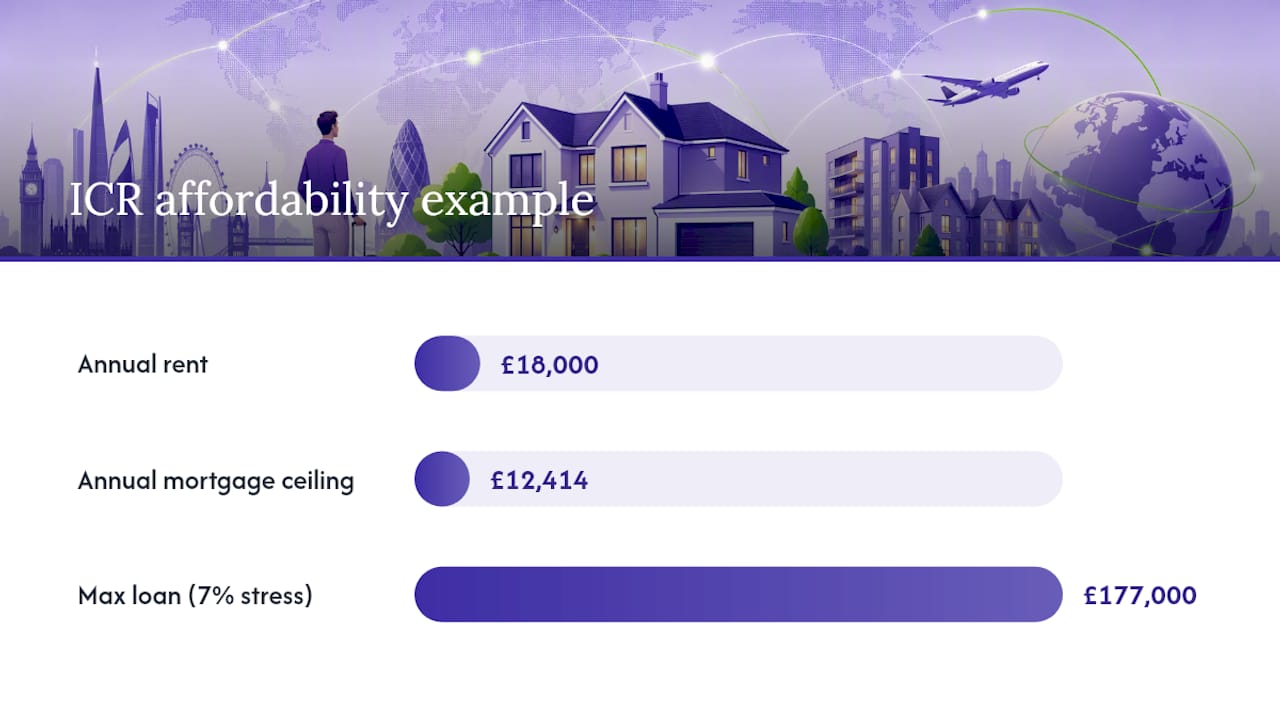
Here’s a worked example.
- Annual rent: £18,000
- Required rental cover: £18,000 ÷ 1.45 = £12,414 annual mortgage payment ceiling
- At a 7% stress rate, that supports a maximum loan of roughly £177,000
Loan-to-value (LTV) limits for expat buy-to-let sit lower than domestic equivalents, commonly landing in the 60%–75% band, against the 75%–80% you’d often see for a UK-resident landlord. Minimum loan sizes typically start from a moderate five-figure amount, with maximum exposure per borrower capped by most lenders, and inexperienced landlords sometimes face tighter caps on complex property types like Houses in Multiple Occupation (HMOs) or Multi-Unit Freehold Blocks (MUFBs).
Where your income is genuinely relevant, such as a top-up test or a portfolio landlord assessment, lenders convert overseas income conservatively, often applying a haircut to account for exchange rate movement. It’s also worth understanding your debt-to-income ratio, since some lenders still weigh this alongside rental cover, particularly for larger portfolios. Specialist brokers note that expat buy-to-let rates typically run 0.5%–1.5% higher than equivalent domestic products, reflecting the additional underwriting complexity.
What documents do you need to apply from overseas
Preparing your paperwork before you approach a lender saves weeks. Expat applications stall more often over documentation gaps than over affordability, largely because certified translations and international verification take longer than a domestic case.
You’ll typically need:
- Identity documents: valid passport, and your National Insurance number if you still hold one.
- Proof of income: recent overseas payslips, an employer reference letter, and foreign tax returns, translated and certified where the lender’s compliance team requires it.
- Bank statements: usually three to six months showing salary or business income landing in your account.
- Credit evidence: overseas credit reports where available, plus a brief written explanation for any gaps in your UK credit history.
- Property and rental evidence: a tenancy agreement if the property is already let, comparable market rent evidence, or written confirmation from a letting agent.
- Deposit proof: a paper trail showing where your deposit funds originated, which matters more for expat cases given anti-money-laundering checks on overseas transfers.
- Company accounts, if you’re buying through an SPV or limited company structure.
If you’re self-employed or run a business overseas, the documentation looks closer to what subcontractors need for a mortgage applying from within the UK: proof of consistent income over time rather than a single payslip. The same principle guides most foreign national mortgage documentation requirements too.
Tax rules and ownership structure for non-resident landlords
The Non-Resident Landlord Scheme (NRLS) catches most first-time expat landlords by surprise. Where you use a letting agent, or a tenant paying more than £100 per week, that agent or tenant is legally required to withhold 20% basic-rate tax from your rent before it reaches you, unless HMRC has approved you for gross payment via form NRL1. That withholding happens regardless of your actual tax liability, so even landlords whose allowable expenses mean they owe little or no tax can find a fifth of their rent disappearing at source until approval comes through.

Pro Tip: *Submit your NRL1 application as early as possible in the process, ideally before your tenancy starts.
Once approved for gross payment, you still declare rental profit through Self Assessment each year. Allowable expenses reduce your bill, but the finance-cost restriction on mortgage interest, now given as a basic-rate tax credit rather than a full deduction, hits higher-rate taxpayers harder than basic-rate ones.
Stamp Duty Land Tax adds a real upfront cost that catches many expats off guard. Non-resident buyers pay a 2% surcharge on top of standard SDLT rates, and because a buy-to-let purchase almost always counts as an additional dwelling, the 5% surcharge stacks on top of that. On a typical mid-range property purchase, stacking surcharges can add a significant amount to your completion costs compared with a UK-resident buyer’s main home. SDLT must be filed and paid within 14 days of completion, and non-residents who spend 183 days or more in the UK within a year either side of the purchase may be able to reclaim the 2% surcharge.
If you later sell the property, Capital Gains Tax must be reported and paid within 60 days of completion using HMRC’s online service, and missing that window triggers automatic penalties regardless of whether tax is actually owed.
On ownership structure, there’s no single right answer. Practical guidance suggests personal ownership tends to work better for smaller portfolios of one to three properties, while a limited company structure often makes more sense at scale because corporation tax rates and full mortgage interest deductibility can outweigh the extra compliance burden of ATED (Annual Tax on Enveloped Dwellings) and annual accounts filing. Weigh both routes against your total portfolio size before you commit to a structure, since switching later usually triggers its own tax charges.
What will it cost to buy or refinance as an expat landlord
Budget for both the one-off purchase costs and the ongoing running costs, because expat buy-to-let often carries a slightly heavier fee load than a domestic purchase on both counts.

Upfront costs typically include your deposit, a valuation fee, legal fees (often higher where a solicitor needs to handle overseas identity verification), a lender arrangement fee, and SDLT. On a £280,000 buy-to-let purchase, a non-resident buyer could face SDLT of well over £20,000 once the standard rate, 5% additional dwelling surcharge and 2% non-resident surcharge are all combined, a stacking effect worth modelling before you make an offer.
Rate pricing also differs from domestic buy-to-let: expat products tend to sit 0.5 to 1.5 percentage points higher than equivalent UK-resident deals, with pricing shaped by your deposit size, the currency your income arrives in, and your country of residence.
How long does an expat buy to let mortgage take to complete
Expect the full process to run somewhere between eight and fourteen weeks from enquiry to completion, longer than a typical domestic purchase because of overseas document handling.
- Fact-find and lender matching (1 week): your broker identifies which lenders will accept your country of residence and property type.
- Document collation (1 to 3 weeks): the stage most likely to slip, especially if documents need certified translation.
- Submission and underwriting (2 to 4 weeks): the lender reviews your ICR case and requests any further evidence.
- Valuation (1 to 2 weeks): can be delayed if the property has tenants in situ and access needs coordinating remotely.
- Mortgage offer to completion (2 to 4 weeks): conveyancing, exchange, and final fund transfers.
Pro Tip: Initiate any international currency transfer for your deposit at least two weeks before completion. Exchange rate swings between offer and completion can move your available deposit by thousands, and last-minute transfers sometimes get held up by anti-money-laundering checks on the receiving end.
How to choose a broker for your expat buy to let case
Not every broker who says they handle “international clients” genuinely places expat cases regularly. Ask direct questions before you commit any time or money.
- Do you operate as a whole-of-market broker, or are you tied to a limited panel of lenders?
- Which lenders on your panel actively accept applicants from my specific country of residence right now?
- What are your fees, and when are they payable, before or after an eligibility check?
- Can you talk through a recent expat case with a similar profile to mine?
Treat certain responses as warning signs: a broker who recommends a single lender without explaining why, one who can’t clearly describe acceptable borrower structures (individual versus SPV), or one who asks for a large advisory fee before confirming you’re even eligible.
Genuine trust signals look different. Confirm the broker is FCA regulated, that they can point to real examples of expat cases they’ve placed, and that they have a clear written process for handling documents that arrive from overseas, including certified translations and identity verification.
An advisor’s perspective on the mistakes expats make
It’s an easy fix if you act early. Beyond that, the timelines rarely surprise clients who’ve been prepared for them upfront. What genuinely changes outcomes is whole-of-market placement: matching your specific country and income profile to the right lender the first time, rather than applying speculatively and getting declined.
Get expert help arranging your expat buy to let mortgage
Prosperhomeloans places expat buy-to-let cases with lenders who actually want them, rather than sending you toward a high street bank that will decline the application after wasting three weeks of your time. As independent, whole-of-market advisors, we work across the specialist lender panel that actively serves UK nationals living abroad, matching your country of residence, deposit size and property type to the lenders most likely to say yes.

If you’ve read this far and want to know exactly where you stand, get in touch through Prosperhomeloans with your country of residence, rough deposit figure and target property value, and we’ll tell you which lenders are realistically open to your case before you spend a penny on a valuation.
Frequently asked questions
Can a UK expat get a buy-to-let mortgage without a UK income? Yes, in most cases. Specialist lenders underwrite primarily against the property’s rental income through the ICR test, so a UK salary usually isn’t required.
Do I need a UK bank account for an expat buy-to-let mortgage? Most lenders require one to receive mortgage payments and rental income, even if they don’t require you to hold UK credit history.
How much deposit do I need for an expat buy-to-let mortgage?
Will I pay extra Stamp Duty as a non-resident landlord? Yes.
What happens if I don’t apply for NRL1 approval?
Should I buy my UK rental property personally or through a limited company? It depends on portfolio size. Personal ownership often suits one to three properties, while a limited company structure tends to benefit larger portfolios due to corporation tax and mortgage interest treatment.
This article is general information, not a substitute for advice from a qualified financial advisor. Consult a qualified financial professional about your own circumstances before acting on anything here.
Sources
- Gov
- Non‑Resident UK property tax 2026 | The Tax Lead
- UK property tax for expats: SDLT, non‑resident surcharge & buy‑to‑let tax guide (2026) | Skybound Wealth
- UK Buy‑to‑Let (BTL) lending to foreign nationals and expats at GB Bank
Recommended
