Bonds UK: what investors need to know

UK bonds offer income, capital preservation, and portfolio diversification at a time when yields are meaningfully higher than they were for most of the 2010s. Whether bonds are right for you depends on your goals, tax position, and time horizon — but for many UK investors, they now deserve a serious look alongside cash and equities.
This guide covers the main bond types available to UK investors:
- Gilts (conventional and index-linked UK government bonds)
- Corporate bonds (investment grade and high yield)
- Premium Bonds (NS&I prize-draw savings)
- Retail savings and fixed-term bonds (from banks and building societies)
- Bond funds and ETFs (pooled, platform-accessible exposure)
Before making any portfolio decision, seek regulated financial advice tailored to your personal circumstances. As a starting point, check whether your bond holdings can sit inside an ISA or SIPP, and be clear on your investment horizon before you commit.
Key takeaways
UK bonds now offer meaningful income and diversification benefits, and the right type depends on your tax position, time horizon, and whether you need guaranteed income or capital security.
| Point | Details |
|---|---|
| Match bond type to your goal | Gilts suit capital preservation; corporate bonds suit income; Premium Bonds suit tax-free, capital-secure saving. |
| Use ISA or SIPP wrappers | Sheltering bonds inside an ISA or SIPP removes income tax and CGT on returns for higher-rate taxpayers. |
| Gilt CGT exemption is valuable | Gilts are CGT-exempt for individuals, making below-par gilts held to maturity tax-efficient outside a wrapper. |
| Funds and ETFs suit most retail investors | Low minimums, diversification, and daily liquidity make bond ETFs the practical starting point for most people. |
| Check live yields before committing | Gilt yields, the Bank Rate, and the NS&I prize fund rate change regularly — verify current figures before investing. |
This article is general information, not a substitute for advice from a qualified financial advisor. Consult a qualified financial professional about your own circumstances before acting on anything here.
Table of Contents
- What are bonds and how do they work in the UK?
- What types of bonds can UK investors access?
- How are bond returns measured?
- What are the main risks of investing in bonds?
- How can you buy bonds in the UK?
- How do Premium Bonds actually work?
- What is the tax treatment of bonds in the UK?
- Bond funds and ETFs versus buying individual bonds
- What does the current UK bond market look like?
- How do you choose the right bond investment for your goals?
- An honest view on bonds in a household portfolio
- Sources
What are bonds and how do they work in the UK?
A bond is a loan you make to an issuer — a government or a company — in exchange for regular interest payments (called the coupon) and the return of your original sum (the principal or face value) when the bond matures. The issuer sets the coupon rate and the maturity date at the outset; after that, the bond can be bought and sold on a secondary market at prices that fluctuate daily.
The most important mechanic to understand is the inverse relationship between bond prices and interest rates. When prevailing interest rates rise, newly issued bonds offer higher coupons, so existing bonds with lower fixed coupons become less attractive and their market prices fall. When rates fall, the opposite happens. This relationship drives most of the short-term volatility you will see in bond funds and individual bonds alike, as IG’s bond guide explains clearly.
Key terms to know:
- Coupon: the fixed annual interest payment, expressed as a percentage of face value
- Face (nominal) value: the amount repaid at maturity, typically £100 per gilt or £1,000 for corporate bonds
- Maturity date: when the issuer repays the principal
- Market price: what you pay to buy the bond today, which may be above or below face value
- Yield: the return you actually earn, calculated from the price you pay and the coupon you receive
The issuer matters enormously for risk. A UK government gilt carries the full backing of HM Treasury; a corporate bond carries the credit risk of the company that issued it. That distinction shapes everything from the yield you can expect to the likelihood of getting your money back.
What types of bonds can UK investors access?
The UK bond market spans several distinct product types, each suited to different goals. Which? explains the main categories well for retail investors.
Gilts (UK government bonds)
Gilts are issued by HM Treasury and managed by the Debt Management Office (DMO). They are listed and traded on public markets, making them among the most liquid fixed-income instruments available to UK investors. Conventional gilts pay a fixed coupon; index-linked gilts adjust both coupon and principal in line with the Retail Prices Index (RPI), offering inflation protection.
One tax point worth noting upfront: gilts are exempt from capital gains tax for individuals under current UK rules. Buying a gilt below its face value and holding to maturity can therefore generate a tax-free capital gain, which is particularly useful for higher-rate taxpayers.
Corporate bonds
Corporate bonds are issued by companies rather than governments. Investment-grade bonds (rated BBB/Baa or above by S&P and Moody’s respectively) carry relatively low default risk and typically offer a modest yield premium over gilts. High-yield bonds (rated below investment grade) offer higher coupons but carry meaningfully greater credit risk. The London Stock Exchange Retail Bond Platform lists a range of corporate bonds accessible to retail investors, though minimum investment sizes can be substantial.
Premium Bonds (NS&I)
NS&I issues Premium Bonds, backed by HM Treasury. These are not interest-bearing bonds in the conventional sense. Instead, your capital is fully protected and entered into a monthly prize draw. Prizes are tax-free and range from £25 to £1 million. The prize fund rate determines the average return across all holders, but individual outcomes vary — some holders win regularly, others rarely. Premium Bonds suit savers who want capital security and tax-free returns but are comfortable with a probabilistic rather than guaranteed income.

Retail savings and fixed-term bonds
Banks, building societies, and National Savings products offer fixed-term savings bonds that pay a guaranteed interest rate over a set period, typically one to five years. These are not tradeable on a secondary market; you generally cannot access your money early without a penalty. They suit investors who want certainty of return and have no need for liquidity during the term.
Bond funds and ETFs
Bond funds and ETFs pool money from many investors to buy a diversified portfolio of bonds. They are the most practical route for most retail investors because they offer broad diversification at low minimums and are available on mainstream investment platforms. Unlike individual bonds, funds have no fixed maturity date, so their price fluctuates continuously. Examples commonly cited include the iShares Core UK Gilts UCITS ETF and Vanguard UK government bond ETFs, which give low-cost exposure to the gilt market. MoneyHelper and Standard Life both provide accessible guidance on how bond funds work within broader portfolios.
How are bond returns measured?
The coupon alone does not tell you what you will actually earn. Three measures matter, and knowing when to use each one will help you compare bonds and funds on equal terms.
Coupon rate is the annual interest payment as a percentage of face value. It is fixed at issuance and never changes. If you pay exactly face value, your return equals the coupon rate.
Running (current) yield adjusts for the price you actually pay. It divides the annual coupon by the current market price. This tells you the income return on your investment today, but ignores the gain or loss you will make when the bond matures.
Redemption yield (yield to maturity, or YTM) is the most complete measure. It accounts for the coupon payments, the price you paid, and the difference between that price and the face value you receive at maturity, spread across the remaining life of the bond.
Worked example
- Running yield: £40 ÷ £950 = 4.21%
- Capital gain at maturity: £1,000 minus £950 = £50, spread over five years = £10 per year
- Approximate YTM: (£40 + £10) ÷ £950 ≈ 5.26%
| Measure | What it shows | When to use it |
|---|---|---|
| Coupon rate | Fixed annual income as % of face value | Comparing income on bonds bought at par |
| Running yield | Income return on price paid today | Assessing current income from a market purchase |
| Redemption yield (YTM) | Total annualised return held to maturity | Comparing bonds bought at different prices |
One further distinction: the clean price of a bond excludes accrued interest since the last coupon payment; the dirty price includes it. When you buy on the secondary market, you pay the dirty price, which means you compensate the seller for the interest accrued since the last coupon date.
What are the main risks of investing in bonds?
Bonds carry lower risk than equities in most market conditions, but they are not risk-free. Fidelity notes that bonds are sensitive to interest-rate changes and can lose capital when rates rise — a point that caught many investors off guard during 2022 and 2023.
The primary risks are:
- Interest-rate risk: when rates rise, existing bond prices fall. Longer-dated bonds are more sensitive to this than short-dated ones. The measure of this sensitivity is called duration — a bond with a duration of 10 years will fall roughly 10% in price for each 1% rise in interest rates.
- Credit/default risk: the issuer may fail to pay coupons or repay principal. Gilts carry negligible credit risk; high-yield corporate bonds carry substantial risk. Credit ratings from S&P (AAA to D) and Moody’s (Aaa to C) give a standardised view of issuer creditworthiness — check these before buying any individual corporate bond.
- Inflation risk: if inflation exceeds your bond’s yield, your real return is negative. Conventional gilts and fixed-rate corporate bonds do not adjust for inflation; index-linked gilts do.
- Liquidity risk: some corporate bonds, particularly those on the Retail Bond Platform, trade infrequently. Selling quickly may require accepting a lower price than you expected.
- Reinvestment risk: when a bond matures or pays a coupon, you may not be able to reinvest at the same rate if yields have fallen in the meantime.
Pro Tip: To reduce interest-rate risk, consider short-dated gilts (maturing within two to three years) rather than long-dated ones. Holding bonds inside an ISA or SIPP shelters income and gains from tax, which improves your net return without taking on additional market risk.
How can you buy bonds in the UK?
There are several practical routes, and the right one depends on whether you want individual bonds or pooled exposure, and how much you are investing.
Answer-first summary: for most retail investors, bond ETFs or funds on an investment platform are the simplest and most cost-effective starting point. Direct gilt purchases suit investors who want a known maturity and yield; Premium Bonds suit those who want capital security with tax-free prize potential.
| Route | Best for | Expected income | Risk | Liquidity | Tax treatment | Minimum / fees | How to buy |
|---|---|---|---|---|---|---|---|
| DMO gilt purchase | Investors wanting a specific gilt at auction | Fixed coupon + potential CGT-free gain | Very low (sovereign) | High (listed market) | Income taxable; CGT exempt for individuals | Varies by gilt; DMO auction or secondary market | Via DMO or stockbroker |
| NS&I Premium Bonds | Capital-protected, tax-free prize saving | Probabilistic (prize fund rate) | None (Treasury-backed) | High (cash in anytime) | Prizes tax-free | £25 minimum; no fees | NS&I website or app |
| LSE Retail Bond Platform | Income-focused investors buying corporate bonds | Fixed coupon (higher than gilts) | Credit risk of issuer | Moderate (listed) | Income taxable; CGT applies | Typically £1,000+ per bond; broker dealing fee | Via stockbroker or platform |
| Investment platform (ETF/fund) | Diversified exposure at low cost | Distribution yield (varies) | Diversified credit/rate risk | High (daily dealing) | ISA/SIPP eligible | From £1; platform and fund charges apply | Hargreaves Lansdown, AJ Bell, Vanguard, etc. |
| Bank/building society fixed-term bond | Guaranteed fixed return, no market risk | Fixed interest rate | Very low (FSCS-protected) | Low (locked in for term) | Interest taxable; ISA versions available | Typically £500–£1,000 minimum | Direct with provider |
Practical checklist before you buy:
- Have valid photo ID and proof of address ready for platform account opening
- Confirm whether the account type (ISA, SIPP, general investment account) suits your tax position
- Check the dealing charge and any platform fee — these reduce your net yield
- For gilts, verify the maturity date and current yield on the DMO website or your broker’s platform
- Settlement for listed bonds is typically two business days (T+2)
- For official gilt information, consult the DMO directly
If you are moving money from overseas to fund a UK bond investment, locking in an exchange rate in advance can protect your purchasing power — a tactic explained in detail in this guide on how to lock in an exchange rate for a UK transfer.
How do Premium Bonds actually work?
Premium Bonds are capital-protected, prize-draw-based savings from NS&I, backed by HM Treasury. They pay no interest. Instead, every £1 bond is entered into a monthly prize draw, and prizes are entirely tax-free regardless of your income tax band.
The prize fund rate is set by NS&I and determines the total value of prizes paid out each month relative to the total amount held in Premium Bonds. Your individual return depends on luck: some holders win multiple prizes in a year; others win nothing. Over a large number of bonds and a long period, the average return tends to approach the prize fund rate, but this is not guaranteed for any individual.
How to buy and manage Premium Bonds:
- Buy directly through the NS&I website or app, by phone, or by post
- Minimum purchase is £25; maximum holding is £50,000 per person
- You can buy Premium Bonds for children under 16 (a parent or guardian holds them on the child’s behalf)
- Check whether your bonds have won using the NS&I prize checker online, by phone, or via the NS&I app
- Cash in at any time with no penalty; funds typically arrive within three banking days
How do Premium Bonds compare to other options?
The prize fund rate is not a guaranteed yield. In periods when gilt yields or savings rates are high, the expected return from Premium Bonds may be lower than a straightforward fixed-rate savings account or a short-dated gilt. The key advantage is the combination of capital security, instant access, and completely tax-free prizes — which makes them particularly attractive to additional-rate taxpayers who have used their Personal Savings Allowance.
Common questions about Premium Bonds:
Are Premium Bond prizes really tax-free? Yes. All prizes are exempt from income tax and capital gains tax, regardless of your tax band or how much you win.
Can I lose money in Premium Bonds? No. Your capital is fully protected by HM Treasury. The only risk is that your return may be lower than inflation or alternative savings rates.
What is the maximum I can hold? £50,000 per person.
What is the tax treatment of bonds in the UK?
The simplest rule: hold bonds and bond funds inside an ISA or SIPP and you pay no income tax on coupons or distributions, and no capital gains tax on growth. Outside a wrapper, the tax picture is more nuanced.
Key tax rules for UK bond investors:
- Coupon income from gilts and corporate bonds is taxable as savings income, subject to your marginal rate after your Personal Savings Allowance (PSA). Basic-rate taxpayers have a £1,000 PSA; higher-rate taxpayers have £500; additional-rate taxpayers have none. HMRC publishes the current income tax rates and allowances.
- Gilt CGT exemption: gilts are exempt from capital gains tax for individuals. This means any gain you make from buying a gilt below face value and holding it to maturity is tax-free, even outside an ISA. For higher-rate taxpayers buying below-par gilts, this can make a meaningful difference to net returns.
- Bond fund distributions are taxed as savings income (interest distributions) or dividends depending on the fund’s structure. Check the fund’s documentation to confirm which applies.
- ISA and SIPP wrappers shelter all income and gains from tax. For higher-rate and additional-rate taxpayers, holding bonds in an ISA or SIPP is typically the most tax-efficient approach.
- Starting-rate band: if your non-savings income is below £17,570 (the personal allowance plus the £5,000 starting rate band for savings), you may be able to apply to receive interest without tax being deducted.
- Premium Bond prizes are always tax-free, with no limit.
For personalised tax guidance, consult HMRC’s official pages or a qualified tax adviser. Tax rules can change, and your position depends on your full income picture.
Bond funds and ETFs versus buying individual bonds
For most retail investors, bond funds and ETFs are the more practical choice. Individual bonds can suit investors who want a specific maturity date and a known redemption yield, but they require larger minimum investments and the ability to assess issuer credit risk independently.
Individual corporate bonds can be impractical for smaller retail investors because of higher minimums and the concentration risk of holding a single issuer. Bond funds and ETFs solve this by pooling credit risk across many issuers and giving diversified exposure at low minimums.
| Feature | Bond funds / ETFs | Individual bonds |
|---|---|---|
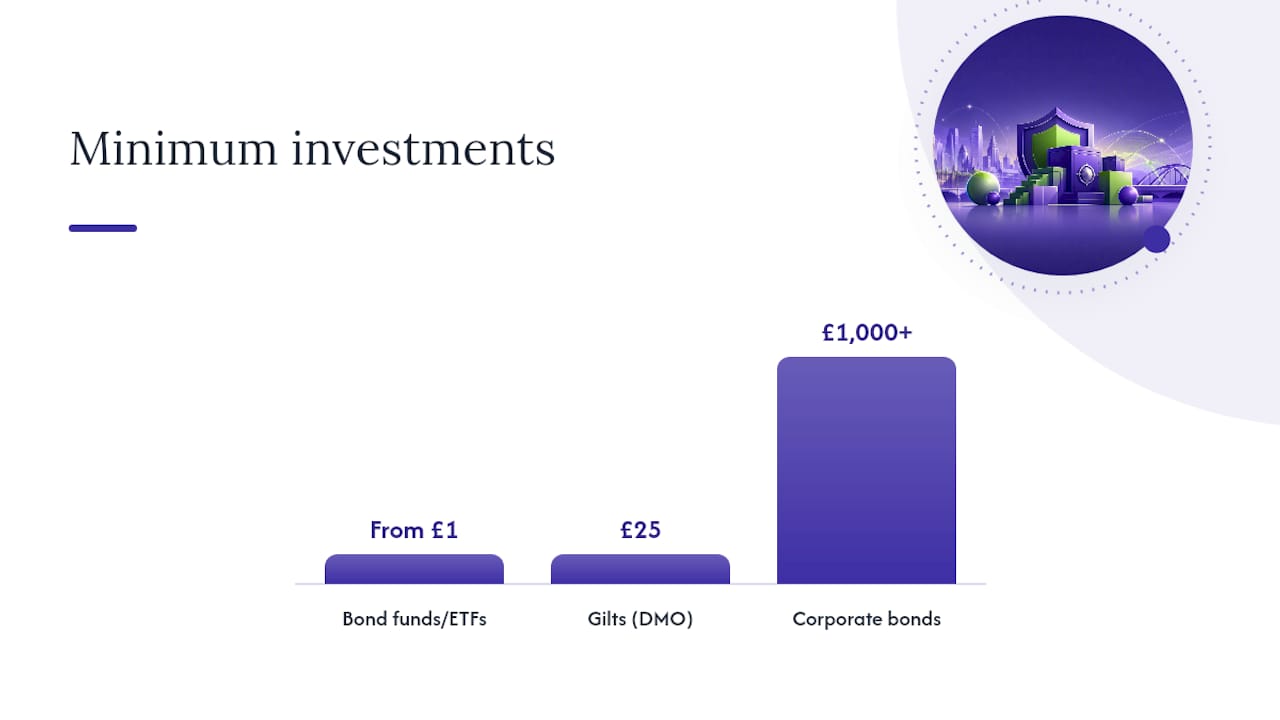
| Minimum investment | From £1 (most platforms) | £25 (gilts via DMO); £1,000+ (corporate, Retail Bond Platform) |
| Diversification | High (many issuers/maturities) | Low (single issuer) |
| Maturity | None (rolling portfolio) | Fixed, known at purchase |
| Liquidity | High (daily dealing on platform) | Moderate to high (listed bonds); low (unlisted) |
| Fees | Ongoing Charge Figure (OCF); platform fee | Dealing commission; no ongoing charge |
| Tax (outside wrapper) | Income taxable; CGT applies to fund gains | Income taxable; gilts CGT-exempt for individuals |
| ISA/SIPP eligible | Yes | Yes (listed bonds via eligible platforms) |
Pro Tip: When comparing bond ETFs, check the Ongoing Charge Figure (OCF) rather than just the headline yield. Also note that a fund’s distribution yield reflects income paid out, while its YTM reflects the total return if the underlying bonds are held to maturity — these two figures can differ significantly.
The iShares Core UK Gilts UCITS ETF and Vanguard UK Government Bond ETF are frequently cited examples of low-cost gilt exposure available on mainstream UK platforms. They are illustrative of the category rather than exclusive recommendations — always compare OCF, yield, duration, and platform availability before choosing.
What does the current UK bond market look like?
Gilt yields in 2025 and into 2026 have remained meaningfully higher than the near-zero levels that characterised much of the 2010s, with 10-year gilt yields notably higher than the near-zero levels seen in the past decade. That shift has restored genuine income opportunities in fixed income for the first time in over a decade, as market commentary from GiltEdge reflects.
Rising rates have pushed yields higher, but they have also increased price volatility for existing bond holders. Fidelity’s analysis makes the point clearly: investors must weigh the higher income now available against the potential for further rate moves to affect capital values.
Sources to check for live figures at publication:
- Bank of England (bankofengland.co.uk): Bank Rate decisions and gilt yield data
- Debt Management Office (dmo.gov.uk): current gilt issuance, auction results and yield curves
- NS&I (nsandi.com): current Premium Bond prize fund rate
- London Stock Exchange (londonstockexchange.com): gilt and retail bond prices and yields
- MoneyHelper (moneyhelper.org.uk): plain-English guidance on bonds and savings
Editor note: update the 10-year gilt yield, Bank Rate, and NS&I prize fund rate from the sources above before publishing this article.
How do you choose the right bond investment for your goals?
Match your bond choice to your objective first, then filter by tax position, time horizon, and cost.
- Define your objective. Are you seeking regular income, capital preservation, inflation protection, or a chance-based tax-free return? Income investors lean towards corporate bonds or gilt funds; capital-preservation investors lean towards short-dated gilts or fixed-term savings bonds; inflation-conscious investors consider index-linked gilts.
- Assess your time horizon. If you need the money within two years, short-dated gilts or fixed-term savings bonds reduce interest-rate risk. If you are investing for ten years or more, a diversified bond fund or ETF may suit better.
- Know your tax band. Additional-rate taxpayers with no PSA benefit most from ISA/SIPP wrappers or from the gilt CGT exemption. Basic-rate taxpayers with unused PSA may hold bond income outside a wrapper without immediate tax cost.
- Check ISA and SIPP availability. If you have unused ISA allowance (£20,000 per tax year), use it. Bond income and gains inside an ISA are completely sheltered.
- Consider your income need. Bond funds pay distributions periodically; individual bonds pay coupons on fixed dates. If you need monthly income, check the fund’s distribution frequency.
- Assess credit risk tolerance. Are you comfortable with the possibility of an issuer defaulting? If not, stick to gilts or investment-grade bond funds. Check S&P and Moody’s ratings for any individual corporate bond you consider.
- Check the minimum investment. Premium Bonds start at £25; gilt ETFs start from £1 on most platforms; individual corporate bonds on the Retail Bond Platform typically require £1,000 or more.
- Compare total costs. For funds, the OCF is the key figure. For individual bonds, factor in dealing commissions. For fixed-term savings bonds, check whether early withdrawal is possible and at what cost.
- Decide on liquidity. Premium Bonds and gilt ETFs offer near-instant access. Fixed-term savings bonds lock your money away. Individual gilts can be sold on the secondary market but settlement takes two business days.
- Seek regulated advice for portfolio-level decisions. The checklist above narrows your options; a regulated financial adviser can confirm the right allocation for your full financial picture.
Generic investor profiles (illustrative, not prescriptive advice):
- Conservative retiree: short-dated gilts or a short-duration gilt ETF inside an ISA, supplemented by Premium Bonds for tax-free prize potential on accessible cash
- Income-focused investor: a diversified investment-grade corporate bond fund inside an ISA or SIPP, with attention to distribution yield and OCF
- Younger diversified investor: a low-cost global bond ETF or UK gilt ETF as a stabilising allocation within a broader equity-heavy portfolio, held inside a Stocks and Shares ISA
An honest view on bonds in a household portfolio
Bonds have spent much of the last fifteen years being dismissed as irrelevant — yields were so low that cash often beat them after costs and tax. That argument has weakened considerably.
What I find underappreciated is the gilt CGT exemption. For higher-rate taxpayers who have used their ISA allowance, buying a below-par gilt and holding to maturity can generate a portion of the return as a completely tax-free capital gain. It is a legal, straightforward advantage that many investors overlook simply because it requires a little more thought than buying a bond fund.
The other point worth making clearly: Premium Bonds are not a bond investment in any conventional sense. They are a capital-protected savings product with a probabilistic return. For additional-rate taxpayers with no PSA, they can be genuinely competitive with savings accounts. For everyone else, the comparison depends on the current prize fund rate versus available savings rates — and that comparison changes regularly.
Bonds belong in most household portfolios in some form. The right form depends on your tax position, your time horizon, and whether you need income or capital certainty. For personalised guidance on how bonds fit alongside your mortgage, protection, and broader financial planning, we are happy to point you in the right direction at Prosperhomeloans.
Sources
- About gilts | Debt Management Office (DMO)
- NS&I
- What role do bonds play now? | Fidelity
- Gov
- Investing in bonds explained | Which?
- What are bonds? | IG
Recommended
