What is debt to income ratio, and what counts as a good one?

Your debt-to-income ratio, or DTI, is the percentage of your gross monthly income that goes towards paying debts each month. Lenders calculate it with a simple formula: total monthly debt payments ÷ gross monthly income × 100.
Say you earn £3,000 a month before tax, and you pay £250 towards your mortgage or rent, £150 on a car finance agreement and £100 in minimum credit card payments. That’s £500 in total monthly debt commitments. Divide £500 by £3,000 and multiply by 100, and your DTI comes out at 16.7%.
As a rough guide, many lenders view a DTI below roughly a third as favourable, a moderate range as manageable but worth a closer look, and a high ratio as risky. Every lender sets its own thresholds, though, and the number is only one part of the affordability picture.
- The formula: total monthly debt payments ÷ gross monthly income × 100
- Worked example: £500 debt ÷ £3,000 income × 100 = 16.7% DTI
- Rule of thumb: under 36% is generally seen as strong; over 50% tends to worry underwriters
Key Takeaways
| Point | Details |
|---|---|
| The formula | Total monthly debt payments ÷ gross monthly income × 100 gives your DTI percentage. |
| Good versus risky ranges | Under roughly a third is generally favourable, moderate ranges are manageable, and higher ratios often trigger closer scrutiny. |
| Use gross income and contractual minimums | Calculate with gross pay and credit card minimum payments, not net income or your chosen repayment amount. |
| Consolidation lowers DTI quickly | Combining several small debts into one loan often reduces your monthly outgoings faster than repaying debts individually. |
| UK macro-prudential limits differ from personal DTI | The FCA and Bank of England cap high loan-to-income lending at 15% of new mortgages per quarter, separate from your own ratio. |
| Get tailored advice from Prosperhomeloans | Prosperhomeloans reviews your DTI alongside deposit, credit history and income type to match you with suitable whole-of-market lenders. |
Table of Contents
- Front-end versus back-end DTI: what each one actually measures
- How to calculate your debt-to-income ratio step by step
- Which debts lenders count, and which they usually ignore
- What counts as a good debt-to-income ratio?
- How lenders actually use your DTI in a mortgage decision
- How to lower your DTI before you apply for credit
- How UK regulators shape DTI limits behind the scenes
- Where DTI misconceptions trip people up
- Why DTI shapes your rate and terms, not just your approval
- What DTI can’t tell a lender, and what else gets checked
- Getting professional advice once you know your number
- What advisers actually see when they review your DTI
- How Prosper Home Loans can help if your DTI is holding you back
- Frequently asked questions
- Sources
Front-end versus back-end DTI: what each one actually measures
Lenders don’t always mean the same thing when they say “DTI”. Front-end DTI looks only at housing costs, your mortgage or rent payment, plus buildings insurance and any service charge, as a percentage of gross income. Back-end DTI is broader. It adds every other debt commitment on top of housing, from car finance to credit cards to personal loans.
Front-end DTI answers a narrower question: can you afford this specific home? Back-end DTI answers the wider one: can you afford this home and everything else you owe? Most UK mortgage lenders lean heavily on back-end DTI because it reflects your total financial pressure, not just the property in front of you. A broker assessing your file will usually want both figures, because a low front-end number can hide a high back-end one if you’re carrying several other debts.
| Measure | What it includes | What it tells a lender |
|---|---|---|
| Front-end DTI | Mortgage or rent, buildings insurance, service charge | Whether the housing cost alone is affordable |
| Back-end DTI | Front-end costs plus credit cards, loans, car finance, other debts | Whether your total monthly commitments are sustainable |
For most mortgage applications, back-end DTI carries more weight. Lenders offering higher loan-to-value products, or looking at applicants with existing borrowing, will often ask for both figures before deciding on rate and terms.
How to calculate your debt-to-income ratio step by step
Working out your own DTI takes three steps, and you can do it in a few minutes with a bank statement and a calculator.
- Work out your gross monthly income. If you’re salaried, take your annual salary before tax and deductions, then divide by 12. If you’re paid weekly, multiply your weekly gross pay by 52 and divide by 12. Self-employed readers should use the average monthly figure from their most recent self-assessment tax returns, typically averaged over two to three years.
- List every contractual monthly debt payment. Include your mortgage or rent, minimum credit card payments, personal loan instalments, car finance, and any court-ordered repayments. Leave out household bills like council tax, utilities or groceries, since lenders don’t count these as debt.
- Divide total debt payments by gross monthly income, then multiply by 100. That percentage is your DTI.
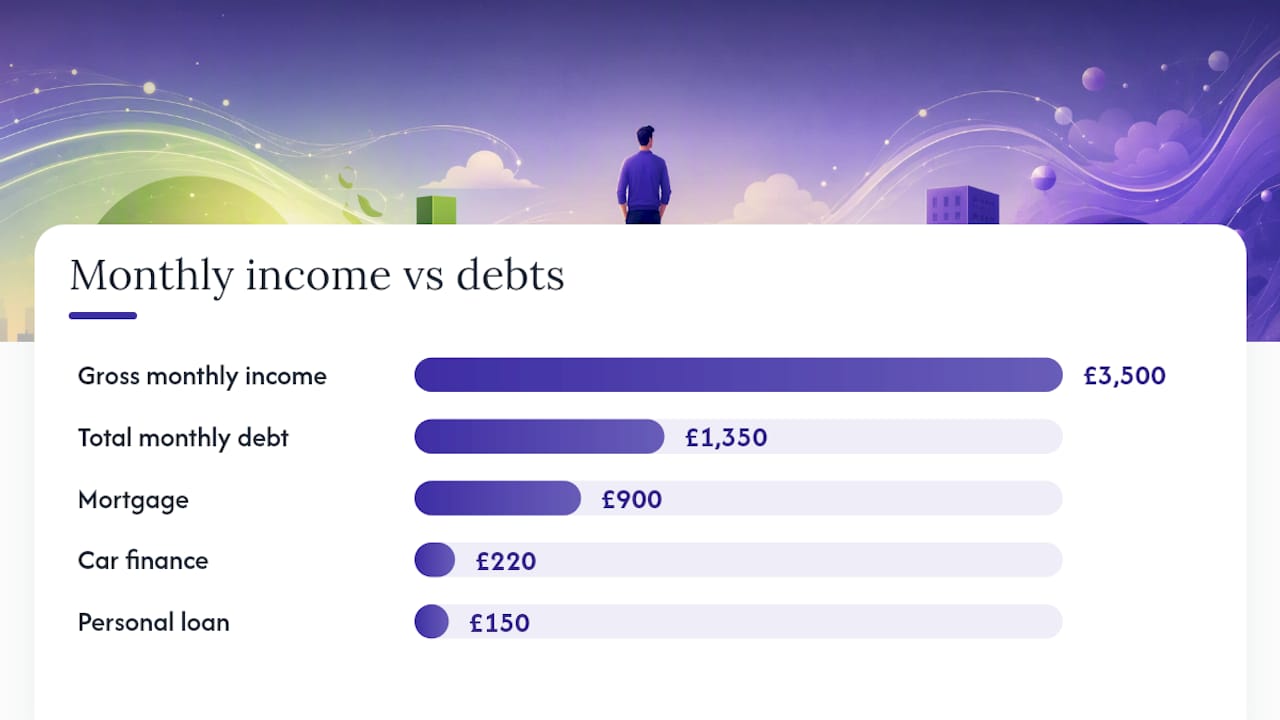
Here’s a fuller worked example. Suppose your gross annual salary is £42,000, giving a gross monthly income of £3,500. Your monthly commitments are: mortgage £900, car finance £220, minimum credit card payment £80, and a personal loan repayment £150. That’s £1,350 in total monthly debt.
£1,350 ÷ £3,500 × 100 = 38.6% DTI.
That sits at the upper end of the “manageable” band many lenders use, which means it’s worth reviewing before applying, particularly if you’re hoping for the most competitive rates.
One detail catches people out: lenders always use gross income, not the take-home pay that lands in your account. Gross figures give lenders a consistent, comparable measure across employed, self-employed, and variable-income applicants, since tax codes and deductions vary too much to use net pay reliably.
Which debts lenders count, and which they usually ignore
Not every financial commitment feeds into your DTI calculation and bank levy concerns. Lenders work from a fairly consistent list, though the fine detail differs slightly between products.
Commonly included:
- Mortgage or rent payments
- Minimum monthly credit card payments
- Personal loan and finance agreement repayments
- Car finance or hire purchase instalments
- Overdraft commitments treated as ongoing borrowing
- Court-ordered repayments, such as County Court Judgments
Commonly excluded:
- Informal loans from family or friends
- Government-backed student loans through the Student Loans Company, which many lenders treat differently from commercial debt
- Household bills like utilities, council tax and insurance premiums that aren’t credit agreements
Pro Tip: Always use the contractual minimum payment on a credit card when calculating your DTI, not the amount you personally choose to pay each month. Lenders calculate affordability on that conservative minimum figure, so using your own higher voluntary repayment will understate your real DTI and give you a false sense of security.
If you’re carrying several smaller debts and want to see how consolidating them might change your position, it’s worth reading about how debt consolidation reduces monthly payments before you calculate your figure.
What counts as a good debt-to-income ratio?
There isn’t one universal cut-off, but most lenders work within similar bands. Guidance from consumer calculators and lending guides generally treats a DTI below 36% as favourable, 36 to 50% as workable but subject to closer scrutiny, and anything over 50% as high risk for most mainstream mortgage products.

| DTI range | Typical lender reaction |
|---|---|
| Below 36% | Generally favourable; often supports access to the most competitive rates |
| 36% to 50% | Manageable, but lenders may want a larger deposit or stronger credit history to offset it |
| Above 50% | High risk; many mainstream lenders will decline or require specialist underwriting |
These bands aren’t fixed law. A strong credit score, a substantial deposit, or a stable employment history can all offset a higher DTI in a lender’s overall assessment. DTI is a filter, not a verdict.
How lenders actually use your DTI in a mortgage decision
DTI never operates in isolation. It’s one input into a wider affordability assessment that also weighs your credit file, employment stability, deposit size and the loan-to-value (LTV) you’re requesting. A lender reviewing your application is really asking one question in several different ways: if your circumstances got worse, could you still pay?
That’s where stress-testing comes in. Lenders model your ability to keep paying if interest rates rose, typically checking affordability against a rate several percentage points above the one you’re actually being offered. Your current DTI at today’s rate might look comfortable, but the stressed figure at a higher rate is what often determines the maximum loan size a lender will offer.
A higher deposit or a cleaner credit history can genuinely soften the impact of an elevated DTI. Lenders don’t view the ratio as a single pass or fail line; they weigh it against everything else in the file before reaching a decision.
Deposit size matters here in a very practical way. A larger deposit reduces the loan amount, which reduces the monthly repayment, which in turn lowers your DTI even before your income or existing debts change. It’s one of the few levers a borrower can pull quickly.
How to lower your DTI before you apply for credit
If your calculated DTI sits higher than you’d like, several practical moves can bring it down before you submit an application.
- Pay off or consolidate high-cost debt. Clearing a credit card balance removes that minimum payment from your calculation entirely.
- Reduce new borrowing in the run-up to applying. Avoid taking on car finance or a new credit card in the months before a mortgage application.
- Increase your gross income where realistically possible, whether through a pay rise, additional contracted hours, or a second income stream that a lender will recognise.
- Use savings to increase your deposit, which lowers the loan size and monthly repayment, and therefore your DTI.
- Renegotiate repayment terms on existing loans if a longer term genuinely reduces monthly outgoings without pushing you deeper into debt overall.
Of these, paying down or consolidating existing debt usually gives the fastest, most measurable improvement, because it removes a monthly payment from the calculation immediately rather than waiting for income to grow.
Pro Tip: Consolidating several small debts into one loan can lower your DTI even if the total amount you owe barely changes. Three minimum payments of £60, £45 and £90 add up to £195 a month. Roll them into a single consolidation loan at £150 a month, and your DTI drops, even though your outstanding balance may be similar. Our guide to what a debt management plan involves explains how structured repayment options interact with affordability checks.
How UK regulators shape DTI limits behind the scenes
Your personal DTI is a household-level calculation. UK regulators also apply a separate, macro-level version of the same idea to the banking system as a whole, and it’s worth understanding the difference.
UK mortgage lenders operate under an LTI flow limit, which restricts the proportion of new mortgages a lender can issue at 4.5 times income or above to no more than 15% of new residential mortgage contracts each quarter. This isn’t your personal DTI. It’s a system-wide cap that governs how much high-multiple lending a bank can do in total, regardless of any individual applicant’s own figures.
The Bank of England’s guidance on high loan-to-income lending frames this as a financial stability measure, aimed at limiting excessive household leverage across the system so that a rise in interest rates or a fall in incomes doesn’t trigger widespread mortgage distress.
Regulators focus on high debt-to-income and loan-to-income lending because concentrated household leverage becomes a systemic risk when economic conditions turn, not just a risk to the individual borrower.
The FCA’s finalised guidance sets out how lenders must apply this 15% ceiling in practice, and legislation formally defines debt-to-income ratio for mortgage assessment as total relevant debt measured against annual income. What this means practically for you: even if your own DTI looks perfectly reasonable, a lender might still decline a high-multiple loan simply because it has already used up its quarterly allowance for that type of lending. It’s a good reason to work with a broker who knows which lenders still have headroom.
Where DTI misconceptions trip people up
The most common mistake is assuming DTI measures total debt owed rather than monthly repayment burden. A £30,000 loan repaid over seven years affects your DTI far less than the same £30,000 repaid over two years, because the calculation only looks at what leaves your account each month, not the outstanding balance.
Another frequent error is calculating DTI using net, take-home pay instead of gross income, which makes the ratio look artificially high and can cause unnecessary panic before an application. People also sometimes forget to include an overdraft that’s used consistently as ongoing borrowing, or they include household bills, like utilities and council tax, that lenders don’t actually count as debt at all.
Self-employed applicants face a particular pitfall: using a single strong year’s income rather than the multi-year average most lenders require, which can produce a DTI that doesn’t match what an underwriter will calculate from your self-assessment records.
Why DTI shapes your rate and terms, not just your approval
Approval isn’t the only thing on the line. A DTI that sits comfortably below a lender’s threshold can also unlock better pricing, because lenders price risk into the interest rate they offer.
A higher DTI can also affect the structure of the loan itself, not just the rate. Lenders may require a larger deposit, a shorter term, or additional conditions such as a guarantor, if your DTI sits near the upper edge of what they’ll accept. In practice, this means two borrowers requesting the same loan amount could walk away with meaningfully different monthly costs, purely because of where their DTI landed.
What DTI can’t tell a lender, and what else gets checked
DTI is a useful, quick snapshot, but it has real limitations. It doesn’t capture how stable your income actually is, whether you have savings to fall back on, or how your spending habits look beyond contracted debt repayments.
That’s why lenders build a fuller picture using your credit score, your employment history, your deposit size and loan-to-value, and increasingly your bank transaction data through open banking checks. Two applicants with identical DTIs can receive very different decisions once a lender factors in a patchy credit history on one side and years of stable saving on the other.
If your income is irregular, self-employed or contract-based, this fuller picture matters even more. Lenders often ask for additional evidence, such as subcontractor income documentation or foreign national verification paperwork, precisely because DTI alone can’t reflect how consistent that income really is.
Getting professional advice once you know your number
Once you’ve worked out your own DTI, the next useful step is getting it reviewed by someone who knows how individual lenders interpret it.
Before speaking to an adviser, it helps to have your last three months of payslips or self-assessment summaries, a list of your current debts with monthly payments, your latest credit report, and details of your deposit ready to hand. That preparation alone can shorten the conversation significantly and lets your adviser give you a genuinely tailored answer rather than a generic one. Working with a whole-of-market broker rather than a single lender also means you’re not limited to one institution’s particular appetite for your DTI profile.
What advisers actually see when they review your DTI
When a client comes to us with a DTI that looks high on paper, we rarely see it as a dead end. We look at it alongside everything else in the file, the deposit, the credit history, how long the debts have left to run, and often find a lender whose criteria fit better than the client expected. What surprises people most is how much a small change, clearing one credit card or waiting three months after a new loan, can shift the outcome. We ask clients for the same handful of documents every time: recent payslips or self-assessment summaries, a list of current debts, and a recent credit report, because that combination tells us far more than the DTI figure alone ever could.
How Prosper Home Loans can help if your DTI is holding you back
Working out your DTI is the easy part. Knowing which of the many UK lenders will actually look past a slightly higher number, because of your deposit, your credit history, or the type of income you earn, is where independent advice earns its keep. Prosperhomeloans is the alternative to applying blind through a single bank’s own calculator, because we search the whole market on your behalf and match you to lenders whose criteria genuinely fit your circumstances, whether you’re self-employed, a sub-contractor, a first-time buyer or an NHS worker.

If your DTI feels higher than you’d like, or you’re simply not sure how a lender will read your file, get in touch before you apply anywhere else. Bring your recent payslips or self-assessment figures, a list of your current debts and a recent credit report, and we’ll give you a clear, honest read on where you stand. Visit the Prosper Home Loans team to arrange a conversation and find out which lenders are the right fit for your numbers.
Frequently asked questions
What is debt to income ratio, in the simplest possible terms? It’s the percentage of your gross monthly income that goes towards debt repayments each month, calculated as total monthly debt payments divided by gross monthly income, multiplied by 100.
Not necessarily.
Does DTI include my student loan? Government-backed student loans through the Student Loans Company are usually excluded from DTI calculations, though private or commercial student loans may be treated differently by some lenders.
Should I use my gross or net income when calculating DTI myself? Always use gross income, before tax and deductions. Lenders calculate DTI this way because it gives a consistent measure across salaried, self-employed and variable-income applicants.
Can I improve my DTI quickly before applying for a mortgage? Paying off or consolidating existing debts usually has the fastest impact, since it removes or reduces a monthly payment from the calculation immediately, rather than waiting for income growth.
This article is general information, not a substitute for advice from a qualified financial advisor. Consult a qualified financial professional about your own circumstances before acting on anything here.
Sources
For readers who want to check the detail behind the figures in this guide, a handful of sources are worth bookmarking.
The Bank of England’s own explanation of its financial stability tools shows exactly how debt is defined for macro-prudential purposes, including which types of borrowing count and which don’t.
The FCA’s finalised guidance on loan-to-income ratios sets out the lender-level rules behind the 15% flow limit in full technical detail. The legislation.gov.uk definition of debt-to-income ratio gives the precise legal wording used for mortgage assessment. For a quick personal calculation, practical consumer calculators let you plug in your own figures and see where you land against typical lender bands before you speak to an adviser.
- What are macroprudential tools? (Brookings)
- Legislation
- FPC housing tools and the DTI definition (Bank of England, 2015)
Recommended
