How a secured loan affects your property sale

You can sell a house with a secured loan on it. The loan does not prevent a sale, but it must be cleared or formally managed at completion so the buyer receives clean legal title. The single most important first step is to request a redemption statement from every secured lender and instruct your conveyancer to check the charges registered against your title at HM Land Registry. Your solicitor or conveyancer will handle the actual repayment on completion day, but they need those figures from you early to plan the transaction properly.
A secured loan, sometimes called a second-charge mortgage or homeowner loan, is a debt registered as a legal charge against your property title. Unlike an unsecured personal loan, the lender has a formal claim on the proceeds of any sale. That distinction shapes every step of the process described below.
Table of Contents
- How secured loans are dealt with when your sale completes
- Do you have to repay the secured loan before you sell?
- Can you move a secured loan to a new property?
- What happens if the sale price does not cover your debts?
- Early repayment charges and other costs to factor in
- A practical checklist for selling with a secured loan
- How Prosperhomeloans can support your sale
- Key takeaways
- What sellers often overlook about secured loans
- Prosperhomeloans: independent advice for your next move
- Useful sources
How secured loans are dealt with when your sale completes
Understanding the completion mechanics removes a lot of the anxiety sellers feel about selling property with a secured loan. The process is orderly and well-established in English and Welsh conveyancing practice.
How sale proceeds are allocated on completion day:
- Your conveyancer receives the full purchase price from the buyer’s solicitor.
- The first-charge lender (usually your main mortgage provider) is repaid in full before any other secured creditor receives a penny.
- Any second charge or additional secured loan is repaid next, in the order the charges are registered on title.
- Conveyancing fees, estate agent fees, and other completion costs are deducted.
- The remaining balance is transferred to you.
Your conveyancer prepares a completion statement in advance showing exactly how funds will flow. They also obtain discharge documentation from each lender confirming the charge has been released, so the buyer’s title is clean from day one.
The order of repayment is strictly governed by the registration of charges on title. Solicitors must pay the first-charge lender in full before allocating funds to any second charge. If the proceeds are insufficient, the seller must provide the shortfall and the sale cannot complete otherwise.

Pro Tip: Request your redemption figure as soon as you accept an offer, not when you are close to exchange. Redemption statements expire after a relatively short period, so you will need a fresh figure near completion anyway, but an early one lets your conveyancer spot any shortfall risk before you are legally committed.
Do you have to repay the secured loan before you sell?
No. Repayment is normally required at completion, not before you market the property or even before exchange of contracts. You can list your home, accept an offer, and proceed through conveyancing with the secured loan still in place. What matters is that the debt is cleared on the day legal ownership transfers to the buyer.
That said, getting your redemption statements early in the process is strongly advisable. A redemption statement typically itemises:
- The outstanding capital balance
- Daily interest accruing to a named settlement date
- Any early repayment charge (ERC) applicable at that date
- Arrears or default fees, if any
- An administrative discharge fee
These figures change every day because interest accrues continuously. Lenders usually give the statement a validity window, after which you need a new one. If your exchange and completion dates are set more than a month apart, plan to request an updated figure shortly before completion to avoid a discrepancy on the day.
Sellers who wait until the week before completion to request figures risk delays. Slow lender responses are a recognised cause of missed buyer mortgage offer deadlines, and a buyer whose offer expires may withdraw or renegotiate.
Can you move a secured loan to a new property?
Direct porting of a secured or second-charge loan to a new property is rare in the UK market. Most second-charge lenders tie their security to a specific property, and transferring that security to a different address requires explicit written consent from the lender. It is assessed on risk, not offered as a standard product feature, and most borrowers should expect to repay the loan on sale.

For context, even in markets where mortgage porting is more established, such as Canada, lenders impose strict conditions and reassessment requirements before approving a transfer. UK second-charge lenders are generally less flexible still.
If you need to borrow again after the sale, your realistic options are:
- Remortgage to absorb the borrowing. If your new property supports a larger first mortgage, you may be able to include the sum you previously borrowed as a second charge within the new first-charge loan, subject to the lender’s LTV limits.
- Apply for a fresh second charge. Once you own the new property, you can apply for a new secured loan against it. Lenders will assess affordability and LTV from scratch.
- Unsecured borrowing. Suitable only for smaller sums; interest rates are typically higher and terms shorter than secured products.
Pro Tip: Before you commit to any route, ask an independent broker to run a quick market test. A broker with access to the whole second-charge market can return indicative terms within 24–48 hours, giving you a realistic picture of what replacement borrowing will cost before you exchange on your new purchase.
What happens if the sale price does not cover your debts?
If your property sells for less than the total outstanding secured debt, you are in negative equity. Lenders will not release their legal charge until the debt is cleared or an alternative arrangement is formally agreed in writing. Completion cannot proceed in the standard way until that is resolved.
Your options in a shortfall situation:
- Bring funds from savings. If the gap is small, covering it from your own resources is the cleanest solution and avoids any credit impact.
- Negotiate a reduced settlement. Some lenders will accept a partial settlement, particularly where the alternative is a lengthy repossession process. This is lender-by-lender and must be agreed in writing before completion.
- Agree a deferred repayment plan. The lender releases the charge but you remain personally liable for the outstanding balance under a separate repayment agreement.
- Consider a fast or binding sale. Where arrears or court action are already in play, standard open-market timelines may be too slow and a rapid sale route may be necessary.
The shortfall does not disappear when the charge is released. Unless the lender formally writes off the debt in writing, you remain personally liable for the outstanding balance after completion. Always get any settlement agreement confirmed in a signed letter from the lender before you proceed.
Early repayment charges and other costs to factor in
ERCs can reduce your net proceeds, and sellers often underestimate them. Check your product terms as early as possible.
A redemption statement will include several components beyond the outstanding balance. The table below shows what each one means for your moving budget.
| Component | What it is | Effect on your proceeds |
|---|---|---|
| Outstanding capital balance | The principal you still owe | Largest deduction from sale price |
| Accrued daily interest | Interest from your last payment to the settlement date | Increases the longer completion takes |
| Early repayment charge (ERC) | A penalty for repaying before the fixed or tie-in period ends | Can be a percentage of the outstanding balance |
| Arrears or default fees | Charges applied if payments have been missed | Added to the redemption total |
| Discharge/admin fee | Lender’s fee for releasing the legal charge | Usually a flat fee, typically modest |
| Solicitor discharge fee | Your conveyancer’s fee for handling the legal release | Varies by firm |
ERCs are most common on fixed-rate or discounted secured loan products. Some lenders calculate them as a percentage of the outstanding balance, others as a set number of months’ interest. Timing your completion date to fall after the ERC period ends can save a meaningful sum, so check your product schedule before you set a target completion date.
Pro Tip: Ask your lender specifically: “Does an ERC apply if I repay on [target date], and if so, how is it calculated?” Request this in writing. A verbal assurance is not binding, and the written product schedule is what your conveyancer will rely on.
A practical checklist for selling with a secured loan
Working through these steps in order keeps the transaction on track and avoids last-minute surprises.
- Check your title. Ask your conveyancer to obtain an official copy of your title register from HM Land Registry. Confirm every charge registered against the property and identify each lender.
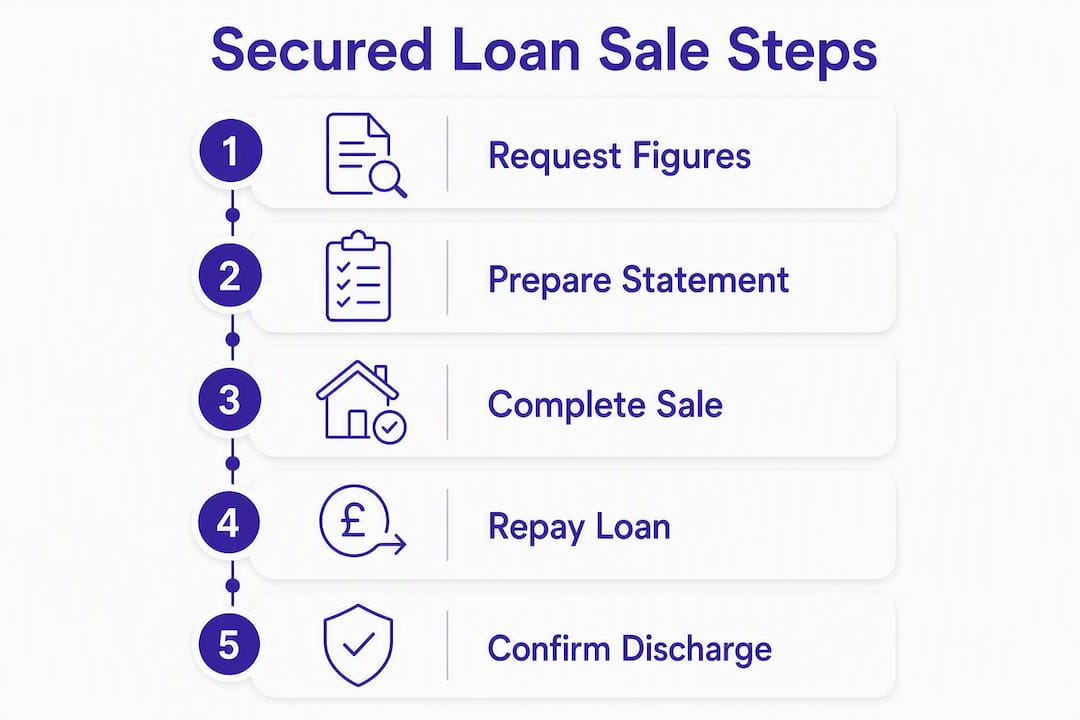
- Request redemption figures from every lender. Do this as soon as you accept an offer. Note the expiry date on each statement.
- Share all redemption statements with your conveyancer. They need these to prepare the completion statement and to flag any shortfall risk early.
- Keep all secured loan payments up to date. Missed payments add default fees to your redemption figure and can trigger lender intervention.
- Check for ERCs and model your net proceeds. Use the redemption figures to calculate what you will actually receive after all debts and costs are cleared.
- Confirm lender consent if required. Some lenders include a consent-to-sell clause in their terms. Your conveyancer will check this, but raise it with your lender directly if you are unsure.
- Request updated redemption figures close to completion. If more than 30 days pass between your original statement and completion, get a fresh figure.
- Confirm discharge on completion day. Your conveyancer should confirm that discharge documents have been received from each lender and that the charges have been removed from title.
Worked example of net proceeds:
The figures above are illustrative. Your actual position depends on your specific redemption statements and agreed fees.
Key timing points to keep in mind:
- Request final redemption figures within a few working days before your target completion date.
- Redemption statements typically expire after a limited period, so a figure obtained at offer stage will need refreshing before completion.
- Your buyer’s mortgage offer also has an expiry date. Slow lender responses on redemption figures are a known cause of delays that can push completion past that deadline.
Tell your buyer’s solicitor at the outset that you have a secured loan in addition to your main mortgage. This is standard information they will need for their own searches and enquiries, and flagging it early avoids unnecessary requisitions later.
How Prosperhomeloans can support your sale
An independent mortgage broker and a conveyancer serve distinct but complementary roles when you are selling with a secured loan. Your conveyancer handles the legal discharge and title work; a broker handles the product and market side, which matters most if you need replacement borrowing after the sale.
At Prosperhomeloans, we can:
- Run a rapid market test for replacement second-charge or remortgage products, returning indicative terms quickly so you can model costs before you exchange.
- Calculate combined loan-to-value across your new property and proposed borrowing, helping you understand what lenders will realistically offer.
- Advise on whether remortgaging to absorb the borrowing or applying for a fresh second charge gives you the better outcome, based on your circumstances.
- Refer you to an FCA-regulated adviser for any specialist product area outside our scope.
A broker can rapidly test replacement product availability and provide indicative LTV modelling that helps sellers decide whether to clear the loan from sale proceeds or refinance into a new product.
Broker advice and legal conveyancing are separate services. A broker advises on mortgage and secured loan products; a solicitor or licensed conveyancer handles the legal discharge of charges and the transfer of title. You need both, and involving each party early reduces the risk of delays.
This article is general information, not legal or financial advice. Please confirm your specific position with a qualified conveyancer and an FCA-regulated mortgage adviser.
Key takeaways
Selling a property with a secured loan is straightforward when you obtain redemption figures early, plan for ERCs, and instruct your conveyancer before exchange.
| Point | Details |
|---|---|
| You can sell with a secured loan | The loan does not block a sale; it must be cleared or managed at completion so the buyer gets clean title. |
| Get redemption figures early | Request statements from every lender at offer stage; note their expiry dates and refresh them close to completion. |
| Budget for ERCs and fees | Include early repayment charges, accrued interest, and solicitor discharge fees in your net proceeds calculation. |
| Shortfalls must be resolved before completion | If sale proceeds fall short, arrange funds or negotiate a written settlement with lenders before you exchange. |
| Prosperhomeloans for replacement borrowing | If you need a remortgage or new second charge after the sale, Prosperhomeloans can model your options and access the whole market. |
What sellers often overlook about secured loans
The most common surprise we see at Prosperhomeloans is not the existence of an ERC, it is the timing. Sellers discover the charge applies only after they have set a completion date, at which point changing the date to avoid it means renegotiating with the buyer and potentially losing the sale. The fix is simple: pull your product schedule on day one, not the week before completion.
There is also a persistent misconception that a second-charge lender must consent to the sale itself. In most standard cases, the lender does not need to approve the sale; they simply need to be repaid. What they do control is the release of their charge, and that release happens only when the redemption figure is paid in full. Conflating “consent to sell” with “charge release” causes unnecessary anxiety and, occasionally, unnecessary correspondence that slows the transaction.
One more point worth raising: sellers in arrears sometimes delay marketing because they assume the lender will block the sale. In reality, selling is often the most orderly resolution available, and lenders generally prefer it to repossession. If you are behind on payments, speak to your lender and a broker before you assume the worst.
Prosperhomeloans: independent advice for your next move
Selling a home with secured borrowing attached involves more moving parts than a straightforward sale, and the cost of getting the timing wrong can run to thousands of pounds in avoidable ERCs or a collapsed transaction. Prosperhomeloans offers independent mortgage and protection advice covering remortgage, second-charge loans, and replacement borrowing, with whole-of-market access so you are not limited to one lender’s products.

When you contact us, we will walk you through a document checklist, model your likely net proceeds, and identify whether a remortgage or a new second charge gives you the better outcome on your next property. There is no obligation at the initial call, and we will refer you to a specialist conveyancer for the legal discharge work if you need one.
Speak to Prosperhomeloans today and get clarity on your options before you exchange.
Prosperhomeloans is an independent mortgage and protection adviser. This article is general information only and does not constitute legal or financial advice. Always seek advice from an FCA-regulated adviser and a qualified conveyancer for your specific circumstances.
Useful sources
- How to Sell Guide (MHCLG, UK Government) — Official government guidance on selling a home in England and Wales, including mortgage redemption obligations and costs.
- How to Complete Transfer of Property With Multiple Mortgages (UKLegalGuides.com) — Detailed explanation of charge priority, conveyancer responsibilities, and completion mechanics for properties with more than one secured debt.
- Can You Sell a House With a Secured Loan on It? (Scotland Property Auction) — Practical overview of redemption statements, ERC considerations, and the sale process for homeowners with secured loans.
- Selling a House With a Second Charge or Secured Loan (Zapperty) — Step-by-step guide covering conveyancer roles, completion fund allocation, and fast-sale scenarios.
- Can I Transfer My Secured Loan to Another Property? (Squared Money) — Explains porting limitations in the UK second-charge market and practical alternatives including remortgage and fresh second-charge applications.
- Is It Possible to Sell a House That Has a Secured Loan on It? (BetterMove) — Accessible overview of the legal charge mechanism and what sellers need to know before marketing.
- Prosperhomeloans — Independent mortgage and protection advisers offering whole-of-market access for remortgage, second-charge loans, and replacement borrowing.
