Fixed vs tracker mortgage: which is right for you in 2026?

There is no universal winner in the fixed vs tracker mortgage debate, and anyone who tells you otherwise is selling something. Fixed-rate mortgages give you payment certainty and suit borrowers with a tight budget or low appetite for risk. Tracker mortgages follow the Bank of England base rate plus a set margin, so they can be cheaper today, but they leave you exposed if that rate climbs.
Two quick match rules help most people:
- Choose fixed if you need to know your exact payment for the next 2 to 5 years, you’re stretched at current affordability limits, or you simply sleep better without surprises.
- Choose tracker if you have a genuine buffer in your budget, you can absorb a rate rise without strain, and you’re comfortable watching Bank of England announcements.
If you’re still torn, that’s normal. A whole-of-market broker like Prosperhomeloans can model both scenarios against your actual numbers before you commit.
Key Takeaways
Fixed mortgages trade a higher starting rate for guaranteed payments, while tracker mortgages trade payment certainty for a rate that moves with the Bank of England base rate.
| Point | Details |
|---|---|
| No universal winner | Fixed suits tight budgets and low risk tolerance; tracker suits borrowers with a genuine affordability buffer. |
| Base-rate moves are quantifiable | A 0.25% rise adds roughly £450 a year on a £250,000 mortgage; a 0.5% rise adds roughly £900. |
| Watch collars and caps | Some trackers limit how far your rate can fall or rise, changing the real risk profile. |
| Plan the remortgage before the deal ends | Around 800,000 fixed deals below 3% expire annually through 2027, so start early to avoid the SVR. |
| Get scenarios modelled before deciding | Prosperhomeloans can search whole-of-market deals and model payment shock against your actual budget. |
Table of Contents
- Fixed vs tracker mortgage: an at-a-glance comparison
- Fixed-rate mortgages: what you get, and what it costs you
- Tracker mortgages: how they move, and where the risk sits
- How a base-rate move actually changes your payment
- How to choose: a practical checklist for 2026
- Why a whole-of-market broker matters for this decision
- Does your credit score limit which mortgage type you can get?
- Does it matter for tax whether you choose fixed or tracker?
- An editorial view on choosing between fixed and tracker
- Get your fixed vs tracker decision modelled properly
- Sources
Fixed vs tracker mortgage: an at-a-glance comparison
Before you dig into the detail, here’s how the two options stack up on the things that actually affect your monthly life.
- Certainty: Fixed locks your rate for the deal term. Tracker moves with the base rate, for better or worse.
- Typical term lengths: Fixed deals commonly run 2, 3, 5, or 10 years. Trackers are more often 2 years, though longer terms exist.
- Typical rate levels: Trackers frequently start lower than fixed deals, though Which?'s 2026 analysis shows this gap narrows and even reverses depending on the LTV band and lender.
- Early repayment charges (ERCs): Fixed deals almost always carry them. Trackers often have lighter ERCs, or none at all.
- Suitability for movers: Trackers tend to offer more flexibility if you expect to sell or remortgage early.
- Fees: Both can carry arrangement fees, though these vary by lender rather than by product type.
The pitfall that catches people out isn’t the deal itself. It’s forgetting the deal ends, and defaulting onto the lender’s standard variable rate (SVR), which is almost always higher than either option.
Fixed-rate mortgages: what you get, and what it costs you
A fixed-rate mortgage locks your interest rate, and therefore your monthly payment, for an agreed period, typically 2, 3, 5 or 10 years. Whatever the Bank of England does with the base rate during that window, your repayment stays put.
That certainty is the entire appeal. You can plan a household budget without wondering whether next month’s mortgage bill will jump. It also protects you specifically from base-rate rises: if the Bank of England raises rates twice next year, a fixed borrower simply doesn’t notice until the deal ends.
The trade-off comes in three ways:
- Higher starting rate. Lenders price in the certainty they’re giving you, so fixed rates usually sit above the equivalent tracker rate at the point you take the deal out.
- Early repayment charges. Leave a fixed deal early, whether to remortgage, sell, or overpay beyond the allowance, and you’ll typically pay a percentage of the outstanding balance as a penalty.
- Opportunity cost. If the base rate falls after you fix, you keep paying the higher locked rate until the term ends.
Fixing usually makes sense when your budget has little slack, when a rate rise would genuinely hurt, or when you’re remortgaging from an unusually low rate and want to bank the security before the market moves. Check the exact terms before you sign. Early repayment charges vary significantly between lenders and can be steeper than borrowers expect.
Tracker mortgages: how they move, and where the risk sits
A tracker mortgage follows an external benchmark, almost always the Bank of England base rate, plus a fixed margin set by the lender. If the base rate sits at 4% and your tracker margin is 0.75%, you pay 4.75%. When the Bank moves, your rate moves with it, automatically and immediately in most cases. That’s different from a lender’s standard variable rate (SVR), which the lender sets and can adjust at its own discretion, not strictly in line with the base rate.
The upside is real: trackers often launch with a lower initial rate than comparable fixes, and many carry lighter ERCs, giving you room to overpay or switch without penalty. NatWest’s tracker terms show some products even allow switching to a fixed deal mid-term without an early repayment charge, alongside a standard annual overpayment allowance.

The risk is equally real. Every base-rate rise lands on your payment directly, and because the pass-through is fast, there’s little time to adjust your budget once it happens.
Some tracker products include a collar (a floor below which your rate won’t drop, even if the base rate falls further) or a cap (a ceiling above which it won’t rise). These limit your exposure in one direction, but they also cap your potential saving in the other.
Pro Tip: Never assume a tracker rate falls one-for-one with the base rate. Read the product terms for collars, caps, and how quickly the lender applies changes, because pass-through speed and floors vary between lenders.
How a base-rate move actually changes your payment
Numbers make this real. On a £250,000 mortgage, a 0.25% rise in the base rate adds roughly £450 a year to your repayments; a 0.5% rise adds roughly £900 a year. Both figures assume a standard repayment mortgage over a typical term, so the true impact on your own deal will shift with your loan size, remaining term, and loan-to-value ratio.
Here’s what that looks like for two borrowers with identical £250,000 balances after a 0.5% base-rate rise. The fixed borrower’s payment doesn’t move at all until their deal ends. The tracker borrower absorbs roughly £75 extra a month straight away, because the Bank of England confirms lenders typically pass base-rate rises through to mortgage pricing without much delay.
That gap is the entire trade-off in miniature: one borrower pays more for the guarantee that this scenario never happens to them.
How to choose: a practical checklist for 2026
Run through this before comparing any specific deal:
- Build a buffer first. Work out what a £75 to £150 monthly increase would do to your budget. If it would hurt, lean fixed.
- Set your horizon. If you expect to move or remortgage within 2 years, a tracker’s lighter ERCs may suit you better.
- Check the ERC schedule. Ask exactly how long charges apply and how they taper, not just whether they exist.
- Model payment shock. Ask a broker to show your payment at +0.5% and +1.0% on the base rate before you commit to a tracker.
- Confirm the tracking mechanism. Some products track the base rate directly; others are lender variable rates dressed up similarly. Ask which.
Questions worth asking any lender or broker directly: what happens to my rate the day after a Bank of England decision, is there a collar or cap, can I switch to fixed without penalty, and what’s your standard variable rate if I do nothing when the deal ends?
Watch for red flags: unusually long ERC periods, a high headline SVR, a vague or unstated margin over base rate, or a product with no switching option at all.
Pro Tip: Roughly 800,000 fixed-rate deals at 3% or below are due to expire annually through 2027, so if you’re one of them, start the remortgage conversation three to six months before your deal ends, not after you’ve already landed on the SVR.
Why a whole-of-market broker matters for this decision
Choosing between fixed and tracker isn’t really a product decision, it’s an affordability decision dressed up as one. A whole-of-market broker such as Prosper Home Loans can search the full lender panel rather than one bank’s shelf, and model your actual numbers against realistic payment-shock scenarios before you sign anything.
Broker input is especially valuable if you’re:
- Self-employed or a subcontractor, where lenders assess income differently and eligibility for certain trackers can be tighter.
- An expat or foreign national navigating additional documentation requirements.
- Approaching the end of a fixed deal and unsure whether to fix again or switch strategy.
- Uncertain how much of a base-rate rise your budget could genuinely absorb.
Preparing your paperwork early, including documents subcontractors typically need, speeds up the whole process once you’ve decided which way to go.
Does your credit score limit which mortgage type you can get?
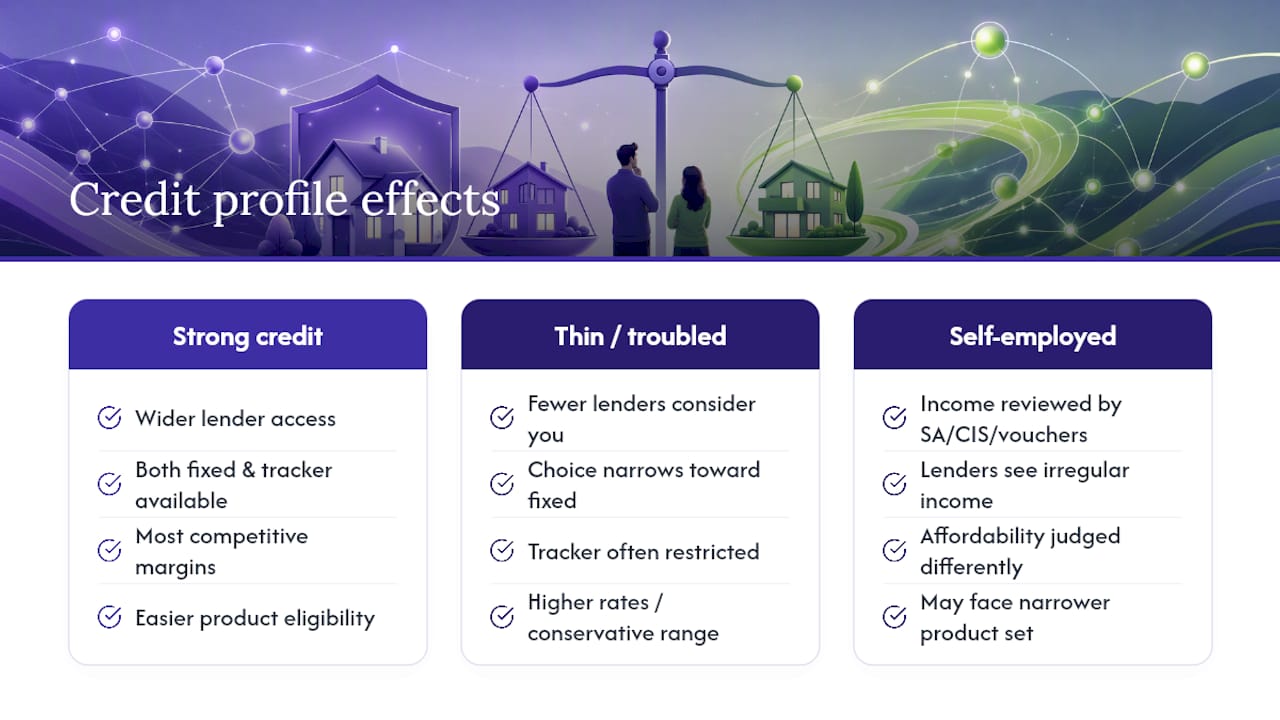
Your credit score doesn’t determine whether you’re offered fixed or tracker specifically, but it does shape which lenders will consider you at all, and that indirectly narrows your choice. Lenders use credit history, alongside income verification and existing debt, to set both your interest rate and your eligibility for their full product range.
Borrowers with a strong credit history typically get access to a wider spread of both fixed and tracker deals, including the most competitive margins over the base rate. Those with a thinner or more troubled credit history often find their choice narrows toward specialist fixed products, since some lenders restrict tracker and other variable-rate ranges to borrowers who meet stricter affordability and credit thresholds.
This matters more for self-employed borrowers and subcontractors, whose income can look irregular on paper even when it’s genuinely stable, because lenders read affordability through gross income, CIS vouchers, and self-assessment returns rather than a single payslip figure. A missed payment or high utilisation on existing credit can push you toward lenders with a smaller, more conservative product range, regardless of which mortgage type you’d prefer.
If your credit profile is complicated, get advice before you apply rather than after a decline. A broker can identify which lenders are realistically open to your circumstances and steer you toward the fixed or tracker products those lenders actually offer, rather than the ones that look best on a comparison table but reject your application outright.
Does it matter for tax whether you choose fixed or tracker?
For the vast majority of homebuyers, on their own residential property, mortgage interest carries no direct tax implication either way. Whether your rate is fixed or tracking the base rate, the interest itself isn’t deductible against your income and doesn’t appear on a personal tax return, so the choice between the two comes down to budgeting and risk, not tax planning.
The picture changes if you’re a landlord or property investor rather than an owner-occupier. Buy-to-let mortgage interest is treated differently by HMRC, and the rate type you hold, fixed or tracker, affects only the amount of interest you pay, not the tax treatment applied to it. A tracker that rises with the base rate simply means a larger interest figure to factor into your annual return; it doesn’t change which tax rules apply to that interest.
Where mortgage type genuinely interacts with tax planning is cash flow. A tracker that jumps after a base-rate rise can squeeze the funds you’d set aside for a tax bill, particularly for self-employed borrowers managing self-assessment alongside a mortgage payment that moves without warning. Fixed payments make that planning easier precisely because one variable, your housing cost, stays constant while everything else in your finances shifts around it. If your tax position is complex, speak to an accountant about your specific circumstances rather than treating either mortgage type as a tax decision in itself.
An editorial view on choosing between fixed and tracker
Most fixed vs tracker guides repeat the same pros-and-cons list and leave you to work out what it means for your own mortgage. That’s the gap worth closing. The genuinely useful question isn’t “which product is cheaper right now”, it’s “what happens to my specific budget if the base rate moves twice next year, and when does my current deal actually end”.
Payment shock modelling gets treated as an afterthought when it should be the starting point.
Remortgage timing gets underweighted too. They’ll be the ones who didn’t start the conversation early enough and drifted onto their lender’s SVR by default. If you take one thing from this, take that: model the shock, then set a remortgage date in your calendar, not just a mortgage type on a form.
— Paul
Get your fixed vs tracker decision modelled properly
Comparison tables can tell you what a tracker or fixed deal looks like on paper, but they can’t tell you what a 0.5% base-rate rise would do to your specific budget. Prosperhomeloans is the alternative to guessing: a whole-of-market broker that models both scenarios against your real income, whether that’s a standard payslip, CIS vouchers, or self-assessment figures, and shows you the actual payment shock before you commit to either route.

That matters most if you’re self-employed, a subcontractor, an expat, or approaching the end of a fixed deal with no clear plan for what comes next. Prosperhomeloans searches across lenders rather than one bank’s limited shelf, checks eligibility against your real circumstances, and flags the collars, caps, and ERC terms that comparison sites tend to gloss over. You can also use independent mortgage calculators to get a rough sense of payment shock before your call.
If your current deal is due to expire in the next six months, or you’re simply undecided between fixed and tracker, get in touch with Prosperhomeloans to have your scenarios modelled properly before you apply.
This article is general information, not a substitute for advice from a qualified financial advisor. Consult a qualified financial professional about your own circumstances before acting on anything here.
Sources
These sources back the figures and mechanics referenced throughout this article:
- Bank of England base rate analysis — Moneyfacts Compare
- The interest rate (Bank Rate) — Bank of England
- What type of mortgage should you choose in 2026? — Which?
- Tracker mortgage — NatWest
Recommended
