6 Month Plan to Beat Remortgage Delays for UK Buy to Let Landlords

Yes, remortgaging a buy-to-let property is possible for most landlords who meet current lender criteria, and the 2026 conditions make it worth checking. Average buy-to-let rates have eased to 4.71% in the first quarter, down 29 basis points on the year, so a review could cut your payments or free up equity. Start now: confirm your deal’s end date and early repayment charges, then gather your paperwork or speak to a broker.
TL;DR:
- Over 75% LTV remains standard, with some lenders offering up to 80% or 85% LTV but with tighter checks; existing equity often covers the deposit.
- Average buy-to-let rates fell to 4.71% in the first quarter of 2026, with remortgage volumes rising by 11.1% year-on-year, indicating favorable lending conditions.
- Key underwriting criteria include a rental coverage ratio of at least 125-145%, depending on the taxpayer, and portfolio lenders assess combined holdings for multiple properties.
- Remortgage costs typically include early repayment charges, valuation, legal fees, product fees, and broker charges, which should be balanced against expected savings.
- Preparation with organized documents and early engagement with brokers or agents can significantly speed up application processing and improve success chances.
Table of Contents
- What is a buy-to-let remortgage and why do landlords do it?
- How do lenders assess buy-to-let remortgage applications?
- What does a buy-to-let remortgage cost?
- A practical 6-month timeline and checklist before your remortgage
- Fixed, tracker, interest-only or repayment: which product fits?
- Is now a good time to remortgage a buy-to-let?
- How to prepare a stronger, faster remortgage application
- Where an independent broker adds the most value
- How Prosperhomeloans helps with your buy-to-let remortgage
- Sources
- FAQ
What is a buy-to-let remortgage and why do landlords do it?
A buy-to-let remortgage replaces your existing mortgage on a rental property with a new one, either with your current lender or a different one. You’re not moving house or buying a new property. You’re refinancing the debt against a property you already let out, usually because your current deal is ending or because your circumstances or the market have shifted since you took it out.
Most landlords remortgage for one of a handful of reasons. Falling onto your lender’s standard variable rate after a fixed term ends is the most common trigger, and it’s often the costliest mistake to ignore, since SVRs typically run well above the rates on offer elsewhere. Others remortgage to release built-up equity for a deposit on another property, to switch from interest-only to repayment (or vice versa) as their strategy changes, or simply to lock in payment certainty before a fixed rate expires.
That said, remortgaging isn’t automatically the right move. It’s rarely worthwhile when:
- Your current deal carries a large early repayment charge that would swallow most of the savings.
- Only a few months remain on your existing fixed term, in which case waiting out the ERC period usually pays off.
- Rental income has slipped and might not clear the affordability tests a new lender applies.
- The property needs significant work that could depress a fresh valuation.
Weighing these against the potential savings is the first real step, and it’s one worth doing with proper numbers rather than gut feel.
How do lenders assess buy-to-let remortgage applications?
Buy-to-let underwriting works differently from a residential mortgage because the lender is really assessing the property’s ability to pay for itself, not just your personal income. Three tests dominate the decision:
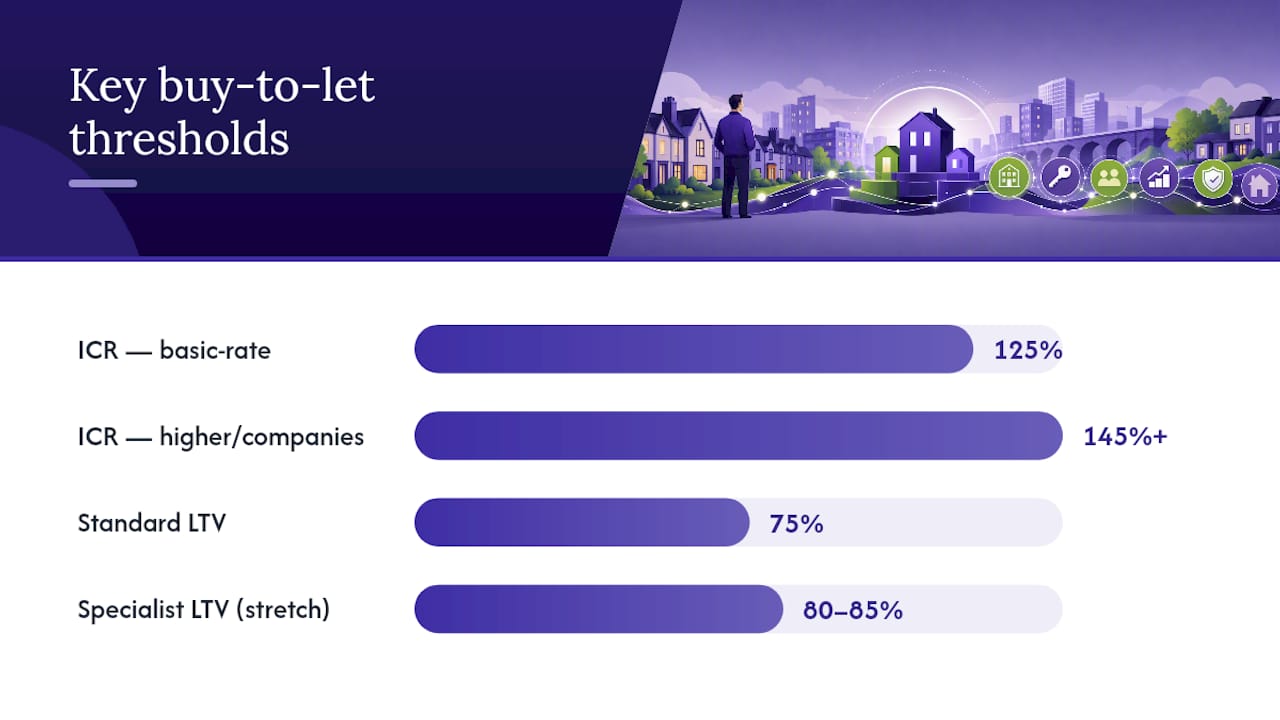
- Interest coverage ratio (ICR). Lenders stress-test the rental income against a notional interest rate, usually well above the pay rate, to check the rent covers the mortgage payment with a buffer. Basic-rate taxpayers typically need rental cover of around 125% of the stressed payment, while higher-rate taxpayers and limited companies often need 145% or more.
- Loan-to-value (LTV). Most buy-to-let remortgages are underwritten to a maximum of 75% LTV, reflecting the standard 25% deposit expectation across the market. A handful of specialist lenders will stretch to 80% or even 85% LTV, but they apply tighter income and credit checks in return.
- Portfolio exposure. If you own four or more mortgaged properties, lenders increasingly assess the whole portfolio together, not just the property you’re remortgaging, and may ask for a full schedule of your holdings, rents, and balances before they’ll commit.
Beyond those three, lenders also look at your credit history (any missed payments or defaults in the past two to three years can narrow your options), the property type (houses in multiple occupation and multi-unit blocks often need specialist lenders), and whether previous arrears show up anywhere in your mortgage history.
Pro Tip: Build your rent schedule and mortgage statements into one document per property before you apply. Lenders ask for this anyway, and having it ready from day one shaves days, sometimes weeks, off underwriting.
What does a buy-to-let remortgage cost?
The rate you’re quoted is only part of the sum. Before you switch, budget for:
- Early repayment charges (ERCs), typically 1% to 5% of the outstanding balance depending on how far through your current deal you are. Check your latest mortgage statement or annual review letter, as this figure is usually printed there.
- Valuation fees, either charged directly or bundled into the product, needed so the new lender can confirm the property’s worth.
- Legal or conveyancing fees, sometimes waived by the lender on remortgage products but not always.
- Product arrangement fees, which can range from a flat few hundred pounds to over £2,000 on some specialist products, and are sometimes addable to the loan.
- Broker fees, where charged, for arranging and negotiating the deal on your behalf.
A rough break-even calculation is worth doing on paper: take your monthly saving from the new rate, then divide your total switching costs (ERC plus fees) by that saving to see how many months it takes to come out ahead. If the answer is longer than the time left on a sensible holding period for that property, the switch probably isn’t worth it yet.
Remortgage lending hit £7.5 billion in the first quarter of 2026, up 15.3% year-on-year, a sign that plenty of landlords are finding the sums work in their favour right now. Watch out too for tenancy gaps that dent your rental evidence, planned works that could lower a valuation mid-application, and non-standard property types (ex-local authority flats, properties above commercial units) that need a specialist lender rather than a mainstream one. Our guide to why early repayment charges matter breaks the maths down further.
A practical 6-month timeline and checklist before your remortgage
Here’s a month-by-month plan:
- Six months out: confirm your current deal’s end date and pull up the ERC schedule. Decide whether you’re aiming to cut rate, release equity, or change repayment type.
- Five months out: gather core documents (see below) and get a rough rental valuation from your letting agent to sense-check affordability.
- Four months out: speak to a broker or start comparing whole-of-market deals directly; get an agreement in principle if you can.
- Three months out: submit the full application once you’re within most lenders’ offer validity windows.
- Two months out: instruct a solicitor, respond promptly to valuer and underwriter queries, and chase any outstanding conditions.
- One month out to completion: confirm the completion date with your outgoing and incoming lenders, and check the new direct debit is set up correctly.
Your document list will differ slightly depending on how you hold the property:
- Individual landlords: last two years’ SA302s or tax overviews, current tenancy agreement, twelve months of mortgage statements, and recent bank statements.
- Limited company landlords: two years of filed accounts, director’s loan account schedule, and a portfolio schedule if you hold multiple properties through the company.
The most common delay isn’t the lender, it’s landlords who leave document-gathering until the application is already submitted. A simple digital folder per property, holding the tenancy agreement, latest mortgage statement, and rent schedule, avoids most of that scramble.
Fixed, tracker, interest-only or repayment: which product fits?
The product choice matters as much as the rate itself, and it comes down to how much certainty you need against how much flexibility you’re willing to trade for it.
- Fixed vs tracker: a fixed rate locks your payment for the deal term, useful if you want predictable cashflow for budgeting or lending affordability elsewhere. A tracker moves with the Bank of England base rate, which can work in your favour if rates continue easing through 2026 but exposes you to increases too. Our comparison of fixed versus tracker mortgages covers the mechanics in more depth.
- Interest-only vs repayment: most buy-to-let mortgages are arranged on an interest-only basis, keeping monthly payments lower and cashflow stronger, but lenders will want a credible repayment strategy on file, whether that’s sale of the property, other investments, or pension funds. Repayment mortgages cost more monthly but build equity and remove the exit-plan question entirely. Which suits you depends on whether you’re holding for income now or planning to sell eventually.
- Releasing equity: remortgaging to pull out equity, say for a deposit on another property, increases your loan size relative to the property’s value, which affects both LTV and the ICR stress test on the new borrowing. Expect the lender to ask for tenancy evidence and, if you’re using the funds for a further purchase, projected rental income on the new property too. Our piece on remortgaging to release equity walks through the underwriting angle.
- Specialist products: portfolio landlords with four or more mortgaged properties, and limited company borrowers, generally need lenders that specialise in those structures rather than mainstream high street products.
Is now a good time to remortgage a buy-to-let?
The direction of travel favours landlords who act rather than drift onto a standard variable rate. Average new buy-to-let lending rates fell to 4.71% in Q1 2026, a 29 basis point drop year-on-year, and lenders are visibly competing for remortgage business rather than just new purchases.
Remortgage activity is resilient: remortgages rose to 39,160 completions in the first quarter of 2026, up 11.1% on the previous year, while remortgage lending value climbed to £7.5 billion, up 15.3%.
UK Finance’s mid-year outlook points to lenders repositioning their product ranges specifically to attract remortgage customers, which usually means sharper pricing and more flexible criteria for borrowers who shop around. National trends won’t tell you what’s right for your specific property, though. A tired ex-rental flat in a soft local market won’t attract the same terms as a well-maintained house in high demand, so treat the market data as context for your decision, not a substitute for getting your own numbers checked.
How to prepare a stronger, faster remortgage application
A little organisation upfront consistently beats scrambling for paperwork mid-application. Build one digital file per property containing:
- The current tenancy agreement and any renewal documents.
- Twelve months of bank statements showing rent received.
- Your latest mortgage statement, including the balance and any ERC figures.
- Evidence of any recent works or improvements, with receipts if the valuer might ask.
For limited company landlords, add two years of filed accounts and a director’s loan account schedule; self-employed applicants should have SA302s or HMRC tax year overviews ready for the last two years. Portfolio landlords benefit most from a simple schedule listing each property’s address, rent, current balance, lender, and expiry date, since this single document answers most of the follow-up questions a lender would otherwise chase individually.
Pro Tip: Tell your letting agent and valuer that a remortgage is in progress before the valuation is booked. A valuer who’s expecting access and has the tenancy details in hand moves noticeably faster than one starting from scratch.

Where an independent broker adds the most value
Brokers earn their keep on the cases that don’t fit a neat box: portfolio landlords juggling exposure across several lenders, limited company structures with layered documentation needs, anyone with a credit blip in the last few years, or landlords racing against an ERC deadline with weeks rather than months to spare.
What a good broker actually does is less about finding a rate you couldn’t find yourself and more about removing the friction that slows applications down. Whole-of-market access means comparing products across lenders you’d never think to approach directly, many of which don’t deal with the public at all. Reviewing your documents before submission catches gaps that would otherwise trigger a slow back-and-forth with underwriters. And negotiating fees or timing with a lender is far easier for someone who works with them week in, week out.
[Details about the adviser’s professional credentials, client testimonials, and certifications or industry accreditations.]
— Paul
How Prosperhomeloans helps with your buy-to-let remortgage
Prosperhomeloans is the local alternative to trawling comparison sites and guessing which lender will actually accept your case. As an independent, whole-of-market broker based in East Sussex and covering Hastings, Eastbourne, Hailsham, and Bexhill-on-Sea, we compare deals across the market rather than pushing one lender’s book, and we’re available seven days a week when a deadline or an ERC date won’t wait for office hours.

We work regularly with self-employed landlords, portfolio owners juggling several mortgaged properties, and limited company borrowers, the exact cases where a mainstream lender’s tick-box criteria fall short and specialist knowledge earns its place. If your fixed deal is coming up for renewal, or you’re weighing whether to release equity for your next purchase, get in touch for a free initial assessment through our remortgaging services page, or explore our dedicated buy-to-let mortgage deals service to see how we’d approach your case. Fee details are set out plainly on our mortgage advice fees page, so you know exactly what you’re paying for before you commit to anything.
Sources
FAQ
Can I remortgage a buy-to-let property?
Portfolio landlords and limited company borrowers can also remortgage, though they usually go through lenders with dedicated criteria for those structures.
What will happen to buy-to-let mortgages in 2026?
Average buy-to-let rates have already eased to 4.71% in the first quarter of 2026, and lenders are actively competing for remortgage business as volumes rise. Whether that trend continues depends on wider interest rate movements, but the current direction favours landlords who review their deal rather than drift onto a standard variable rate.
How much deposit do I need for a buy-to-let mortgage?
Most lenders expect a 25% deposit, giving 75% loan-to-value, though a small number of specialist lenders will stretch to 80% or 85% LTV with tighter income and credit criteria. On a remortgage, your existing equity often covers this requirement without needing fresh cash.
Is buy-to-let still worth it in the UK?
That depends on your yield, borrowing costs, and local rental demand rather than any single national figure. With remortgage lending reaching £7.5 billion in Q1 2026 and rates easing, many existing landlords are finding it worthwhile to refinance rather than sell, though new purchases need their own affordability check against current stress rates.
Should I choose interest-only or repayment on my remortgage?
Interest-only keeps monthly payments lower and preserves cashflow, but lenders require a credible repayment strategy for the capital, such as an eventual sale. Repayment costs more each month yet builds equity and removes the need for an exit plan, so the right choice depends on whether you’re holding the property for income or planning to sell.
Recommended
