Missed payments and their impact on debt consolidation loans

A recent missed payment makes mainstream debt consolidation harder to get and usually means paying more if you’re approved. That’s because missed payments land on your credit file, and lenders weigh recent payment history heavily alongside how much you already owe and what you can genuinely afford to repay.
We see this pattern constantly with clients who come to us after a difficult year: the debt itself often isn’t the biggest obstacle. It’s what a lender sees when they pull the credit file.
Before you apply anywhere, we’d suggest three things:
- Check your credit file with all three agencies so you know exactly what a lender will see.
- Pause new applications for now. Each one leaves a mark, and multiple marks in a short space of time make things worse.
- Work through the preparation steps later in this guide before submitting anything.
Pro Tip: Order matters more than speed here. Applying too early, before your file settles, often costs you a better rate you could have secured by waiting a few months.
Key Takeaways
Missed payments reduce mainstream consolidation eligibility and push approved loans towards higher rates, smaller amounts, or secured terms, but recency and preparation both shift the outcome.
| Point | Details |
|---|---|
| Recency beats history | A missed payment from months ago carries far more weight with lenders than one from years back. |
| Six-year rule doesn’t reset | Missed payments stay on file for six years regardless of when you settle the balance. |
| Score impact is substantial | A single missed payment can cut a credit score by roughly 50 to 100 points. |
| Secured routes carry property risk | Turning unsecured debt into a secured loan means repeated arrears could risk your home. |
| Prosperhomeloans searches whole-of-market | Regulated advice from Prosperhomeloans helps identify lenders suited to your specific credit history. |
Where to get authoritative guidance and free advice
For free, regulated debt advice, contact StepChange or National Debtline. To check or correct your credit file, contact Experian, Equifax, or TransUnion directly. For personalised consolidation advice, Prosperhomeloans offers a regulated broker route.
Table of Contents
- Why missed payments affect consolidation: what counts as a miss
- How long missed payments stay on file and why timing matters
- How lenders assess missed payments for a consolidation loan
- How missed payments change the deal you’re offered
- Can you still consolidate with missed payments on file?
- Practical steps to improve your chances before applying
- The risk of missing payments on the consolidation loan itself
- What the evidence actually shows
- An adviser’s view on consolidating after missed payments
- Getting regulated help with your consolidation options
- Frequently asked questions
- Sources
Why missed payments affect consolidation: what counts as a miss
Lenders and credit reference agencies (CRAs) don’t treat every payment problem the same way. A late payment means you paid, just after the due date. A missed payment means nothing was paid by the date it fell due. If it goes unpaid for long enough, usually several months, it can escalate into a default, which is a much more serious marker.
These entries are recorded by Experian, Equifax, and TransUnion, the UK’s three main credit reference agencies. Lenders typically see:
- How many months late the payment was (one month reads very differently to six).
- Whether the account defaulted or stayed as a missed payment.
- How many separate accounts show a problem, rather than just one.
A default carries more weight than a missed payment, which in turn carries more weight than a single one-off late payment. Lenders read these markers as a hierarchy of risk, not a flat “good or bad” label.
How long missed payments stay on file and why timing matters
A missed payment or default stays on your credit report for six years from the date it was recorded. Paying off the balance afterwards doesn’t remove the marker early or reset that clock. It simply shows as settled.
What changes over those six years isn’t the marker itself. It’s how much attention lenders pay to it. Recency is the strongest signal most lenders use, so a payment missed last month is a far bigger obstacle than one from three years ago, even though both technically remain visible on your file.
Scenario: Picture two applicants with an identical missed payment on their file. One missed a payment eight months ago; the other missed one three years ago and has had a clean record since. The second applicant will typically see far more mainstream lender options open to them, even though the credit file entry looks similar on paper.
This is worth remembering if you’re tempted to apply the moment your finances stabilise. Sometimes waiting another few months, so the miss slips further into the past, genuinely changes your options.
How lenders assess missed payments for a consolidation loan
Consolidation lenders don’t just glance at a credit score and make a decision. They build a fuller picture from several factors together:
- Recency and frequency: one missed payment eighteen months ago reads very differently to three in the last six months.
- Severity: whether anything escalated to a default or County Court Judgment.
- Existing debt levels and how much of your available credit you’re already using.
- Affordability: what you earn against what you spend, not just what your score says.
- Recent hard credit searches, since several in a short window suggests financial strain to an underwriter.
Mainstream lenders, generally high street banks and larger building societies, tend to apply firmer credit cut-offs but offer noticeably cheaper rates to those who qualify. Specialist lenders take a more flexible view of adverse credit, but that flexibility comes at a cost, typically higher interest or a requirement for security against an asset.
Some lenders now lean on Open Banking data, looking directly at your bank transactions rather than relying solely on a credit score. This can work in your favour if your score looks poor but your actual spending has been under control for months. A broker who understands affordability checks can point you towards lenders using this approach.
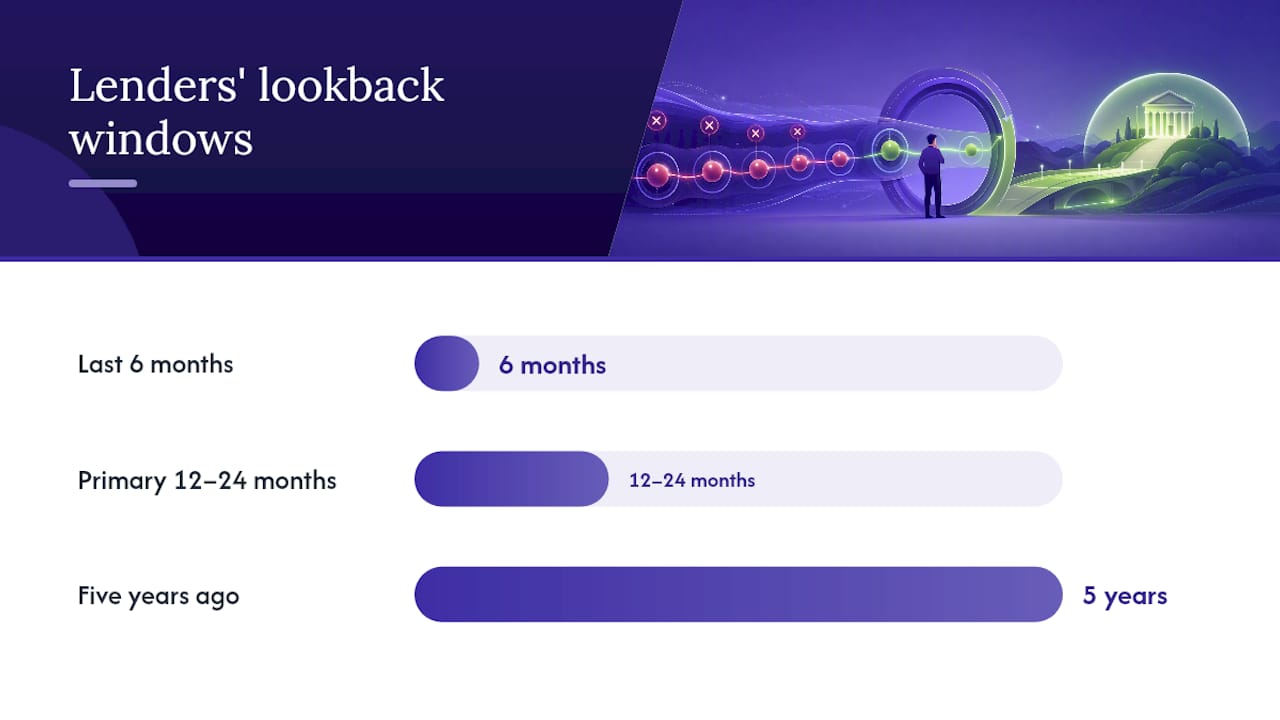
Pro Tip: Most underwriters concentrate on the most recent 12 to 24 months of your payment behaviour. A clean run over that period does more for your application than an otherwise perfect file from five years ago.
How missed payments change the deal you’re offered
Getting approved is only half the picture. The terms attached to that approval shift substantially once a missed payment is on file. Expect any offer following a recent miss to typically involve a higher interest rate, a smaller maximum loan amount, and a shorter repayment term than you’d have been offered with a clean record.
A single missed payment can reduce a credit score by roughly 50 to 100 points, with the drop often steeper for people who previously had strong scores. That scale of movement is enough on its own to shift an applicant from mainstream pricing into specialist territory.
Mainstream lenders generally offer the cheapest rates but the tightest eligibility criteria; specialist lenders accept more applicants with adverse history but charge materially more for the privilege, sometimes requiring the loan to be secured.
That last point deserves real caution. Turning unsecured debt, credit cards, personal loans, into a loan secured against your home changes the entire risk profile. Missed payments on secured borrowing are treated far more seriously by lenders than missed payments on unsecured credit, and repeated arrears on a secured loan risks the property itself. If you’re weighing that trade-off, it’s worth reading about how a secured loan affects a future property sale before signing anything.
Can you still consolidate with missed payments on file?
Yes, in most cases, though which route suits you depends on how recent and severe the missed payments were.
- Wait and rebuild. If your finances have stabilised, giving it three to six months of clean payments before applying often unlocks noticeably better terms.
- Use a broker. A broker with access to specialist lenders can find manual-underwriting options that a direct online application might reject outright.
- Consider secured consolidation carefully. Only appropriate once you’ve weighed the repossession risk against the savings, and ideally with regulated advice.
- Speak to a debt charity first if affordability is the real issue. StepChange and National Debtline offer free, regulated guidance and will tell you honestly if consolidation isn’t the right fix for your situation.
Each route trades speed against cost and risk. There’s no universally right answer here, only the one that fits your circumstances.
Practical steps to improve your chances before applying
- Check your file with all three CRAs. Experian, Equifax, and TransUnion don’t always hold identical information, so checking each one matters.
- Correct any errors immediately. Wrongly recorded missed payments happen more often than you’d think, and disputing them can lift your score quickly.
- Bring every account up to date. Even small overdue balances count against you if they’re still open.
- Reduce your credit utilisation where you can, ideally below 30% of your available limit.
- Avoid multiple applications in a short window. Each hard search adds a small negative mark, and several together look like desperation to an underwriter.
- Gather evidence of your income and any one-off circumstances, such as a redundancy or illness, that explain the missed payment.
Where possible, build a run of three to six months of consistent on-time payments before applying. It’s the single change lenders respond to most.
Pro Tip: A regulated broker who understands Open Banking submissions and manual underwriting can often place a case that a comparison site would automatically decline. It’s worth the conversation before you assume you’re stuck with specialist rates.
The risk of missing payments on the consolidation loan itself
Consolidating debt doesn’t remove the consequences of missing a payment again. It just resets the clock. Missing a repayment on your new consolidation loan brings late fees, a fresh negative marker on your file, and potentially a default if it drags on.

If the loan is secured against your home, the stakes rise sharply. Repeated missed payments on a secured consolidation loan can lead to repossession, a far heavier consequence than anything attached to unsecured credit. Any short-term credit repair you gained from consolidating can be undone within months, and the long-term cost of restarting that recovery is usually higher than if you’d never consolidated at all.
What the evidence actually shows
The numbers back up what advisers see in practice. A single missed payment can knock 50 to 100 points off a credit score, though the exact drop depends heavily on how strong your score was beforehand, people starting from a high score tend to see a steeper fall. That marker then sits on file for six years, though as established earlier, lenders care far more about how recently it happened than the fact it exists at all.
Consolidation itself usually causes a small, short-term dip in your score when you apply, from the hard search and new borrowing, but consistent on-time repayments afterwards can improve your score over time.
Debt charities are consistent on one point: consolidation is a tool for managing repayments, not a fix for the reasons the payments were missed in the first place. Without addressing the underlying budget problem, moving debt into a new loan can simply set up the next round of arrears.
An adviser’s view on consolidating after missed payments
Consolidation genuinely helps people, but only when the new repayment is affordable and there’s a real plan behind it, not just a lower headline rate on paper. We’ve seen consolidation work brilliantly for straightforward cases and badly for people who consolidated without fixing the spending pattern that caused the arrears.
If your situation involves multiple defaults, a recent CCJ, or you’re unsure whether secured borrowing is wise, that’s exactly when regulated, personalised advice earns its keep rather than generic guidance.
This article is for general information and does not constitute regulated financial advice specific to your circumstances.
Getting regulated help with your consolidation options
If you’ve read this far wondering exactly where you stand, that’s precisely the conversation Prosperhomeloans has with clients every week. Unlike a single-lender application or a comparison site that only shows headline rates, we search across mainstream and specialist lenders to find who will actually consider your file, missed payments and all.

Our value comes from three things: a whole-of-market search rather than one lender’s criteria, direct experience placing adverse-credit and Open Banking cases with lenders who look beyond a score alone, and one-to-one regulated advice rather than an automated decision. We’ll also flag honestly if a debt management plan or affordability review, rather than a new loan, is the better route for you.
Prosperhomeloans is authorised to give regulated mortgage and protection advice, and there’s no cost to have an initial conversation about your options. If you’d like a straightforward assessment of your consolidation eligibility, get in touch with Prosperhomeloans to talk through what’s realistic for your file today.
Frequently asked questions
Does one missed payment ruin my chances of consolidation? No. One missed payment, especially an older one, is very different from multiple recent misses or a default. Many lenders, particularly specialist ones, still consider applicants with an isolated missed payment.
Will paying off the missed payment remove it from my file? No. Settling the balance shows the account as resolved, but the marker itself remains visible for six years from the original recording date.
Do all three credit reference agencies show the same information? Not always. Experian, Equifax, and TransUnion can hold slightly different records, which is why checking all three before applying matters.
Is a secured consolidation loan riskier after missed payments? Yes. If you’ve missed payments before, adding property as security raises the stakes considerably, since further arrears could put your home at risk rather than just your credit score.
How soon after a missed payment can I apply for consolidation? There’s no fixed rule, but building three to six months of on-time payments first typically improves both approval odds and the rate you’re offered.
This article is general information, not a substitute for advice from a qualified financial advisor. Consult a qualified financial professional about your own circumstances before acting on anything here.
Sources
- Debt consolidation | StepChange
- How long do missed payments stay on your credit report? | Zable UK
- How missed payments affect your credit score UK
- Impact of late payments on credit score | Capital One
Recommended
