30–37 m² Rule: How to Secure a UK Studio Flat Mortgage

Yes, you can get a studio flat mortgage in the UK, but approval hinges on details many buyers overlook until it’s too late. Lenders scrutinise floor area, lease length and service charges far more closely than they do on a standard one-bed flat. Before you make an offer, confirm the exact measured square metreage and the remaining lease term. Those two figures decide which lenders will even consider your case.
TL;DR:
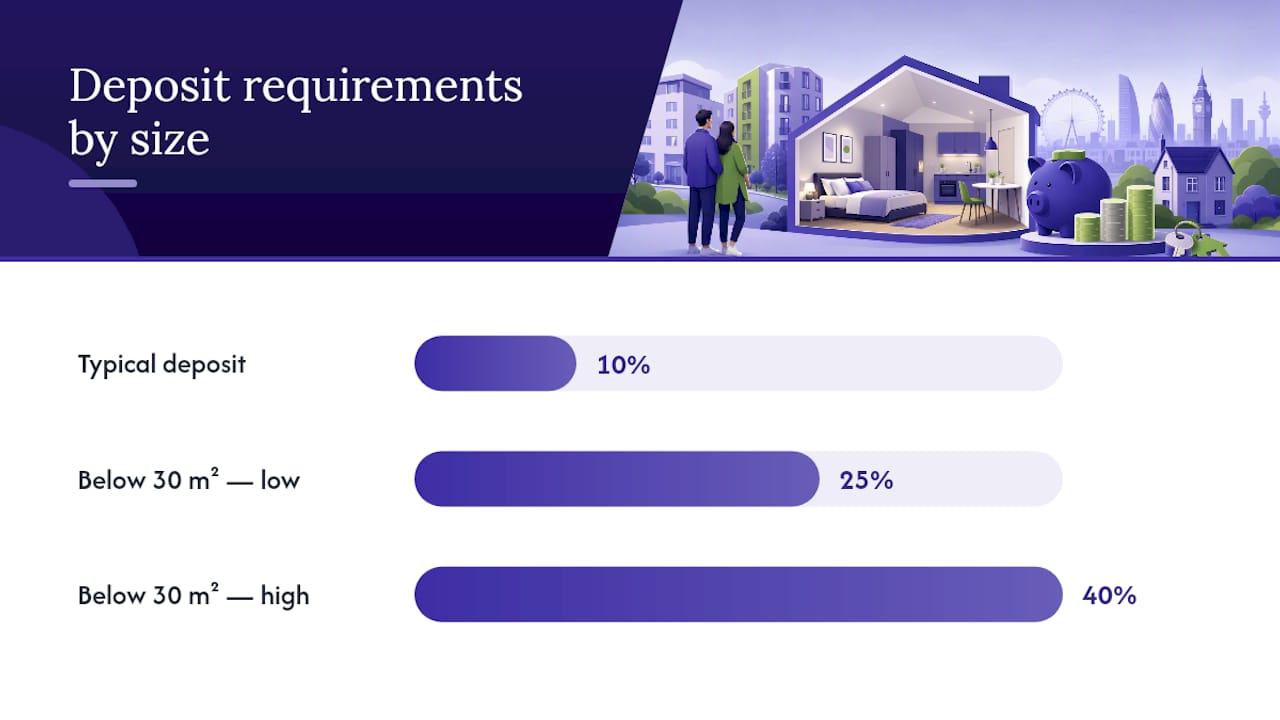
- Studios below 30 m² face highly limited lending options, often requiring larger deposits of 25% to 40% and referral-only decisions from specialist lenders.
- Verifying actual floor area and lease length before making an offer is crucial, especially if the property is near a lender’s size threshold.
- High service charges relative to property value can trigger affordability concerns, while poorly managed leases or change-of-use restrictions can prevent mortgage approval.
- Borrowers with weaker financial profiles, such as short leases or shaky credit, must prepare for stricter conditions and larger deposits.
- Using a whole-of-market broker can significantly increase approval chances by matching specific property and borrower details with suitable lenders upfront.
Table of Contents
- Can you get a mortgage on a studio flat? — lenders’ perspective
- Property checks that determine whether a lender will approve the mortgage
- Borrower criteria and affordability: deposit, income and documentation
- Buy-to-let: what investors must check before buying a studio
- How a whole-of-market broker improves the chance of approval
- Perspective: what our advisers see work best for studio buyers
- How Prosperhomeloans can help you secure a mortgage for a studio flat
- Sources
Can you get a mortgage on a studio flat? — lenders’ perspective
Lenders treat studio flats differently because of resale liquidity. A three-bedroom semi will always attract buyers; a 28 square metre studio in a converted building has a much narrower pool of future purchasers, and that narrower pool is exactly what underwriters price for.
Most high-street lenders apply an internal floor-area cut-off before they’ll even run a full assessment. The two figures that come up again and again are around 30 m² and 37 m², the latter aligning with the Nationally Described Space Standard for a one-person new-build studio. Fall below either threshold and your options change:
- Above 37 m²: broadly treated like any other flat, with mainstream rates and standard deposit requirements.
- Between 30 m² and 37 m²: many lenders proceed, though some restrict the loan-to-value or apply extra underwriting scrutiny.
- Below 30 m²: the pool shrinks fast. Expect referral-only decisions, specialist lenders, or a larger deposit.
- New-build micro-studios often fare worse than similarly sized older conversions, since developers building deliberately small units can trigger stricter internal policies.
Before instructing anything, pull the EPC certificate, ask the agent for the exact floor plan, and cross-check the square metreage they’ve advertised. Agents round generously.
Pro Tip: If your studio sits within a metre or two of a lender’s threshold, don’t take the estate agent’s figure at face value. Request the original floor plan and compare it against the EPC before you commit to a survey or valuation fee.
Property checks that determine whether a lender will approve the mortgage
Property risk, not just borrower risk, drives most studio flat declines. Four checks matter more here than on a standard flat purchase.
- Floor area verification. If your case sits close to a 30 m² or 37 m² cut-off, an RICS measurement carried out before survey stage can prevent a valuer’s re-measurement from derailing the case midway through underwriting.
- Lease length. Aim for 90-plus years remaining. Some lenders start restricting terms once the unexpired lease drops below 80 years, and a short lease can also complicate any future lease extension negotiation.
- Service charges and ground rent. Small flats often carry disproportionately high per-square-metre service charges, because fixed building costs (lifts, communal heating, cleaning) are split across fewer, smaller units. Lenders read a high service charge relative to property value as an affordability red flag.
- Planning history. Former purpose-built student accommodation (PBSA) conversions, or flats with change-of-use restrictions still attached, can be effectively unmortgageable regardless of size.
Lease problems, weak management company accounts, or onerous ground rent terms are consistently flagged in lender underwriting manuals as reasons to decline an otherwise affordable application.
Below 30 m², deposit requirements commonly rise to between 25% and 40%, a jump that catches many first-time studio buyers off guard when they’ve budgeted around a standard 10% deposit.
Ask the seller’s agent for the last three years of service charge accounts and a copy of the lease before you instruct a survey. It’s a five-minute email that can save you a wasted valuation fee.
Borrower criteria and affordability: deposit, income and documentation
Once the property clears its checks, your own financial profile takes over. Deposit size, income evidence and credit history all interact with property risk, and a stronger borrower profile can sometimes offset a marginal property.
- Deposit ranges. Standard flats might need 5% to 15% down. Studios, particularly those near or below the 30 m² mark, often require 15% to 40%, depending on lender appetite and the flat’s exact size.
- Affordability stress testing. Lenders apply a stress rate well above your actual mortgage rate to check you could still afford repayments if rates rose. For a £150,000 mortgage, most lenders want household income comfortably covering repayments even at a stressed rate several points higher than the headline deal.
- PAYE applicants typically need three months of payslips and P60s.
- Self-employed and subcontractor applicants usually need two to three years of accounts or tax returns; if you work under the Construction Industry Scheme, our guide on documents subcontractors need for a mortgage covers exactly what lenders expect.
- Foreign nationals often face additional visa and residency documentation. Our article on what documents foreign nationals need for a mortgage walks through the specifics.
- Credit history. Past arrears or an active Debt Management Plan don’t rule you out, but they do narrow your lender pool further, on top of an already narrower studio-flat pool.
Buy-to-let: what investors must check before buying a studio
Studio flats can generate strong rental yields on paper, but buy-to-let lenders apply their own layer of restrictions on top of everything above.
- Minimum property values. Many buy-to-let lenders set a floor, sometimes tied to being within the M25 or a similar geographic marker, below which they won’t lend regardless of yield.
- Landlord experience requirements. First-time landlords buying a sub-30 m² studio may find fewer products available than experienced portfolio landlords.
- Void risk. Studios often turn over tenants more frequently than family flats, and a few months empty erodes annual yield fast on a smaller rental figure.
- Per-metre service charges. The same disproportionate service charge issue that affects owner-occupiers hits landlords harder, since it eats directly into net yield.
- Limited-company structures are commonly used by portfolio investors for tax efficiency, and specialist buy-to-let products often suit small-unit purchases better than mainstream residential ranges.
Pro Tip: When calculating yield on a studio, model at least one month of annual void as standard, not as a worst-case scenario. Smaller flats in dense buildings tend to turn over faster than family-sized units.
Expats considering this route should also look at expat buy-to-let mortgage options, since eligibility criteria differ again from standard UK-resident landlord products.

How a whole-of-market broker improves the chance of approval
A broker’s real value on a studio flat case isn’t finding you a lender. It’s finding the right lender the first time, before a valuer or underwriter has a chance to pull the offer.
- We match your case, floor area, lease length, service charge level, income type, against lenders whose current criteria actually accept it, rather than submitting to a mainstream lender likely to refer or decline.
- We prepare the file with floor plans, lease summaries and service charge accounts upfront, so nothing surprises the valuer mid-process.
- Where mainstream lending isn’t viable, we can look at specialist lenders, bridging finance, or staged deposit strategies as realistic alternatives.
- We’re upfront about likely timescales and any broker fees before you commit to anything.
| What you get | Why it matters for studio flats |
|---|---|
| Whole-of-market lender access | Reaches specialist lenders mainstream branches don’t offer |
| Pre-submission document checks | Reduces risk of a mid-process decline or referral |
| Realistic timeline guidance | Sets expectations before survey and legal costs are spent |
| Alternative finance routes | Covers cases mainstream lenders won’t touch |
Perspective: what our advisers see work best for studio buyers
Three rules hold up again and again: verify the floor area before you fall in love with the flat, budget for a bigger deposit than you’d expect on a standard flat, and read the service charge accounts before booking a survey. When a lease is short and the management company’s accounts look shaky, that’s often the moment to walk away rather than push a case through. Resale risk doesn’t disappear just because your own mortgage got approved.
— Paul
How Prosperhomeloans can help you secure a mortgage for a studio flat
Prosperhomeloans is the alternative to guessing which lender will actually accept your studio flat case. We already know, because matching non-standard properties to the right lender is what we do daily for clients across the South East. Whether you’re a first-time buyer, self-employed, a subcontractor, a foreign national, an NHS worker, or an investor building a buy-to-let portfolio, we search the whole market rather than pushing you toward whichever lender happens to be on a branch’s shelf.

A first call with us usually covers three things: what documents you’ll need, which lender route looks most realistic given your flat’s floor area and lease, and a realistic timeline for offer to completion. We support clients locally in East Sussex and also remotely across the UK. If you’ve found a studio flat and want to know where you stand before you make an offer, book a free eligibility check with Prosper Home Loans and we’ll talk you through your realistic options.
Sources
For primary detail beyond this guide, see the Property Passport UK studio flat buying guide, the CalcHub studio flat mortgage guide, and Gov for formal legal positions on leasehold and insolvency matters. Always check your own lease and lender criteria directly before committing.
This article is general information, not a substitute for advice from a qualified financial advisor. Consult a qualified financial professional about your own circumstances before acting on anything here.
- Studio Flat Buying Guide — Mortgage Challenges, Resale Value, and What to Check | Property Passport UK
- Calchub
Recommended
