Save on fees: UK semi commercial mortgage costs, 65–75% LTV

A semi-commercial mortgage finances a single-title property combining residential and commercial uses, such as a shop with a flat above. Lenders treat these deals differently to standard residential or buy-to-let cases, applying specialist underwriting, variable loan-to-value limits, and valuation tests that can catch unprepared borrowers off guard. Working with a broker who understands this niche widens your options considerably.
TL;DR:
- Semi-commercial mortgages are affected by specialist underwriting, variable loan-to-value limits, and valuation methods that can lower borrowing capacity compared to standard residential loans.
- Valuations are often based on a vacant possession basis, which can be significantly more conservative than market value, directly influencing max loan amounts and terms.
- Lenders examine commercial tenant covenant strength, lease length, and use class—weak or short-term leases or sector-specific risks can lower lender appetite or reduce available LTVs.
- Fixed rates through 2026 are driven more by swap rates than Bank of England base rate changes, making timing on rate dips less predictable for borrowers.
- Common application delays stem from incomplete documentation, lease uncertainties, and valuation issues, making early preparation and expert brokerage essential.
Table of Contents
- What counts as a semi-commercial property in the UK?
- Who this product suits, and when to use specialist advice
- How lenders assess semi-commercial cases: valuation and underwriting tests
- Rates, LTVs, and the full cost of borrowing in 2026
- Eligibility, borrower structures, and the documents lenders want
- How to prepare a strong application and what to expect in timing
- Risks and common pitfalls, and practical mitigations
- Why a specialist broker makes a measurable difference on semi-commercial cases
- How Prosper Home Loans can help you progress your application
- Sources
- FAQ
What counts as a semi-commercial property in the UK?
A semi-commercial property is any asset held under a single title that combines a residential element with a commercial or business use. The classic example is a shop or takeaway with a self-contained flat above it. But the category stretches further than most people realise, and getting the classification wrong before you approach a lender can cost you time, a failed valuation, or a declined application.
Here’s what typically qualifies as semi-commercial:
- A retail unit with residential accommodation above or attached
- A pub, café or restaurant with a manager’s flat or living quarters
- A guest house or B&B with an owner’s private residential wing
- A doctor’s or dentist’s surgery with a flat above
- A light industrial unit with an on-site caretaker’s flat
- Mixed parades where one title covers several shop units and flats
Borderline cases cause the most confusion. A block of flats above a row of separately titled shops, for example, is not semi-commercial in the same sense, because each unit sits on its own title. Equally, a single house that’s simply been converted into a home office doesn’t count. The residential and commercial elements need to share one legal title and, usually, one building.
Classification matters because it determines which lenders will even consider your case. Get it wrong, and you might spend weeks with a lender who ultimately rejects the application because the asset doesn’t fit their semi-commercial product criteria, or because the commercial element is too dominant (or too marginal) for their appetite. A specialist whole-of-market broker will usually flag this at the outset, before you’ve paid for a valuation that goes nowhere.
Who this product suits, and when to use specialist advice
Semi-commercial finance suits two broad groups: investors buying a mixed-use asset purely for rental income, and owner-occupiers who plan to run a business from the commercial space while living above or beside it. The lending route differs depending on which camp you’re in, because lenders assess affordability and risk differently for each.
- Investors typically need the deal to stand up on rental income alone, with lenders scrutinising the commercial tenant’s covenant strength and the residential rent achievable.
- Owner-occupiers may be assessed partly on personal income and business trading figures, alongside the property’s rental potential if any part is let.
- Portfolio landlords adding a mixed-use asset to an existing book often find lenders more comfortable, given a track record of managing tenanted property.
Semi-commercial finance isn’t always the right answer, though. If the property is genuinely residential with only a token commercial element, such as a home office annexe with no separate business use, a standard residential or buy-to-let mortgage is usually cheaper and faster to arrange. If you need to complete quickly on an auction purchase, or the commercial element needs significant refurbishment before it can be let, bridging finance often makes more sense as a first step.
This is precisely where specialist advice earns its keep. Lender appetite for semi-commercial cases varies enormously, and no single lender’s criteria map neatly onto every property type. A broker working across the whole market can match your specific asset, whether that’s a pub with living accommodation in Bexhill-on-Sea or a shop and flat in Hastings town centre, to the handful of lenders most likely to say yes on workable terms.
How lenders assess semi-commercial cases: valuation and underwriting tests
This is where semi-commercial mortgages diverge most sharply from anything you’ll have encountered on a residential purchase. Lenders don’t simply ask an estate agent what the property is worth. They commission a RICS valuation specifically instructed to answer lending questions, and the methodology chosen can swing the final figure by a significant margin.
Vacant possession versus market value
Many lenders instruct valuations on a vacant possession basis, meaning the valuer assesses what the property would fetch if sold with no tenants in place. This tends to produce a more conservative figure than an estate agent’s marketing appraisal, because it strips out the assumption that a buyer would inherit rental income immediately. Guidance from Advocate Finance confirms that valuers often adopt this cautious approach, focusing on long-term marketability rather than the property’s current income story.
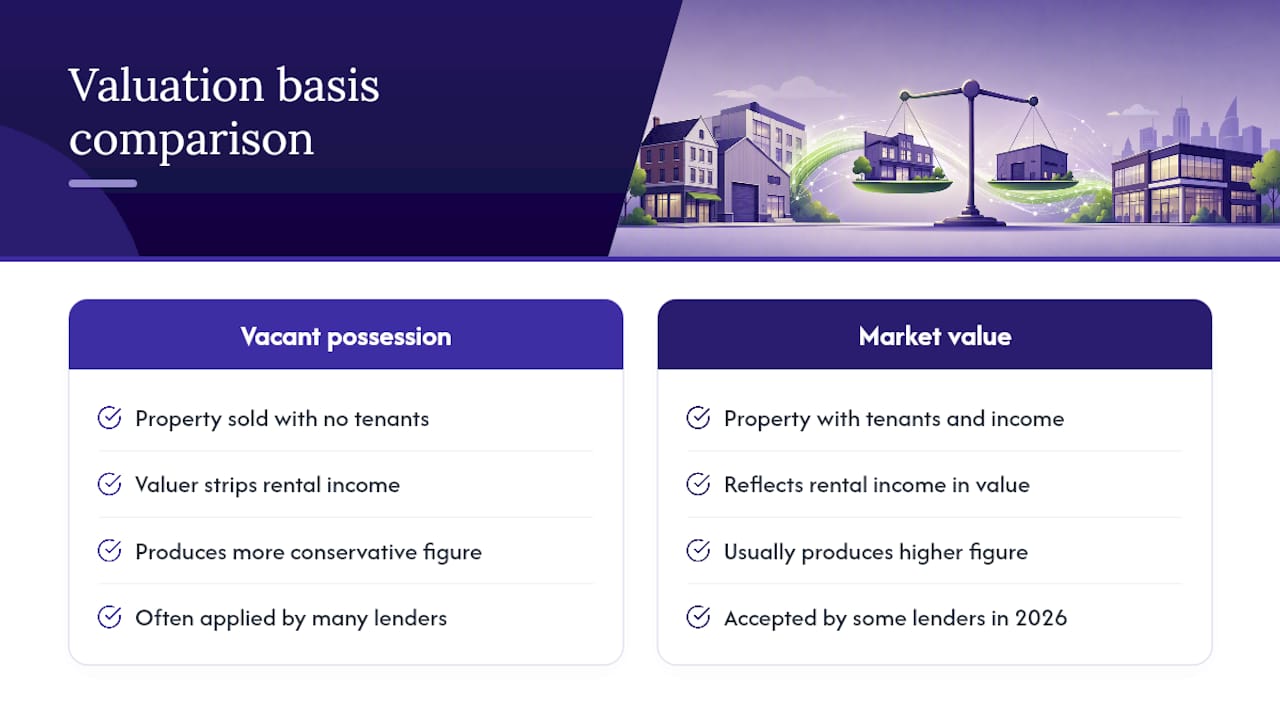
Not every lender insists on vacant possession, though. Market conditions through 2026 have pushed some lenders to broaden their criteria, occasionally accepting a market value basis, which reflects the property with tenants and income in place, in order to place more semi-commercial business. Mortgage Introducer reports this shift directly, noting lenders are competing harder on flexibility rather than just headline rate.
The gap between these two figures can be substantial, and it directly caps how much you can borrow. Knowing in advance which basis a lender will apply, before you instruct and pay for the valuation, saves both money and disappointment.
Pro Tip: Ask your broker which valuation basis a shortlisted lender typically uses before you commit to an application fee. Valuers can sometimes provide both a vacant possession figure and a hypothetical blended figure in one report, so ask for this upfront rather than discovering the shortfall after the fact.
Yield-based versus comparable capital approaches
Where reliable rental comparables exist for both the commercial and residential elements, valuers often use a yield-based approach, capitalising the net income at a market-appropriate yield to arrive at a value. Where comparable evidence is thin, particularly for unusual commercial uses, they may fall back on a comparable capital approach, looking at recent sales of similar mixed-use assets nearby. Advocate Finance notes that the method chosen depends heavily on data availability, and rural or unusual properties tend to see more conservative comparable-based figures.
Tests on the commercial element
Underwriters scrutinise the commercial half of the deal closely, and this is often where cases stall. Expect a lender to examine:
- Tenant covenant strength: is the commercial tenant a recognisable, financially stable business, or a new venture with no trading history?
- Lease length remaining: a lease with under five years unexpired makes lenders nervous about income continuity and can reduce the LTV offered.
- Passing rent versus market rent: if the tenant is paying well below market rate, or well above it, lenders will query sustainability.
- Break clauses: an imminent tenant break option is treated almost as a lease expiry for risk purposes.
- Use class and specialist fit-out: heavily adapted commercial units (a former restaurant with a full commercial kitchen, for example) can be harder to re-let to a different tenant, which affects the lender’s exit assumptions.
The residential element and combined decision
The residential portion is usually assessed on achievable rent (if let) or straightforward owner-occupier affordability. Lenders then blend both elements into a single lending decision, weighting the commercial risk more heavily because it’s typically the larger and more volatile component. A property where the commercial unit represents 70% of the floor area and value will be underwritten very differently to one where the flat above dominates and the shop below is almost incidental. Getting a sense of this weighting early, ideally before instructing a valuation, helps set realistic expectations on both LTV and rate.
Rates, LTVs, and the full cost of borrowing in 2026
Headline rates on semi-commercial mortgages tend to sit above standard buy-to-let pricing, reflecting the additional underwriting complexity and the lender’s higher perceived risk. But focusing purely on the advertised rate misses most of what actually determines your total cost of borrowing.
Typical loan-to-value ranges for semi-commercial mortgages generally run from around 65% to 75%, though this varies by lender, property type, and how strong the commercial tenant’s covenant is. Minimum loan sizes matter too: many mainstream lenders decline commercial and semi-commercial lending below roughly £150,000, according to Mortgage Introducer’s coverage of the 2026 market, which pushes smaller deals towards a narrower pool of specialist and high-street lenders willing to consider them.
In 2026, fixed-rate pricing on commercial and semi-commercial mortgages is being driven substantially by five-year SONIA swap rates rather than the Bank of England base rate alone, according to Mortgage Introducer. When swap rates sit above base rate, as they have done through parts of 2026, fixed offers can stay elevated even after a base rate cut.
This matters practically: if you’re waiting for a Bank Rate reduction hoping fixed pricing will follow, you may be disappointed. Swap-rate movements don’t always track base rate changes in step, so the sensible move is to focus on term matching, comparing the full cost over your intended holding period, rather than timing the market for a rate dip that may not materialise.
The fee stack you need to budget for
The rate you see advertised is rarely the whole story. Industry commentary through 2026 increasingly points to the “fee stack” as the real battleground for borrowers, not headline rate competition. Expect to budget for:
- Arrangement fees, typically 1% to 2% of the loan, sometimes added to the loan rather than paid upfront.
- Valuation fees, which are usually higher for semi-commercial assets than standard residential valuations, given the specialist RICS input required.
- Legal fees, covering both your own solicitor and, in many cases, the lender’s legal costs too.
- Product fees, which some lenders charge on top of the arrangement fee for particular fixed-rate products.
Other underwriting tests that shape pricing
Beyond LTV, lenders increasingly apply debt-yield and interest cover ratio (ICR) tests to gauge whether the rental income comfortably services the debt, particularly on the commercial portion. A weak ICR can reduce the maximum loan on offer even where the LTV looks acceptable on paper. Market analysis suggests 2026 is shaping up as a period of stabilisation rather than a boom, with lenders selectively broadening appetite for well-packaged, sustainable assets while remaining cautious elsewhere.
Eligibility, borrower structures, and the documents lenders want
How you hold the property affects which lenders will consider you and how the deal is taxed and administered afterwards.
Individuals buying in their own name often find a slightly wider pool of high-street and specialist lenders willing to lend, and the process tends to feel more familiar if you’ve bought residential property before. Limited companies and SPVs (special purpose vehicles), by contrast, are increasingly the preferred structure for investors building a portfolio, largely for tax efficiency around mortgage interest relief, though not every lender offers products to corporate borrowers on the same terms.
Whichever structure you choose, lenders will want a consistent paper trail. Assemble the following before you approach a broker:
- Proof of identity and address for all directors or individual borrowers.
- SA302s or three years of accounts for self-employed applicants or trading businesses, showing gross income and net profit trends.
- Tenancy agreements and lease abstracts for both the residential and commercial elements, showing rent, term, and any break clauses.
- A current rent roll if multiple units are let, detailing tenant, rent, and lease expiry for each.
- A property schedule if you already hold other mortgaged property, since most lenders assess your existing portfolio exposure.
- A CAPEX plan and costings if any part of the building needs refurbishment before or shortly after completion.
If foreign income, residency status or non-standard employment complicates your case, expect lenders to ask for additional evidence; our guide on documents foreign nationals need for a UK mortgage covers this in more depth.
Pro Tip: If your loan size sits close to a lender’s minimum threshold, or the commercial income needs a few months to stabilise before it looks convincing on paper, a staged approach can work well: short-term bridging finance to complete the purchase, followed by a refinance onto a semi-commercial mortgage once the rental picture is proven.
How to prepare a strong application and what to expect in timing
Preparation is where semi-commercial cases are won or lost, and it starts well before you submit anything to a lender.
- Gather your evidence early. Have lease documents, rent rolls, accounts, and identification ready before you speak to a broker, rather than assembling them piecemeal once underwriting has already begun.
- Get a realistic valuation steer. Ask your broker to sense-check likely valuation basis and figure against comparable local sales, so you’re not surprised later.
- Package the case with granular detail. Lenders in 2026 respond faster to applications that arrive with clear tenant information, forecasts, and supporting documentation already attached, rather than a bare application form. Mortgage Introducer notes that well-packaged, detailed applications are increasingly winning out in a cautious lending environment.
- Instruct the valuation only once the lender fit is confirmed. Paying for a valuation before establishing that a lender’s appetite matches your property type wastes money if the case is later declined.
- Keep your solicitor briefed early. Legal delays, particularly around lease abstracts and title queries on older mixed-use buildings, are one of the most common causes of slippage.
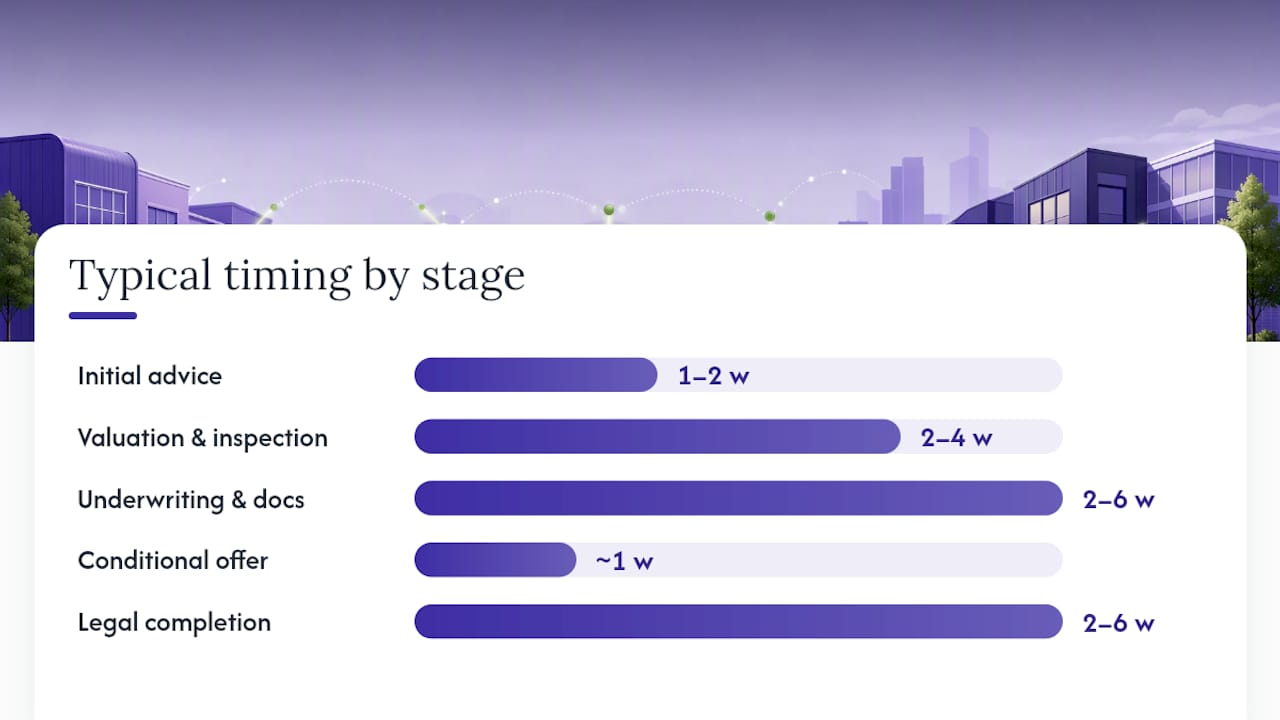
A realistic timeline runs roughly as follows: initial advice and lender selection typically takes one to two weeks; valuation instruction and inspection another two to four weeks, depending on surveyor availability; underwriting and further documentation requests can run two to six weeks depending on case complexity; a conditional offer usually follows within a week of underwriting sign-off; and legal completion adds a further two to six weeks on top, depending on chain complexity and title issues.
Common causes of delay include incomplete lease paperwork, late-discovered short lease terms, missing rent evidence, and valuations coming back below the price agreed. Each of these is avoidable with early preparation and a broker who flags likely sticking points before they become live problems.
Risks and common pitfalls, and practical mitigations
Several recurring issues derail semi-commercial applications, and most are foreseeable if you know where to look.
- Void risk on the commercial unit worries lenders more than residential voids, because commercial rent often makes up the larger share of income. A history of gaps between tenants will prompt harder questions.
- Short leases, particularly under five years remaining, can reduce the LTV a lender will offer or trigger a request for lease renewal evidence before completion.
- Specialist commercial uses, especially hospitality and leisure, face notably tighter lender appetite. Mortgage Introducer confirms hospitality and leisure assets remain harder to place through 2026, while owner-occupied purchases and living-related sectors see stronger demand.
- CAPEX-heavy assets needing significant work before letting can push lenders towards lower LTVs or staged fund releases rather than a single drawdown.
Practical mitigations exist for most of these. A lower LTV request often unlocks appetite from a lender who would otherwise decline. Staged fund releases, tying drawdowns to refurbishment milestones, reassure lenders on CAPEX-heavy deals. Personal guarantees from a strong commercial tenant, or a rent deposit held in escrow, can offset covenant concerns. And where hospitality or leisure use makes mainstream lenders nervous, a specialist lender familiar with that sector, identified through a broker with wide market access, is often the only realistic route.
Pro Tip: If a lease has under five years remaining, ask the tenant about renewal intentions before you apply. A signed agreement to renew, even in principle, can materially change a lender’s willingness to proceed.
Why a specialist broker makes a measurable difference on semi-commercial cases
Semi-commercial cases reward preparation more than almost any other mortgage type we handle, and that preparation is exactly where a broker earns their fee. Lender mapping matters enormously here: knowing which lenders will even look at a pub with living accommodation, versus which will only touch a shop-and-flat with a strong retail covenant, saves weeks of wasted applications. Valuation briefing matters too, flagging the likely basis and figure before a client pays for a report that comes back lower than expected.
Local knowledge counts for more than people expect. Understanding the commercial rental market in Hastings, the tenant mix around Eastbourne’s seafront parades, or how lenders view mixed-use stock in Hailsham and Bexhill-on-Sea gives us a genuine edge when packaging a case, because we can pre-empt the questions a valuer or underwriter will ask about local demand.
Documentation packaging is the unglamorous part that actually decides outcomes. Cases arriving with lease abstracts, rent rolls, and accounts already organised move through underwriting noticeably faster than those assembled reactively. That’s not a theory, it’s simply how underwriters work when the alternative is chasing paperwork for six weeks.
— Paul
How Prosper Home Loans can help you progress your application
A specialist independent mortgage broker can save you weeks spent cold-calling lenders one by one to find who will consider your mixed-use property. Whole-of-market advisors based locally in East Sussex may access lenders across the specialist and high-street spectrum, including those more likely to consider hospitality, leisure, or unusual commercial-use assets that mainstream lenders tend to avoid.

Some brokers work with sub-contractors, self-employed business owners, and property investors in Hastings, Eastbourne, Hailsham, and Bexhill-on-Sea, and can understand the local commercial rental market well enough to flag valuation and lender-fit issues before they cause delays or costs. Before you get in touch, have your lease documents, a rough rent roll, and recent accounts to hand, it speeds up our first conversation considerably. From there, we typically give you a realistic lender shortlist and next steps within a few working days. If you’re weighing up a semi-commercial purchase or refinance, visit Prosper Home Loans to arrange a conversation about your specific property and circumstances.
Sources
This guide draws on 2026 UK commercial mortgage market reporting and specialist valuation guidance to explain how lenders assess mixed-use property. Key sources include analysis on lenders broadening criteria and valuation approaches, reporting on swap-rate driven fixed pricing, and Advocate Finance’s guidance on valuation methodology for semi-commercial assets. Sectoral demand patterns come from reporting on purchase demand outpacing refinancing, and broader market context is drawn from analysis of 2026 as a year of stabilisation rather than boom. For personal advice on your specific property, visit Prosper Home Loans.
This article is general information, not a substitute for advice from a qualified financial advisor. Consult a qualified financial professional about your own circumstances before acting on anything here.
- Commercial mortgage market holds firm as lenders broaden their criteria | Mortgage Introducer
- Commercial mortgage market repriced as swap rates diverge from base rate | Mortgage Introducer
- How Lenders Value Semi-Commercial Properties in the UK | Advocate Finance
FAQ
What are current semi-commercial mortgage rates in the UK?
Rates vary by lender, LTV, and commercial tenant strength, but they typically sit above standard buy-to-let pricing because of the additional underwriting complexity involved. Fixed-rate pricing through 2026 is being pushed by five-year SONIA swap levels as much as by Bank Rate, so it’s worth getting a current quote rather than relying on published rate tables.
What is the 28% mortgage rule in the UK?
The 28% rule is a general residential affordability guideline suggesting mortgage repayments shouldn’t exceed roughly 28% of gross income; it doesn’t directly apply to semi-commercial lending, which is assessed instead on rental income, debt-yield, and interest cover ratios specific to the property.
Can you get a mortgage on a commercial property in the UK?
Yes, commercial mortgages are widely available in the UK for standalone business premises, and semi-commercial mortgages specifically cover properties that mix commercial use with a residential element on one title.
What’s the minimum loan size for a semi-commercial mortgage?
Many mainstream lenders avoid semi-commercial deals below roughly £150,000, which means smaller purchases often need a specialist lender or a broker who knows which of them still consider lower-value cases.
Recommended
