Buy to Let Minimum Income in the UK: Why £25,000 Often Matters

There is no fixed statutory minimum income for buy-to-let in the UK. Lenders assess affordability through an interest coverage ratio and income tests, and personal earnings from roughly £25,000 upwards satisfy many lenders’ criteria, though expats and interest-only applicants often face higher thresholds. We find that matching your profile to the right lender matters more than hitting a single number.
TL;DR:
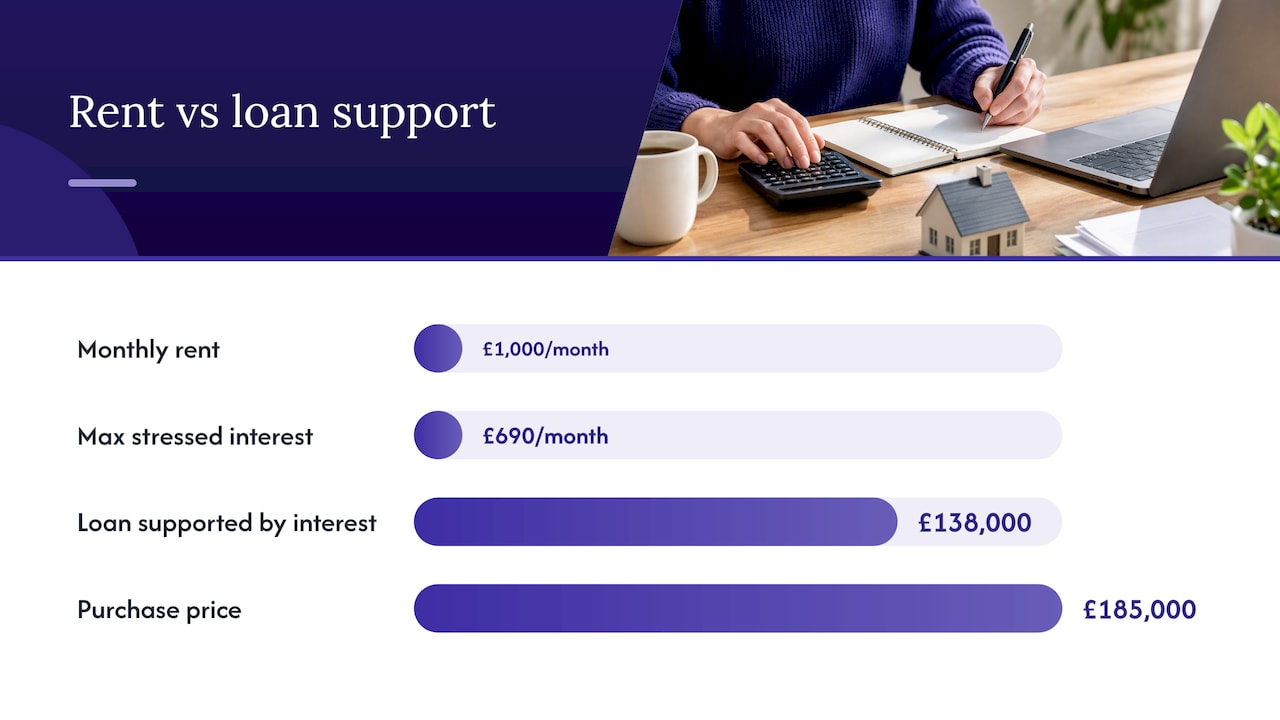
- Most lenders require rental income to cover 125% to 145% of the stressed interest rate, which often results in borrowing limits around £138,000 on a £185,000 purchase at a 6% stress rate.
- Personal income floors vary by lender but generally start around £25,000, with joint applications and shared incomes helping to meet affordability, especially for applicants with lower individual earnings.
- Income verification for self-employed, contractors, or overseas earners involves specific documentation and may include currency haircuts, reducing the recognized foreign income significantly.
- Top-slicing personal income to supplement rental coverage depends on the lender, but only some allow this after a full affordability assessment, affecting the borrowing capacity.
- Running accurate calculations and gathering complete, consistent documents before applying can prevent delays and improve chances of approval, especially in complex cases like interest-only or variable-income applicants.
Table of Contents
- What lenders test: ICR, stressed rates and income affordability
- Typical minimum personal income floors and worked examples
- Self-employed, contractors, CIS and umbrella pay: proving your income
- Foreign income and currency haircuts
- Top-slicing and using personal income to cover ICR shortfalls
- How to model your own case before you apply
- Documents lenders commonly ask for and how to prepare them
- How a broker helps with minimum income and evidence issues
- Author perspective: next steps and realistic cautions
- How Prosper Home Loans can help with your buy-to-let mortgage
- FAQ
- Sources
What lenders test: ICR, stressed rates and income affordability
Most buy-to-let decisions come down to one calculation: the interest coverage ratio, or ICR. This measures how comfortably the expected rental income covers the mortgage interest, and it sits at the centre of almost every lender’s underwriting process.
The Bank of England’s supervisory statement SS13/16 sets the industry benchmark, recommending firms apply a minimum stressed ICR of around 125% and verify expected rent properly rather than taking an applicant’s estimate at face value. Lenders must also account for tax when setting that stressed ratio, which is why the threshold moves depending on your tax position.
Rather than testing affordability against the pay rate you might actually get, lenders apply a stressed interest rate, a higher hypothetical figure designed to prove the rent would still cover repayments if rates rose. MoneyHelper’s buy-to-let guidance confirms that rental income is usually expected to cover between 125% and 145% of mortgage repayments, with the exact figure set by each lender’s own policy.
Tax status changes the picture further. The Bank of England has explained that stressed ICRs differ depending on whether you are a basic-rate or higher-rate taxpayer, since higher-rate taxpayers retain less of their rental income after tax and therefore need a stronger ratio to meet the same underlying affordability standard.
On top of the rental calculation, many lenders layer in a personal income check, particularly where:
- The rental yield is tight relative to the purchase price
- The applicant is a first-time landlord with no letting track record
- The property type (an HMO, say, or a new-build flat) carries extra lender caution
- The mortgage is being arranged on an interest-only basis
Valuers play a quiet but important role here too. When a surveyor visits the property, their assessment of achievable rent, not your own estimate or the asking rent from a letting agent, is what feeds into the ICR calculation. A property that looks profitable on paper can fail the test if the valuer’s rent opinion comes in lower than expected.
Typical minimum personal income floors and worked examples
Lenders set personal income floors partly as a safety net and partly as a proxy for financial resilience. If rent falls through for a month, or costs spike, a landlord with reliable outside income is in a stronger position to keep repayments going. That is the logic behind the floors you will see across the market, even though there is no single legal figure.
Guidance compiled by MoneyHelper notes that some lenders ask for evidence of separate employment income, commonly cited around £25,000 or more. That figure is a frequently used reference point, not a universal rule: some specialist lenders will lend to portfolio landlords with lower personal income if the rental cover is strong, while others set higher floors, particularly for interest-only lending or for applicants without a letting history.
A typical mainstream buy-to-let lender expects rental income to cover at least 125% to 145% of the stressed mortgage interest, according to MoneyHelper’s explainer, a threshold that determines how much you can borrow before personal income is even considered.
Working through a simple example helps make this concrete.
- Monthly rent of £1,000 needs to cover 145% of the stressed interest payment under that lender’s policy
- That means the maximum stressed monthly interest allowed is £1,000 divided by 1.45, which comes to roughly £690
- At a 6% stressed rate, £690 a month in interest supports a loan of around £138,000
- If the purchase price is £185,000, the rent alone would not support the full loan, so the lender may ask for evidence of personal income to bridge the gap, or a bigger deposit to bring the loan size down
Joint applications change the maths too. Combining two incomes can help satisfy a personal income floor that one applicant alone could not meet, and it widens the pool of lenders willing to consider the case, though the lender will still want both incomes evidenced properly rather than taking a combined household figure on trust.
Expats face a different adjustment again. Because overseas income is harder for UK lenders to verify and carries currency risk, many lenders apply a reduced recognition of foreign earnings or restrict the loan-to-value available, meaning the effective personal income needed from an expat applicant is often higher than the UK norm, a point we explore further in the next section.
Self-employed, contractors, CIS and umbrella pay: proving your income
Non-PAYE income is treated differently by nearly every lender, and getting the evidence right the first time saves weeks. The documents accepted generally fall into a few categories:
- SA302s or HMRC tax year overviews covering the relevant years
- Full accounts, ideally accountant-prepared, for limited company directors
- CIS vouchers alongside SA302s for subcontractors paid under the Construction Industry Scheme
- Umbrella company payslips, usually alongside the contract underpinning the assignment
- A current contract or letter confirming day rate and expected duration for contractors
Timeframes matter as much as document type. Self-employed applicants are commonly asked for 12 to 24 months of trading history, while umbrella contractors are typically asked for 3 to 6 months of payslips rather than a full two years, since the umbrella structure already demonstrates a consistent pay pattern. Our guide on umbrella company payslips and mortgage evidence sets out exactly what underwriters look for in that paperwork.
Fluctuating income gets averaged rather than taken at its highest point. A self-employed applicant whose profits varied between £28,000 and £42,000 over two years will usually have those figures averaged, not the higher year used in isolation, and bonuses or commission are generally only included where there is a consistent history of receiving them.
CIS subcontractors face a particular quirk: vouchers show gross payments before the standard CIS deduction, so lenders need to reconcile that gross figure against the SA302 to arrive at an income figure they are comfortable lending against. We have written in more detail about how lenders assess CIS income against vouchers and SA302s, which is worth reading before you apply if you work under CIS.

Pro Tip: Keep your SA302s, CIS vouchers and bank statements in one folder from the start of the tax year, rather than scrambling to request them from HMRC when a lender asks.
Applicants on zero-hours contracts or with genuinely irregular earnings face the longest evidence trail, often 12 to 24 months of proof, and our piece on getting a mortgage on a zero-hours contract covers what that process looks like in practice.
Foreign income and currency haircuts
When a buy-to-let applicant’s main income comes from overseas, UK lenders rarely accept the full stated figure at face value. Instead, most apply what is known as a currency haircut, discounting the foreign income by a set percentage to account for exchange rate volatility and the practical difficulty of verifying pay through a foreign payroll system.
The haircut exists because a salary that looks comfortable in euros or dollars today could be worth meaningfully less in sterling by the time repayments are due, particularly during periods of currency instability. A lender might, for example, only recognise 80% of a foreign salary once converted, reducing the income figure used in affordability and ICR calculations and, in turn, the amount that can be borrowed.
Timing and documentation both affect how harsh that discount ends up being:
- Provide several months of bank statements showing the income actually landing, not just a contract or payslip
- Where possible, show a consistent exchange rate pattern rather than a single favourable snapshot
- Use a lender experienced with your specific country of income, since haircut policies vary significantly between lenders
- Consider whether a UK-based guarantor or additional UK income could reduce reliance on the discounted foreign figure
We cover this in more depth, including how contractors and expats can limit the impact, in our guide on avoiding exchange rate haircuts on UK mortgages. For anyone looking at buy-to-let from abroad specifically, our article on expat buy-to-let mortgage options walks through the documentation expats are typically asked to provide.
Top-slicing and using personal income to cover ICR shortfalls
Top-slicing is the practice of using personal income to make up a shortfall when the rental income alone does not meet a lender’s ICR threshold. Rather than rejecting the application outright, the lender looks at whether your surplus personal income, after your own living costs and existing commitments, is enough to cover the gap.
Not every lender offers this. Some apply ICR strictly and will not consider personal income at all, while others allow top-slicing but only after a full affordability assessment of your outgoings, other debts and committed expenditure, not just a quick glance at your payslip. This variability is one of the main reasons whole-of-market advice matters: knowing which lenders will entertain top-slicing for a particular profile can be the difference between an application that works and one that stalls.
If it does, and the lender permits top-slicing, the application can proceed even though the property alone would not have passed.
How to model your own case before you apply
Before submitting anything to a lender, it is worth running your own rough numbers. This will not replace a full affordability assessment, but it will tell you whether you are in realistic territory or need to adjust your expectations.
- Get a realistic rent estimate, ideally from a local letting agent rather than a portal listing, and use the conservative end of any range given
- Choose a stressed rate to test against, typically between 5.5% and 7%, or the product rate plus 2%, since testing against today’s low product rate will overstate what you can borrow
- Calculate the monthly stressed interest on the loan amount you are considering, then divide your rent by that figure to get your ICR
- If your ICR comes out below your target lender’s threshold, usually 125% to 145%, check whether your personal income could realistically support top-slicing, or whether reducing the loan size brings the ICR back into range
| Step | What you work out | Example figure |
|---|---|---|
| Rent estimate | Expected monthly rent | £1,000 |
| Stressed rate | Hypothetical interest rate used for testing | 6% |
| Stressed interest | Monthly interest at the stressed rate | £690 |
| ICR | Rent divided by stressed interest | 145% |
If your worked ICR falls short, that is the point to speak to a broker rather than approach lenders one by one, since each one calculates the stress test slightly differently.

Documents lenders commonly ask for and how to prepare them
Gathering paperwork in advance is one of the simplest ways to avoid delays once an application is underway. Most lenders will ask for a broadly similar set of documents, though the detail varies by employment type:
- Employment: recent payslips and a P60, or SA302s and accounts for self-employed and contractor income
- Deposit: bank statements showing the source of funds, and a signed gift letter if any part of the deposit is gifted
- Rental evidence: a letting agent’s rental assessment, plus the independent valuer’s own rent opinion once instructed
- Identity and address: a valid passport or driving licence and a recent utility bill or council tax statement
When submitting bank statements, send full months rather than partial screenshots, and be ready to explain any unusually large or irregular transactions, since underwriters will query anything that does not match your stated income pattern.
How a broker helps with minimum income and evidence issues
Working through ICR calculations, stressed rates and lender-specific income floors is a lot to manage alongside buying a property, and this is where a broker’s day-to-day familiarity with lender policy earns its keep. We assess each case against the relevant ICR and affordability rules before approaching any lender, then prepare an evidence pack suited to that lender’s specific requirements rather than a generic application.
For umbrella contractors, that often means presenting payslips alongside the underlying contract so the underwriter sees a consistent pay pattern rather than a series of disconnected figures. For CIS subcontractors, it means reconciling voucher totals against SA302s before submission, avoiding the back-and-forth that slows so many contractor applications. For NHS bank staff with variable shift income, it means choosing a lender whose income averaging policy actually works in the applicant’s favour.
As an independent broker, we check documentation against each lender’s criteria before submission, which is typically where delays happen when applicants go direct. Our advice covers the full buy-to-let picture, from first enquiry through to the written confirmation a lender provides once a case is accepted.
Author perspective: next steps and realistic cautions
Having worked through ICR calculations and lender documentation requirements for a wide range of landlord profiles, my honest view is that most buy-to-let applications fail not because the applicant’s income is genuinely too low, but because the paperwork does not match what the chosen lender expects. A self-employed applicant with strong year-on-year profits can be turned down simply for applying to a lender whose averaging policy works against them.
Before you apply anywhere, run the modelling walkthrough above with your own numbers, gather your core documents, and be honest with yourself about ongoing landlord costs, insurance, maintenance, letting agent fees, that eat into the rental cover you are relying on.
Watch for three red flags in particular: rent that only just scrapes past the ICR threshold with no margin, documentation that is incomplete or inconsistent, and complex income without clean records to back it up. If any of those apply to you, get broker input before you submit anything, not after a decline shows up on your credit file.
— Paul
How Prosper Home Loans can help with your buy-to-let mortgage
We are an independent broker available to talk through a buy-to-let case whatever your income shape, employed, self-employed, CIS subcontractor or umbrella contractor. Rather than sending you to a single lender’s online calculator, we check your figures against lenders whose criteria actually fit your profile.

Our support for buy-to-let clients typically includes:
- Running your ICR and affordability numbers against current lender criteria before you commit to a property
- Preparing a tailored evidence pack for self-employed, CIS or umbrella income
- Arranging affordability calculations and written confirmation so you know where you stand before making an offer
- Advising on debt consolidation mortgages and contractor mortgages where existing borrowing is affecting what you can raise
If you would like a straightforward review of your buy-to-let position, visit our buy-to-let mortgage deals page to see how we can help, or get in touch to book an initial conversation.
This article is general information, not a substitute for advice from a qualified financial advisor. Consult a qualified financial professional about your own circumstances before acting on anything here.
FAQ
Can I get a £200,000 mortgage on a £40,000 salary?
For a residential mortgage this depends on the lender’s income multiple and your other commitments, but for buy-to-let the calculation is different: lenders focus primarily on the rental income’s ICR cover rather than a simple salary multiple. a personal income of around £25,000 or more commonly supports the floors many lenders expect, though the rent itself must still clear the 125% to 145% cover requirement.
Can I get a buy-to-let mortgage with no income?
Most mainstream lenders require some personal income alongside rental cover, since this gives them confidence the mortgage can be maintained if the property is empty for a period. A small number of specialist lenders will consider applications with minimal personal income where rental cover is particularly strong, but this sits outside the mainstream market and usually needs broker access to find.
Can I get a 25 year mortgage at age 47?
Yes, a mortgage term taken later in life would fall within many lenders’ maximum age limits, which falls within many lenders’ maximum age limits, though some lenders cap the term earlier or ask for evidence of pension income to support the later years of the loan. Each lender sets its own maximum age at application and at the end of term, so this varies by provider rather than following a single rule.
Can I get a £300,000 mortgage on a £50,000 salary?
For a residential purchase, many lenders use income multiples of around 4 times salary, which would put £200,000 within reach for some applicants on £50,000, subject to credit history and existing commitments. For buy-to-let, the salary matters less than whether the property’s rental income clears the lender’s ICR threshold, with personal income used mainly as a supporting check rather than the primary test.
Sources
- SS13/16 ‘Underwriting standards for buy-to-let mortgage contracts’
- Buy-to-let mortgages explained | MoneyHelper
Recommended
