3–6 Months' Payslips: What UK Lenders Need from Umbrella Contractors

Yes, lenders will accept umbrella company payslips as evidence of income, but they rarely accept payslips alone. You should expect to provide several months of payslips alongside bank statements, assignment schedules and a contract with your agency or end client. If your payslips show unusual deductions or payments that sit outside PAYE, sort these out with your umbrella company before you apply.
TL;DR:
- Most lenders require three to six months of consistent payslips, bank statements, and a contract with the agency or client to verify umbrella income.
- Red flags include unexplained deductions, payments outside PAYE, high margins, or frequent employer changes, which can delay or block mortgage approval.
- Income valuations often rely on annualizing a stable day rate and assessing contract renewal history, with longer or repeated contracts viewed as lower risk.
- Proper documentation, including reconciliation statements and clear payslip organization, can speed up underwriting and improve approval chances.
- Working with a broker familiar with umbrella income and obtaining written confirmation of assignment details boosts mortgage success prospects.
Table of Contents
- What lenders accept as income evidence for umbrella contractors
- How lenders assess umbrella income and calculate borrowing power
- Payslip checks and red flags for mortgage applications
- Build a mortgage-ready evidence pack: documents to prepare and how to present them
- How to improve your chances: practical steps to increase borrowing power and avoid declines
- Publisher perspective: how Prosper Home Loans supports umbrella contractors
- How Prosper Home Loans can help
- Sources
- FAQ
What lenders accept as income evidence for umbrella contractors
Underwriters look for evidence that is independent of the borrower and adequate for the period they are assessing, a principle set out in the FCA’s MCOB 11.6 rules. For umbrella contractors, that usually means combining payslips with documents that confirm the work behind the pay.
Most lenders will ask for a mix of the following:
- Recent payslips covering multiple months, showing consistent gross and net pay.
- Bank statements confirming that the net pay on your payslips actually reaches your account.
- Assignment schedules and reconciliation statements, which explain how your umbrella fee and deductions are calculated.
- A contract with the agency or end client, since this shows the underlying work generating your income.
P60s or self-assessment SA302s become relevant if you have a longer trading history, have moved between umbrella companies during the year, or have mixed income from both umbrella and self-employed work. Gov recommends keeping payslips and reconciliation statements on file specifically so you can verify your pay when asked, which is exactly the situation a mortgage application creates.
How lenders assess umbrella income and calculate borrowing power
Underwriters tend to work backwards from your day rate as much as forwards from your payslip. A common approach is to annualise the day rate using a contractor-friendly week count, then check that your actual payslips and year-to-date figures broadly support that number. This means a single strong month is less persuasive than a steady pattern across several assignments.
Lenders also weigh contract length and renewal history. A contractor on their third renewal with the same agency reads as lower risk than someone on a first, short assignment, even if the day rate is identical.
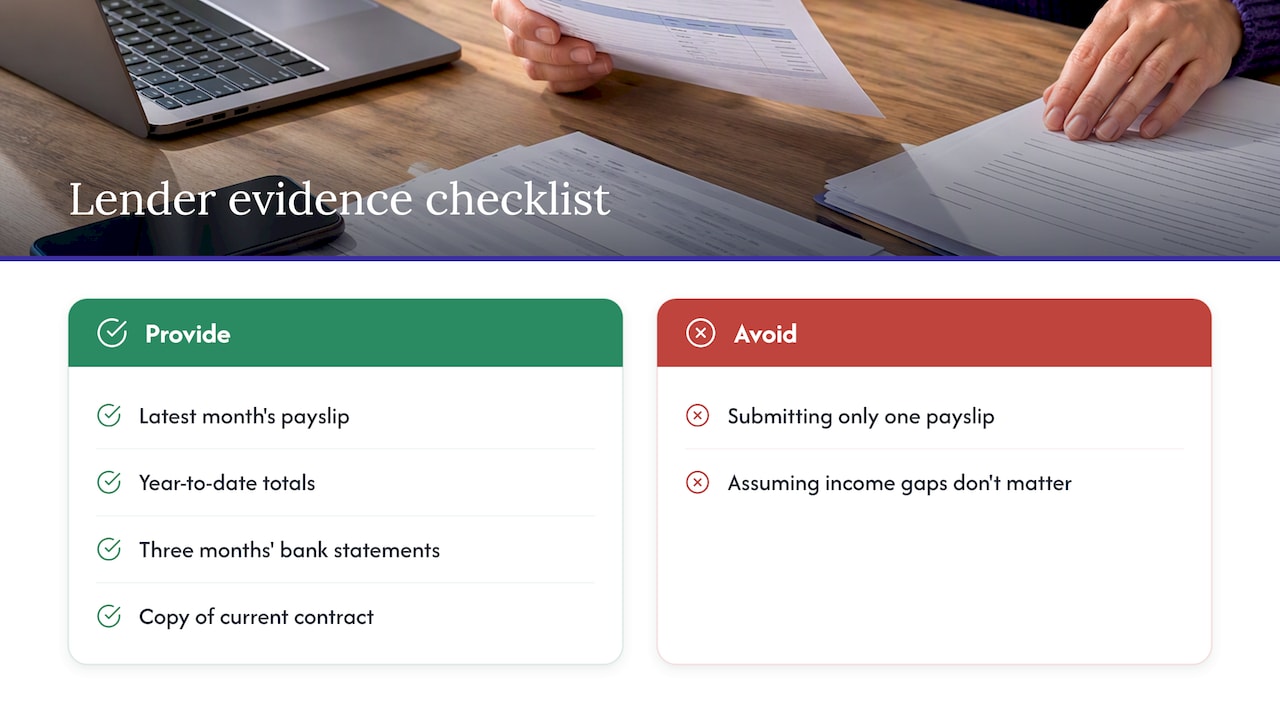
Affordability checks are shaped by the FCA’s MCOB responsible lending rules, which require evidence adequate for the period being assessed rather than a single snapshot. In practice, this is why lenders such as Santander’s intermediary guidance sets out specific evidence expectations for contractors, including the latest month’s payslip, year-to-date totals, three months of bank statements and a copy of your contract. Exactly how many months a lender wants often depends on how stable your income looks on paper, so a contractor with gaps between assignments should expect to provide more, not less.
Payslip checks and red flags for mortgage applications
Before you submit anything to a lender, go through your own payslips as an underwriter would. GOV.UK’s payslip checklist sets out what to verify and what should raise concern.
- Confirm your employer’s name and PAYE reference match across every payslip.
- Check hours worked, gross pay and net pay reconcile with your assignment schedule.
- Review tax and National Insurance deductions for consistency month to month.
- Note any pension contributions and make sure they are shown separately.
- Check the umbrella company’s margin or fee is stated clearly, not folded into another deduction.
- Compare year-to-date totals against the sum of your individual payslips.
Red flags that can cause an underwriter to pause include deductions grouped together with no explanation, payments made outside PAYE, a margin that looks unusually high, or frequent changes of employer or PAYE reference. GOV.UK warns that some umbrella arrangements disguise remuneration through payments outside PAYE, which can leave the worker owing tax and facing penalties, quite apart from what it does to a mortgage application.
Pro Tip: If you spot anything odd, ask your umbrella company for a corrected payslip and a reconciliation statement before you apply, rather than hoping an underwriter will overlook it.
Build a mortgage-ready evidence pack: documents to prepare and how to present them
A well-organised evidence pack does more to speed up underwriting than any single document within it. Aim to gather:
- Three to six months of payslips, in date order.
- Three months of bank statements clearly showing your salary credits landing.
- Assignment schedules and reconciliation statements covering the same period.
- Your contract with the end client or agency.
- A recent P60 or SA302, if you have one, for added continuity.
Label every file clearly rather than sending a single unsorted PDF. A short, one-page cover summary explaining how your umbrella pay is calculated, and flagging any irregular entries yourself, does a lot to reassure an underwriter who is working through dozens of cases. Our guide on what documents subcontractors need for a mortgage goes through this in more detail.
If your income history is short or mixed, an accountant’s certificate or a broker-written confirmation can help. These documents pull your payslips and contract evidence into one clear statement, which often moves an application through underwriting faster than raw paperwork alone.

How to improve your chances: practical steps to increase borrowing power and avoid declines
Contact your agency or end client and ask for written confirmation of your current assignment length and any expected renewal. This single document often does more for an application than an extra month of payslips, because it speaks directly to the income sustainability lenders are assessing.
Keep your payslips clean. Minimise unnecessary deductions where you can, and always hold onto the reconciliation statement that explains any deduction that isn’t self-evident from the payslip itself.
Finally, working with a broker who understands umbrella income means your evidence gets presented the way a lender expects to see it, and matched against lenders who are comfortable underwriting this kind of income rather than treating it as an exception. If your payslips show irregular patterns, our piece on using day-rate evidence for a contractor mortgage covers alternative ways to demonstrate sustainable income.
Publisher perspective: how Prosper Home Loans supports umbrella contractors
We work with umbrella contractors regularly, and the pattern is consistent: applications succeed when the evidence tells a clear story, not when there is simply more of it. We provide independent advice and can help match a contractor’s payslip and contract evidence to lenders who accept umbrella income, rather than relying on a generic checklist.
Part of our role is packaging that evidence properly, turning payslips, assignment schedules and contracts into something an underwriter can read in minutes rather than piece together themselves. Affordability calculations and written confirmation services can make the difference between a smooth case and one stuck in queries.
We serve contractors in Hastings, Eastbourne, Hailsham, Bexhill-on-Sea and the wider East Sussex area, and can review mortgage cases.
— Paul
How Prosper Home Loans can help
If you’re an umbrella contractor trying to work out whether your payslips will stack up, we can review your evidence pack before you approach a lender, not after a decline. We regularly advise on contractor mortgages, CIS voucher considerations for self-employed income, and debt consolidation mortgages for contractors with multiple debts.

Services include affordability calculations and written confirmation, which can be helpful with underwriters reviewing umbrella income. We operate locally in Hastings, Eastbourne, Hailsham and Bexhill-on-Sea, East Sussex, and also assist clients further afield.
Get in touch through our mortgage advice and fees page to arrange a free initial review, or visit our self-employed and contractor mortgage page to see how we support contractor cases specifically.
Sources
- FCA Handbook - MCOB 11.6
- Self‑employed income and accountant’s certificate guide - Santander (intermediaries)
- Gov
This article is general information, not a substitute for advice from a qualified financial advisor. Consult a qualified financial professional about your own circumstances before acting on anything here.
FAQ
Is HMRC cracking down on umbrella companies?
New PAYE rules for labour supply chains involving umbrella companies took effect from 6 April 2026, increasing transparency across the sector. This makes accurate, well-documented payslips more important than ever for mortgage applicants.
How many payslips do I need for a mortgage in the UK?
Most lenders ask for three to six months of payslips, alongside matching bank statements, as set out in Santander’s intermediary guidance. The exact number depends on the lender and how stable your income appears across that period.
Is it better to be paid by PAYE or umbrella?
Both are taxed through PAYE, so the real difference for a mortgage application is documentation rather than the payment route itself. Umbrella contractors simply need to supply extra corroboration, such as assignment schedules and contracts, alongside their payslips.
Do mortgage companies check payslips?
Yes, and they check them closely against bank statements and contract evidence under the FCA’s MCOB rules, which require evidence that is independent of the applicant. Underwriters look for consistency between your gross and net pay, deductions and year-to-date totals across every payslip you submit.
Recommended
