20–40% Commercial Mortgage Deposit in the UK: Funding, East Sussex Help

Three things move that figure most: what the property is, how long the business has traded, and how much risk the lender’s sector appetite allows.
TL;DR:
- Most commercial lenders expect a deposit of at least 25–40%, with owner-occupiers and established businesses typically requiring 20–30%.
- If the property valuation is lower than the purchase price, your cash deposit must cover the difference since lenders lend only against the lower amount.
- Documentation of the deposit’s source, including proof of funds and clear paper trails, is essential, especially if using gifts, loans, or external investments.
- A larger deposit can lower monthly payments and improve financing options but does not automatically guarantee the lowest interest rate.
- The deposit must usually be paid as a lump sum at completion, with staged payments rare and mostly relevant to development projects.
Table of Contents
- Typical commercial mortgage deposit ranges by borrower and property type
- How does loan-to-value relate to your deposit?
- What documents and checks do lenders require for the deposit?
- Does a bigger deposit get you a better mortgage rate?
- Where can you raise the money for your deposit?
- What else should you budget for beyond the deposit?
- Can you pay a commercial mortgage deposit in stages, or does it need to be a lump sum?
- What restrictions do lenders place on where deposit funds come from?
- Does deposit size affect mortgage insurance requirements?
- When does using a broker actually pay off?
- Get help arranging your commercial mortgage deposit in East Sussex
- Where to check the rules and figures yourself
- Sources
- FAQ
Typical commercial mortgage deposit ranges by borrower and property type
Allica Bank’s guidance confirms lenders typically expect 25–40%, but where you sit in that band depends on the deal in front of you.
- Owner-occupiers running an established trading business often see 20–30%. A dental practice buying its own surgery for £400,000 with three years of solid accounts might secure 75% LTV, needing a £100,000 deposit.
- Investors and buy-to-let purchasers usually sit at 30–35%, because lenders treat rental income as the repayment source rather than trading profit.
- Specialist assets, such as pubs, hotels, care homes, and petrol stations, commonly need 35% or more. Lenders see these as harder to resell if things go wrong, which is why Industrial Property Finance flags exit risk as a key driver of higher deposits on niche buildings.
- London and the South East often carry a premium of around 5–10% on top of the standard expectation, reflecting higher property values and tighter margins on some asset classes.
If you’re weighing up a specialist purchase locally, our holiday let mortgage case study shows how a 25% deposit played out for one East Sussex buyer.
How does loan-to-value relate to your deposit?
It sounds simple until the valuation comes in below the price you agreed, which is where many buyers get caught out.
- The lender lends against the lower of purchase price and valuation, never the higher. Industrial Property Finance explains that if the valuer marks the property below the agreed price, your cash requirement rises to cover the gap.
- Worked example: you agree to buy a warehouse for £500,000 at 70% LTV, expecting a £150,000 deposit. The valuer values it at £480,000. The lender now advances 70% of £480,000, which is £336,000, leaving you to find £164,000 in cash rather than £150,000.
- For investment purchases, lenders also size the loan against rental income and interest cover, not just the property value, so a strong tenant and lease term can sometimes offset a tighter LTV.
What documents and checks do lenders require for the deposit?
Lenders assess your trading history, management accounts, and cash flow before confirming both the deposit percentage and the LTV they’ll offer. Businesses with under two years of trading, or thinner margins, often see deposit expectations climb to 30–35% or higher, so a strong paper trail genuinely earns you better terms.
Expect to provide:
- Two to three years of accounts or management accounts
- Six months of business bank statements
- A short business plan, particularly for owner-occupiers
- Tenancy schedules and lease agreements for investment purchases
- Proof of identity and residency for all directors or partners
- Documented evidence of where the deposit money has come from
That last point matters more than borrowers expect. Anti-money-laundering rules mean lenders will not accept unexplained cash; every pound needs a source they can verify. If you’re bringing documents together as a foreign national buyer, our guide on documents foreign nationals need covers what’s typically accepted.
Pro Tip: If any part of your deposit has come from a director’s loan, an investor, or a family gift, get the paperwork sorted before you apply. A clear paper trail submitted upfront avoids weeks of back-and-forth with underwriters later.
Does a bigger deposit get you a better mortgage rate?
A larger deposit usually improves your pricing and widens your choice of lender, but it does not guarantee the best rate on its own — affordability, credit history, and sector risk still carry weight in the decision.
A 5% shift in LTV can meaningfully change your monthly cost. Move from 75% to 70% LTV on a £600,000 loan and you’re borrowing £30,000 less, which on a typical commercial rate can trim your monthly repayment by a noticeable margin over the loan term.
For buy-to-let commercial deals, deposit size interacts directly with interest-cover ratio tests. A bigger deposit lowers the loan amount, which makes the rent-to-loan ratio easier to satisfy, sometimes tipping a marginal deal into an approvable one.
- Test affordability at two or three different deposit levels before committing funds
- Keep a cash buffer aside; do not commit every spare pound to the deposit itself
- Compare fixed and tracker options once your deposit level is set, since the choice affects how repayments respond to rate changes (fixed vs tracker guide)
Where can you raise the money for your deposit?
Most buyers combine two or three sources rather than relying on one. Each route carries its own trade-offs.
- Retained profits or cash reserves are the cleanest option lenders like to see, with no complications, though building enough cash can take years.
- Remortgaging another property, or drawing on a SIPP or SSAS pension, can release equity, though pension routes come with specific contribution and borrowing limits worth checking with a pensions specialist.
- Investor injections or director loans are acceptable to most lenders provided the source is documented; gifted funds face closer scrutiny and some lenders won’t accept them at all.
- Mezzanine finance, vendor finance, or bridging can plug a shortfall, but these tend to be short-term and higher-cost, best treated as a last resort rather than a core plan.
- Using another property as additional security can sometimes reduce the cash deposit needed, an option worth discussing if you already own unencumbered property.
If remortgaging is on your list of options, our remortgaging services page runs through how that process typically works.
What else should you budget for beyond the deposit?
Plan for total upfront costs roughly 20–30% above your deposit figure once every fee is added in.
- Stamp Duty Land Tax applies to non-residential and mixed-use purchases on a sliding scale; check the current bands on Gov before you budget.
- Arrangement fees commonly run at 1–2% of the loan amount.
- Valuation and solicitor fees are payable regardless of whether the purchase completes.
- VAT can catch buyers out where the seller has opted to tax the property, sometimes requiring short-term VAT bridging finance until it’s reclaimed.
Our semi-commercial mortgage fees guide breaks down arrangement and valuation costs in more detail if you’re weighing a mixed-use purchase.
Can you pay a commercial mortgage deposit in stages, or does it need to be a lump sum?
For the vast majority of standard commercial mortgage purchases, the deposit needs to be available as a lump sum at completion. Lenders release their portion of the funds on completion day, and your deposit has to be sitting ready to complete the balance at the same moment, in the same transaction. There’s no facility with mainstream commercial lenders to drip-feed a deposit in instalments once a purchase has been agreed.
Where staged payments genuinely come into play is on new-build or development-linked commercial property, where a developer might ask for a reservation fee followed by staged payments tied to construction milestones, with the mortgage deposit itself finalised at legal completion. That’s a different structure entirely from a standard purchase of an existing commercial unit, shop, or investment property, and it’s worth clarifying with your solicitor exactly when each payment falls due.
If cash flow is tight and you’re worried about having the full deposit ready at once, the answer usually isn’t to try to stagger the deposit itself. It’s to look earlier at how you raise it, whether that’s timing a remortgage to complete before your purchase, releasing funds from a pension vehicle with enough lead time, or bringing in an investor whose contribution is confirmed and documented well before exchange. Getting that funding route sorted months ahead, rather than assuming you can pay part now and part later, avoids a scramble in the final weeks before completion.
What restrictions do lenders place on where deposit funds come from?
Lenders are increasingly strict about the origin of deposit money, and this is one area where assumptions catch buyers out. Most mainstream commercial lenders will not accept gifted funds from anyone other than an immediate family member, and even then, they’ll typically want a signed gift letter confirming the money is a genuine gift with no expectation of repayment or any stake in the property.
Some lenders go further and won’t accept gifted deposits at all for commercial purchases, treating them differently from residential mortgages where family gifts are far more routine. If part of your deposit is coming from a gift, checking that specific lender’s policy early saves wasted time on an application that was never going to work.
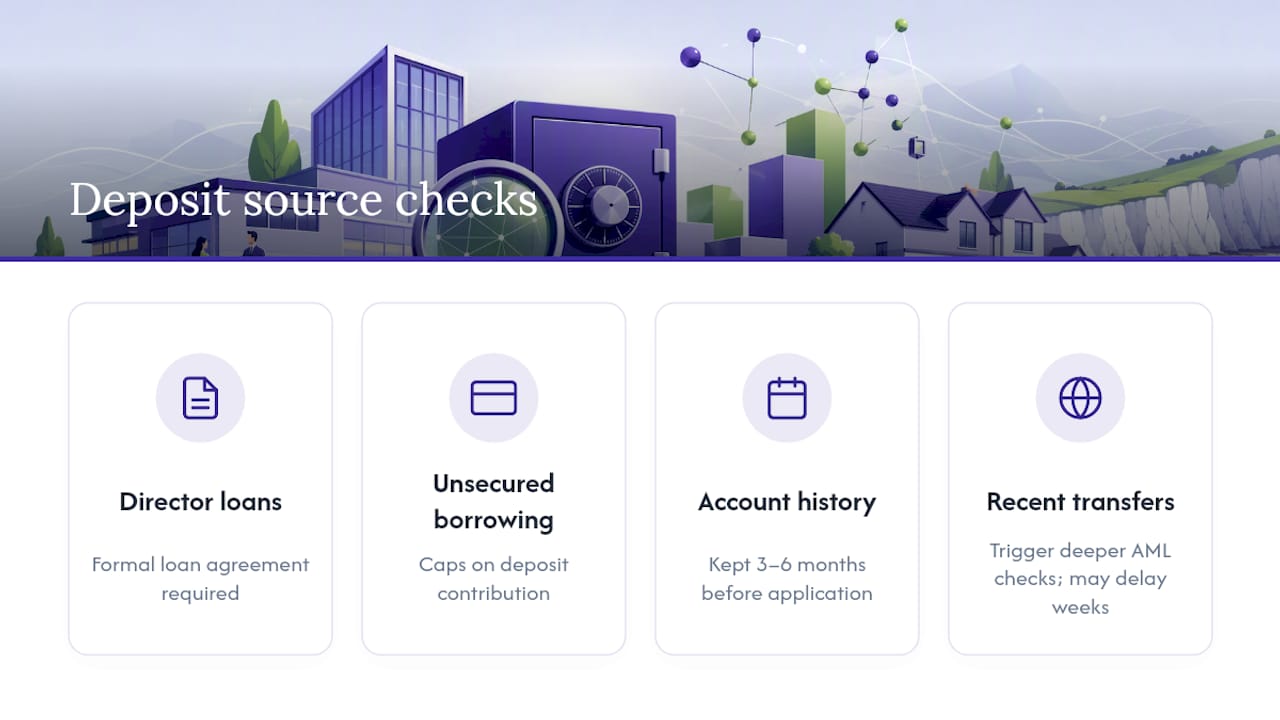
Beyond gifts, lenders want a verified source for every element of the deposit. Money sitting in a business account for years with a clear trail is straightforward. Funds that arrived recently from an unclear source, moved between multiple accounts, or came from overseas without supporting documentation will trigger deeper anti-money-laundering checks and can stall an application for weeks.
Common restrictions you’ll encounter include a requirement that investor or director loan contributions are formally documented with loan agreements, limits on how much of a deposit can come from unsecured borrowing elsewhere, and a general preference for funds that have been in your account for at least three to six months before application. None of these are designed to catch honest buyers out. They exist because lenders have regulatory obligations to satisfy, and the more organised your paperwork, the faster your deal moves.
Does deposit size affect mortgage insurance requirements?
Commercial mortgages don’t carry an equivalent of the residential mortgage indemnity guarantee that penalises low-deposit borrowers on standard home loans. There’s no separate mortgage insurance premium that kicks in below a certain deposit threshold in the way some residential lenders once charged for high-LTV lending.
That said, deposit size does influence the insurance a lender will insist on around the deal itself. Buildings insurance covering the full reinstatement value of the property is a standard condition of any commercial mortgage offer, regardless of deposit size, because the lender’s security depends on the building being protected. Where deposit is lower and the loan larger, some lenders look more closely at business interruption cover or loss-of-rent insurance on investment purchases, since a bigger loan balance means more exposure if a tenant defaults or the building becomes unusable.
For owner-occupiers, a smaller deposit and correspondingly larger loan can also prompt a lender to ask about key person insurance or business protection cover, particularly where the mortgage repayment depends heavily on one or two individuals within the business. This isn’t a formal requirement tied to a specific LTV threshold in the way SDLT bands work; it’s a risk-based judgement each lender makes deal by deal. Discussing your protection needs alongside your mortgage application, rather than as an afterthought, tends to produce a cleaner offer with fewer conditions attached.
When does using a broker actually pay off?
Where we add value on deposit questions is knowing which lenders will flex on LTV for your specific sector, and chasing the documentation so nothing stalls underwriting. Local knowledge counts too. Lenders price East Sussex and South East deals differently, and we see that appetite shift deal by deal. If your case is straightforward and well-documented, going direct can work. If it’s not, a broker’s fee is usually repaid many times over in the terms you end up with.
— Paul
Get help arranging your commercial mortgage deposit in East Sussex
There are local brokerage options that provide independent, whole-of-market services in East Sussex, assisting clients in areas like Hastings, Eastbourne, Hailsham, and Bexhill-on-Sea by identifying lenders suited to your deposit level before you apply.

Our specialist lending service covers commercial and semi-commercial cases, from owner-occupier purchases to investment deals needing careful structuring around interest cover. We start with a review of your position and a simple documentation checklist, so you know exactly what evidence to gather before you approach a lender. Appointments run locally or remotely, whichever suits you, seven days a week. Our fees are set out clearly on our mortgage advice fees page, alongside how commission from lenders works, so there are no surprises. If you’re ready to find out what deposit and LTV you’re realistically looking at, get in touch through our main site to arrange an initial review.
Where to check the rules and figures yourself
- Stamp Duty Land Tax bands for non-residential and mixed-use property: Gov
- Commercial property finance options: British Business Bank
- Typical deposit ranges by lender: Allica Bank and Tide
Sources
- Commercial mortgage deposits: a complete guide — Allica Bank
- How to finance a commercial property purchase — British Business Bank
- Gov
- Commercial Mortgage Deposit — Industrial Property Finance
- Understanding commercial mortgage deposits — Tide
FAQ
How much deposit do you need for a commercial mortgage in the UK?
Most lenders want between 20% and 40% of the property’s value, with 25–40% being the common range across the market. Owner-occupiers with strong trading history often sit at the lower end; specialist properties and newer businesses sit higher.
Is there a 2% deposit mortgage available in the UK?
No.
Are 5% deposit mortgages still available for commercial property?
Commercial lenders assess trading history, sector risk, and property type, and even the strongest applicants are unlikely to secure anything below a 20% deposit.
Can you get a 90% commercial mortgage?
Some niche or asset-backed lending structures might approach this using additional security, but for a standard purchase you should plan around the 20–40% range instead.
Can Prosperhomeloans help me work out my deposit before I apply?
Yes, our advisors can review your circumstances and give you a realistic deposit and LTV expectation before you approach any lender. Contact us through our main site to arrange an initial review.
Recommended
