How to Access 90% LTV on a Skilled Worker Visa Mortgage in East Sussex

Yes, you can get a mortgage in the UK on a Skilled Worker visa, but the terms depend on your deposit, how long you’ve lived here, how much time is left on your visa, and the UK credit footprint you’ve built. Lenders assess these four factors together rather than in isolation. Get your paperwork right and speak to an FCA-regulated broker, and most applicants find the process far more accessible than the forums suggest.
TL;DR:
- Most lenders require at least six months of UK residency, but some accept shorter periods if your income and credit history are strong.
- A 12-month residency period generally allows access to 90% loan-to-value mortgages, with larger deposits needed if residency is under a year.
- Lenders evaluate your UK credit footprint, income stability, overseas earnings, and visa validity, which can all impact your borrowing capacity.
- Applying jointly with a partner who has a longer UK credit history can significantly improve your mortgage options and terms.
- Working with an FCA-regulated broker helps avoid unnecessary credit searches and identifies lender options better suited to visa holders, especially with specialist or manual underwriting.
Table of Contents
- Which lenders will consider skilled worker visa mortgages?
- What deposit and LTV should you expect on a skilled worker visa mortgage?
- What do lenders check for a skilled worker home loan?
- What documents do you need to apply for a mortgage?
- How can you widen your lender options before applying?
- How much can you actually borrow?
- When do specialist lenders change the equation?
- Why work with an FCA-regulated broker for a skilled visa property purchase?
- A broker’s honest view on skilled worker visa mortgages
- Get local, independent advice from Prosper Home Loans
- Sources
- FAQ
Which lenders will consider skilled worker visa mortgages?
Most mainstream banks and building societies will lend to Skilled Worker visa holders, but the details vary sharply from one lender to the next. Some want a full 12 months of UK residency before they’ll even open a conversation; others are comfortable at six months if the rest of your file is strong. This inconsistency catches a lot of applicants out, because the lender that rejected your neighbour might be perfectly happy with your circumstances.
A few thresholds come up again and again when brokers assess a skilled worker mortgage UK application:
- UK residency: many lenders ask for 6–12 months, with some accepting less if income and credit history are solid
- Remaining visa length: shorter remaining terms can restrict which products you’re offered, even when you meet every other criterion
- Deposit size: larger deposits open up more of the market and better rates
- Credit history: a thin or non-existent UK credit file limits your options regardless of income
When mainstream lenders won’t budge, building societies and specialist lenders with dedicated visa-holder ranges often step in, sometimes with more flexible residency rules than the high street offers.
What deposit and LTV should you expect on a skilled worker visa mortgage?
Your deposit expectations should shift depending on how established you are in the UK. Someone who arrived eight months ago faces a different ladder to someone approaching indefinite leave to remain.
As a rough guide:
- Under 12 months’ residency: expect to need a larger deposit with most lenders, though some cap loan-to-value lower still
- 12 months or more: many lenders open up 90% LTV, meaning a 10% deposit becomes realistic
- Approaching settled status: you’re increasingly treated like other UK applicants, accessing the full range of mainstream deals
Cambridge Building Society announced a move to 90% LTV for eligible foreign-national visa holders who meet its residency conditions, illustrating how lender policy in this space can become more favourable.
New-build purchases sometimes change the maths too. If part of your deposit is gifted or came from overseas, keep every transfer traceable. Lenders want to see the money has been sitting in your UK account for a reasonable period, with a clear paper trail back to its source.
What do lenders check for a skilled worker home loan?
Underwriters look at four things closely, and weakness in any one of them can outweigh strength in the others.
- UK credit footprint: a current account, a credit card used sensibly, and household bills in your name all build a track record lenders can assess
- Income and affordability: your income multiple depends on stability of employment, with probationary periods sometimes treated cautiously
- Overseas income: HSBC’s non-resident mortgage guidance shows how major lenders apply stricter income verification and lower LTV limits when earnings originate outside the UK
- Visa evidence: you’ll need your eVisa share code to prove your right to reside, and most lenders want at least six months remaining on your visa at application
Applicants with a probationary period at work sometimes find lenders ask for extra confirmation from the employer before offering a full mortgage approval for skilled visa applicants.
What documents do you need to apply for a mortgage?
Gathering the right paperwork before you approach a lender saves weeks. Work through this list before your first appointment:
- Passport and eVisa share code, generated from your UK Visas and Immigration account, confirming your right to reside
- Recent payslips (usually three months), your employment contract, and a P60 or employer reference letter
- Bank statements covering the last three to six months, showing salary deposits and day-to-day spending
- Proof of deposit, including savings statements or a signed gifted deposit letter if family are contributing
- Proof of UK address, such as a utility bill or tenancy agreement, ideally spanning the residency period a lender wants to see
Our guide on what documents foreign nationals need for a mortgage breaks this down in more depth if any of these are unfamiliar.
How can you widen your lender options before applying?
A few deliberate moves in the months before you apply can shift you from a narrow shortlist of lenders to a much wider field.
Open a UK current account early and use a credit card for small, regular purchases you pay off in full. Register on the electoral roll if you’re eligible, since this is one of the simplest ways lenders verify address history. If your visa renewal is approaching, consider renewing before you apply rather than after, since remaining visa length shapes which products are available. Waiting until you pass the 12-month residency mark, where possible, often unlocks meaningfully better rates.
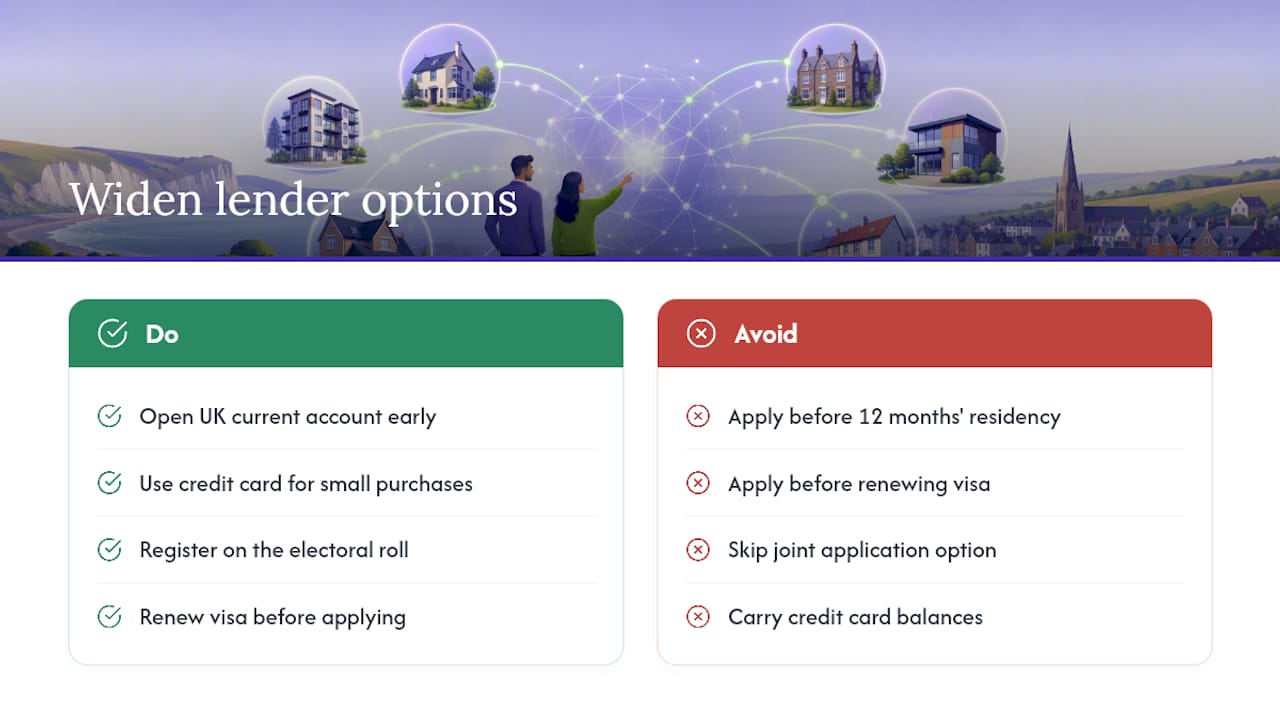
Pro Tip: Applying jointly with a partner who has a longer UK credit history can strengthen your application considerably, even if your own income is the larger share of the household total.
How much can you actually borrow?
Lenders typically multiply your income to set a borrowing ceiling, then stress-test that figure against a higher interest rate to confirm you could still afford repayments if rates rose.
- Income multiple: most lenders offer 4 to 4.5 times gross income, though this narrows for shorter-term contracts or high existing outgoings
- Stress testing: lenders check affordability at a rate several percentage points above your actual offer, which reduces your effective borrowing power
- Worked example: on a household income of £45,000, a 4.5x multiple suggests a ceiling near £202,500, though your real figure depends on debts, dependants, and the specific lender’s stress rate
This is why two applicants earning identical salaries can be offered very different amounts. Outgoings, credit commitments, and even the length of your remaining visa term all feed into the final number.
When do specialist lenders change the equation?
Building societies and specialist lenders sometimes operate outside the standard rulebook entirely. Several run dedicated ranges built specifically around skilled worker mortgage UK applicants, with underwriters trained to assess these files manually rather than by automated scoring alone.
- Specialist intermediaries such as Perenna’s skilled worker mortgage range advertise higher LTV options for applicants who meet strict income and residency conditions
- Manual underwriting means a lender can look past a thin credit file if the rest of the application is strong, which some skilled worker visa mortgage guides note is increasingly common among gifted-deposit cases
- New-build exceptions, including builder-funded deposit contributions, can bring a 95% LTV purchase within reach
A broker who tracks these niche products day to day will usually spot a fit faster than an applicant searching alone, simply because the differences between lender policies are rarely published in plain language.
Why work with an FCA-regulated broker for a skilled visa property purchase?
Every lender has its own quirks on residency, visa length, and gifted deposits, and applying to the wrong one first can mean a wasted credit search that dents your file before you’ve even found the right match.
- A whole-of-market broker checks your circumstances against multiple lender panels before submitting anything, avoiding unnecessary hard searches
- Specialist knowledge matters for cases like studio flats under 30 to 37 square metres, where lender rules differ from standard properties
- Brokers who understand expat and foreign-national criteria can flag buy-to-let routes too, useful once you’re settled and considering a second property
- Always verify a broker’s status on the FCA register before sharing financial details
Some brokers work with Skilled Worker visa holders across East Sussex regularly, and the recurring pattern is simple: preparation beats speed. A well-documented file submitted to the right lender the first time beats a rushed application sent to five lenders at once.
A broker’s honest view on skilled worker visa mortgages
The biggest misconception is that visa status itself is the obstacle. It rarely is. What actually derails applications is a thin credit file paired with an applicant who approached only one or two big-name banks and gave up after rejection. Lender policy in this space moves fast, and the gap between a cautious high-street bank and a specialist range willing to lend at 90% LTV can be enormous. Don’t let one “no” convince you the door is shut everywhere. Start gathering your documents now, get your visa share code ready, and speak to a broker who works these cases regularly. If you’re in Hastings, Eastbourne, Hailsham, Bexhill-on-Sea, or anywhere else in East Sussex, that local knowledge often makes the difference between months of frustration and a straightforward approval.
— Paul
Get local, independent advice from Prosper Home Loans
An independent, whole-of-market broker can provide advice from people knowledgeable about which building societies and specialist lenders accept Skilled Worker visa holders, and on what terms. Rather than applying blind and risking multiple credit searches, you get a broker who checks your circumstances against lender panels first.

Support is available for first-time buyers, self-employed applicants, and foreign nationals across Hastings, Eastbourne, Hailsham, Bexhill-on-Sea, and East Sussex, using a tailored approach whatever your visa status. A typical first appointment covers your income, deposit, visa timeline, and credit history, then maps out which lenders are realistically open to you. If you’re ready to find out where you stand, visit Prosper Home Loans to arrange a conversation, or explore our dedicated page for first-time buyers if this is your first UK property purchase.
Sources
- Skilled Worker Visas Criteria · HRBS intermediaries
- Mortgages for non-UK residents · HSBC UK
- FCA register entry
FAQ
Can skilled workers get mortgages in the UK?
Yes. Most mainstream lenders and several specialist building societies accept Skilled Worker visa applicants, though deposit requirements and remaining visa length thresholds vary by lender.
What salary do I need for a £250,000 mortgage in the UK?
Using a typical 4 to 4.5 times income multiple, your required household income varies depending on outgoings and the specific lender’s stress test.
Can I get a mortgage in the UK if I have foreign income?
It’s possible, but lenders apply stricter verification and often lower LTV limits to overseas earnings, as reflected in HSBC’s non-resident mortgage guidance; a broker can identify which lenders are most comfortable with your income mix.
How long do I need to live in the UK to get a mortgage?
Many lenders ask for 6–12 months of UK residency, though some specialist ranges accept shorter periods if your deposit, income, and credit history are strong.
How much do I need to earn for a £500,000 mortgage in the UK?
At a 4 to 4.5 times income multiple, the household income needed will vary, with affordability stress tests and your deposit size affecting the exact figure lenders offer.
Recommended
