25% Deposit for East Sussex Holiday Let Mortgages in 2026

Yes, you can get a holiday let mortgage in the UK, but expect specialist underwriting, a deposit of 25% or more in most cases, broker-led access, and post-FHL tax treatment that reduces net yield. Lenders will stress-test your projected seasonal income rather than simply looking at your salary, and the abolition of the Furnished Holiday Lettings regime means the tax perks that once made these properties attractive have largely gone.
TL;DR:
- Most holiday let mortgages require a deposit of at least 25% and are offered mainly by specialist lenders, often through brokers.
- Lenders stress-test projected seasonal income based on occupancy modeling, typically around 30 to 39 weeks per year, rather than relying on simple rent figures.
- Post-FHL abolition, rental income is taxed the same as residential lettings, with mortgage interest relief capped at 20%, impacting net profit especially for higher-rate taxpayers.
- Additional costs include a 5% stamp duty surcharge, valuation fees, lender arrangement fees, and solicitor charges, increasing the initial cash requirement.
- Strong underwriting depends on local licensing, property condition, and accurate income forecasts from a professional letting agent.
Table of Contents
- What is a holiday let mortgage and how does it differ from buy-to-let?
- How lenders actually model your seasonal income
- Deposit size, LTV limits, and the real cash you need on completion
- Tax after the FHL abolition: what it actually costs you now
- Which lenders offer holiday let mortgages and what rates look like in 2026
- Eligibility, income floors, and the paperwork you’ll need
- Licensing and local rules that can derail your mortgage offer
- Why a specialist broker earns their fee on this type of case
- How your mortgage term and repayment choice affect the numbers
- Insurance: what a standard buy-to-let policy won’t cover
- The risks lenders weigh before they say yes
- Economic conditions and their effect on holiday let lending
- When a holiday let mortgage makes sense in 2026
- Getting expert help with your holiday let application
- Where these figures come from
- Sources
- FAQ
What is a holiday let mortgage and how does it differ from buy-to-let?
A holiday let mortgage funds a property you market commercially to short-stay guests, typically for a week or less at a time, rather than to a single long-term tenant. That single distinction changes almost everything about how the loan is assessed. A standard buy-to-let mortgage is regulated by the Financial Conduct Authority when let to a single household on a long lease, whereas most holiday let products fall outside that framework because they’re treated as a business activity. Second-home mortgages are different again, designed for a property you’ll use personally rather than let out for income.
The practical differences matter:
- Holiday let lenders usually cap how many weeks a year you can occupy the property yourself, often 30 to 90 days, because the loan is priced on rental income, not personal use.
- Consumer protections that apply to regulated mortgages don’t automatically extend to these business-purpose loans, so read the terms carefully.
- Lenders want evidence the property is being actively marketed to holidaymakers, not sitting empty as a lifestyle purchase.
If your plan is a single long-term tenant, you want buy-to-let mortgage deals instead, which are priced and underwritten differently.
How lenders actually model your seasonal income
This is where holiday let underwriting gets technical, and where most first-time applicants underestimate what lenders expect to see. Rather than asking for a single annual rent figure, lenders build a projection from a blended weekly rate multiplied by an assumed occupancy level.
Occupancy assumptions vary, but many lenders model somewhere around 30 to 39 weeks a year, often close to 60% occupancy. Say your property could achieve £900 a week in peak season and £400 in the shoulder months, blending to roughly £600 a week across 35 modelled weeks. That gives a projected gross income of £21,000.
Pro Tip: Get a letting agent’s written income projection before you approach a lender. A credible, professionally produced forecast carries far more weight than your own optimistic estimate, and underwriters know the difference.
Lenders commonly require net rental income, after that 20% letting fee, to cover 125% to 145% of the stressed mortgage interest, with the higher figure often applying to higher-rate taxpayers or interest-only products.
- Stressed rates commonly sit around 5.5%, or the product rate plus roughly 2 percentage points, whichever gives the more cautious figure.
- Some lenders run two hurdles simultaneously on repayment cases: a 125% basic coverage check plus a further 145% test, depending on your tax band and the fix length you choose.
- The stress rate, not the actual pay rate, decides how much you can borrow, so a lower headline rate doesn’t always translate into a bigger loan.
Deposit size, LTV limits, and the real cash you need on completion
Most specialist lenders cap holiday let mortgages at a relatively high loan-to-value, meaning a significant deposit is the realistic starting point for anyone budgeting for this purchase. A small number of specialists will stretch to 80% in select cases, usually where the property has an exceptional letting history or the borrower has substantial other assets, but treat that as the exception rather than the plan.
The deposit is only part of the cash you need on day one. Because a holiday let counts as an additional dwelling, you’ll pay the 5% stamp duty surcharge on top of the standard SDLT bands. On a £325,000 property, that surcharge alone adds £16,250 to your completion costs, before you’ve paid a penny of standard stamp duty on the purchase itself.
Budget for the full picture:
- Deposit of at least 25% of the purchase price.
- The 5% additional-dwelling SDLT surcharge, calculated on the full purchase price.
- Lender arrangement fees, which vary by product and are sometimes added to the loan rather than paid upfront.
- A valuation fee, reflecting the specialist nature of the survey required.
- Solicitor’s fees, typically running to £2,500 to £3,500 once local searches and licensing checks are included.
Tax after the FHL abolition: what it actually costs you now
The Furnished Holiday Lettings regime was abolished for income tax and capital gains tax from 6 April 2025, and the effect on holiday let investors has been significant. Income from these properties is now taxed the same way as a standard residential rental, which strips out several advantages that used to make holiday lets a favoured structure for landlords.
The change that hits hardest is mortgage interest relief. Under the Section 24 mechanic that already applies to standard buy-to-let, you can no longer deduct mortgage interest as an expense against rental income. Instead, you receive a tax credit worth 20% of the interest paid, regardless of your income tax band. For a basic-rate taxpayer that’s a wash. For a higher-rate or additional-rate taxpayer, it’s a real cut to net income, because relief that used to be worth 40% or 45% is now capped at 20%.
Capital gains on sale are also affected: gains are now taxed at the standard residential rates of 18% or 24%, and some capital allowances that FHL owners previously claimed have gone too.
- Model your numbers using the 20% tax credit, not the old full-interest deduction, especially if you’re a higher-rate taxpayer.
- Factor CGT at 18% or 24% into any exit strategy from the outset, not as an afterthought.
- Speak to an accountant who understands the post-abolition rules before you commit, since structuring (personal name versus a limited company) can materially change your tax position.
Which lenders offer holiday let mortgages and what rates look like in 2026
Specialist building societies dominate this market. High-street banks generally don’t compete here at any scale, because holiday let underwriting requires occupancy modelling and seasonal income analysis that mainstream mortgage factories aren’t built for. Building societies with regional roots in tourist areas, plus a handful of specialist lenders, do the bulk of the lending.
Headline rates typically sit 0.8 to 1.5 percentage points above vanilla buy-to-let, reflecting the extra risk lenders take on with fluctuating seasonal income rather than a fixed monthly rent.
- Product ranges, fees, and criteria differ noticeably between lenders, so comparing one rate in isolation tells you very little.
- The overwhelming majority of holiday let products are broker-only, meaning you can’t simply walk into a branch or apply directly online.
- Lenders publish detailed intermediary criteria guides covering occupancy calculations, minimum property values, and acceptable locations, and these guides change often enough that working from an out-of-date PDF can cost you an approval.
This is precisely why the broker channel exists: a broker who tracks these criteria guides day to day can match your property and circumstances to the lender most likely to say yes, rather than you guessing.
Eligibility, income floors, and the paperwork you’ll need
Lenders typically want to see a personal income floor, often somewhere in the region of £20,000 to £40,000 a year, on top of the projected rental income, because they want reassurance you can cover the mortgage even in a poor season. Age limits and UK residency requirements also apply, and vary by lender.
Expect to provide:
- Proof of identity and address, as with any mortgage application.
- Recent tax returns or payslips evidencing your personal income.
- A professional letting forecast from a local agent, ideally with historic booking data if the property already trades.
- Evidence the property meets minimum value thresholds, since many lenders won’t lend below a set figure, often around £75,000 to £100,000.
If you’re a non-UK national or living abroad, the documentation gets more involved. Our guide on what documents foreign nationals need for a mortgage covers what to prepare in advance, and expats should also look at expat buy-to-let mortgage options if residency status complicates a standard application.
Licensing and local rules that can derail your mortgage offer
Local regulation isn’t a side issue here, it can directly stop a lender from proceeding. Scotland now requires mandatory short-term let licensing, and operating without one is a criminal offence, not just an administrative slip. Lenders will ask your solicitor to confirm the property either holds a licence or clearly doesn’t need one.
In London, a 90-day annual cap on letting out an entire home as a short-term let applies, and other councils across England have introduced Article 4 directions restricting change of use to short-let purposes.
- Solicitors routinely check local licensing and planning status as part of conveyancing on holiday lets.
- A restrictive covenant on the title, sometimes barring commercial letting entirely, can cause a lender to withdraw an offer late in the process.
Pro Tip: Ask your solicitor to run licensing and covenant checks before you commit to a mortgage application, not after, since a licensing problem discovered late can unpick weeks of underwriting work.
Why a specialist broker earns their fee on this type of case
Sourcing the right lender for a holiday let is genuinely difficult without market-wide access, because criteria shift between building societies and few of them are visible on comparison sites. A broker builds your letting forecast into the right shape for underwriting, checks licensing and covenant issues before they become a problem, and handles the paperwork trail that specialist lenders expect.
Before your first meeting with a broker, gather:
- A letting agent’s income and occupancy forecast for the property.
- Evidence of your personal income, including recent payslips or tax returns.
- Confirmation of any licensing requirements that apply to the property’s location.
- Details of your deposit source and any other assets you’d want considered.
Mortgage brokers operate locally in areas such as Hastings, Eastbourne, Hailsham and Bexhill-on-Sea, offering independent, whole-of-market advice for specialist cases of this type.
How your mortgage term and repayment choice affect the numbers
The term length and repayment structure you choose shape both your monthly outgoings and how much a lender will let you borrow. A 25-year repayment mortgage on a holiday let carries higher monthly payments than the same loan on interest-only terms, but it builds equity steadily and reduces the interest bill stressed at underwriting.
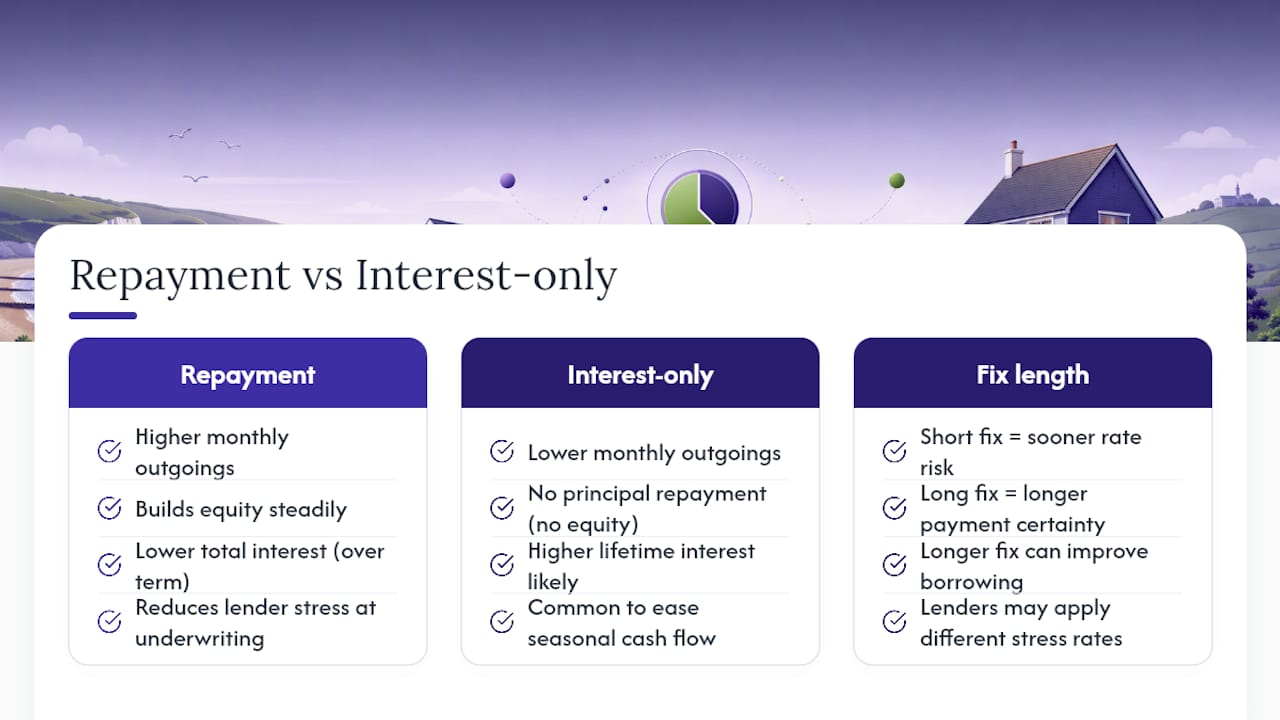
Interest-only is common in this market because it keeps monthly cash flow lower during quieter months, which suits the seasonal nature of holiday income.
Fix length also matters more here than on a standard mortgage. A shorter fix, say two years, exposes you to rate risk sooner, while a five-year fix gives you longer certainty over your outgoings, useful given how variable holiday letting income can be year to year. Some lenders apply different stress rates depending on the fix you choose, so a longer fix can sometimes improve how much you’re able to borrow. Our guide to fixed versus tracker mortgages covers this trade-off in more depth if you’re weighing up which suits your situation.
Whichever term and structure you choose, model your repayments against your weakest likely season, not your best one. Holiday lets rarely produce even income across twelve months, and a mortgage that comfortably works in August can feel very different in February.
Insurance: what a standard buy-to-let policy won’t cover
Standard buy-to-let or home insurance policies generally exclude short-term holiday letting, which means running a holiday let on the wrong policy can leave you completely uninsured when you need to cover most. You need a specific holiday let insurance policy, and most mortgage lenders will insist on proof of one before completion.
A proper holiday let policy typically covers buildings and contents as standard, but the areas that matter most for this type of property are public liability cover, since you’re hosting paying guests who could be injured on-site, and loss of rental income if the property becomes uninhabitable, say after a burst pipe or storm damage, and you can’t let it out while repairs happen.
Cover for guest belongings and accidental damage caused by holidaymakers is worth checking closely too, since turnover of unfamiliar occupants brings a different risk profile than a single long-term tenant would. Some insurers also offer key cover, useful if you’re managing changeovers remotely or through a letting agent rather than living nearby.
If the property sits empty for extended periods outside peak season, check the policy’s unoccupancy clause, because many standard policies restrict cover after 30 or 60 consecutive empty days, and a holiday let in a seasonal location can easily exceed that during winter months.
Get insurance quotes before you apply for the mortgage, not after. Lenders will ask for evidence of adequate cover at completion, and discovering a coverage gap at that late stage can delay or derail the whole purchase.
The risks lenders weigh before they say yes
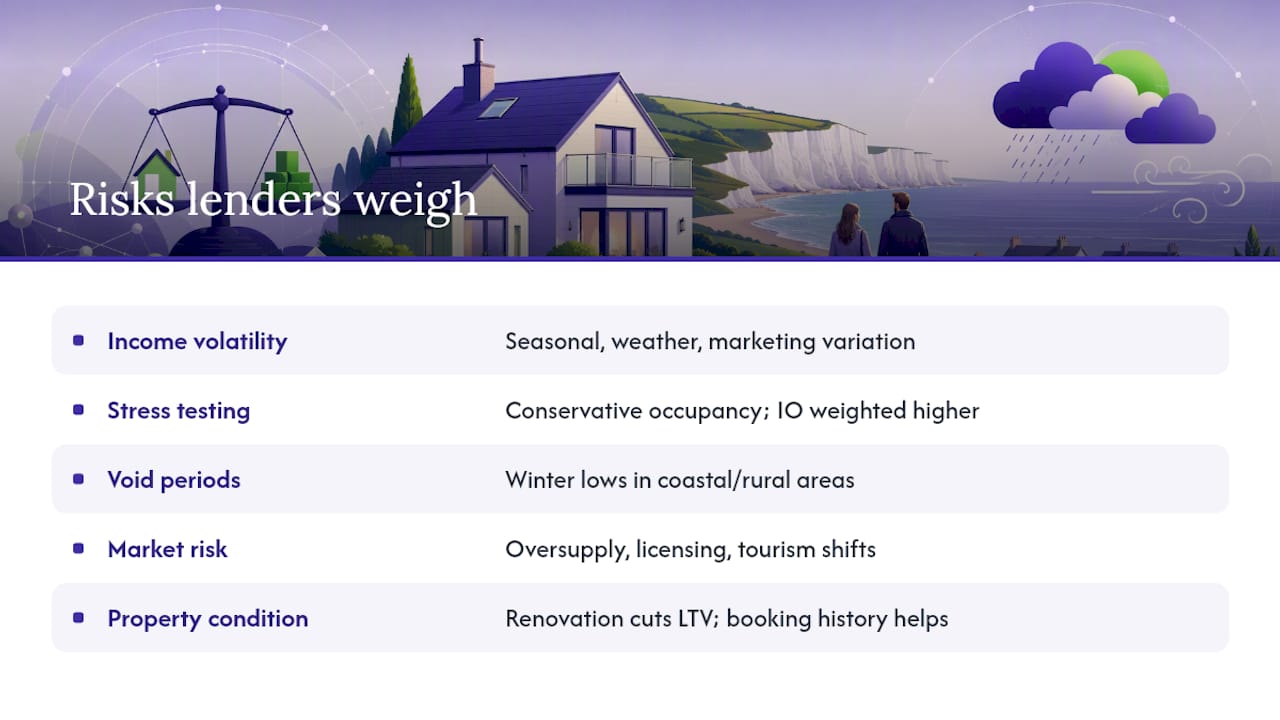
Lenders assess holiday let applications more cautiously than standard buy-to-let for one straightforward reason: income here is inherently less predictable. A long-term tenant on a twelve-month lease gives a lender a fixed, contracted rent. A holiday let depends on bookings that vary by season, by weather, by local events, and by how well the property is marketed.
That volatility is why occupancy-based stress testing exists in the first place. Lenders build in a buffer against a bad season by modelling a conservative occupancy figure rather than your best-case projection, and they weight interest-only applications more heavily because the loan balance never falls to compensate for a weak year.
Void periods are the other risk lenders watch closely, particularly in seasonal coastal or rural locations where winter bookings can drop close to zero. A property near a beach in East Sussex might comfortably let every week in July and August, then sit largely empty from November to February. Lenders factor that seasonality into their occupancy assumptions rather than assuming a flat rate across the year.
Void risk sits alongside broader market risk: local oversupply of holiday lets, changes to local licensing rules, or a shift in tourism patterns can all affect future letting income in ways a lender can’t fully model at the point of application. That’s part of why the personal income floor exists, it’s a backstop for the lender if rental income underperforms, not just a formality.
Property condition and location also feed into risk assessment. A property requiring significant renovation, or in a location with limited tourist appeal outside a narrow season, will face harder scrutiny and potentially a lower maximum LTV than a well-established holiday letting property with a proven booking history.
Economic conditions and their effect on holiday let lending
Base rate movements feed through to holiday let pricing faster than to many other mortgage types, because the specialist lender pool is smaller and more sensitive to funding costs. When swap rates rise, holiday let products tend to reprice quickly, and the already-existing rate premium over standard buy-to-let can widen further during periods of market uncertainty.
Post-Brexit changes to trade and travel patterns have shifted UK holiday demand in ways that indirectly support this market: more UK households holidaying domestically has, in general terms, sustained demand for staycation properties in areas like East Sussex, though this varies significantly by region and property type rather than applying uniformly. Currency movements affecting the cost of overseas travel can also nudge demand toward UK-based holiday lets, though this effect fluctuates with exchange rates and is far from guaranteed.
Lender appetite itself has narrowed and widened at different points as the specialist market has adjusted to funding costs and regulatory changes, including the FHL abolition reshaping how attractive the asset class looks to some investors. The practical effect for you as a borrower is that rates, maximum LTV, and even which lenders are actively accepting new holiday let business can shift over a matter of months, which is another reason working through a broker who tracks these changes closely matters more here than on a standard residential mortgage.
When a holiday let mortgage makes sense in 2026
If you already understand seasonal income and can absorb a quiet winter without strain, a holiday let mortgage is a sound route into this asset class. If you’re relying on optimistic peak-season figures to make the numbers work at all, buy-to-let or a straightforward second-home mortgage is the safer path.
Model your own numbers conservatively: stress your occupancy below what the letting agent projects, and use a stressed rate a point or two above the actual product rate. Keep a cash buffer covering at least three months of mortgage payments for the seasons when bookings inevitably dip.
— Paul
Getting expert help with your holiday let application
Specialist mortgage brokers provide an alternative to navigating complex lender criteria alone. Independent, whole-of-market advisors in Hastings, Eastbourne, Hailsham and Bexhill-on-Sea track criteria guides and rate changes across specialist lenders, and are available seven days a week for clients in East Sussex.

After you get in touch, we’ll review your income documents, build an affordability picture against realistic occupancy assumptions, and source the specialist products most likely to accept your case, whether that’s a straightforward holiday let purchase, a remortgage to release equity from an existing property for your deposit, or a case complicated by self-employment or foreign national status. If you already run a letting business and want help improving bookings once the mortgage is sorted, specialist marketing support for short-let properties can help fill those quieter months. Our affordability calculations and written confirmation service gives you a clear, documented answer before you make an offer on a property. Get in touch through our mortgage advice page to start the conversation about your holiday let plans.
Where these figures come from
Claims in this article draw on GOV.UK’s guidance on the FHL abolition and published lender criteria guides from specialist building societies.
This article is general information, not a substitute for advice from a qualified financial advisor. Consult a qualified financial professional about your own circumstances before acting on anything here.
Sources
- Gov
- BDO — Tax changes for furnished holiday lets
- Landlord Resource — Holiday let mortgage explained (2026)
FAQ
Can I get an Airbnb mortgage in the UK?
Yes, though lenders call it a holiday let mortgage rather than an “Airbnb mortgage.” The property must be marketed commercially for short stays, and standard residential or buy-to-let mortgages typically prohibit Airbnb-style letting under their terms.
What is the 10-year rule for holiday lets?
There is no universal statutory minimum term for holiday let mortgages; requirements vary by lender and often relate to specific product conditions, so check the exact terms of any product with your broker or lender directly.
Is it hard to get a holiday let mortgage?
It’s harder than a standard residential mortgage but entirely achievable with the right preparation.
Recommended
