Home Reversion vs Lifetime Mortgage: Key Differences Explained

A lifetime mortgage is a loan secured on your home, and you keep ownership. A home reversion plan is a sale: you sell all or part of your home to a provider for a lump sum or income and stay there. Both are types of equity release, and the right choice depends on your age, your plans for the property and what you want to leave behind.
We are a local broker serving Hastings, Eastbourne, Hailsham, Bexhill-on-Sea and the rest of East Sussex. This guide sets out the differences in plain English, so you know what to ask before you speak to an adviser.
TL;DR
- A lifetime mortgage is a loan against your home. You keep ownership, but interest can build up and reduce what you leave behind.
- A home reversion plan sells a share of your home, or all of it. It is not a loan, so no interest is charged, but you may receive less than the market value of the share you sell.
- Both reduce the estate available to your beneficiaries, and both can affect means-tested benefits.
- Lifetime mortgages are the more common of the two, and the available choice differs between providers.
- Get regulated advice before you commit. Your circumstances and the provider’s criteria decide what is available.
Table of Contents
- What is the difference between a lifetime mortgage and a home reversion plan?
- How each one affects ownership and inheritance
- The risks to weigh up
- Can I get a lifetime mortgage?
- Where a retirement interest-only mortgage fits
- Other options to consider first
- Our view on choosing between them
- Getting the right advice
- FAQ
- Sources
What is the difference between a lifetime mortgage and a home reversion plan?
The two are the main types of equity release, according to Legal & General’s overview of equity release types. They work in very different ways.
With a lifetime mortgage, you borrow against your home and keep ownership. Age UK’s equity release factsheet explains that interest on these loans can compound, which means you pay interest on interest as well as on the original sum.
With a home reversion plan, you sell a share of your property, or all of it, in exchange for a cash sum or regular income, and a right to remain in the home. Age UK notes that it is not a loan and does not carry interest. The catch is that the price paid is usually below the market value of the share you sell.
| Lifetime mortgage | Home reversion plan | |
|---|---|---|
| What it is | A loan secured on your home | A sale of all or part of your home |
| Ownership | You keep it | You give up the share you sell |
| Interest | Can compound over time | None, as it is not a loan |
| Effect on inheritance | Debt grows and reduces the estate | The share sold no longer forms part of the estate |
| Price risk | Repay what is owed when the home is sold | Share may be sold below market value |
How each one affects ownership and inheritance
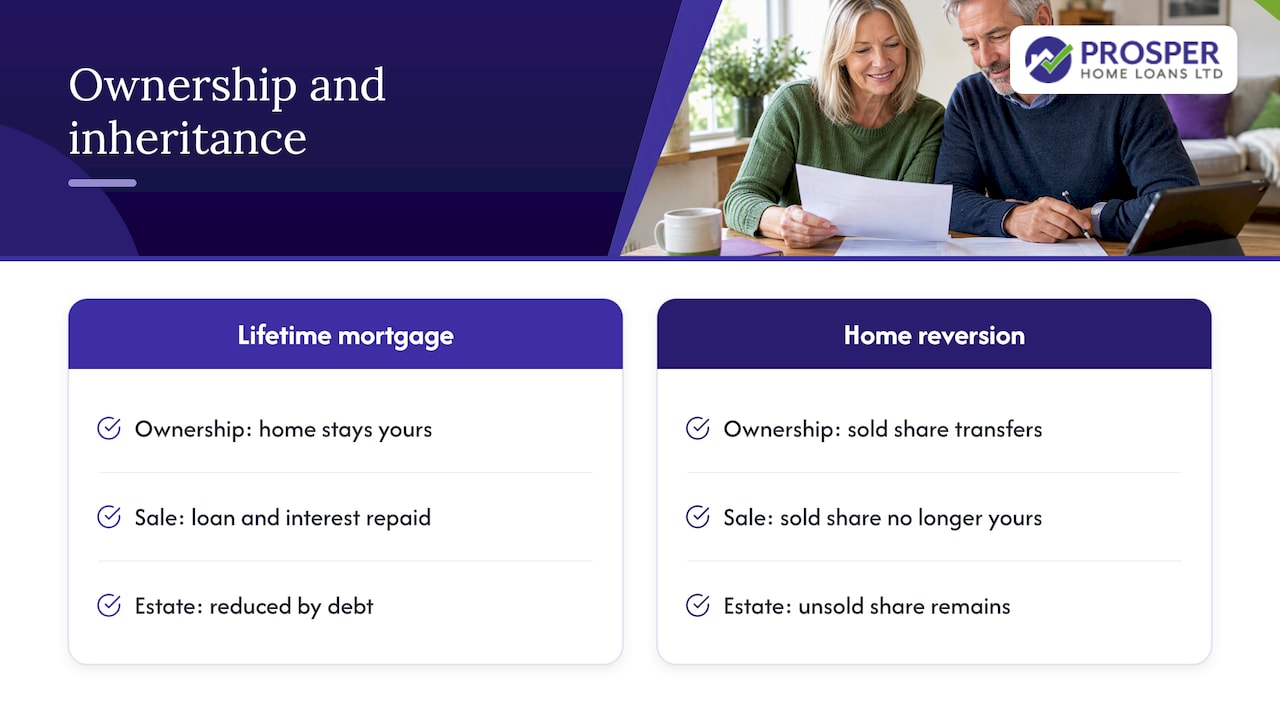
Ownership is the clearest dividing line. A lifetime mortgage leaves the home in your name. A reversion plan transfers the share you sell to the provider.
Inheritance is affected either way. Age UK states that equity release, whether a lifetime mortgage or a home reversion plan, reduces the size of the estate available to your beneficiaries.
With a lifetime mortgage, the loan and rolled-up interest are repaid from the sale of the home, usually when you die or move into long-term care. With a reversion plan, the portion you sold is no longer yours to leave, though you keep any share you did not sell.
If you want to talk through the plan with your family, do that early. Beneficiaries are often surprised by how quickly compounding interest can grow a debt over a long retirement.
The risks to weigh up
Neither route is free of downsides. Age UK lists the main ones: a much smaller estate, effects on means-tested benefits, fast-growing interest on a lifetime mortgage, and the possibility of selling at a low price through home reversion.
MoneyHelper warns that the money you release may affect your eligibility for means-tested benefits and local authority support. Check this before you proceed, not after.
There are protections to look for. Age UK says a lifetime mortgage may come with a no-negative-equity guarantee, which means you would not have to repay more than the sale proceeds of your property, provided its terms and conditions are met. UK Finance explains that if your provider is a member of the Equity Release Council, you may have access to additional protections.
Things to ask any adviser:
- What will the total owed look like after 10, 15 and 20 years?
- Can I make voluntary payments, and what are the charges if I repay early?
- What happens if I need to move or go into care?
- Will this change my benefits or council support?
- Does the plan carry the no-negative-equity guarantee?
Can I get a lifetime mortgage?
Eligibility depends on your age and personal circumstances. MoneyHelper says providers set a minimum age, typically 50 to 55, and the property must be your main residence.
Age also affects how much you can access. Age UK advises that the younger you are, the less you can borrow with a lifetime mortgage or receive from a home reversion plan. Lenders then look at the value and condition of your property and any existing mortgage that would need to be repaid first.
We cannot say what a lender will offer you until we know your details. Criteria differ between providers, which is one reason an adviser who can look across the market is useful.
Where a retirement interest-only mortgage fits
If you can afford monthly payments, a retirement interest-only (RIO) mortgage is worth comparing. MoneyHelper’s RIO guidance says you pay the interest each month, based on affordability, which avoids the compounding of a roll-up lifetime mortgage. It may also let you borrow a larger proportion of your home’s value.
The trade-off is that the monthly payments must stay affordable throughout retirement. If your income is likely to fall, think carefully. Our guide to interest-only residential mortgages explains the wider principles.

Other options to consider first
Equity release is not the only way to use the value in your home. Depending on your age and income, you might consider:
- Remortgaging to release equity, if you still meet a lender’s age and affordability rules. See how remortgaging to release equity works.
- A second charge or secured loan, which leaves your main mortgage alone. Our blog compares a secured loan and a remortgage.
- Downsizing, which frees capital without borrowing.
- Using savings or pension income where that is realistic.
If the money is for a specific purpose, our guides on equity release for care costs and equity release for home improvements go into more detail.
Our view on choosing between them
In our experience, people usually start by asking which product is better. A more useful question is what the money is for, how long you expect to stay in the home and what you want to leave behind.
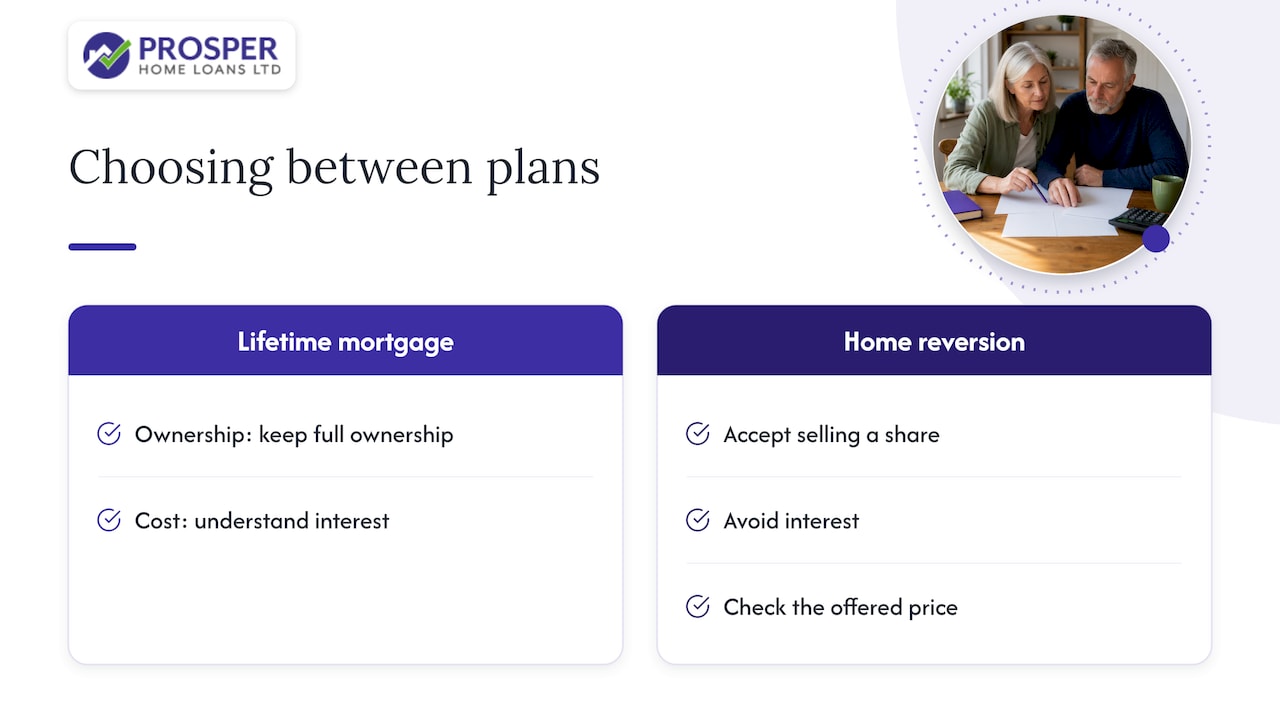
If keeping full ownership matters to you, a lifetime mortgage is the natural comparison, with the cost of interest as the main thing to understand. If you would rather avoid interest and accept selling a share, a reversion plan is worth looking at, with the price you are offered as the main thing to check.
We explain the costs and risks before you decide, and we look at alternatives as well as equity release. We do not promise approval or any particular outcome, because options depend on your circumstances and each lender’s criteria. A plan that works on paper but leaves your family surprised is not a good plan.
— Paul McMath CeMAP CeRER
Getting the right advice
Equity release is a major decision that is hard to undo. Compare how much different providers will let you release and which products fit your situation, and bring a solicitor into the process too. If you want to find a financial adviser or solicitor to review your estate plans alongside the equity release decision, make that part of your preparation.
We can talk you through lifetime mortgages and equity release as part of our remortgage and later-life lending service. We are based in St. Leonards-on-Sea and help homeowners across Hastings, Eastbourne, Hailsham, Bexhill-on-Sea and East Sussex, as well as clients elsewhere in the UK.
FAQ
Is a home reversion plan a good idea?
It can suit some people, but it involves selling part or all of your home, usually for less than its market value. You would not be charged interest, because it is not a loan. Check how it affects your estate and benefits, and take regulated advice first.
What are the disadvantages of a lifetime mortgage?
The main ones are compound interest, which can grow the debt quickly, and a smaller inheritance. It can also affect means-tested benefits. Ask about voluntary payments, early repayment charges and the no-negative-equity guarantee.
Is it safer to choose a lifetime mortgage or a home reversion plan?
Neither is safer in every case, because the risks differ. A lifetime mortgage carries the risk of growing debt, while reversion carries the risk of a low sale price. Protections such as Equity Release Council membership and the no-negative-equity guarantee matter more than the product label.
Can I get a lifetime mortgage at 55?
Minimum ages are typically 50 to 55, depending on the provider. The property must also be your main residence. The younger you are, the less you can usually borrow, so speak to an adviser about your own position.
Sources
- Equity release factsheet, Age UK
- Lifetime mortgage, MoneyHelper
- Retirement interest-only (RIO) mortgage, MoneyHelper
- Later life lending leaflet, UK Finance
- Types of equity release, Legal & General
Recommended
- Secured Loan vs Remortgage: A UK Homeowner Guide
- Remortgage Before Your Fix Ends: East Sussex’s Six Month ERC Check
- Homeowner Loan After an IVA: Your Options and Risks
This article provides general information and is not a personal mortgage recommendation. Mortgage availability and eligibility depend on your circumstances and lender criteria. Rates and criteria can change. We will explain any applicable fees before you commit. Think carefully before securing other debts against your home. Consolidating debts over a longer term may reduce your monthly payments but increase the total amount you repay. Your home may be repossessed if you do not keep up repayments
