2026–26 UK Data: Interest-Only Residential Mortgages and Adviser Checklist

An interest-only residential mortgage means your monthly payments cover only the interest charged on the loan, leaving the amount you originally borrowed unchanged until the end of the term. These mortgages remain available in the UK, but only in limited circumstances under FCA rules, and lenders need proof of a credible plan to repay the capital. If you are worried about an existing deal, speak to your lender, a regulated adviser such as Prosper Home Loans, or check gov.uk for support options.
TL;DR:
- Most interest-only mortgages in the UK require credible proof of a plan to repay the capital, with stricter lending rules and lower loan-to-value limits than repayment mortgages.
- The typical monthly interest cost on a £200,000 loan at 5% interest is around £833, but total interest paid over the loan’s life is usually higher than on a repayment mortgage due to the full balance remaining unpaid.
- Borrowers relying on property sales, remortgaging, investments, or pensions as exit strategies must have active, well-documented plans that fit within FCA rules; short-term or unverified strategies are inadequate.
- When the mortgage matures, most borrowers repay or refinance within months; lenders are required to start discussions years in advance and offer options like extending, converting to repayment, or switching to retirement interest-only or lifetime mortgages.
- Using interest-only effectively requires a clear, credible repayment plan and careful planning around tax implications and funding sources to avoid the risk of shortfall or mis-selling.
Table of Contents
- How interest-only residential mortgages work
- Who qualifies, and what lenders must check under FCA rules
- Repayment strategies borrowers actually rely on
- What happens when the mortgage reaches the end of its term
- What interest-only actually costs you
- The risks, and why mis-selling still shapes the rules
- How to decide if interest-only suits you
- How Prosper Home Loans assesses interest-only cases
- Tax implications of an interest-only residential mortgage
- Where this leaves borrowers considering interest-only
- How Prosper Home Loans can support your interest-only decision
- Sources
- FAQ
How interest-only residential mortgages work
With a standard repayment mortgage, each payment chips away at both the interest and the capital you borrowed. An interest-only mortgage strips that down: you pay the interest each month, and the capital sits untouched until the mortgage matures, at which point the full original loan is due.
Say you borrow £200,000 on an interest-only basis over 25 years. On the day you take out the mortgage, you owe £200,000. On the day the term ends, assuming no overpayments, you still owe £200,000. Nothing has been chipped away in between, which is exactly why lenders now ask hard questions about how you intend to clear that balance.
A few variants turn up regularly in the UK market:
- Pure interest-only: the whole loan is on an interest-only basis for the full term.
- Part-and-part: a portion of the balance is repayment, the rest interest-only, splitting the risk.
- Retirement interest-only (RIO): designed for older borrowers, typically repaid when the property is sold, the borrower dies or moves into long-term care.
- Lifetime mortgages: a form of equity release where interest can roll up rather than being paid monthly, reducing the equity left in the property over time.
Short-term interest-only arrangements also appear in bridging finance, where the loan is cleared quickly through a sale or refinance rather than run for decades.
Who qualifies, and what lenders must check under FCA rules
Not every borrower can simply choose interest-only. The FCA’s MCOB 11.6 rules restrict when lenders can offer it and require them to factor in the cost of your repayment strategy when assessing whether the mortgage is affordable, not just the interest payments themselves.
In practice, lenders want to see:
- A maximum loan-to-value, often lower than for repayment mortgages, sometimes requiring 25% to 50% equity depending on the lender and repayment vehicle.
- Documented proof of a repayment plan, such as investment statements, pension forecasts or evidence of a second property you intend to sell.
- For retirement interest-only, evidence that the plan holds up against a longer, less predictable timeframe, since there is no fixed end date tied to a working income.
Lenders are not always locking you into interest-only forever, either. Under FCA finalised guidance, firms can allow a temporary switch to interest-only, sometimes for up to six months, as a forbearance measure for borrowers in payment difficulty, without needing the full affordability reassessment a permanent change would trigger. A permanent switch, by contrast, still needs the same credible repayment evidence any new interest-only application would require.
Repayment strategies borrowers actually rely on
Every interest-only mortgage needs an exit plan, and lenders will only accept certain ones as credible. The most common routes are:
- Selling the property: straightforward in theory, though timing matters, since a slow market or a leasehold with a short lease remaining can eat into the sale proceeds you were counting on.
- Remortgaging onto a repayment basis: feasible if your income and age still fit a new lender’s criteria, but it depends on rates and affordability at the time you switch.
- Savings and investments: ISAs, unit trusts or other investment-backed vehicles, though returns are never guaranteed and tax treatment (such as capital gains tax on investment growth) needs factoring in.
- Pension encashment: usable from age 55 (rising to 57 from 2028), but drawing a large lump sum can trigger tax charges and leave less for retirement income.
- Part-and-part conversion: switching some of the balance to repayment reduces the outstanding capital gradually, which some lenders will agree to mid-term.
- Inheritance or proceeds from another property sale: sometimes accepted, though lenders generally want firmer evidence than an expectation of a future windfall.
Retirement interest-only and lifetime mortgages differ from the above in that repayment is usually deferred to a life event, sale or death, rather than a date on the calendar, which suits borrowers who cannot point to a fixed repayment moment but can point to the property itself as the eventual source of funds.
What happens when the mortgage reaches the end of its term
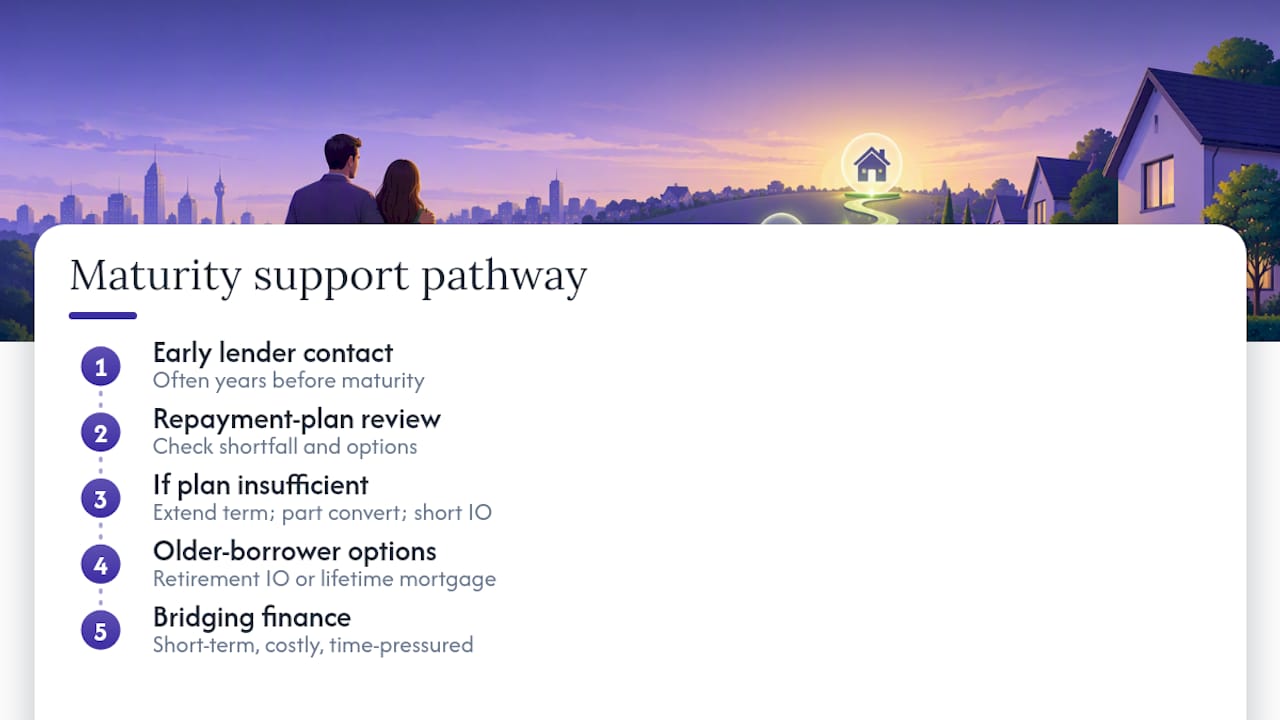
When an interest-only mortgage matures, the full capital balance becomes due. Most borrowers see this coming and act well before the deadline, either selling, refinancing, or drawing on savings they have built up specifically for this purpose. UK Finance data shows that most borrowers approaching maturity repay or refinance within months of their term ending, and the small minority who cannot generally need tailored support rather than facing immediate enforcement action.
Lenders are expected to make contact well ahead of maturity, often starting conversations several years out for older interest-only back-book customers, to understand what repayment plan is actually in place. Where the original plan has fallen short, lenders have a range of options rather than jumping straight to repossession: extending the term, converting part of the balance to repayment, agreeing a short period of continued interest-only payments, or, for older borrowers, exploring a switch to retirement interest-only or a lifetime mortgage. Short-term bridging finance sometimes covers the gap between maturity and a planned sale, though it carries its own cost and time pressure.
What interest-only actually costs you
The monthly payment on an interest-only mortgage is lower than an equivalent repayment mortgage, because you are only servicing the interest, not chipping away at the capital. That lower monthly cost is the appeal, but it comes at the price of paying interest on the full original balance for the entire term, which usually makes the total interest paid higher over the mortgage’s life than it would be on a repayment deal at the same rate.
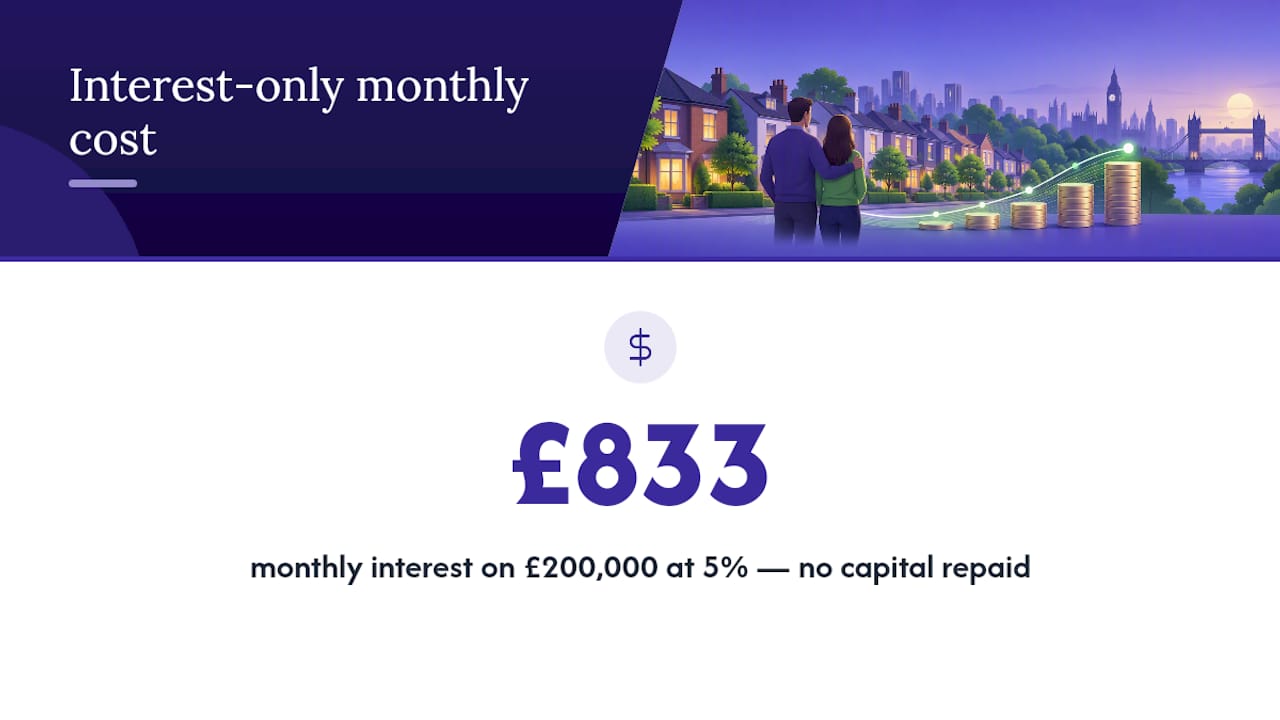
The maths behind a monthly interest-only payment is simple: take the outstanding balance, multiply by the annual interest rate, then divide by 12. On a £200,000 balance at a 5% annual rate, that works out as £200,000 × 0.05 ÷ 12, or roughly £833 a month in interest, before any fees. That figure moves with the rate and stays flat with the balance, since none of it goes toward reducing what you owe.
A significant number of pure interest-only mortgages remained outstanding across the UK at the end of 2025, continuing a steady decline from previous years, according to UK Finance. That decline reflects a book that is steadily shrinking as older interest-only deals mature and fewer new ones are written under today’s tighter rules.
Beyond the rate itself, factor in arrangement fees, valuation costs, and early repayment charges if you switch or remortgage before a fixed period ends, since these can shift the timing and cost of any refinance decision.
The risks, and why mis-selling still shapes the rules
The biggest risk with interest-only is a shortfall: the repayment vehicle you were relying on doesn’t produce enough to clear the balance. This happened extensively with endowment policies sold alongside interest-only mortgages in the 1980s and 1990s, and the Financial Ombudsman Service has upheld redress in cases where those investment vehicles were mis-sold, using the RU89 method to calculate fair compensation.
Property market risk sits alongside investment risk. If you’re relying on a sale to clear the balance, a falling market or a leasehold flat with dwindling years left on the lease can both reduce what you actually walk away with.
This history is exactly why lenders now insist on documented, credible repayment evidence rather than taking a borrower’s word for it. Poor advice decades ago left people exposed at maturity with no way to clear what they owed, and MCOB’s evidential requirements exist to stop that recurring.
How to decide if interest-only suits you
Before committing, work through a short checklist:
- Check your current loan-to-value and whether it sits within what lenders typically require for interest-only lending.
- Confirm your repayment vehicle is active and on track, whether that’s an investment, a pension, or a planned sale.
- Consider your retirement horizon, since a fixed-term interest-only mortgage that matures after you stop working needs a plan that doesn’t depend on employment income.
- Build in a contingency, in case your investment underperforms or a sale takes longer than expected.
- Stress-test your affordability margin, allowing for rate rises if you’re not on a fixed deal.
When you speak to a lender or adviser, ask exactly what evidence they need for your repayment strategy, how the deal fits MCOB requirements, and what fees and exit costs apply if your circumstances change.
Pro Tip: Treat an unclear repayment strategy, or pressure to buy an investment product you don’t fully understand, as a red flag rather than a detail to sort out later.
How Prosper Home Loans assesses interest-only cases
We look at each interest-only enquiry on its own terms, particularly for self-employed applicants and contractors whose income doesn’t fit a standard payslip format. That usually means gathering day-rate contracts, CIS voucher evidence, self-assessment returns, and, where relevant, pension forecasts to support a credible repayment plan.
As a whole-of-market broker, we can compare lenders who take a more flexible view of contractor and CIS voucher income against those who don’t, and help build the documented repayment evidence MCOB requires. Our remortgaging, self-employed mortgage support, and affordability calculations with written confirmation are built around exactly this kind of case.
Tax implications of an interest-only residential mortgage
For most owner-occupiers, an interest-only mortgage on your main residence carries no special tax treatment purely because it’s interest-only. Mortgage interest relief for residential owner-occupiers was withdrawn decades ago, so whether you’re on interest-only or repayment, you cannot offset that interest against income tax.
Where tax questions genuinely arise is around the repayment vehicle itself, not the mortgage structure. Drawing a pension lump sum to clear the balance can push you into a higher tax band or trigger charges beyond your tax-free allowance, depending on how much you take and when. Selling investments held outside an ISA to repay the capital may trigger capital gains tax if the gain exceeds your annual exempt amount. Selling the property itself to repay the mortgage is normally free of capital gains tax for your main residence, thanks to private residence relief, though this doesn’t apply to second homes or buy-to-let properties used with interest-only lending.
If your repayment strategy involves a second property, a rental income stream, or investments held outside a tax-efficient wrapper, it’s worth checking the specific tax position with an accountant or tax adviser alongside your mortgage adviser, since the mortgage decision and the tax consequences of funding it are two separate conversations that both need proper answers.
Where this leaves borrowers considering interest-only
Interest-only isn’t a shortcut, and it isn’t a relic either. Used well, it’s a legitimate tool for someone with a genuine, documented way to clear the capital, whether that’s a pension, an investment portfolio, or a planned sale. Used badly, it becomes a deferred problem dressed up as a lower monthly payment.
Anyone without a clear, evidenced plan for the capital should speak to a regulated adviser before committing to this route. Bring your income evidence, any investment or pension statements, and a realistic view of your timeline to that first conversation.
— Paul
How Prosper Home Loans can support your interest-only decision
Whether you’re weighing up an interest-only residential mortgage, need a debt consolidation mortgage to bring borrowing under one roof, or are self-employed and need a CIS voucher mortgage that reflects your enhanced income properly, we work through the detail with you rather than leaving you to interpret lender criteria alone.

We are local and available across various towns in East Sussex, offering:
- Independent, whole-of-market mortgage advice, including interest-only and part-and-part structuring.
- Contractor and CIS voucher mortgage support, built around day-rate and self-assessment income.
- Remortgaging and affordability calculations with written confirmation, so you know where you stand before you apply.
Bring your last two or three years of income evidence and details of any repayment vehicle to your first meeting. Our mortgage advice fee is explained upfront before any work begins. Get in touch with Prosper Home Loans to book a consultation and find out what’s realistic for your circumstances.
Sources
This guide draws on the FCA’s MCOB 11.6 rules governing interest-only lending, UK Finance’s interest-only mortgage data covering 2025 and 2026, Gov, and a Financial Ombudsman Service decision illustrating how redress is calculated in mis-selling cases. These sources underpin the figures, rules, and outcomes described throughout this article and are worth reading directly if you want the full regulatory detail.
This article is general information, not a substitute for advice from a qualified financial advisor. Consult a qualified financial professional about your own circumstances before acting on anything here.
- UK Finance — interest‑only mortgage data
- FCA handbook — MCOB 11.6 (responsible lending and interest‑only rules)
- Financial Ombudsman decision (example RU89 calculation)
FAQ
Can you still get an interest-only mortgage in the UK?
Yes, interest-only residential mortgages are still available, though FCA rules under MCOB 11.6 restrict when lenders can offer them and require proof of a credible repayment strategy. Availability depends heavily on your loan-to-value, age and the strength of your repayment evidence.
How much would a £200,000 interest-only mortgage cost per month?
Using a 5% annual interest rate, the calculation is £200,000 multiplied by 0.05 and divided by 12, which comes to roughly £833 a month in interest alone. This figure changes with the interest rate applied and excludes any fees.
Are there interest-only residential mortgages, or are they only for buy-to-let?
Interest-only residential mortgages do exist for owner-occupiers, not just landlords, though lenders apply tighter eligibility rules for residential cases under MCOB. Retirement interest-only and part-and-part options are common residential variants alongside pure interest-only deals.
Which lender offers the best interest-only mortgage rates?
Rates vary by lender, loan-to-value and the strength of your repayment evidence, so there is no single lender that consistently offers the best rate for every borrower. A whole-of-market adviser such as Prosper Home Loans can compare current options across lenders based on your specific circumstances and repayment plan.
Recommended
