Avoid Tax Traps: UK Lenders and Solicitors on Gifted Equity Mortgages

A gifted equity mortgage lets a buyer purchase a property below market value from a family member, with the discount itself counting as the deposit. Lenders still base loan-to-value calculations on the full market valuation, insist on a solicitor-drafted gifted deposit letter, and expect both sides to take independent legal advice. Because Inheritance Tax, Capital Gains Tax, and Stamp Duty Land Tax all come into play, we always recommend speaking to a broker like Prosper Home Loans before agreeing terms with family.
TL;DR:
- Gifted equity deals often allow the lender to assess mortgage affordability based on full market valuation, even if the sale price is heavily discounted.
- Lenders require detailed, recent gift letters and rigorous solvency checks for both donor and buyer, especially when the property is transferred at less than market value.
- Tax considerations, including inheritance tax, capital gains tax, and stamp duty, can significantly impact both donor and seller, making early advice essential.
- The sale must be disclosed to the lender as a concessionary purchase, with separate solicitors for buyer and seller to avoid conflicts of interest.
- Accessing the best mortgage rates depends on matching the lender’s policy on family relationships and discounts, which varies widely between lenders.
Table of Contents
- What is a gifted equity mortgage? Deposit vs equity explained
- How a gifted equity mortgage works in practice
- What lenders ask for: documents, solvency checks and policy limits
- Tax implications: Inheritance Tax, Capital Gains Tax and SDLT
- Legal steps: solicitors, declarations and protecting both sides
- Risks and pitfalls: what actually goes wrong
- Checklist: what to prepare before you apply
- How Prosper Home Loans supports gifted equity applications
- The conventional advice on gifted equity misses the real risk
- Get tailored advice on your gifted equity purchase
- Sources
What is a gifted equity mortgage? Deposit vs equity explained
The terms “gifted deposit” and “gifted equity” get used interchangeably, but lenders treat them quite differently, and getting this distinction right shapes everything else about your application.
A gifted deposit is a cash sum, often from parents or grandparents, transferred into the buyer’s account before completion. The buyer then uses that cash alongside their mortgage to purchase a property from an unconnected seller on the open market. Say a buyer needs a deposit representing a typical percentage on a £200,000 flat. A parent transfers that £30,000 directly. The lender sees a straightforward purchase with a documented cash injection.
Gifted equity works differently. Here, the seller is also the donor. A parent selling their house at a discounted price to their child has gifted equity representing the difference between the market value and the sale price. No cash moves at all. The “gift” exists only as the gap between market value and the price the buyer actually pays. This is sometimes called a concessionary purchase, and it is the scenario most family property transfers actually involve.
The lender treatment differs sharply between the two:
- Gifted deposit: the lender calculates loan-to-value against the full purchase price, because that price reflects market value paid to an unconnected party.
- Gifted equity: the lender still values the property at full market value, but bases the mortgage amount and LTV on the discounted price, effectively treating the “missing” equity as the buyer’s deposit.
- Documentation burden: gifted equity cases trigger closer scrutiny because buyer and seller are connected, so lenders want proof there is no hidden loan arrangement.
- Speed: gifted deposit purchases usually move at the pace of a normal chain transaction; gifted equity deals often take longer because of the extra legal and valuation checks.
Both routes reduce the cash a buyer needs upfront. Gifted equity tends to suit families who want to help without giving away liquid savings, particularly where a parent is downsizing or moving into a smaller home and simply wants their child to take on the family property at a fair, reduced price.
How a gifted equity mortgage works in practice
The mechanics hinge on one figure: the surveyor’s market valuation, not the price written into the sale contract.
A lender’s own surveyor values the property independently of whatever figure buyer and seller have agreed between themselves. That valuation becomes the basis for calculating loan-to-value, affordability, and which mortgage products the buyer can access. Lenders typically value the property at market value and treat the discount as the buyer’s deposit, regardless of the contracted sale price.
Here’s how that plays out with real numbers. Suppose a parent’s house is valued at a certain amount. They agree to sell it to their daughter at a discounted price reflecting a percentage discount. The gap between valuation and sale price is the gifted equity. The lender calculates LTV against the market valuation, not the sale price, resulting in a better LTV ratio than using the discounted price. That’s a materially better position than if the lender had used the discounted price as the ceiling, and it often unlocks more competitive rate bands than the buyer would qualify for on a standard purchase with a small deposit.
The sequence of steps typically runs like this:
- Initial agreement between family members on the sale price and discount, ideally discussed with a solicitor before any formal offer.
- Mortgage application submitted to a lender that explicitly permits concessionary purchases, declaring the family relationship and discount from the outset.
- Lender valuation instructed, carried out by the lender’s own surveyor rather than relying on estate agent estimates.
- Solvency and credit checks run against both buyer and seller, since some lenders require insolvency indemnity insurance where property changes hands below value.
- Conveyancing and gift documentation finalised, including the gifted deposit letter and, where relevant, a Declaration of Trust.
- Completion, at which point the mortgage funds and any balancing payment change hands.
Pro Tip: Contact the lender or your broker before instructing a solicitor. Not every high street lender accepts concessionary purchases, and finding that out at application stage rather than after paying conveyancing fees saves both time and money.
A quirk worth flagging: because the valuation, not the sale price, drives the LTV calculation, gifted equity buyers sometimes access better rates than cash-strapped first-time buyers with genuinely small deposits, purely because the “equity” behaves like a much larger deposit on paper.
What lenders ask for: documents, solvency checks and policy limits
Lenders approach gifted equity cases with more caution than standard purchases, because a discounted sale between connected parties creates room for undisclosed arrangements. Expect more paperwork, not less.
The gifted deposit letter and donor declaration
Every lender wants a formal letter from the donor confirming the gift is genuine. According to typical mortgage lender guidance, this letter usually needs to be dated close to completion, often within three months, and should include:
- The donor’s full name, address, and relationship to the buyer.
- The exact amount or percentage being gifted.
- The property address the gift relates to.
- An explicit statement that the gift is unconditional and carries no expectation of repayment.
- Confirmation that the donor will not seek any share of the property or occupation rights in exchange for the gift.
Solvency and source-of-funds checks
Lenders don’t take the gift letter at face value. They typically run bankruptcy and solvency searches against the donor, particularly where the gift represents a large slice of the property’s value. UK Finance’s Lenders’ Handbook sets out the standard conveyancing instructions solicitors follow on behalf of mortgage lenders, and gifted equity cases sit among the more heavily scrutinised categories within it. Where a property is transferred at a significant undervalue, some lenders will insist on an insolvency indemnity insurance policy, protecting against the risk that a donor’s creditors later challenge the transaction as a deliberate attempt to place assets beyond their reach.
If the gift originates from overseas, whether that’s a parent living abroad or a gifted deposit from overseas relatives, expect additional identity and source-of-funds evidence. Anti-money laundering rules mean lenders want a clear paper trail showing exactly where the funds came from, translated and certified where the original documents aren’t in English. Our guide on documents foreign nationals need for a mortgage covers the identity evidence lenders generally expect in these cases.
Who counts as family, and how big can the discount be?
Most lenders restrict concessionary purchases to close family relationships, typically parents, grandparents, siblings, or occasionally in-laws. Distant relatives or friends acting as donors are far less likely to be accepted under standard policy.
Discount caps vary by lender. Some permit discounts of up to 50% of market value in specified family circumstances, while others set lower ceilings or assess each case individually. A handful of lenders will accept a Declaration of Trust or, less commonly, a second charge in favour of the donor, but many prefer the gift to be entirely unencumbered, with no ongoing financial interest retained by the seller. This is exactly the kind of detail a whole-of-market broker checks before you commit to a particular lender.
Tax implications: Inheritance Tax, Capital Gains Tax and SDLT
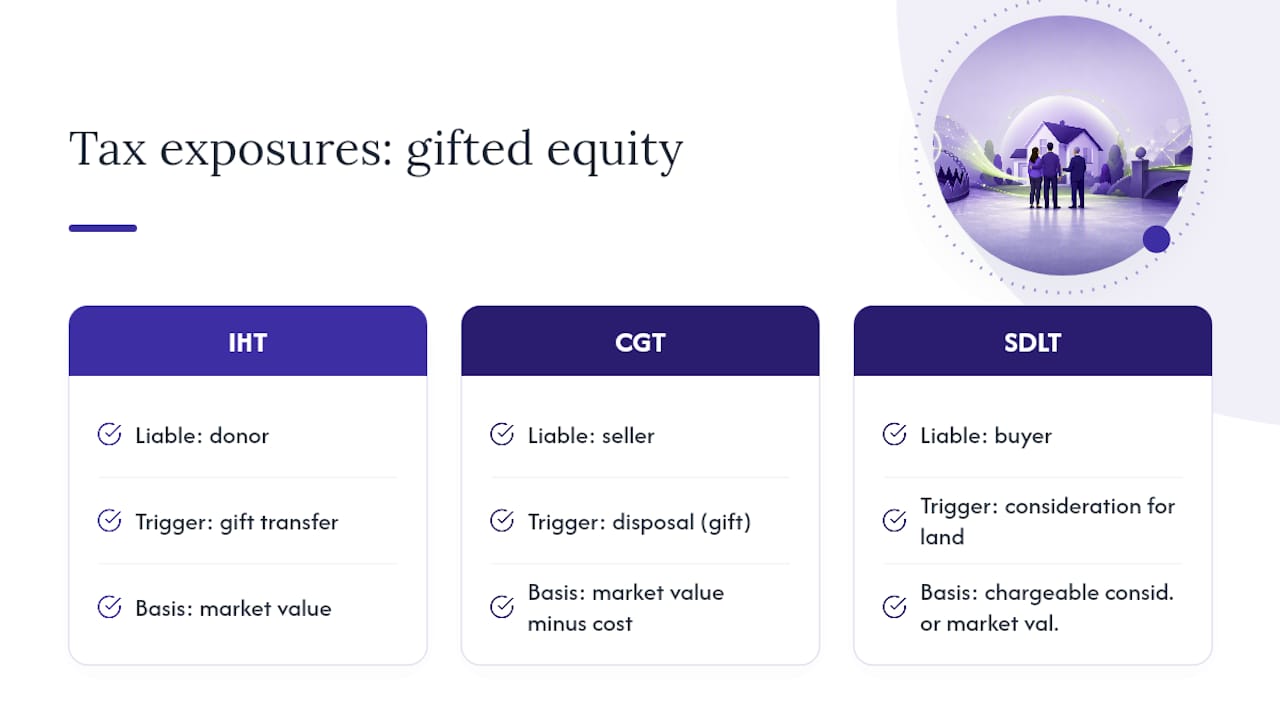
Gifted equity transactions have implications across multiple tax regimes, and missing any one of them can lead to costly issues.
Inheritance Tax and the seven-year rule
HMRC treats a gift of equity as a Potentially Exempt Transfer for Inheritance Tax purposes. If the donor dies within seven years of making the gift, its value can be brought back into their estate for IHT calculation, with the tax rate tapering down the longer the donor survives after the gift. A gift made six years and eleven months before death is treated very differently to one made six years and one month before death, so timing matters more than most families realise.
There’s a further trap here. If the donor continues living in the property after the sale without paying a market rent, HMRC can treat this as a “reservation of benefit,” which can nullify the IHT advantage of the gift entirely, effectively treating the property as still belonging to the donor’s estate.
Capital Gains Tax exposure for the seller
This is the piece families most commonly overlook. Even though no cash changes hands for the discounted portion, HMRC values the disposal at full market value for Capital Gains Tax purposes whenever the sale is to a connected person, such as a child or grandchild. The seller is taxed as if they’d sold at market value, not at the discounted price actually agreed.
Private Residence Relief usually shelters this if the property being sold has been the donor’s only or main home throughout ownership. But if the property being gifted is a second home, an inherited property, or a former buy-to-let, the seller could face a real CGT bill despite receiving less money than the property is worth. This is precisely why independent advice for the seller matters just as much as advice for the buyer.
Stamp Duty Land Tax on the buyer’s side
SDLT calculation surprises a lot of buyers in gifted equity deals. Rather than being based on market value, SDLT is generally charged on the actual consideration paid by the buyer, which in most cases is the discounted price, not the full valuation.
There’s a critical exception: if the buyer takes over an existing mortgage on the property as part of the transaction, that assumed mortgage debt counts as consideration for SDLT purposes and gets added to the cash price paid. This can push the SDLT bill up considerably, sometimes catching buyers who assumed the discount alone determined their liability.
Steps worth raising with your solicitor and tax adviser:
- Confirm whether Private Residence Relief will apply to the seller’s disposal.
- Establish the exact SDLT base, including any mortgage debt being assumed.
- Discuss whether repaying the seller’s existing mortgage before transfer might reduce the buyer’s SDLT exposure.
- Document the transaction date clearly for the IHT seven-year clock to start running.
Legal steps: solicitors, declarations and protecting both sides
Because buyer and seller are related, the temptation to save money by sharing one solicitor is understandable but risky. Their interests genuinely diverge once tax and future ownership questions arise.
- Instruct separate solicitors. Advisers generally stress that both parties should receive independent legal advice, confirming the gift is unconditional and that neither side has been pressured into terms they don’t understand. One solicitor cannot properly advise both a seller facing a potential CGT bill and a buyer relying on that seller’s goodwill.
- Consider a Declaration of Trust where appropriate. This records each party’s beneficial interest in the property without creating a registered charge against it, useful where a donor wants some recognition of their contribution without it functioning as a loan that could jeopardise the buyer’s affordability assessment.
- Address occupation carefully if the donor plans to stay on. If parents intend to keep living in the property after selling it to their child, that arrangement needs formal structuring, whether through a market-rent tenancy or a clearly time-limited occupation agreement, to avoid the reservation-of-benefit trap.
- Supply documentation early. Donor bank statements, the gift letter, and solicitor confirmations of independent advice should all be gathered well before the target completion date, since gathering them under pressure late in the process is where most delays creep in.
Risks and pitfalls: what actually goes wrong
Most gifted equity transactions complete without drama, but the failures that do happen tend to follow familiar patterns.
- Undisclosed loans dressed up as gifts. If a donor expects repayment, even informally, and this isn’t disclosed, the lender has been misled about the buyer’s true financial position, which is mortgage fraud, not a technicality.
- Contacting the lender too late. Not every lender accepts concessionary purchases, and discovering this after instructing solicitors and paying for a valuation wastes real money.
- Ignoring the seller’s tax position entirely. Sellers who don’t take advice on CGT sometimes only discover a liability exists once HMRC’s self-assessment deadline is looming.
- Assuming a Declaration of Trust fixes every risk. It records beneficial shares; it does not prevent IHT clawback if the donor dies within seven years, and it does not automatically protect against relationship breakdown between the parties.
Pro Tip: Write “this gift carries no expectation of repayment and no future claim on the property” into the gift letter in plain terms. Vague wording is the single most common reason lenders send documentation back for revision.
Checklist: what to prepare before you apply
Gather these before approaching a lender, and the application moves considerably faster.
- Gift letter stating donor details, relationship, amount or percentage gifted, property address, and an explicit no-repayment clause.
- Donor bank statements covering at least three to six months, showing the source of funds or equity clearly.
- Existing mortgage statements if the seller has a mortgage being repaid or assumed as part of the sale.
- Proof of identity and relationship for both buyer and donor, particularly important where gift funds for the mortgage originate from overseas.
- Separate solicitor instructions confirmed for both buyer and seller before exchange.
- Lender policy check completed, ideally through a broker, confirming the specific lender accepts concessionary purchases at the discount level involved.
- Tax advice booked early enough that CGT, SDLT, and IHT positions are understood before contracts are signed, not after.
How Prosper Home Loans supports gifted equity applications
Gifted equity cases sit outside standard lending criteria, which is exactly why a whole-of-market broker earns their fee here. We check which lenders currently accept concessionary purchases at your specific discount level, help you assemble the gifted deposit letter and donor evidence a lender will actually accept first time, and flag early where an insolvency indemnity policy might be needed. Our guide on what a whole-of-market broker does explains this matching process in more detail. We also coordinate with your solicitor and, where useful, refer you to a tax adviser so the IHT, CGT, and SDLT positions are settled before you’re locked into a completion date.
The conventional advice on gifted equity misses the real risk

Most guidance on gifted equity fixates on the buyer’s deposit problem and treats the tax questions as an afterthought. That’s backwards. The lender paperwork, however fiddly, is procedural and predictable. The genuine risk sits with the seller’s Capital Gains Tax exposure and the donor’s Inheritance Tax position, both of which get discovered too late in far too many family transactions.
Our view: get separate tax advice for the seller before agreeing a discount figure, not after. The size of the discount should be set with CGT and IHT consequences already understood, rather than negotiated first and taxed as an afterthought. Families also underestimate how much a Declaration of Trust cannot do, particularly around reservation of benefit if a parent stays living in the property. Prioritise the seller’s tax exposure first, the occupation question second, and the mortgage mechanics third. Get those three in the right order and the lender documentation, while thorough, rarely derails a well-planned transaction.
— Paul
Get tailored advice on your gifted equity purchase
Prosper Home Loans is an independent, whole-of-market broker, meaning we compare lenders’ concessionary purchase policies side by side rather than steering you towards a single provider’s standard product range. That matters enormously in gifted equity cases, where discount caps, family-relationship rules, and indemnity insurance requirements vary significantly from one lender to another, and getting matched to the wrong one wastes weeks.

If you’re planning a family sale below market value, whether that’s a parent downsizing to their child or a wider family arrangement, we’ll review your circumstances, identify which lenders currently accept your discount level and family relationship, and help you assemble a gifted deposit letter that won’t bounce back from underwriting. We also work alongside sub-contractors, self-employed applicants, and first-time buyers navigating this alongside other complications, such as an existing secured loan affecting a property sale. Get in touch through Prosper Home Loans for an initial review of your gifted equity plan before you approach a lender directly.
This article is general information, not a substitute for advice from a qualified financial advisor. Consult a qualified financial professional about your own circumstances before acting on anything here.
Sources
- Gifted Deposit and Gifted Equity Explained — Helping a Family Member Buy a Property | Property Passport UK
- Gov
- Can I Buy My Parents’ House? A Comprehensive Guide to Family Property Transfers | Gorvins Residential LLP
Recommended
