Get a UK Contractor Mortgage With Bad Credit: Use Day Rate Evidence

Yes, contractors with bad credit can get a mortgage, though your options narrow and pricing usually rises. The best first move is to speak with a specialist contractor broker and gather your contracts, bank statements and credit reports before applying. Lenders will weigh how severe and recent your adverse credit is, how established your current contract looks, and how well you can evidence income.
TL;DR:
- Contractors with bad credit can still access mortgages, but options are limited, and interest rates typically increase by 1 to 3 percent depending on severity.
- Specialist lenders favor documented contracts, bank statements, and proven income stability, often requiring three to twelve months remaining on current contracts.
- A larger deposit, such as 15 or 20 percent, significantly improves pricing and broadens lender choices, especially for adverse credit cases.
- Reconciling credit reports, settling defaults, and maintaining low credit utilization before applying can greatly boost mortgage chances and reduce application challenges.
- Using a regulated broker to pre-assess eligibility through soft searches minimizes unnecessary credit impacts and increases the likelihood of timely approval.
Table of Contents
- Why specialist contractor underwriting matters
- How bad credit changes your options: panels, pricing and deposits
- Documents and evidence lenders routinely ask for
- Practical steps to improve your mortgage chances before applying
- Applying: how the process differs for adverse contractor cases
- Remortgage and buy-to-let considerations for contractors with bad credit
- How Prosperhomeloans helps contractors with adverse credit
- A contractor case, and what it taught us
- How Prosperhomeloans can help you now
- Sources
Why specialist contractor underwriting matters
Standard high street underwriting was never built with contractors in mind. Most lenders want two years of accounts or PAYE payslips, which penalises anyone paid through day-rate contracts rather than a salary.
Specialist lenders take a different view. They can annualise your day rate rather than relying purely on your accounts, multiplying your rate by a typical working week and then by 46 to 48 weeks a year. This often produces a higher borrowing figure than accounts-based assessment alone, particularly if you’ve only recently gone contracting or your accountant has minimised profit for tax efficiency.
If you work inside IR35 through an umbrella company, lenders generally treat your income much like PAYE, so payslips and standard employment evidence carry the case. Outside IR35, contract-based evidence does the heavy lifting.
Most specialist lenders want to see at least three months remaining on your current contract, though six to twelve months makes underwriters considerably more comfortable. A letter confirming likely contract renewal or upcoming work strengthens a borderline case.
To present your contracting history convincingly, have ready:
- Signed contracts showing start and end dates, day rate and the contracting parties
- Extension letters or agency confirmation of renewed terms
- Business bank statements showing consistent day-rate receipts matching your contract value
- A NatWest-style breakdown of tax returns and accounts if you also draw dividends
How bad credit changes your options: panels, pricing and deposits
Adverse credit doesn’t close the door, but it does shrink the room you’re working in. Lenders assess events by type, age and whether they’ve been satisfied, so a defaulted mobile phone bill from four years ago is treated very differently to an unsatisfied CCJ registered last month.
Combining contractor income assessment with adverse credit narrows your lender panel considerably, and rate uplifts of roughly 1 to 3 percent above clean contractor pricing are common depending on severity.
Roughly, expect these tiers, though every lender weighs cases individually:
- Near-prime cases (satisfied defaults, no CCJs, minor missed payments over a year old) often see the smallest pricing penalty
- Moderate adverse cases (satisfied CCJs, a recent default) sit in a mid-tier bracket with fewer lenders and noticeably higher rates
- Heavy adverse cases (multiple unsatisfied CCJs, a discharged bankruptcy, or an active DMP) access only a handful of specialist lenders, often at higher rates and lower maximum loan-to-value
Specialist adverse contractor lenders don’t advertise on comparison sites and rarely deal directly with the public. They distribute through brokers only, which is part of why going direct so often ends in a decline rather than a conversation.
The most reliable lever you control is deposit size. Moving from 10% to 15% or 20% deposit frequently unlocks better pricing and a wider panel, because lower loan-to-value reduces the lender’s exposure if your circumstances change.
Documents and evidence lenders routinely ask for
Contractors with adverse credit face a heavier paperwork load than a straightforward PAYE applicant, because underwriters need to satisfy themselves on both income and risk. Before approaching a broker, aim to have:
- Signed contracts clearly showing day rate, contract dates and the contracting parties
- Extension letters or future work evidence, since a strong pipeline reassures underwriters your income won’t dry up mid-term
- Business bank statements covering three to six months, showing day-rate payments landing consistently
- Payslips, if you work through an umbrella company under IR35
- Tax returns and company accounts, including dividend evidence if you pay yourself that way
- Full credit reports from Experian, Equifax and TransUnion, plus proof that any CCJ or default has actually been satisfied
- ID documents and proof of deposit source, including a signed declaration if any part of the deposit is gifted, or sale paperwork if it’s coming from a property sale
Our guide to subcontractor mortgage documents walks through examples of acceptable contracts and bank statement formats in more depth.
Practical steps to improve your mortgage chances before applying
You have more control over this process than most contractors assume. A handful of deliberate actions in the months before applying can genuinely widen your options.
- Pull all three credit files and check them line by line; errors on a credit report are more common than people expect, and getting one corrected in writing before you apply avoids a mid-application shock
- Where a CCJ or default can be settled, do it and get formal proof of satisfaction, since a satisfied entry is viewed far more favourably than an outstanding one
- Register on the electoral roll if you haven’t already, as lenders use it to verify your identity and address history
- Keep credit utilisation low, avoid taking out new credit in the months before applying, and never use payday lending, which specialist underwriters flag heavily
- If your deposit is thin, saving a larger one or discussing a guarantor arrangement with your broker can shift you into a better pricing tier
Pro Tip: Every hard credit search leaves a mark that other lenders can see. Let one broker run a soft, whole-of-market assessment first, so you only face a full search with the lender most likely to say yes.
Applying: how the process differs for adverse contractor cases
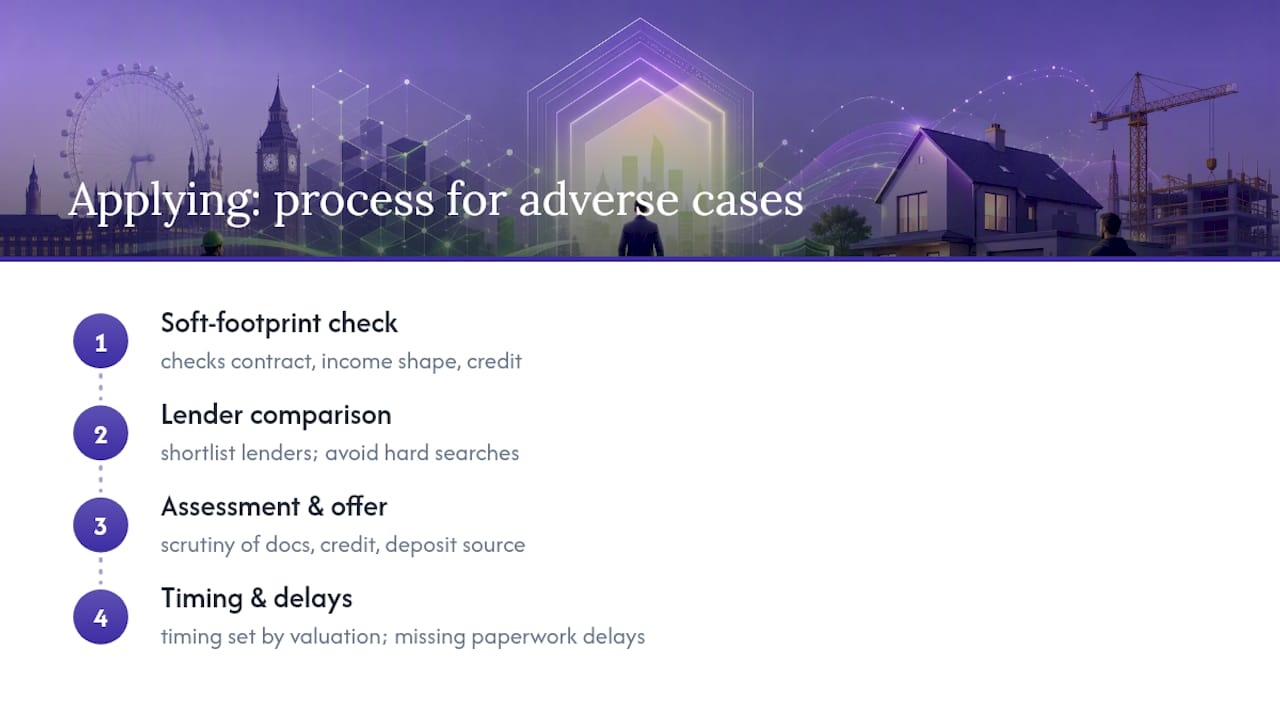
A specialist broker typically starts with a soft-footprint assessment, checking your contract, income shape and credit file against several lenders before anyone runs a hard search. That single step avoids the multiple-application spiral that damages so many contractor applications.
From there, expect an assessment and offer process that involves scrutiny of your documentation, credit history, contracts, and deposit source, with timing dependent on valuation and paperwork submission.
Delays usually come from missing paperwork rather than the adverse credit itself, which is precisely why preparation matters more here than for a standard PAYE case.
Remortgage and buy-to-let considerations for contractors with bad credit
Remortgaging with adverse credit works differently to a purchase, because your existing equity does a lot of the persuading. The more equity you hold, the more comfortable specialist lenders feel, even where credit history is patchy.
Buy-to-let applications add another layer. Lenders assess rental cover ratios rather than personal income alone, and many adverse-credit buy-to-let products are structured through limited companies rather than personal names, which changes both the tax treatment and the underwriting criteria.
- A Debt Management Plan or IVA can block mainstream remortgage routes entirely, since most high street lenders decline outright while one is active
- Specialist lenders exist for DMP and IVA cases, though the panel is small and rates reflect the higher perceived risk
- Our detailed piece on remortgaging with a DMP sets out the realistic routes available if you’re in this position
How Prosperhomeloans helps contractors with adverse credit
Our role is straightforward: match your contracting income and your credit history to the specific lenders on our panel that underwrite both well, rather than sending you into a high street process built for salaried applicants. As a whole-of-market broker, Paul can access intermediary-only products that never appear on comparison sites.
Before recommending you submit anywhere, Paul typically checks:
- Your contract length, rate and continuity against each lender’s minimum criteria
- The age, type and satisfaction status of every adverse credit entry
- Your deposit size against the loan-to-value bands each specialist lender offers
- Whether documentation gaps (missing bank statements, unsigned contracts) need resolving first
If you’re exploring related routes, our articles on subcontractor mortgage documents, remortgaging with a DMP, and Help to Buy for subcontractors cover the practical detail behind each scenario.
A contractor case, and what it taught us
His accountant’s figures alone wouldn’t have supported the purchase he wanted. Annualising his day rate against a signed twelve-month contract changed that picture entirely, and a specialist lender approved him within six weeks once his default satisfaction letter came through.
The lesson holds broadly: timing and paperwork decide outcomes more than the credit blemish itself. Contractors who prepare their satisfaction letters and contract evidence before applying move faster and get better pricing than those who apply first and fix things mid-process.
— Paul
How Prosperhomeloans can help you now
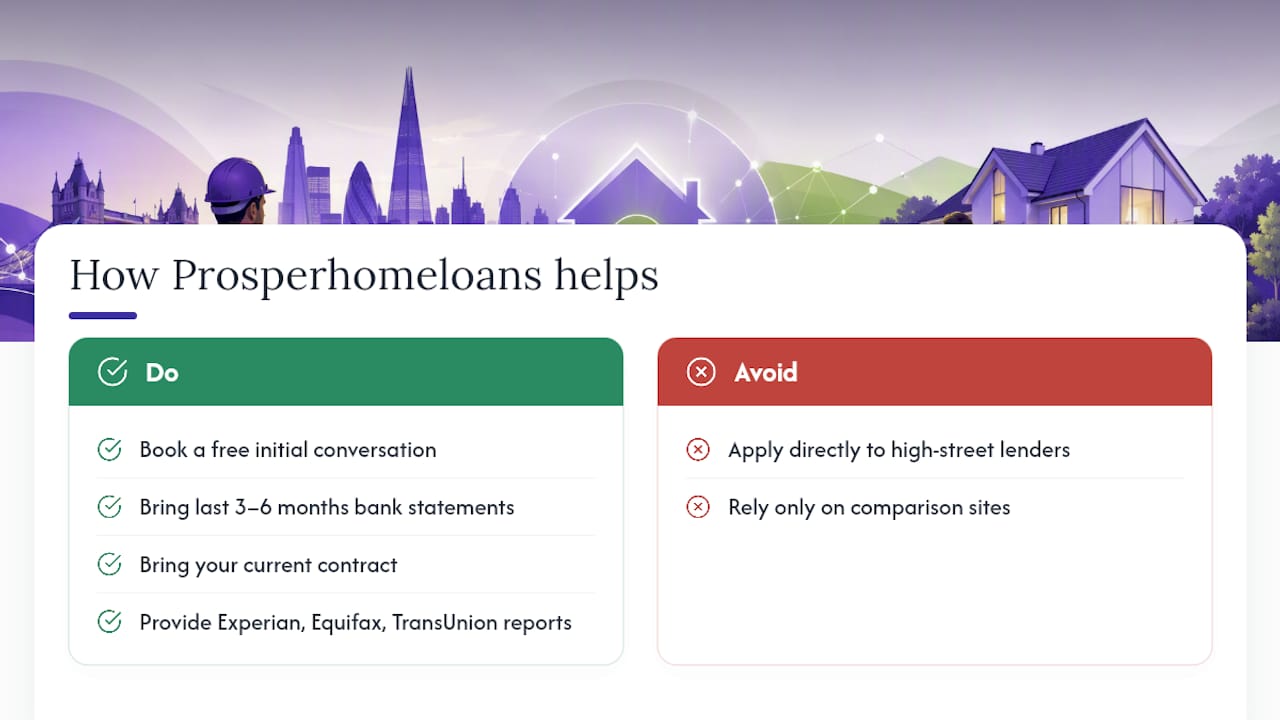
There are other ways to approach an adverse contractor mortgage: going direct to a single high street lender, or trying comparison sites that rarely reach intermediary-only products. Both routes tend to end the same way for contractors with bad credit, in decline letters and wasted credit searches. Prosperhomeloans exists to stop that from happening to you.

A free initial conversation with Paul costs nothing and commits you to nothing. Bring your last three to six months of bank statements, your current contract, and copies of your Experian, Equifax and TransUnion reports if you have them, and we’ll give you an honest read on where you stand. Because many of the lenders best suited to contractor and adverse credit cases only deal through regulated intermediaries, going it alone often means missing the products actually built for your situation. Prosperhomeloans is directly authorised, giving you the regulatory protection that comes with FCA-regulated advice.
Ready to find out what’s realistically available to you? Start your mortgage conversation with Prosperhomeloans and get a clear picture of your options.
Sources
For readers who want to check the detail themselves, Experian’s guide to self-employment and credit explains how credit files work for contractors, while NatWest’s self-employed mortgage guide sets out standard documentation expectations. You can verify any broker’s permissions on the FCA register, and check a limited company’s trading history via Companies House.
This article is general information, not a substitute for advice from a qualified financial advisor. Consult a qualified financial professional about your own circumstances before acting on anything here.
- Does being self‑employed affect your credit? | Experian
- Mortgages for contractors with bad credit — First Rung Now
Recommended
