UK treasury bonds: guide for private investors

A UK treasury bond, better known in the market as a gilt, is a sterling loan you make to HM Treasury in exchange for regular interest and your money back at a fixed maturity date. Gilts suit investors who want reliable income and very low default risk, though their prices still move when interest rates change, sometimes sharply.
To act on that today:
- Check live prices and yields via the Debt Management Office (DMO) or a market-data provider such as the Financial Times.
- The simplest buying route for most people is through a broker like Hargreaves Lansdown, held inside an ISA to shelter the interest from tax.
Key Takeaways
Gilts deliver low-default-risk income for UK investors, but price and real return depend entirely on interest-rate direction, inflation, and the tax wrapper you hold them in.
| Point | Details |
|---|---|
| Check two sources first | Use the DMO for auctions and issuance, and the FT or TradingEconomics for live yields and charts. |
| Understand price-yield inversion | Rising Bank of England rates typically push existing gilt prices down, and vice versa. |
| Match duration to your timeline | Shorter-dated gilts suit near-term goals; longer ones carry bigger price swings before maturity. |
| Use an ISA wrapper | ISAs shelter gilt interest and gains from tax, a meaningful edge over a taxable account. |
| Choose type by inflation view | Conventional gilts suit stable-inflation expectations; index-linked gilts protect against inflation surprises. |
Table of Contents
- What is a UK treasury bond (gilt) and what types exist?
- How are gilt prices and yields quoted?
- How do you buy UK government bonds?
- How do you value a gilt and manage interest-rate risk?
- What are the main risks and tax rules for gilt investors?
- Where can you track live gilt prices and yields?
- How do you buy at auction and what does the calendar look like?
- How do interest rates and fiscal policy move gilt yields?
- How do index-linked gilts protect against inflation?
- How liquid is the gilt secondary market?
- Where do gilts fit in a household portfolio?
- Where to check gilt data and prices
- Frequently asked questions
- Sources
What is a UK treasury bond (gilt) and what types exist?
A gilt is a sterling-denominated liability issued by HM Treasury and usually listed on the London Stock Exchange (LSE). Prices are quoted per £100 nominal value, which is the amount you get back at maturity regardless of what you paid to buy it.
Three main instruments cover most of what a private investor will encounter:
- Conventional gilts pay a fixed coupon twice a year and return the £100 nominal at a set maturity date, the simplest and most common type.
- Index-linked gilts adjust both the coupon and the principal in line with inflation, protecting real purchasing power at the cost of a lower headline yield.
- Treasury bills are short-term instruments, typically maturing in a month to a year, issued through weekly tenders rather than the longer gilt auction calendar.
Before reading any live quote, it helps to know five terms: the coupon (the fixed annual interest rate paid on the nominal value), redemption value (the £100 you get back at maturity), accrued interest (interest earned since the last payment date but not yet paid), yield to maturity (the total annualised return if held to redemption), and the distinction between real and nominal yields, which matters enormously once inflation-linked gilts enter the picture.
How are gilt prices and yields quoted?
Every gilt price you see is quoted per £100 nominal, so a price of “£98.50” means you pay £98.50 for every £100 of face value you eventually get back. That price sits below or above £100 depending on how the fixed coupon compares with current market interest rates.
Three yield figures matter, and conflating them is the most common mistake new gilt investors make. Current yield is simply the coupon divided by the price, a rough income snapshot. Yield to maturity (YTM) is more useful: it accounts for the coupon, the price paid, and the capital gain or loss you’ll realise at redemption. For index-linked gilts, you also need to separate nominal yield from real yield, since the inflation uplift on the principal isn’t captured in the quoted coupon alone.
Statistic callout: Gilt prices and interest rates move in opposite directions almost mechanically. Market analysis confirms that when the Bank of England raises its policy rate, existing fixed-rate gilt prices typically fall, because new issuance at higher rates makes older, lower-coupon gilts less attractive unless their price drops to compensate.
Here’s a worked example of reading a quote. You’re paying below par (£100) because market rates have risen since issue, so the price fell to bring the effective yield up closer to today’s rates. Add in accrued interest: if the gilt is sold 30 days after its last coupon payment, the seller is due roughly 30/365 of the annual coupon on top of the quoted price. This is why the cash price you actually pay (called the “dirty price”) is always the clean quoted price plus accrued interest. Gilts also carry an ex-dividend date: buy after this point and the next coupon goes to the seller, not you, which is reflected in a lower price.
How do you buy UK government bonds?
Three routes exist, and which one suits you depends on how hands-on you want to be.
- Primary auctions run by the DMO, which publishes a financing remit and auction calendar setting out issuance dates. Direct participation is technically possible but is generally structured for institutional investors known as Gilt-edged Market Makers; most individuals access new issuance indirectly through intermediaries.
- Secondary market purchases through a broker or platform with LSE access, buying gilts already in circulation at the current market price.
- Funds and ETFs that hold baskets of gilts, a simpler option if you don’t want to manage individual maturities or reinvestment yourself.
Whichever route you choose, holding gilts inside an ISA is usually the most tax-efficient wrapper, since ISAs shelter both interest and capital growth from income tax and capital gains tax in most circumstances.
Before you commit funds, confirm the following with your broker or platform:
- Commission or dealing charges per trade.
- The bid/ask spread, which widens for less liquid, longer-dated gilts.
- Settlement mechanics, typically through CREST, and the expected settlement date.
How do you value a gilt and manage interest-rate risk?
Two metrics do the heavy lifting for professional and serious private investors alike: duration and convexity. Duration (specifically modified duration) measures how sensitive a gilt’s price is to a change in interest rates, expressed roughly as the percentage price change for a 1%) shift in yields.
Statistic callout: As a working rule, a gilt with a modified duration of 8 will lose approximately the same percentage of its price as the yield change in points, and gain roughly the same if yields fall by 1 point. Longer-dated gilts carry higher duration and therefore greater price swings than short-dated ones, all else being equal.
Convexity refines that estimate for larger yield moves. Duration alone slightly understates gains and overstates losses when rates swing a long way, because the actual price/yield relationship curves rather than moves in a straight line. For most private investors, knowing that convexity exists and that it works in your favour on big moves is sufficient; the precise calculation is best left to portfolio tools or your adviser.
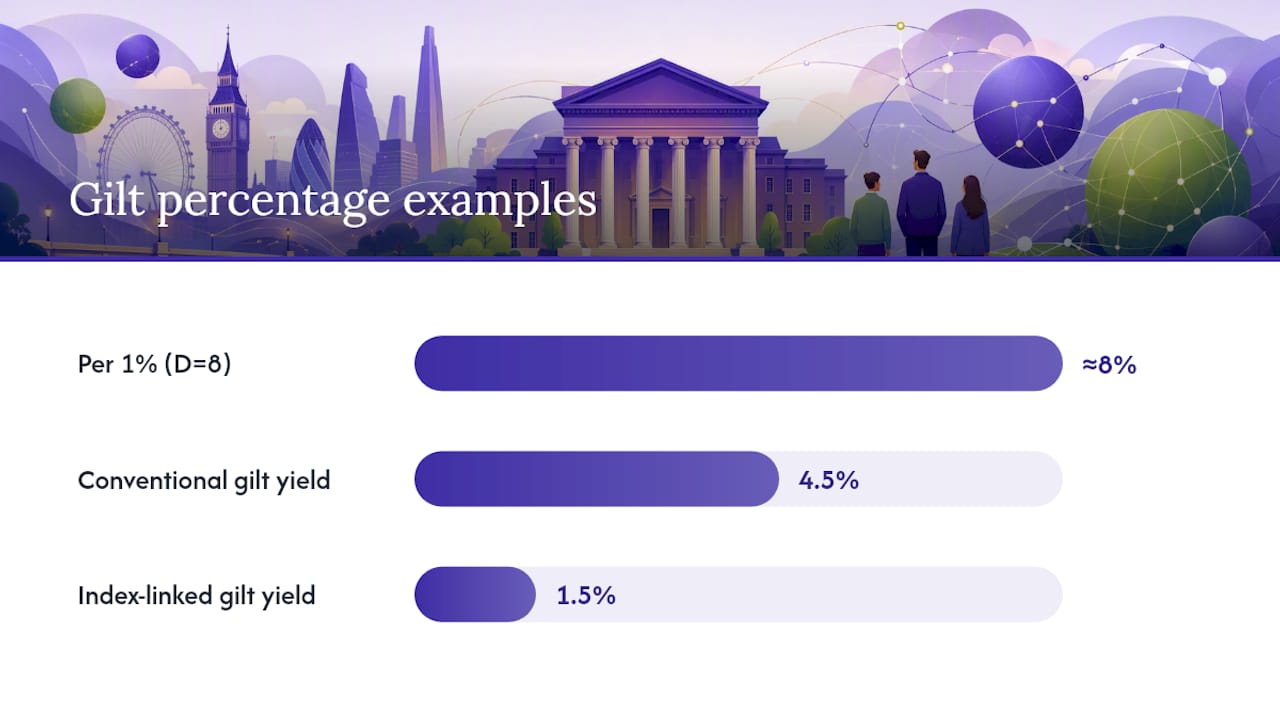
The real versus nominal distinction matters just as much. A conventional gilt yielding 4.5% looks attractive until you subtract inflation; an index-linked gilt yielding a lower headline 1.5% but with inflation-adjusted principal can outperform in real terms if inflation runs hot. This is why gilts are often called “risk-free” only in terms of default: the near-certainty of getting your money back at maturity says nothing about what that money will actually buy.
Pro Tip: Match the gilt’s maturity to when you’ll actually need the cash. If you’re saving for a house deposit in three years, a gilt maturing in three years removes the guesswork, whatever happens to prices in between.
- Short duration: lower price sensitivity, lower long-term yield typically.
- Long duration: higher price sensitivity, potential for greater capital gains or losses before maturity.
- Holding to maturity sidesteps interim price volatility entirely, since you’ll receive the full £100 nominal regardless of market swings along the way.
What are the main risks and tax rules for gilt investors?
Interest-rate risk is the big one: sell a gilt before maturity when rates have risen since you bought it, and you’ll likely take a capital loss, even though the gilt itself hasn’t defaulted. Inflation risk hits conventional (non-index-linked) gilts hardest, since a fixed coupon buys progressively less if prices rise faster than expected. Liquidity risk is smaller but real, particularly for older, smaller gilt issues where the bid/ask spread can widen noticeably during volatile markets.
On tax, the position for UK taxable accounts is more favourable than many investors assume, since most of the return on a low-coupon gilt bought below par comes as a capital gain, which is exempt from capital gains tax on gilts specifically. Interest, however, is taxable outside a wrapper. Holding gilts in an ISA removes this complexity entirely and is worth checking against HMRC’s own guidance for your specific circumstances.
Compared with corporate bonds, gilts sit at the lower end of the credit risk spectrum, backed by the UK government rather than a company’s balance sheet. Corporate bonds typically offer a higher yield to compensate for that extra credit risk, plus additional exposure to the issuing company’s specific financial health. Supranational bonds, issued by bodies like the World Bank, sit somewhere between the two on credit quality but often trade with lower liquidity than gilts in the UK market.
- Interest-rate risk: capital value falls if you sell before maturity during a rising-rate environment.
- Inflation risk: fixed coupons on conventional gilts lose real value if inflation runs above expectations.
- Liquidity risk: wider spreads on smaller or older issues, especially in stressed markets.
- Tax treatment: ISA wrappers shelter both income and gains; taxable accounts benefit from CGT exemption on gilts but still tax interest.
Where can you track live gilt prices and yields?
Four sources cover almost everything a private investor needs, each suited to a different job.
- The DMO is the definitive source for auction schedules, tender results and official technical notes on gilts and Treasury bills.
- The LSE carries the actual traded price listings for gilts in the secondary market.
- The Financial Times offers accessible live yield quotes and historical charts, useful for tracking the 10-year gilt yield at a glance.
- TradingEconomics and similar market-data providers consolidate yield tables and historical series, handy for spotting trends over months or years.
- Broker platforms like Hargreaves Lansdown show tradable prices alongside the dealing costs you’ll actually pay.
Most free feeds carry a short delay rather than true real-time pricing; if you’re trading actively rather than just monitoring, check whether your broker’s own dealing screen shows live prices before you place an order.
How do you buy at auction and what does the calendar look like?
The DMO runs gilt auctions on a published schedule, releasing its financing remit at the start of each fiscal year and updating the auction calendar as issuance needs evolve. Auctions typically happen weekly or fortnightly, spread across a mix of short, medium and long-dated conventional gilts, plus periodic index-linked auctions.
The mechanics work through a uniform-price or multiple-price tender system depending on the gilt type, where Gilt-edged Market Makers (the primary dealers) submit competitive bids for the amount and price they’re willing to pay. Non-competitive bidding allows smaller allocations to be filled at the average accepted price, though this route is structured mainly for institutional and eligible private client participation rather than the general public buying directly online.
For Treasury bills specifically, the DMO runs weekly tenders, and historical tender results are published showing the amounts issued and yields achieved. This gives a useful real-time read on short-term interest-rate expectations, since T-bill yields react quickly to anticipated Bank of England moves.
For the vast majority of private investors, the practical takeaway is that auction access matters less than it sounds. New gilts flow into the secondary market almost immediately after issuance, and buying through a broker days or weeks after an auction gets you the same instrument at a market-clearing price, without navigating the tender process directly.
How do interest rates and fiscal policy move gilt yields?
Gilt yields respond to two forces more than anything else: what the Bank of England is expected to do with interest rates, and how much new debt the government plans to issue. Central-bank signals and fiscal issuance expectations are widely seen as the dominant drivers of short-to-medium-term gilt price movements, more so than most other single factors.
When the Bank of England signals rate rises are coming, gilt yields tend to climb in anticipation, pushing existing gilt prices down before any actual rate change happens. Markets price in expectations, not just announcements. The reverse holds during periods when rate cuts look likely.
Fiscal events matter just as much. A government budget that signals higher borrowing than markets expected typically pushes yields up, since more gilt supply usually needs to find buyers at a more attractive price. HM Treasury’s annual debt management report sets out issuance strategy and outstanding stock levels, giving a useful read on how much new supply is coming and across which maturities. Larger issuance programmes at the long end of the curve, for instance, tend to put more upward pressure on long-dated gilt yields specifically, rather than affecting the whole curve evenly.
How do index-linked gilts protect against inflation?
Index-linked gilts adjust both the coupon payment and the principal repaid at maturity in line with movements in the Retail Prices Index (RPI), the inflation measure the UK’s index-linked gilt programme has historically used. Instead of a fixed coupon on a fixed £100 nominal, both figures scale up (or theoretically down) as the index moves.

Here’s the mechanic in practice: if you hold an index-linked gilt with a 1% real coupon and inflation runs at 3% over a year, the nominal value of your principal effectively rises with that 3%, and your coupon payment is calculated on the inflated principal, not the original £100. Over the life of a long-dated index-linked gilt, this compounding effect on the principal can be substantial if inflation runs persistently above expectations.
The trade-off is a lower starting real yield compared with the nominal yield on a conventional gilt of similar maturity. You’re paying, in effect, an insurance premium against inflation surprising to the upside. If inflation turns out lower than the market priced in, a conventional gilt would have delivered a better return; if inflation runs hotter than expected, the index-linked gilt wins. This is precisely why comparing headline yields between the two types without adjusting for inflation expectations is one of the more common analytical mistakes among newer gilt investors.
How liquid is the gilt secondary market?
Gilts are among the most liquid fixed-income instruments in the UK market, particularly benchmark issues at popular maturities like 5, 10 and 30 years, where trading volumes stay high and bid/ask spreads remain tight even during volatile sessions.
Liquidity thins noticeably away from these benchmark points. Older gilts nearing maturity, smaller “off-the-run” issues, and some index-linked gilts with less trading interest can carry wider spreads, meaning you might pay a slightly worse price to buy or sell quickly. This matters more if you’re trading in size or need to exit a position on short notice; for a buy-and-hold private investor planning to reach maturity, day-to-day liquidity swings matter far less.
Trading happens primarily through Gilt-edged Market Makers who quote prices continuously on the LSE, with brokers and platforms accessing this liquidity on behalf of retail clients. During periods of market stress, spreads across the whole gilt market can widen temporarily, a pattern seen in most government bond markets globally when volatility spikes and market makers price in extra risk to hold inventory.
Where do gilts fit in a household portfolio?
Gilts sit naturally in the lower-risk slice of most portfolios, offering income and capital preservation rather than growth, alongside sensitivity to Bank of England policy that few other assets share so directly. That sensitivity is exactly why they diversify well against equities during growth scares.
If you’re dealing with large sums, complex tax positions, or want to hedge a specific future liability with duration matching, that’s the point to bring in an adviser rather than going it alone. A conversation about how gilts interact with your wider mortgage and protection planning, explored further here, is worth having before committing significant capital.
Where to check gilt data and prices
- DMO: auction calendar, tender results, official technical notes.
- LSE: live traded gilt prices.
- Financial Times: yield quotes and historical charts.
- gov.uk: debt management reports and issuance strategy.
- TradingEconomics: consolidated yield tables for quick trend checks.
Frequently asked questions
What is the difference between a gilt and a UK treasury bond? They’re the same thing. “Gilt” is the UK market’s own term for what is generically called a UK treasury bond, distinguishing it from US Treasury bonds or other sovereign debt.
Are UK treasury bonds a safe investment? Default risk is very low since gilts are backed by HM Treasury, but prices can still fall if you sell before maturity during a period of rising interest rates, so “safe” doesn’t mean “price-stable”.
How do I buy UK government bonds as a private investor? Most individuals buy through a broker or platform offering LSE access, ideally within an ISA for the tax benefits, rather than bidding directly at a DMO auction.
What’s the current UK bond yield on a 10-year gilt? Yields change daily with market conditions, so check a live feed such as the Financial Times gilt tearsheet for the current figure rather than relying on a fixed number.
Do index-linked gilts always beat conventional gilts? No. They outperform when inflation runs higher than the market expected at purchase, but underperform if inflation comes in lower than priced in, since you accepted a lower starting real yield as the trade-off.
Can I lose money on a gilt held to maturity? Not in nominal terms. You’ll receive the full £100 nominal value back regardless of price swings in between, though inflation can still erode the real value of that fixed sum over a long holding period.
This article is general information, not a substitute for advice from a qualified financial advisor. Consult a qualified financial professional about your own circumstances before acting on anything here.
Sources
Recommended
