ISA investments: stocks and shares ISA guide 2026

An ISA is a tax-free wrapper that shelters your savings and investments from UK income tax and capital gains tax. A stocks and shares ISA specifically protects dividends, interest, and capital gains from HMRC, meaning every pound of growth stays in your pocket rather than being reduced by tax. For anyone with a long-term investment horizon, typically five years or more, it is one of the most efficient structures available to UK investors.
Here is what you need to know at a glance:
- Who can open one: UK residents aged 18 or over (16 for a cash ISA). Crown employees serving abroad and their spouses also qualify.
- Annual allowance: The overall ISA subscription limit for 2026–27 is £20,000, shared across all ISA types you hold.
- Best suited to: Long-term investors comfortable with market fluctuations who want tax-efficient growth over five or more years.
- Multiple same-type subscriptions: Since April 2024, you can subscribe to more than one ISA of the same type in a single tax year, provided your total contributions stay within the £20,000 limit.
The sections below cover what you can hold inside a stocks and shares ISA, how the tax shelter works in practice, what fees to expect, and how to open or transfer one.
Key takeaways
A stocks and shares ISA is the most tax-efficient wrapper for long-term UK investors, sheltering dividends and capital gains from HMRC while giving you access to a wide range of qualifying investments.
| Point | Details |
|---|---|
| Annual allowance is £20,000 | The overall ISA subscription limit for 2026–27 is £20,000, shared across all ISA types. |
| Stocks & shares ISAs suit long-term growth | A five-year-plus horizon is recommended to manage market volatility and benefit from compounding. |
| Fees compound over time | Compare total cost of ownership (platform fee plus fund OCF), not just the headline platform rate. |
| ISAs do not shelter from IHT | ISA assets form part of your estate; surviving spouses can inherit your allowance via an APS. |
| 2026 rule changes matter | LTAFs are now permitted in stocks and shares ISAs; cETNs are restricted to IFISAs from 6 April 2026. |
For your next step, revisit the practical checklist in the section above and use our ISA rates guide to compare current options.
Table of Contents
- What are the four main ISA types and which suits you?
- How does the ISA tax shelter actually work?
- What can you actually hold inside a stocks and shares ISA?
- What fees should you expect from a stocks and shares ISA?
- Who should use a stocks and shares ISA and what are the risks?
- How do you choose the right stocks and shares ISA provider?
- How to open, contribute to, and transfer a stocks and shares ISA
- Practical checklist and scenarios to help you decide
- Our perspective at Prosperhomeloans
- Sources
What are the four main ISA types and which suits you?
GOV.UK sets out four main adult ISA types: cash ISA, stocks and shares ISA, innovative finance ISA (IFISA), and Lifetime ISA (LISA). Each wrapper serves a different purpose, and understanding the distinction saves you from putting money into the wrong account.
Cash ISA holds savings in deposit accounts. Interest is tax-free, and your capital is not at risk. It suits short-term goals or emergency funds where you cannot afford to see the value fall.
Stocks and shares ISA holds shares, funds, bonds, ETFs, and other qualifying investments. Growth and income are sheltered from tax, but the value can go down as well as up. This wrapper suits investors with a five-year-plus horizon who want their money working harder than a savings account typically allows.
Innovative finance ISA holds peer-to-peer loans and, from 6 April 2026, cryptoasset exchange traded notes (cETNs). Returns can be higher than cash, but the risks are considerably greater and FSCS protection does not apply to peer-to-peer lending.
Lifetime ISA is available to those aged 18–39 and pays a 25% government bonus on contributions up to £4,000 per year. It is designed for a first home purchase or retirement from age 60. Withdrawing for any other reason triggers a penalty that effectively claws back the bonus and more.
Junior ISAs (JISAs) are available for under-18s, with a separate annual allowance of £9,000 for 2026–27. A parent or guardian opens the account, but the child controls it from age 16 and can access the funds from 18.
| ISA type | Primary purpose | Typical risk | Age requirement | Counts toward £20,000 allowance? |
|---|---|---|---|---|
| Cash ISA | Short-term savings / emergency fund | Low | 16+ | Yes |
| Stocks & shares ISA | Long-term growth | Medium to high | 18+ | Yes |
| Innovative finance ISA | Peer-to-peer lending / cETNs | High | 18+ | Yes |
| Lifetime ISA | First home / retirement | Low to high | 18–39 | Up to £4,000 of the £20,000 |
| Junior ISA | Long-term savings for a child | Low to high | Under 18 | Separate £9,000 allowance |
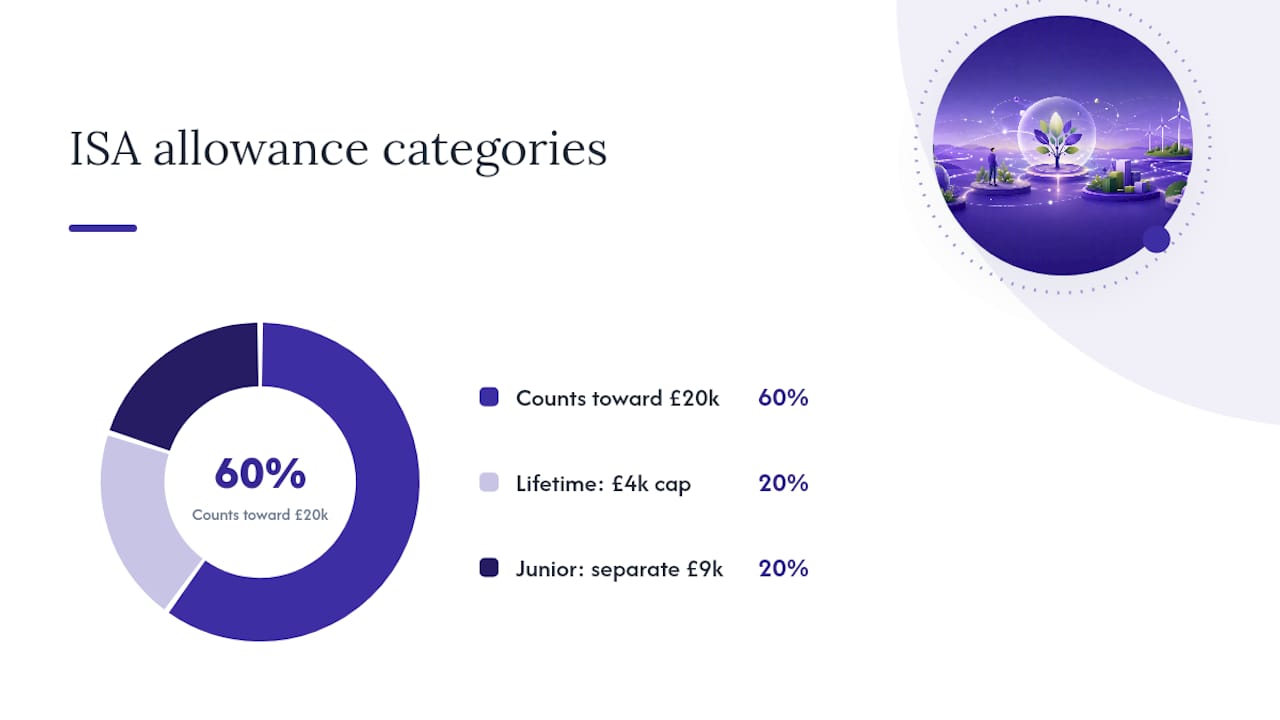
One practical point worth noting: the April 2024 rule change means you are no longer limited to one subscription per ISA type per year. You could, for example, open a stocks and shares ISA with one platform in April and a second with another platform in October, as long as your combined contributions across all ISAs do not exceed £20,000.
How does the ISA tax shelter actually work?
The tax advantages of ISA investments are straightforward in principle, though the boundaries of the shelter are worth understanding precisely. Inside a stocks and shares ISA, you pay no income tax on dividends or interest, and no capital gains tax (CGT) when you sell investments at a profit. You also do not need to declare ISA income or gains on a self-assessment tax return.
Outside an ISA, dividends above the annual dividend allowance are taxed at your marginal rate, and capital gains above the annual CGT exempt amount are taxed at 18% or 24% depending on your income band. For a higher-rate taxpayer with a growing portfolio, those charges compound meaningfully over a decade.
What the ISA wrapper does not protect against:
- Inheritance Tax (IHT): ISA assets form part of your estate on death and are subject to IHT at 40% above the nil-rate band. The tax-free status does not transfer to your beneficiaries in the same way, though a surviving spouse or civil partner can inherit your ISA allowance through an Additional Permitted Subscription (APS).
- Stamp Duty Reserve Tax (SDRT): When you buy UK shares inside an ISA, you still pay 0.5% stamp duty on the transaction. The ISA wrapper shelters the growth, not the purchase cost.
- Loss offsetting: As LITRG explains, losses realised inside an ISA cannot be used to offset gains in a general investment account or other taxable portfolio. If you hold a loss-making position, it may be more tax-efficient to hold it outside the ISA where the loss has practical value.
Flexible vs non-flexible ISAs add another layer. A flexible ISA allows you to withdraw money and replace it within the same tax year without the replacement counting as a new subscription. Most platforms do not offer flexible ISAs, so check before assuming you can top up after a withdrawal.
A practical illustration: a higher-rate taxpayer investing £10,000 in a fund that returns 7% annually would, after 20 years, have roughly £38,700 inside a stocks and shares ISA with no tax drag on dividends reinvested. Outside an ISA, dividend tax and CGT on disposal would reduce that figure, depending on individual allowances used elsewhere. The ISA wrapper does not change the investment return; it simply prevents tax from eroding it.

What can you actually hold inside a stocks and shares ISA?
The official qualifying investments guidance for ISA managers sets out what is permitted inside a stocks and shares ISA. The range is broader than many investors realise.
Qualifying investments include:
- Shares in companies listed on a recognised stock exchange (UK and overseas)
- UK government bonds (gilts) and corporate bonds
- Unit trusts, OEICs, and other collective investment schemes authorised in the UK or EEA
- Exchange-traded funds (ETFs) listed on a recognised exchange
- Investment trusts listed on a recognised exchange
- Fractional interests in any of the above (where the platform supports them)
- Cash held within the ISA pending investment
- Life assurance policies that meet the qualifying conditions
- Long Term Asset Funds (LTAFs), following the 2026 regulatory amendment
The 2026 rule changes are significant for investors interested in private markets. From 6 April 2026, LTAFs can be held within a stocks and shares ISA, opening access to less liquid, longer-horizon assets such as infrastructure, private equity, and real estate funds. These are not short-term holdings. LTAFs are designed for patient capital, and redemption windows can be quarterly or longer, so they suit investors who will not need to access that portion of their portfolio quickly.
cETNs, which track cryptocurrency prices, are no longer eligible for new stocks and shares ISA subscriptions from 6 April 2026. If you held cETNs in a stocks and shares ISA before that date, transitional arrangements apply, but no new cETN positions can be opened in that wrapper. They move to the IFISA going forward.
For most retail investors, the practical investment universe inside a stocks and shares ISA remains shares, funds, ETFs, and bonds. The LTAF expansion is relevant mainly to those with larger portfolios and a specific interest in diversifying into private markets.
What fees should you expect from a stocks and shares ISA?
Fees are the single most controllable variable in long-term investing. The investment return is uncertain; the charges are not. Understanding how they stack up is worth the effort before you commit to a platform.
Common fee types:
- Platform fee: Usually a percentage of assets under management (e.g. 0.15%–0.45% per year) or a flat monthly charge. Percentage fees favour smaller portfolios; flat fees become cheaper as your portfolio grows.
- Dealing charges: A fee per trade when you buy or sell shares or ETFs. Some platforms charge nothing for fund trades but levy a fee for shares.
- Fund ongoing charge (OCF/TER): The annual cost of the fund itself, separate from the platform fee. A global index tracker might carry an OCF of 0.07%–0.22%; an actively managed fund could be 0.75% or more.
- Transfer-out fees: Some platforms charge per holding when you transfer your ISA to another provider. This can add up if you hold multiple funds.
- Adviser fees: If you use a regulated financial adviser to manage your ISA, their charge is additional and typically 0.5%–1% per year on assets, or a fixed fee per service.
Pro Tip: The headline platform fee is rarely the whole story. Check for dealing charges on ETFs, foreign exchange fees on overseas share purchases, and whether the platform charges separately for a SIPP or general account if you hold both. The total cost of ownership, platform fee plus weighted average OCF across your holdings, is the number that matters.
The difference of 0.90% per year compounds to roughly £29,000 over two decades on a static £50,000 starting point. On a portfolio that grows through regular contributions, the gap widens further. MoneySavingExpert’s ISA platform guide reinforces that comparing total cost rather than headline rates is the right approach.
Who should use a stocks and shares ISA and what are the risks?
A stocks and shares ISA is not the right wrapper for every situation. Understanding the risks and the profile of investor it suits helps you decide whether to use one, and how much of your annual allowance to direct here versus a cash ISA or pension.
The fundamental risk is that the value of your investments can fall. Unlike a cash ISA, there is no guarantee you will get back what you put in. Markets can and do fall sharply in the short term. Which? notes that while the tax advantages are real, so is the investment risk, and investors should be prepared for periods of negative returns.
Time horizon matters more than most investors appreciate. MoneyHelper recommends treating a stocks and shares ISA as a long-term commitment, typically five years or more. Over shorter periods, a market downturn at the wrong moment can leave you worse off than a cash account. Over longer periods, the historical tendency of diversified equity portfolios to recover and grow makes the risk more manageable.
FSCS protection applies to the platform, not the investments. If your ISA provider fails, the Financial Services Compensation Scheme covers up to £85,000 of eligible claims against the firm. Investment losses caused by market movements are not covered. Most platforms hold client assets in nominee accounts, meaning your investments are legally separate from the platform’s own assets, which provides a layer of protection in the event of platform insolvency. Ask your provider how client assets are held before you open an account.
Key risks to weigh before investing:
- Capital value can fall, and you may receive less than you invested
- Short-term volatility can be significant, particularly in equity-heavy portfolios
- FSCS protection covers platform failure up to £85,000, not market losses
- LTAFs carry liquidity risk: redemption windows can be quarterly or longer
- Inflation risk in cash held within the ISA pending investment
Estate planning considerations are often overlooked. ISA assets do not sit outside your estate for Inheritance Tax purposes. On death, the value of your ISA forms part of your taxable estate. A surviving spouse or civil partner can inherit your ISA allowance through an Additional Permitted Subscription, preserving the tax-efficient wrapper. For unmarried partners or other beneficiaries, the ISA tax status ends on death. For guidance on managing investment risk over time, our article on investment horizons and volatile markets covers this in more detail.
How do you choose the right stocks and shares ISA provider?
Choosing a platform is a practical decision, not a brand loyalty one. The right provider for a cost-conscious DIY investor building a global index portfolio looks very different from the right one for someone who wants a ready-made portfolio and occasional adviser access.
Objective criteria to compare:
- Fees: Platform percentage vs flat fee, dealing charges, OCF on available funds, transfer-out costs
- Minimum investment: Some platforms accept £1 per month; others require £500 or more to open
- Investment range: Access to shares, ETFs, funds, bonds, investment trusts, and now LTAFs for those who want private market exposure
- Tools and model portfolios: Ready-made portfolios, risk-profiling tools, and portfolio analysis features vary widely
- Mobile app: If you plan to manage your ISA on your phone, test the app before committing
- Customer service: Phone, chat, and email availability; response times matter when markets move quickly
- FSCS protection and custody: Confirm client assets are held in nominee accounts and ask how assets are ringfenced
Four providers commonly referenced by UK investors:
Hargreaves Lansdown is the UK’s largest retail investment platform by assets. It offers a wide investment range including shares, funds, ETFs, and investment trusts, with a well-regarded mobile app and strong customer service. Its platform fee is percentage-based and capped for shares, which suits larger portfolios, though its fund charges are higher than some competitors for smaller accounts.
AJ Bell positions itself as a lower-cost alternative with a broad investment range and a straightforward platform. It suits investors who want flexibility across asset types without paying a premium for the brand. Its dealing charges and platform fee structure reward investors who trade infrequently.
Vanguard offers a limited but focused range of its own funds and ETFs at low cost. Its platform fee is competitive, and its index funds carry some of the lowest OCFs available to UK retail investors. The trade-off is range: you can only hold Vanguard products, which suits passive investors but not those wanting individual shares or third-party funds.
NatWest offers a stocks and shares ISA through its investment platform, which suits existing NatWest customers who value integration with their current account. The range is more limited than specialist investment platforms, and the fee structure is worth comparing carefully against dedicated providers.
Questions worth asking any provider before you open an account:
- Is the ISA flexible (can I replace withdrawals within the same tax year)?
- What are the transfer-out fees, and how long does an ISA transfer typically take?
- Are fractional shares available, and how are they held in custody?
- Does the platform support LTAFs if you want private market access?
For a current comparison of ISA rates and platform costs, our ISA rates guide for 2026–27 sets out the key figures in one place.
| Criteria | DIY cost-focused investor | Hands-off / ready-made investor |
|---|---|---|
| Platform fee priority | Flat fee or low percentage | Percentage fee (scales with portfolio) |
| Investment range | Wide: shares, ETFs, bonds | Curated: model portfolios, risk-rated funds |
| Tools needed | Portfolio tracker, dealing screen | Risk profiler, auto-rebalancing |
| Customer service | Self-serve, occasional phone | Guided support, adviser access |
| Minimum investment | Low or none | May be higher for managed portfolios |
How to open, contribute to, and transfer a stocks and shares ISA
Opening a stocks and shares ISA is straightforward. The process typically takes 15–30 minutes online, though ID verification can add a day or two if documents need manual review.
Eligibility checklist:
- You must be a UK resident for tax purposes
- You must be aged 18 or over (16 for a cash ISA)
- You must have a National Insurance number
- Crown employees serving abroad and their spouses or civil partners are also eligible
Step-by-step: opening your account
- Choose a platform based on the criteria above (fees, range, tools, FSCS protection)
- Complete the online application with your personal details, National Insurance number, and address history
- Verify your identity (most platforms accept a passport or driving licence, often via an automated check)
- Fund the account by bank transfer or direct debit
- Select your investments, or choose a ready-made portfolio if the platform offers one
- Set up a regular contribution if you want to invest monthly rather than as a lump sum
Contributing within the allowance: Your £20,000 annual allowance resets each tax year on 6 April. You can contribute as a lump sum, in regular instalments, or a combination. Since April 2024, you can split contributions across multiple ISAs of the same type, but your total across all ISAs must not exceed £20,000.
Transferring an existing ISA: You can transfer previous years’ ISA savings to a new provider without affecting your current year’s allowance. Transfers of the current year’s subscription must be transferred in full; prior years’ savings can be transferred in part. The transfer process typically takes 15–30 days for cash transfers and longer for in-specie transfers (where investments are moved without being sold). Some platforms require you to sell holdings and transfer cash, which means you are out of the market during the transfer window.
Pro Tip: Never withdraw money from an ISA and redeposit it elsewhere, thinking this counts as a transfer. A withdrawal uses your annual allowance when you redeposit, unless you are in a flexible ISA. Always use the official ISA transfer process, initiated by the receiving platform, to preserve your allowance.
Checklist to avoid common mistakes:
- Do not exceed the £20,000 annual limit across all ISAs combined
- Notify your provider if your tax residency changes, as non-UK residents cannot subscribe to an ISA
- Check whether your ISA is flexible before withdrawing and redepositing
- When moving investments into an ISA via a “bed and ISA” transaction (selling outside, buying inside), be aware this crystallises any capital gain and may trigger a CGT liability
- Confirm transfer-out fees before initiating a move to a new platform
Practical checklist and scenarios to help you decide
Translating guidance into action is where most investors stall. The checklist below gives you a clear sequence, and the three scenarios that follow show how different household situations map to different ISA choices.
Your pre-investment checklist:
- Decide your time horizon: under three years points toward a cash ISA; five or more years suits a stocks and shares ISA
- Check FSCS protection and custody arrangements with your chosen platform
- Calculate your total cost of ownership: platform fee plus weighted average OCF across your planned holdings
- Confirm the investments you want are qualifying assets for the wrapper you are using
- Plan whether you will invest as a lump sum, monthly, or both
- Set a calendar reminder to review your ISA annually, ideally before 5 April
Scenario 1: First-time buyer saving for a deposit A 27-year-old saving for their first home should consider a Lifetime ISA. The remaining £16,000 of the annual allowance can go into a cash ISA for accessible, lower-risk savings. A stocks and shares ISA is less suitable here because a market downturn close to the purchase date could reduce the deposit.
Scenario 2: Higher-rate taxpayer with a 15-year horizon A 45-year-old higher-rate taxpayer investing for retirement alongside a pension should prioritise a stocks and shares ISA for tax-efficient growth. Dividends and capital gains accumulate without tax drag, and unlike a pension, there is no minimum age to access the funds. A globally diversified equity fund or a low-cost multi-asset fund suits this profile, with annual rebalancing to maintain the target allocation.
Scenario 3: Near-retirement saver reducing risk A 58-year-old approaching retirement may want to gradually shift their stocks and shares ISA toward bonds and lower-volatility funds, reducing exposure to equity market swings. The ISA wrapper remains tax-efficient in retirement for income drawdown, and the flexibility to withdraw without tax makes it a useful complement to pension income.
Pro Tip: If you have family members with unused ISA allowances, consider using the full household allowance across spouses or civil partners. Each adult has their own £20,000 limit, so a couple can shelter up to £40,000 per year in ISA wrappers. Review rebalancing annually rather than reacting to short-term market moves, which typically increases costs without improving outcomes.
Our perspective at Prosperhomeloans
At Prosperhomeloans, our core work is mortgage and protection advice, but we work with clients every day who are thinking about their broader financial picture alongside a home purchase or remortgage. ISA investments come up regularly, particularly for first-time buyers weighing a Lifetime ISA against a cash deposit, and for property investors thinking about how to hold savings tax-efficiently alongside a buy-to-let portfolio.
What we consistently observe is that the ISA wrapper is well understood in principle but poorly used in practice. People know ISAs are tax-free; fewer take the time to compare total platform costs, check custody arrangements, or think through the inheritance implications. The 2026 rule changes around LTAFs and cETNs are a good example: they matter to a specific group of investors, but most people we speak to have not yet heard of them.
Our role is to help you see how your mortgage, protection, and savings decisions connect. If you are buying a property and wondering whether a Lifetime ISA or a stocks and shares ISA better serves your goals, or if you are a self-employed investor trying to use your annual allowance efficiently alongside a pension, those are conversations worth having with a qualified adviser.
We are not a financial adviser in the investment sense, but we can point you toward the right resources and, where appropriate, refer you to a regulated investment adviser who can give you personalised guidance. If you have questions about how your mortgage or protection arrangements interact with your savings strategy, speak with our team at Prosperhomeloans and we will help you find the right path forward.

Sources
The following authoritative sources were used to build this guide and are worth bookmarking for ongoing reference:
- Stocks and shares ISAs - MoneyHelper
- Stocks and shares ISA — Which?
- Individual savings accounts (ISAs) | Low Incomes Tax Reform Group
This article provides general information about ISA investments and is not a substitute for personalised financial advice. Tax rules can change, and their effect depends on your individual circumstances. Confirm current rules with HMRC or a regulated financial adviser before making investment decisions.
Recommended
