Barclays money transfer guide: how to move money safely

A Barclays money transfer lets you convert available credit on your Barclaycard into cash paid directly into a UK current account in your name. It is not the same as a balance transfer, and choosing the wrong one can cost you more than you expect.
Here is what you need to know before you start:
- A Barclaycard money transfer moves credit from your Barclaycard into your bank account as cash, typically arriving by the end of the next working day if you request it before 7pm on a working day.
- The minimum you can transfer is £100; the maximum depends on your available credit limit after accounting for existing balances and the transfer fee itself.
- The account must be a UK current account held in your name, and you must hold a debit card for that account. Third-party accounts and foreign accounts are not permitted.
- A one-off fee applies, typically charged as a percentage of the amount transferred. Barclaycard’s illustrative example shows a 2.9% fee.
- Purchases made with the transferred funds do not carry Section 75 protection under the Consumer Credit Act — a point many people overlook.
This guide covers Barclaycard money transfers step by step, domestic transfers inside the Barclays app and Online Banking, international payments, fees, security, and where to find live offers.
Table of Contents
- How does a Barclays money transfer actually work?
- Money transfer versus balance transfer: which one do you need?
- How to send money using the Barclays app and Online Banking
- How do Barclays international payments work?
- Eligibility, limits, fees and timescales at a glance
- What to do when a transfer fails or is delayed
- Where to find current Barclaycard money transfer offers
- Key takeaways
- A note from Prosperhomeloans
- Useful sources and official links
How does a Barclays money transfer actually work?
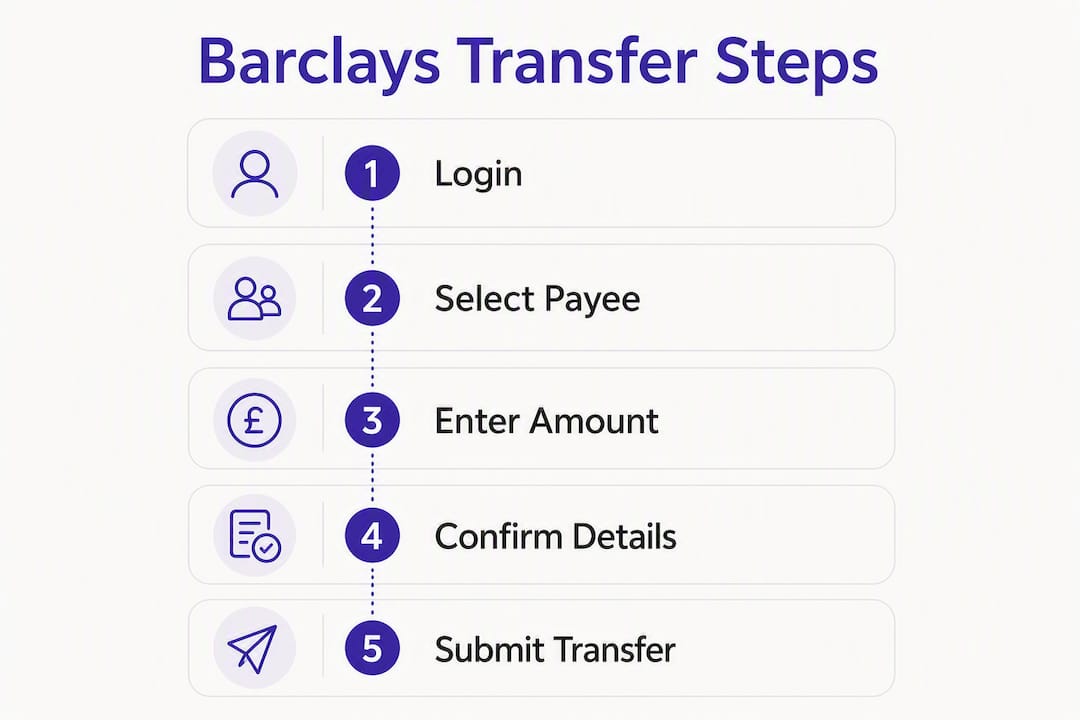
The process is straightforward once you know where to look. Log into the Barclays app or Barclays Online Banking, navigate to your Barclaycard, and follow the steps below.
- Open the Barclays app or Online Banking — and select your Barclaycard from the account list.
- Select “Money transfer” — and review any promotional offer shown, including the fee percentage and any 0% interest period attached to it.
If Barclays runs additional security checks on your request, processing can take longer than one working day. You will normally be notified if this happens.
Pro Tip: Check your available credit before you start, not just your credit limit. The fee is charged to your card, so you need headroom for both the transfer amount and the fee — plus any upcoming transactions you have planned.

If the app does not show a money transfer option, it may mean no promotional offer is currently available on your account. In that case, calling Barclaycard directly is the quickest way to find out whether an offer can be applied, as live offers depend on your account and eligibility.
Money transfer versus balance transfer: which one do you need?
These two products are frequently confused, and using the wrong one can increase your costs or strip away consumer protections you would otherwise have.
The core distinction: a money transfer moves available credit from your Barclaycard into your bank account as cash. A balance transfer moves existing debt from another card onto your Barclaycard, usually to access a lower or 0% interest rate. They serve entirely different purposes.
Practical differences at a glance:
- Fee range: — both products typically carry a one-off fee in the 2–4% range of the amount transferred. Barclaycard’s illustrative example for a money transfer is 2.9%.
A worked example illustrates the cost difference. For instance, transferring a few thousand pounds via a money transfer can incur several tens of pounds in fees upfront, depending on the fee percentage. If you instead used a balance transfer by mistake (moving debt rather than getting cash), the product would not deliver cash to your account at all — you would still need another solution and would have paid a fee for nothing. Independent guides consistently flag this as the most common and costly error people make with these products.
How to send money using the Barclays app and Online Banking
For day-to-day domestic transfers, the Barclays app and Online Banking handle three distinct actions: transferring between your own Barclays accounts, paying a new payee, and paying an existing payee. Each lives under “Pay & Transfer” in the app.
Transferring between your own Barclays accounts
- Open the Barclays app and tap “Pay & Transfer”.
- Select “Transfer between accounts”.
- Choose the source account and the destination account.
- Enter the amount and an optional reference, then confirm.
Transfers between your own Barclays accounts are typically instant.
Paying a new payee
- Tap “Pay & Transfer”, then “Pay someone new”.
- Enter the payee’s full name, sort code, and account number.
- The app will display the account name matched to those details — verify it before proceeding.
- Enter the amount and a payment reference, then confirm with your PIN or biometric.
The app asks for a reference so the recipient can identify the payment. Keep it clear and specific.
Paying an existing payee
Select the payee from your saved list under “Pay & Transfer”, enter the amount, confirm the details, and submit.
Pro Tip: Faster Payments handles most domestic transfers instantly and is free. CHAPS is the alternative for same-day guaranteed transfers of larger amounts, but Barclays charges a fee for CHAPS payments. Use CHAPS only when the recipient specifically requires a same-day guaranteed transfer and the amount justifies the cost.
Key details the app will ask for when paying someone new:
- Payee’s full name (as it appears on their bank account)
- Six-digit sort code
- Eight-digit account number
- Payment reference (your name or invoice number works well)
How do Barclays international payments work?
Barclays supports sending money abroad in multiple currencies through its app and Online Banking. The process sits under “Pay & Transfer” and then “Pay someone abroad” or “International payment”, depending on your app version.
Cost components for a Barclays international transfer:
- Transfer fee: Barclays charges a fixed fee for international payments; the exact amount depends on the destination and payment method. Check the current fee schedule in the app or on the Barclays payments page before you send.
- Exchange rate margin: Barclays applies its own exchange rate, which includes a margin above the mid-market rate. The delivered amount in the recipient’s currency will reflect this margin.
- Correspondent bank charges: for some destinations, intermediary banks may deduct charges from the transfer amount before it reaches the recipient. This is more common with SWIFT transfers to certain countries.
Required beneficiary details for most international payments:
- Full name and address of the recipient
- IBAN (for European destinations) or account number
- BIC/SWIFT code of the recipient’s bank
- Bank name and address
Delivery timescales vary. Payments within the Single Euro Payments Area (SEPA) often arrive within one working day. SWIFT transfers to destinations outside SEPA typically take two to five working days, though this depends on the receiving bank and any intermediary routing.
Pro Tip: Before you confirm an international transfer, check the total delivered amount shown in the app — this reflects the exchange rate and fees combined. If the total cost is significantly higher than you expected, a specialist foreign exchange service may offer a better rate for larger transfers. For smaller amounts, the convenience of sending directly through Barclays usually outweighs the rate difference.
| Transfer type | Typical timescale | Key cost component |
|---|---|---|
| Domestic (Faster Payments) | Instant to a few hours | No fee |
| Domestic (CHAPS) | Same working day | Fixed fee applies |
| SEPA (Europe) | 1 working day | Exchange rate margin |
| SWIFT (international) | 2–5 working days | Fee + exchange rate margin + possible correspondent charges |
Eligibility, limits, fees and timescales at a glance
Before submitting any Barclaycard money transfer, confirm you meet every condition below.
- Minimum transfer: £100
- Maximum transfer: determined by your available credit limit minus existing balances and the fee
- Eligible accounts: UK current accounts only, held in your name, with a debit card attached
- Transfer fee: a one-off percentage fee charged to your Barclaycard balance (Barclaycard’s illustrative example shows 2.9%)
- Timing: requests submitted before 7pm on a working day typically arrive the next working day; requests outside those hours take around two working days
- Offer conditions: approval is subject to application, financial circumstances and borrowing history — the amount and fee offered will vary by customer
| Condition | Detail |
|---|---|
| Minimum amount | £100 |
| Fee structure | One-off percentage of transfer amount (2.9% illustrative) |
| Processing time | Next working day (before 7pm cut-off); ~2 working days otherwise |
| Account eligibility | UK current account in your name with a debit card |
| Section 75 protection | Not applicable to purchases made with transferred funds |
Pre-submission checklist:
- Available credit covers the transfer amount plus the fee
- Destination account details are correct (sort code and account number)
- You have noted the fee amount and any promotional end date
- You understand that Section 75 protection will not apply to spending from the transferred funds
What to do when a transfer fails or is delayed
Most delays on a Barclays money transfer come down to one of four causes: incorrect account details, insufficient available credit, a security hold, or a transfer limit being exceeded.
Common problems and immediate actions:
- Incorrect account details: the transfer will fail or, in rare cases, reach the wrong account. Check your confirmation email for the details you entered. If funds have gone to the wrong account, call Barclays immediately — recovery is possible but not guaranteed.
- Insufficient available credit: the app will usually flag this before you submit. If it does not, and the transfer is declined, check your available credit (not just your credit limit) and reduce the transfer amount to allow for the fee.
- Security or fraud hold: Barclays may run additional checks on any transfer, which can extend processing beyond the next working day. You will typically receive a notification. Wait for contact from Barclays or call the number on the back of your card.
- Limit exceeded: if your requested amount exceeds what Barclays will approve for a single transfer, reduce the amount or call to discuss your options.
Cancelling or amending a transfer
Once a money transfer is submitted and processing has begun, cancellation is not straightforward. The realistic window to cancel is very short — effectively before the request enters the processing queue. If you need to cancel, call Barclays immediately using the number on the back of your card. Do not wait until the next day.
For in-app messaging, use the Barclays app’s chat function for non-urgent queries. For urgent issues involving funds in transit, always call directly.
Where to find current Barclaycard money transfer offers
Live offers appear inside the Barclays app or the Barclaycard app under “Your cards” or “Manage your cards”, then “Transfers and offers”. The app is the primary place where Barclays surfaces personalised transfer offers, including the current fee and any promotional 0% interest period.
What to look for when you find an offer:
- The fee percentage and the exact fee amount on your intended transfer sum
- The length of the promotional interest period (if 0% applies, note the end date)
- The minimum monthly payment requirement to keep the promotional rate active
- Whether the offer expires — promotional offers are time-limited and may not reappear
Pro Tip: Before accepting a money transfer offer, compare the total cost (fee plus any interest after the promotional period) against your overdraft rate or a personal loan. For example, borrowing £1,500 at Barclaycard’s 2.9% illustrative fee with a 12-month 0% period would result in a fee of £43.50. A 0% overdraft or a low-rate personal loan might cost less overall, depending on your circumstances.
If no offer appears in the app, it does not necessarily mean you are ineligible. Call Barclaycard on the number on the back of your card to ask whether a transfer offer can be applied to your account.
Key takeaways
A Barclaycard money transfer is a practical short-term borrowing tool, but it works only to a UK current account in your name, carries a one-off fee, and removes Section 75 protection from any spending made with the transferred funds.
| Point | Details |
|---|---|
| Confirm eligibility first | The destination must be a UK current account in your name with a debit card attached. |
| Check fee and promotional period | A one-off fee applies (Barclaycard’s illustrative example is 2.9%); note the promotional end date before committing. |
| Verify account details carefully | Incorrect sort codes or account numbers can misdirect funds and are difficult to recover. |
| Expect next working day timing | Submit before 7pm on a working day for next-day arrival; later requests take around two working days. |
| Section 75 does not apply | Purchases made from transferred funds in your bank account carry no Section 75 protection. |
A note from Prosperhomeloans
A Barclaycard money transfer can be a sensible short-term solution when you need cash quickly and have available credit at a reasonable promotional rate. We see clients use it to clear an overdraft before a mortgage application, for example, or to cover a one-off expense without touching their savings. Used with clear eyes on the fee and repayment timeline, it is a legitimate tool.
Where we would urge caution is when a money transfer is being considered as part of a larger borrowing picture — debt consolidation, a remortgage, or a purchase that will affect your credit profile. In those situations, the interaction between your Barclaycard balance, your credit utilisation, and a lender’s affordability assessment matters more than most people realise.
If your transfer decision connects to a mortgage application or a broader borrowing plan, speaking with an independent adviser before you proceed is worth the time. We are here to help you find the right solution for your circumstances.
Get in touch with Prosperhomeloans for independent mortgage and protection advice tailored to your situation.

This article is general information, not financial advice. Confirm current terms, fees, and eligibility directly with Barclays or Barclaycard, and consult a qualified adviser before making borrowing decisions.
Useful sources and official links
- What is a money transfer? | Barclaycard — full explanation of how Barclaycard money transfers work, including fees, eligibility, and Section 75 implications.
- Balance transfer and money transfer offer T&Cs | Barclaycard — the official terms and conditions covering minimum amounts, offer conditions, and how approval works.
- How do balance transfers work? | Barclaycard — useful for understanding the difference between a balance transfer and a money transfer before you apply.
- — short video walkthrough showing where transfers and offers appear inside the Barclays app.
- Prosperhomeloans — independent mortgage and protection advice for UK clients, including guidance on how borrowing decisions affect mortgage applications.
