Bank acronym guide: common UK abbreviations explained

A bank acronym is a short form, usually an initialism, used to label a bank, payment system, or technical term. Most of what you see on UK statements are initialisations, not true acronyms, because you say each letter separately (BACS, CHAPS, IBAN) rather than pronouncing them as a single word. The distinction matters less than knowing what each one means, so here are the most common UK banking abbreviations at a glance:
- BACS — Bankers’ Automated Clearing Services; used for direct debits and salary payments
- CHAPS — Clearing House Automated Payment System; same-day high-value transfers
- Faster Payments — the UK scheme for near-instant transfers up to £1 million
- IBAN — International Bank Account Number; identifies your account for cross-border payments
- SWIFT/BIC — Society for Worldwide Interbank Financial Telecommunication / Bank Identifier Code; identifies the receiving bank internationally
- DD — Direct Debit; a regular payment authorised by you and collected by a merchant
- SO — Standing Order; a fixed, regular payment you set up yourself
- ATM — Automated Teller Machine; a cash machine
- CR/DR — Credit / Debit; money in or money out
- TRF — Transfer; movement of funds between accounts
- HSBC — initialism for The Hongkong and Shanghai Banking Corporation
The Bank of England oversees the payment infrastructure that gives most of these abbreviations their meaning. Prosperhomeloans clients encounter several of them daily, and mortgage applicants meet a second layer of lending-specific shorthand on top.
Pro Tip: When you spot an unfamiliar code on a statement, check the date, amount, and transaction reference first. Those three details let you match the entry to a specific payment before you contact your bank or merchant.
Key takeaways
Most banking abbreviations are initialisations, not true acronyms, and knowing the difference between BACS, CHAPS, Faster Payments, and the lending shorthand on a mortgage offer gives you genuine control over your financial decisions.
| Point | Details |
|---|---|
| Check date, amount, reference first | These three fields decode most unknown statement entries before you need to look up any abbreviation. |
| Know the main payment-system codes | BACS, CHAPS, and Faster Payments each serve different transaction types with varying clearing times appropriate to their use. |
| Acronym vs initialism | Most bank abbreviations are initialisations (each letter spoken); true acronyms like NATO are pronounced as words. |
| Watch lending acronyms on mortgage offers | APRC, LTV, ERC, and SVR together determine the true cost and flexibility of any mortgage deal. |
| Use official sources for verification | Bank help pages resolve bank-specific codes; ECB/EBA abbreviation lists cover regulatory shorthand. |
Table of Contents
- What does every bank acronym mean? An A–Z glossary for UK readers
- How to read the abbreviations on your UK bank statement
- Acronym, initialism, or abbreviation: what is the difference, and is “bank” an acronym?
- Mortgage and lending acronyms every UK borrower should know
- What to do when you spot an unfamiliar banking abbreviation
- Why acronyms matter more than most clients realise
- Sources
What does every bank acronym mean? An A–Z glossary for UK readers
The list below covers the abbreviations you are most likely to encounter on UK bank statements, mortgage documents, and international transfer forms. Each entry gives the full form, a plain-English definition, and where it typically appears.
A
- AML — Anti-Money Laundering. The legal framework requiring banks to verify customer identity and report suspicious activity. Appears in onboarding documents and compliance correspondence.
- APR — Annual Percentage Rate. The yearly cost of borrowing, expressed as a percentage, including interest and mandatory fees. Shown on personal loan and credit card agreements.
- APRC — Annual Percentage Rate of Charge. The mortgage-specific version of APR, calculated over the full assumed term of the loan. Required on all mortgage illustrations under UK regulation.
- ATM — Automated Teller Machine. A cash machine. Appears as a transaction type on statements, often followed by a location code.
B
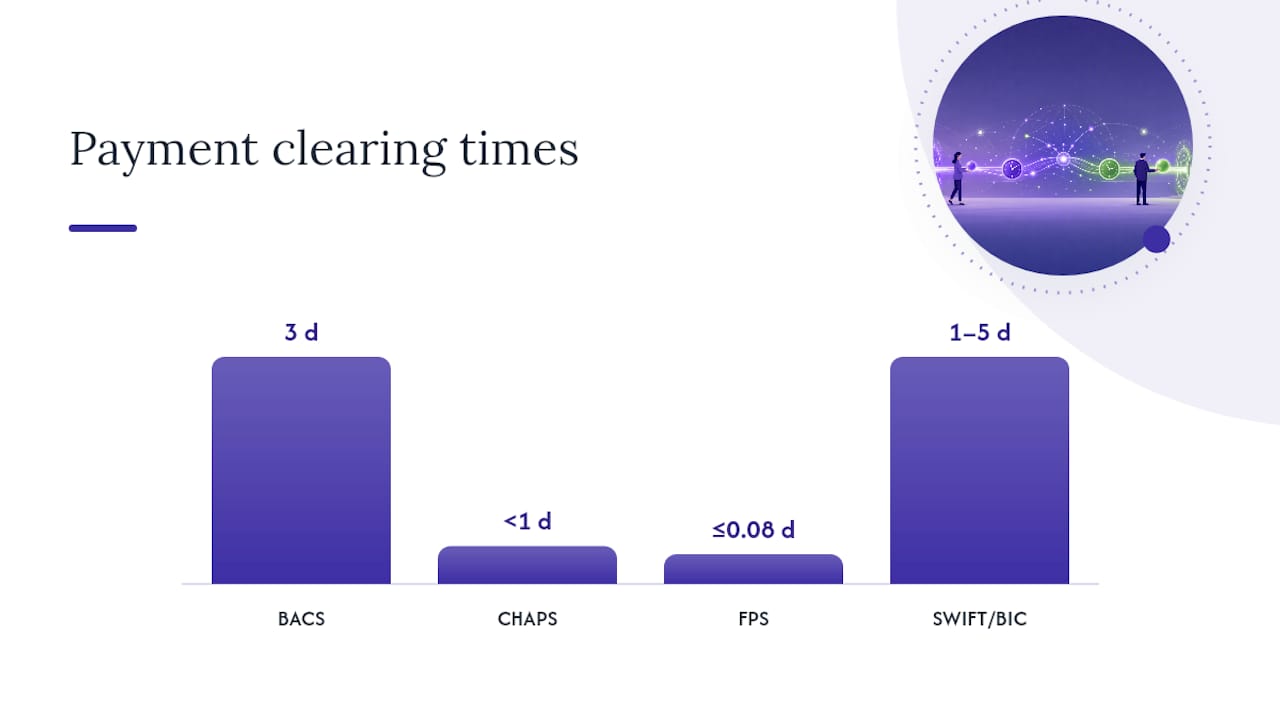
- BACS — Bankers’ Automated Clearing Services. The UK’s bulk payment scheme, used for direct debits and regular credit transfers such as salaries. Payments typically clear within a few working days. BACS, CHAPS, and Faster Payments together form the backbone of UK domestic payments, as the European Central Bank notes when mapping European payment infrastructure.
- BAL — Balance. The running total in your account after each transaction. Common in printed and online statement formats.
- BIC — Bank Identifier Code. An eight or eleven-character code that identifies a specific bank in international transfers. Used alongside IBAN.
C
- CHAPS — Clearing House Automated Payment System. The UK’s same-day, high-value payment scheme, operated by the Bank of England. Used for property completions, large business payments, and time-critical transfers.
- CHG — Charge. A fee applied by the bank, such as an overdraft charge or a foreign transaction fee. Appears as a standalone line on statements.
- CR — Credit. Money coming into your account. Shown in the credit column of a statement.
- CIS — Construction Industry Scheme. A HMRC tax deduction scheme relevant to subcontractors; appears on payslips and mortgage affordability documents.
D
- DD — Direct Debit. A recurring payment authorised by you and pulled by a merchant on agreed dates. Appears on statements with the payee name and a BACS reference.
- DR — Debit. Money leaving your account. Shown in the debit column or as a negative figure.
- DTI — Debt-to-Income ratio. The proportion of gross monthly income committed to debt repayments. Lenders use it to assess affordability; a lower ratio improves borrowing capacity.
E
- ERC — Early Repayment Charge. A fee charged by a mortgage lender if you repay part or all of the mortgage during a fixed or discounted rate period. Stated as a percentage of the outstanding balance in your mortgage offer.
- EBA — European Banking Authority. The EU-level regulator that publishes supervisory standards and abbreviation glossaries. Relevant for UK readers dealing with cross-border accounts.
F
- FCA — Financial Conduct Authority. The UK’s primary conduct regulator for financial services firms. Appears in regulatory correspondence and firm authorisation documents.
- FPS — Faster Payments Service. The UK scheme enabling near-instant transfers, typically settling within seconds for amounts up to £1 million. Shown on statements as FPS or Faster Payment.
H
- HSBC — An initialism derived from The Hongkong and Shanghai Banking Corporation, the founding entity of the group established in 1865. HSBC’s own archived FAQs confirm this origin. Like many large banks, HSBC retained the initialism as its trading brand long after the full name ceased to reflect its global scope.
I
- IBAN — International Bank Account Number. A standardised identifier for a bank account used in cross-border transfers within the SEPA zone and beyond. A UK IBAN begins with GB, followed by two check digits, the bank’s sort code, and the account number.
K
- KYC — Know Your Customer. The identity-verification process banks must complete before opening an account or processing certain transactions. You will see KYC requests when opening accounts or making large international transfers.
L
- LTI — Loan-to-Income ratio. The multiple of your annual income a lender is willing to lend. The Bank of England’s macroprudential rules cap most residential mortgage lending above 4.5 times income.
- LTV — Loan-to-Value ratio. The mortgage amount expressed as a percentage of the property’s value. A lower LTV generally unlocks better interest rates.
P
- PRA — Prudential Regulation Authority. The Bank of England subsidiary responsible for the safety and soundness of banks, insurers, and major investment firms.
R
- RBS — Royal Bank of Scotland. Now trading as NatWest Group, though RBS remains the legal entity name for some products and correspondence.
- REF / REFT — Reference / Reference Transfer. A code or number linking a transaction to a specific instruction or payee. Useful when querying a payment with your bank.
S
- SO — Standing Order. A fixed, regular payment you instruct your bank to make on set dates. Unlike a direct debit, the amount and date are controlled by you, not the payee. Appears on statements with the payee name and your reference.
- SVR — Standard Variable Rate. The default interest rate a mortgage lender charges once a fixed or tracker deal expires. SVR is set by the lender and can change at any time.
- SWIFT — Society for Worldwide Interbank Financial Telecommunication. The global messaging network banks use to send payment instructions internationally. Often paired with BIC as SWIFT/BIC.
T
- TRF — Transfer. A movement of funds between your own accounts or to another person. Appears on statements as TRF followed by the destination account or reference.
- TSB — Trustee Savings Bank. A UK retail bank with roots in the nineteenth-century savings bank movement; now a standalone brand.
Payment system summary
| Acronym | Stands for | Typical use | Typical clearing time |
|---|---|---|---|
| BACS | Bankers’ Automated Clearing Services | Salaries, direct debits | 3 working days |
| CHAPS | Clearing House Automated Payment System | Property completions, large transfers | Same day |
| FPS / Faster Payments | Faster Payments Service | Everyday transfers, online banking | Seconds to 2 hours |
| IBAN | International Bank Account Number | Cross-border account identification | Varies by destination |
| SWIFT/BIC | Society for Worldwide Interbank Financial Telecommunication / Bank Identifier Code | International bank identification | 1–5 working days |
Pro Tip: Regulatory abbreviations such as AML, KYC, and EBA are updated periodically by supervisory bodies. When a code looks regulatory rather than transactional, check the ECB and EBA abbreviations pages rather than a third-party glossary, since official lists reflect the current supervisory framework.
How to read the abbreviations on your UK bank statement
The three things to scan first on any statement line are the value date, the amount, and the transaction reference. Those three fields together almost always tell you what a payment is, even before you decode the abbreviation.
Common statement abbreviations decoded
| Abbreviation | Full phrase | Likely origin | What to do if unknown |
|---|---|---|---|
| DD | Direct Debit | BACS payment scheme | Check payee name; contact merchant if unrecognised |
| SO | Standing Order | Your own bank instruction | Verify payee and amount match your records |
| TRF | Transfer | Bank internal system | Check destination account reference |
| CHG | Charge | Bank fee schedule | Review fee tariff or call the bank |
| ATM | Automated Teller Machine | Card network | Check location code and date |
| CR | Credit | Payment scheme or bank | Identify payer from reference field |
| DR | Debit | Payment scheme or bank | Match to a known payment or query immediately |
| BAL | Balance | Bank system | Running total; no action needed |
| REF / REFT | Reference / Reference Transfer | Bank or payment scheme | Use the reference number when contacting the bank |
| FPS | Faster Payments Service | Faster Payments scheme | Check payee name and reference |
System-level codes versus bank internal shortcodes
BACS, CHAPS, and FPS are scheme-level codes: they tell you which payment rail carried the money. The abbreviations DD, SO, and TRF are bank-level shortcodes that describe the payment type. You will often see both on the same line, for example: “DD BACS — UTILITY CO — REF 123456”, which means a direct debit processed through BACS from a utility company.
Banks also use their own internal shortcodes that do not appear in any universal glossary. HSBC, for instance, uses statement descriptions that differ from those used by Barclays or Lloyds for the same underlying transaction type. Pairing a general glossary with your own bank’s help pages produces the fastest resolution for most queries.
What to do when a transaction is unknown or disputed
- Note the value date, amount, and full reference as it appears on the statement.
- Search your bank’s help pages for the abbreviation, then check the payment-scheme pages for BACS, CHAPS, or Faster Payments.
- Contact the bank or merchant directly, quoting the transaction reference.
- If you believe the entry is fraudulent, raise a formal dispute with your bank immediately. Under the UK’s Contingent Reimbursement Model (CRM), banks are required to reimburse victims of authorised push payment fraud in most circumstances.
- Keep screenshots or printed copies of the statement entry and any correspondence.
Acronym, initialism, or abbreviation: what is the difference, and is “bank” an acronym?
The distinction is straightforward. An abbreviation is any shortened form of a word or phrase. An initialism is a type of abbreviation made from initial letters, where each letter is pronounced separately. An acronym is also made from initial letters, but it is pronounced as a single word.
- Abbreviation (general): etc. (et cetera), St (Street), approx. (approximately)
- Initialism: BBC (British Broadcasting Corporation), HSBC, ATM — each letter said separately
- Acronym (pronounced as a word): NATO (North Atlantic Treaty Organisation), LASER (Light Amplification by Stimulated Emission of Radiation)
Most banking abbreviations are initialisations, not true acronyms. BACS, CHAPS, IBAN, and SWIFT are all said letter by letter in everyday speech, even though SWIFT could technically be pronounced as a word.
Is the word “bank” an acronym?
No. “Bank” is not an acronym, and it never was.
The Wikipedia entry for Bank confirms this etymology clearly. The word shares a Proto-Germanic root with the geographical term “river bank,” but the two senses evolved separately; neither is derived from the other, as English Stack Exchange discussions on the topic confirm.
The confusion likely arises because so many bank names are initialisations. HSBC, RBS, and TSB are all initialisms, which makes it easy to assume the word “bank” itself must be one too. It is not.
Mortgage and lending acronyms every UK borrower should know
When you apply for a mortgage, you will encounter a second layer of financial institution abbreviations that go beyond payment systems and statement codes. These lending acronyms directly affect how much you can borrow, what you pay each month, and what it costs to leave a deal early. Understanding them before you sit down with a lender or adviser puts you in a much stronger position.
The key lending acronyms explained
APR (Annual Percentage Rate) is the yearly cost of borrowing expressed as a percentage, covering interest and mandatory charges. It is the standard comparison figure for personal loans and credit cards.
APRC (Annual Percentage Rate of Charge) is the mortgage-specific equivalent. It is calculated over the full assumed term of the loan and includes all costs: interest, arrangement fees, valuation fees, and any other mandatory charges. Because it spreads fees across the full term, the APRC is almost always lower than the headline rate on a short fixed deal, but it gives a truer picture of total cost. Lender guides such as the NatWest mortgage jargon buster explain APRC alongside SVR and LTV in consumer-friendly terms.
LTV (Loan-to-Value) is the mortgage amount as a percentage of the property’s value.
SVR (Standard Variable Rate) is the rate your mortgage reverts to once a fixed or tracker deal ends. It is set by the lender, not the Bank of England base rate, and can change at any time. Most borrowers remortgage before reaching SVR to avoid paying above the market rate.
LTI / DTI (Loan-to-Income / Debt-to-Income) are affordability ratios. LTI measures the mortgage amount against your gross annual income. DTI measures total monthly debt commitments against gross monthly income. Both are used by lenders to stress-test whether you can sustain repayments if rates rise.
ERC (Early Repayment Charge) is the penalty for repaying your mortgage, or a portion of it, during a fixed or discounted rate period. ERCs are typically expressed as a percentage of the outstanding balance, often stepping down year by year through the deal period.
A worked LTV example
Say you are buying a property valued at £250,000. The difference in monthly cost can be significant over a two or five-year fixed term.
Acronyms to check on any mortgage offer or illustration
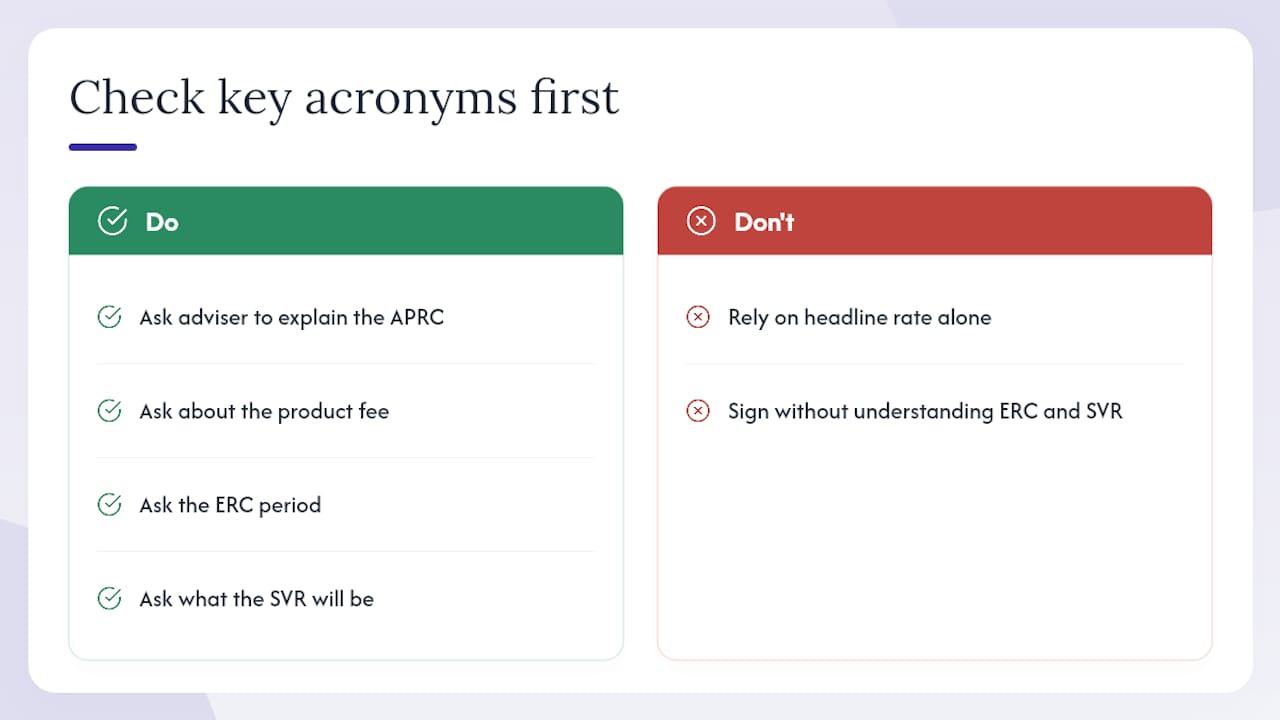
- APRC — compare across lenders, not just the headline rate
- LTV — confirm the lender has used the correct property valuation
- ERC — check the percentage and the period it applies to
- SVR — know what rate you revert to at the end of the deal
- Product fee — sometimes called an arrangement fee; can be added to the loan or paid upfront
- LTI — understand the multiple your lender is applying to your income
Pro Tip: Always ask for the APRC and the product fee on any mortgage illustration, not just the headline rate. A low headline rate with a high product fee can cost more overall than a slightly higher rate with no fee, especially on smaller loan amounts.
For personalised guidance on any of these lending acronyms and how they apply to your specific circumstances, Prosperhomeloans offers independent mortgage advice tailored to your situation, whether you are a first-time buyer, self-employed, or a property investor.
What to do when you spot an unfamiliar banking abbreviation
The fastest resolution follows a three-step approach: check the statement metadata, search official sources, then contact the bank or merchant directly.
Step-by-step verification
-
Check the value date, amount, and reference. These three fields narrow down the payment type before you look up any abbreviation. A reference starting with your sort code and account number usually indicates an internal transfer; a reference with a company name points to a merchant payment.
-
Search your bank’s help pages first. Banks use internal shortcodes that differ from one institution to the next. Your bank’s own statements-explained page is the fastest way to decode a bank-specific code. HSBC’s help pages, for example, explain their statement descriptions for customers. For scheme-level codes (BACS, CHAPS, FPS), the payment scheme operators publish plain-English guides.
-
Check official regulator and supervisory lists. For codes that look regulatory rather than transactional, the ECB and EBA banking supervision abbreviations pages are the authoritative reference. The European Banking Authority also maintains supervisory glossaries that cover cross-border and prudential terminology. For broader financial jargon, a resource such as Finblog’s financial jargon guide can help bridge the gap between regulatory language and everyday usage.
-
Contact the bank or merchant with the transaction reference. Quote the exact reference, date, and amount. Most banks can trace a payment within minutes using the reference number. If the payment came via Faster Payments, the bank can retrieve the sending account details.
-
Raise a formal dispute if you suspect fraud. Do this immediately. Under the UK Payment Systems Regulator’s rules, banks must investigate disputed transactions promptly. Keep a record of every communication, including the date, time, and name of the person you spoke to.
What to keep when contacting your bank
- A screenshot or printed copy of the statement entry
- The full transaction reference as it appears on the statement
- The value date and exact amount
- Any prior correspondence with the merchant
Why acronyms matter more than most clients realise
Most people assume that understanding a mortgage offer is just a matter of reading the numbers. The rate, the monthly payment, the term. In practice, the acronyms carry as much weight as the figures themselves.
I have sat with clients who accepted a mortgage product because the headline rate looked competitive, only to discover later that the ERC ran for five years and the SVR they would revert to was well above the market average. Neither of those facts was hidden; they were both on the illustration, clearly labelled. The client simply did not know what ERC and SVR meant, so they did not ask.
The habit that avoids this is simple: before signing any mortgage illustration, ask your adviser to walk through the APRC, the product fee, the ERC period, and the SVR. Those four items tell you the true cost of the deal and the cost of leaving it early. LTV matters too, because it determines which products you can access in the first place.
Prosperhomeloans works with clients across a wide range of circumstances, from first-time buyers trying to understand their first mortgage offer to experienced property investors comparing buy-to-let products. In almost every case, the questions that matter most come down to a handful of acronyms. Knowing what APR, APRC, LTV, and ERC mean before the conversation starts means you spend the meeting making decisions rather than learning definitions.
Sources
The sources below are the most reliable starting points when you need a definitive answer on a banking abbreviation or acronym.
Recommended
