UK government bonds: a practical guide for retail investors

UK government bonds, known as gilts, are sterling liabilities issued by HM Treasury and managed by the Debt Management Office (DMO). They pay a fixed or inflation-linked income and return your capital at a set maturity date, which is why they sit at the cautious end of most portfolios.
If you want to check where yields stand today, the 10-year gilt yield is the benchmark most commentators quote, and you can find it live on Bloomberg or TradingEconomics, with official end-of-day reference prices published via FTSE-Tradeweb.
Your immediate next step depends on your situation:
- Checking a rough return? Look up the current 10-year gilt yield.
- Ready to buy? Compare a broker platform against the DMO’s Purchase & Sale Service.
- Unsure how gilts fit your finances? Speak to an independent adviser before committing funds.
Key Takeaways
Gilts offer government-backed income and capital return, but post-tax yield, not the headline coupon, determines whether a gilt genuinely suits your goals.
| Point | Details |
|---|---|
| Check official reference prices | Use FTSE-Tradeweb end-of-day prices alongside Bloomberg or TradingEconomics for live yields. |
| Understand the two gilt types | Conventional gilts pay fixed coupons; index-linked gilts adjust for RPI inflation. |
| Calculate real yield-to-maturity | Factor in price, coupon, and time to redemption, not just the headline coupon rate. |
| Compare buying routes carefully | Brokers offer flexibility; the DMO/Computershare service settles in around three business days. |
| Mind the tax treatment | Coupon income is taxable, but capital gains on gilts are generally exempt for individuals. |
Bookmark these for ongoing gilt research
- DMO: official issuance data, auction results and the Purchase & Sale Service.
- FTSE-Tradeweb: official end-of-day reference prices.
- Bloomberg/TradingEconomics: live yield tracking.
- Private investor’s guide to gilts: tax and YTM detail.
- Savings Grove’s fixed income guide: broader context if you’re new to bonds generally.
If gilts are part of a bigger financial picture involving your mortgage, protection needs, or debt consolidation, it’s worth talking to an independent adviser who can look at the whole picture rather than one asset in isolation. Prosperhomeloans offers independent mortgage and protection advice across the UK, helping you fit decisions like this into a coherent household plan.
Table of Contents
- Where to check UK government bond yields and prices
- Conventional gilts versus index-linked gilts
- How does gilt pricing and yield-to-maturity work?
- How to buy UK government bonds
- How are UK government bonds taxed?
- What are the main risks of holding gilts?
- Frequently asked questions
- Sources
Where to check UK government bond yields and prices
Several sources publish gilt data, but they serve different purposes, and mixing them up leads to confusion when you’re comparing what you see on a platform against what you read in the news.
The DMO publishes official information on outstanding gilts and its issuance programme through its financing remit, which also shows how the government balances short, medium and long maturities to keep the market liquid. FTSE-Tradeweb produces the end-of-day reference prices that count as the official closing benchmark, released for public non-commercial use from noon the following day. For live, minute-by-minute movement, Bloomberg’s UK rates and bonds page and TradingEconomics are the go-to references most private investors and journalists cite.
The 10-year gilt yield gets the most attention because it’s the standard proxy for long-term borrowing costs and mortgage-rate expectations, but the short end (2-year) reacts faster to Bank of England policy, and the long end (30-year) moves with inflation expectations and pension-fund demand.
Prices are quoted per £100 nominal value, so a gilt trading at £98 costs £98 for every £100 you’ll get back at redemption.
| Source | What it provides |
|---|---|
| DMO | Official issuance data, auction results, financing remit |
| FTSE-Tradeweb | End-of-day reference prices (official benchmark) |
| Bloomberg | Live yields and charts |
| TradingEconomics | Live yields, historical time series |
| Broker/platform | Retail dealing quotes (may include a spread) |
Pro Tip: Platform prices often carry a small spread above the FTSE-Tradeweb reference price, so always check the reference figure before assuming your broker’s quote is the market rate.
Conventional gilts versus index-linked gilts
The gilt market splits into two main types, and the difference determines whether you’re protecting against inflation or simply banking a known income.
- Conventional gilts pay a fixed coupon twice a year and return the face value at maturity. What you see is what you get.
- Index-linked gilts adjust both coupon and principal in line with the Retail Prices Index (RPI), applied with a lag, so your income and final redemption rise with inflation.
- Conventional gilts suit investors wanting predictable income or a known redemption date for planning purposes.
- Index-linked gilts suit those worried about inflation eroding real returns, particularly over long holding periods.
According to the DMO’s own guidance, a conventional gilt paying a 4% coupon delivers exactly £4 per £100 nominal each year regardless of inflation, while an index-linked equivalent would see that £4 (and the £100 redemption) uplifted by the RPI movement over the same period. Over a decade of high inflation, that gap compounds substantially.
How does gilt pricing and yield-to-maturity work?
Gilt prices and yields move in opposite directions. When market interest rates rise, expected from the Bank of England or shifting inflation expectations, existing gilts with lower fixed coupons become less attractive, so their price falls until the yield matches the new market rate. The reverse happens when rates fall.
A few terms you’ll need before working through a calculation:
- Coupon: the fixed annual interest rate paid on the nominal value.
- Nominal (par): the £100 face value used for quoting and redemption.
- Clean price: the quoted price excluding accrued interest.
- Dirty price: what you actually pay, including interest accrued since the last coupon.
Here’s a simplified yield-to-maturity (YTM) walkthrough:
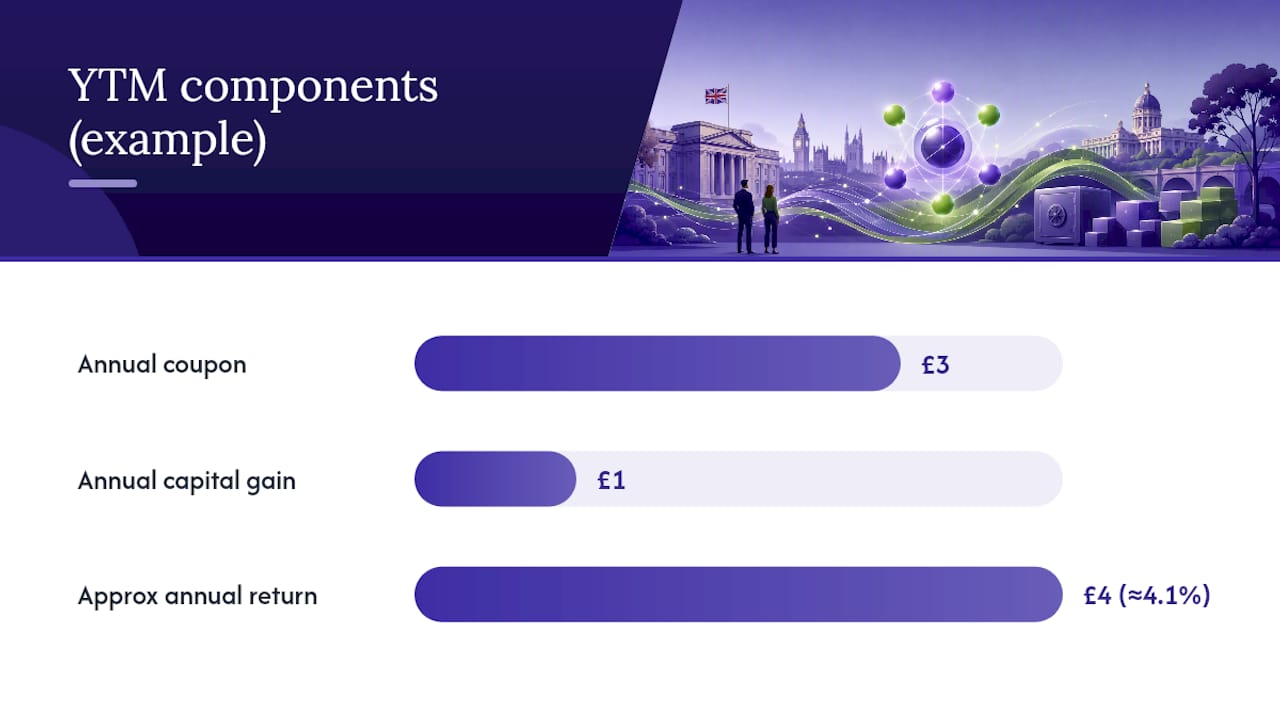
- Take a fictional gilt with a 3% coupon, priced at £95, with 5 years to redemption at £100.
- Add the annual coupon (£3) to the average annual capital gain: (£100 minus £95) divided by 5 years, which is £1.
- That gives an approximate annual return of £4 on an average price of roughly £97.50.
- Divide £4 by £97.50 to get an approximate YTM of around 4.1%, noticeably higher than the 3% headline coupon.
Pro Tip: Always check the settlement date and accrued interest shown on your platform before comparing prices across brokers. Two identical gilts can look different in price purely because of timing.
How to buy UK government bonds
You have three realistic routes into the UK bond market, and each suits a different type of investor.
Broker or platform: most DIY investing platforms let you buy and sell gilts within an ISA or pension wrapper, with dealing costs varying by provider. This route gives you flexibility and same-day trading during market hours, though platform prices typically include a small spread.
Funds and ETFs: if picking individual gilts feels like too much admin, a gilt fund or ETF gives instant diversification across maturities, though you lose the certainty of a fixed redemption date and price.
DMO Purchase & Sale Service: administered by Computershare, this execution-only service is open to UK residents who meet the DMO’s Approved Group criteria. You cannot set a maximum purchase price; your order is dealt at the market price on the day your paperwork and funds clear.
| Route | Order to settlement | Best suited to |
|---|---|---|
| Broker/platform | Typically same day to 2 business days | Investors wanting ISA/pension access and flexibility |
| Fund/ETF | Same day, ongoing basis | Those wanting diversification without picking individual gilts |
| DMO/Computershare | Around 3 business days | UK residents comfortable with execution-only, non-price-limited dealing |
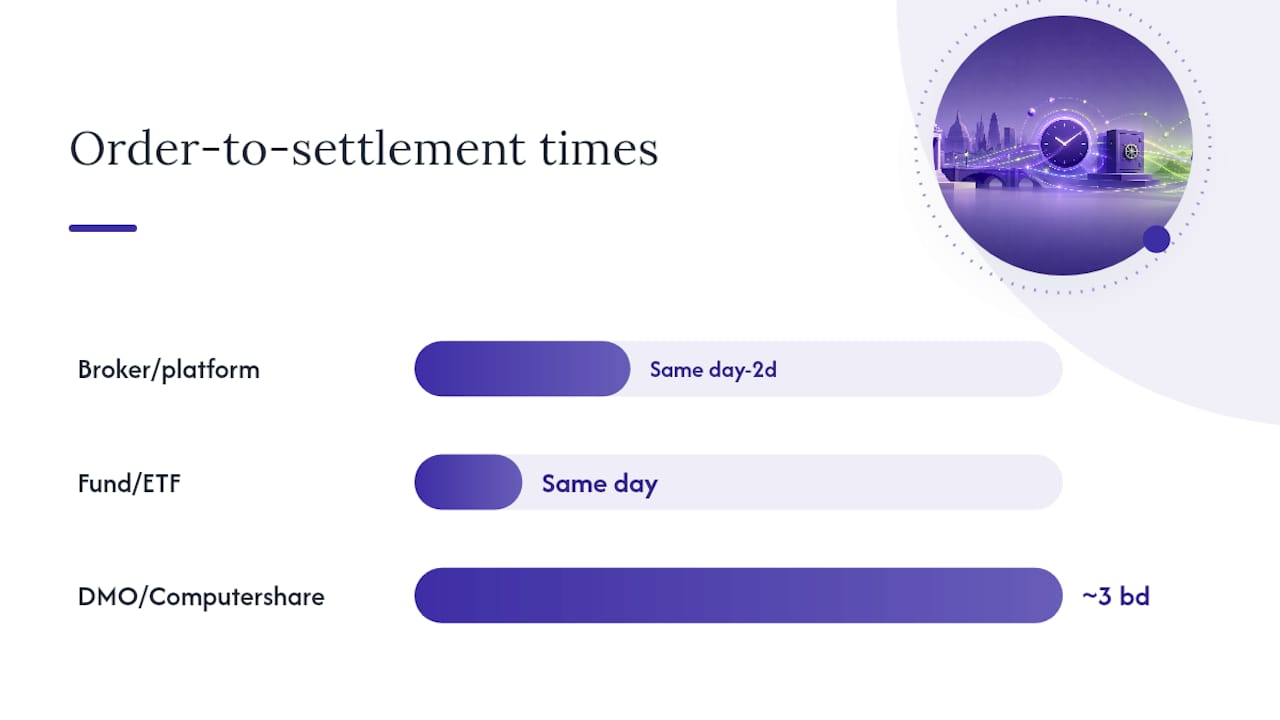
The DMO’s retail Q&A confirms settlement through the Purchase & Sale Service is typically three business days after execution, with commission charged on a tiered scale for small trades.
A quick checklist for the Computershare route:
- Confirm you meet the Approved Group residency criteria.
- Submit your application form with cleared funds.
- Accept that your order deals at the prevailing market price, not a price you set.
- Allow roughly three business days for settlement.
If you’d rather use a whole of market broker for wider access to platforms and funds, that route also gives you more control over timing than the execution-only DMO service.
How are UK government bonds taxed?
Coupon income from gilts is taxable as savings income, but capital gains on gilts are generally exempt from capital gains tax for individuals, according to the private investor’s guide to gilts published via the London Stock Exchange and DMO.
That split matters more than most headline coupon figures suggest. A gilt priced below par, where more of your return comes from capital appreciation rather than coupon income, can be more tax-efficient for a higher-rate taxpayer than one with a high coupon and less price gain.
Say a basic-rate taxpayer and a higher-rate taxpayer both hold a gilt yielding 4% pre-tax, split evenly between coupon and price gain. Post-tax, the higher-rate taxpayer’s real return narrows considerably compared to the headline 4%.
Pro Tip: Holding gilts inside a Stocks and Shares ISA or pension removes the coupon tax question entirely, which is worth considering if you’re a higher-rate taxpayer building a bond ladder.
What are the main risks of holding gilts?
Gilts carry very low credit risk since the UK Government backs them, but that doesn’t mean they’re risk-free.
- Interest-rate risk: rising rates push existing gilt prices down, hitting longer-dated gilts hardest.
- Inflation risk: conventional gilts lose real value if inflation outpaces the fixed coupon.
- Reinvestment risk: if rates fall, income from maturing gilts gets reinvested at lower yields.
- Liquidity risk: some older or smaller issues trade less frequently, widening the spread you pay.
- Credit risk: extremely low, though not zero in theory, given the UK’s sovereign backing.
Gilts generally suit risk-averse savers, retirees seeking predictable income, and anyone wanting capital preservation or inflation protection through index-linked issues. They’re less suited to short-term traders chasing equity-like growth. Bank of England base rate decisions directly influence short-dated yields, while long-dated gilts respond more to inflation expectations and market sentiment.
Gilt terms explained simply
- Coupon: the fixed interest rate paid annually, usually in two instalments.
- Nominal/par: the £100 face value used for pricing and redemption.
- Redemption: the date the government repays the nominal value.
- Accrued interest: interest built up since the last coupon payment.
- Clean/dirty price: quoted price versus price including accrued interest.
- Yield to maturity (YTM): total return if held until redemption.
- Duration: a measure of price sensitivity to interest-rate changes.
- Index-linked: coupon and principal adjusted for RPI inflation.
- RPI: Retail Prices Index, the inflation measure used for index-linked gilts.
How we think about gilts for household finances
Gilts work best as a stabilising piece of a wider financial plan, not a standalone strategy, and the tax mechanics deserve as much attention as the headline yield. We see plenty of clients weighing fixed income alongside mortgage and protection decisions, and the same discipline, checking real numbers rather than headline figures, applies to both.
Frequently asked questions
What is the current 10-year gilt yield? Check live figures on Bloomberg or TradingEconomics, since yields shift daily with Bank of England policy expectations and inflation data.
Are UK government bonds a safe investment? Gilts carry very low credit risk because the UK Government backs them, though prices still fluctuate with interest-rate and inflation changes.
Can I buy gilts directly without a broker? Yes, UK residents meeting the DMO’s Approved Group criteria can use the execution-only Purchase & Sale Service administered by Computershare.
Do I pay tax on gilt interest? Coupon income is taxable as savings income, but capital gains on gilts are generally exempt from capital gains tax for individuals.
What’s the difference between conventional and index-linked gilts? Conventional gilts pay a fixed coupon; index-linked gilts adjust coupon and principal in line with RPI inflation.
This article is general information, not a substitute for advice from a qualified financial advisor. Consult a qualified financial professional about your own circumstances before acting on anything here.
Sources
- About gilts — Debt Management Office
- DMO gilt purchase and sale service — Debt Management Office
- A private investor’s guide to gilts — London Stock Exchange / DMO (PDF)
Recommended
