Mortgage With a CCJ: What Lenders Look At and Your Options

Yes, you can get a mortgage with a CCJ, but your choice of lenders will usually be narrower and the terms may be less competitive. A County Court Judgment is not an automatic six-year ban. Lenders look at how old it is, how much it was for, whether it is paid and what has happened to your credit since. We are a local broker in St. Leonards-on-Sea, helping people across Hastings, Eastbourne, Hailsham, Bexhill-on-Sea and East Sussex, and this guide explains what to expect.
TL;DR
- A CCJ can limit your lender choice, raise your rate or reduce what you can borrow, but it does not always mean a refusal.
- Age, amount and whether it is satisfied matter. Lender rules differ widely, so one refusal does not mean all lenders will refuse.
- Check your credit reports, pay or settle the judgment if you can, and avoid new credit applications before you apply.
- Speak to a broker before applying. Each failed application leaves a search on your file.
- Remortgaging with a CCJ or defaults is possible in some cases, but it depends on your circumstances and lender criteria.
Table of Contents
- How a CCJ affects a mortgage application
- How long a CCJ stays on your record
- What lenders look at: age, amount and status
- Does the reason for the CCJ matter?
- Steps to improve your chances
- Self-employed, CIS and contractor applicants
- Remortgaging with a CCJ or defaults
- Our view: why advice matters before you apply
- Talk to a local mortgage broker
- FAQ
- Sources
How a CCJ affects a mortgage application
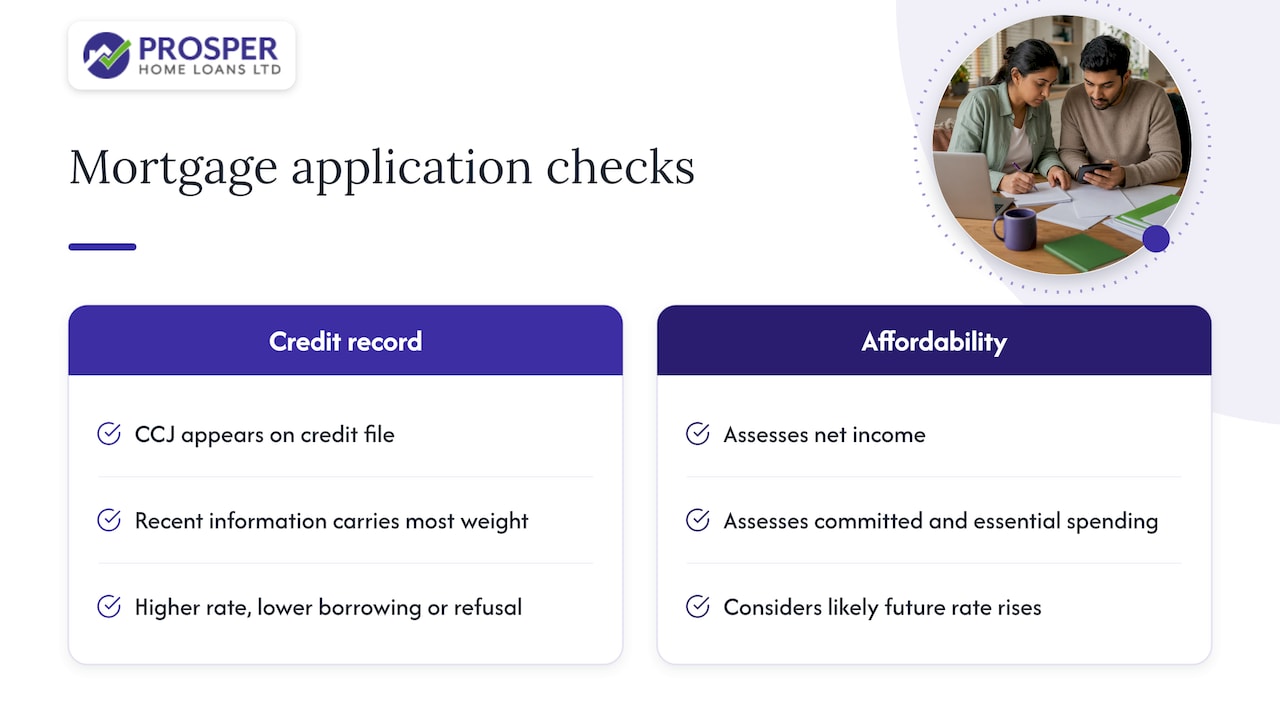
A CCJ is a court record that you were ordered to repay a debt and did not. Lenders see it when they check your credit file. HMRC’s guidance notes that a registered CCJ may make future credit harder to get, or available only with restrictions or higher-than-usual interest.
MoneyHelper explains that lenders focus on your current situation, so the most recent information carries the most weight. Poor credit can mean a higher rate, lower borrowing or a refusal.
Lenders must also assess affordability. Under the FCA’s responsible lending rules, they have to consider your net income, your committed and essential spending, and the effect of likely future interest rate rises. A CCJ is a credit signal. Affordability is a separate test, and you need to pass both.
How long a CCJ stays on your record
A CCJ stays on the Register of Judgments, Orders and Fines for six years in England and Wales. What you do next changes how it looks:
- Paid in full within one month: you can ask the court to remove it from the register.
- Paid after one month: it can be marked as satisfied, but it stays on the register for the full six years.
- Unpaid: it stays marked as outstanding, which most lenders view less favourably.
To get a certificate, you apply to the court in writing or on form N443 and send proof of payment. Scotland works differently: the equivalent is a decree, and the details are held by the Registry Trust, as the Scottish Courts and Tribunals Service explains.
What lenders look at: age, amount and status
There is no single rule. Published criteria vary a lot, which is why the same CCJ can be a decline at one lender and acceptable at another. These examples come from lenders’ own criteria pages and are only illustrations. Criteria change, and your own case may be assessed differently.
| What the lender looks at | Example of published criteria |
|---|---|
| Age of the CCJ | One building society’s specialist criteria accept CCJs in the last 36 months only if the total is up to £6,000 and none fall in the last 12 months |
| Value of the CCJ | A bank’s intermediary criteria for one product consider CCJs over 36 months old, or newer ones only if the total is £300 or less |
| Satisfied or not | The same bank does not distinguish between satisfied and unsatisfied CCJs for that product |
| Recent history | One Right to Buy style product requires no CCJs registered in the last 24 months |
| Buy-to-let | Another building society’s buy-to-let criteria accept CCJs over 6 months and up to 3 years old only if the combined value is under £250 |
The pattern is clear. Older, smaller and settled CCJs give you more options. Recent, large or unpaid ones give you fewer. Some mainstream lenders will decline automatically, which is why an application sent to the wrong lender can fail within minutes.
Does the reason for the CCJ matter?
Sometimes, yes. One industry report notes that applications are often declined by automated systems at first, but that a broker can sometimes put forward a case with a strong explanation for past problems.
Typical explanations include a billing dispute, a change of address that meant you never saw the claim, or a temporary drop in income. A lender will want the explanation to be believable and the conduct since to be clean. That is easier to show with paperwork, such as correspondence, proof of settlement and recent statements.
Steps to improve your chances
There is no shortcut, but these steps help.
- Check all three credit reference agencies. Make sure the CCJ details are correct, including the amount, date and status. MoneyHelper’s guide to checking your report explains how to do it for free.
- Settle the judgment if you can. A satisfied CCJ is generally easier to place than an outstanding one, though some lenders treat both the same.
- Keep recent conduct clean. Pay everything on time and keep balances low.
- Avoid new credit applications. MoneyHelper advises avoiding other credit applications in the six months before applying for a mortgage, and a hard search can stay on your report for up to two years.
- Do not apply speculatively. What Mortgage also advises explaining the CCJ and avoiding speculative applications.
- Build your deposit. A larger deposit can widen your choices with some lenders, though it is not guaranteed to.
- Get your paperwork in order. Our mortgage pre-approval guide walks through preparing documents before you apply.
Self-employed, CIS and contractor applicants
Many of the people we speak to are subcontractors or contractors, where a CCJ often comes from a late payment during a quiet month or a dispute over an invoice. The CCJ is only part of the picture. Your income evidence matters too.
Some lenders may take gross CIS earnings into account when assessing affordability, subject to their criteria. This does not increase your actual income and does not guarantee higher borrowing. Whether it helps depends on the lender and your paperwork, such as CIS vouchers, tax returns and bank statements. Our CIS subcontractor mortgages page explains how we approach this, and our guide to contractor mortgages with bad credit covers day rate evidence.
Remortgaging with a CCJ or defaults
If you already own a home, a CCJ or default does not automatically stop you remortgaging. Your options depend on how much equity you have, your payment record, and whether your current lender will offer you a new deal.
A product transfer with your existing lender can be simpler, since it usually involves fewer credit checks, but it may not be the best deal. Remortgaging to a new lender means a full affordability and credit assessment, and some lenders will not accept recent defaults. Defaults are assessed in a similar way to CCJs: age, amount and status all count, and lenders differ.
If you are considering borrowing more to clear debts, our guide to a debt consolidation mortgage with a CCJ sets out the trade-offs. Lower monthly payments can mean a longer term and a higher total cost, and the debts become secured against your home. We also look at alternatives, such as a second charge mortgage or staying with a smaller adjustment to your budget. You can read more in our bad credit mortgage guide.

Our view: why advice matters before you apply
In our experience, the biggest mistake people with a CCJ make is applying directly to the first lender they see. A decline is recorded on your file, and it can make the next application harder. Most people are better served by finding out first which lenders are likely to consider their circumstances.
We do not promise approval, and we cannot tell you a lender will accept you before we have seen your full picture. What we can do is explain the options, costs and risks clearly, so you decide with the facts in front of you. MoneyHelper also points out that regulated advice gives you extra complaint rights if a mortgage later proves unsuitable.
— Paul McMath CeMAP CeRER
Talk to a local mortgage broker
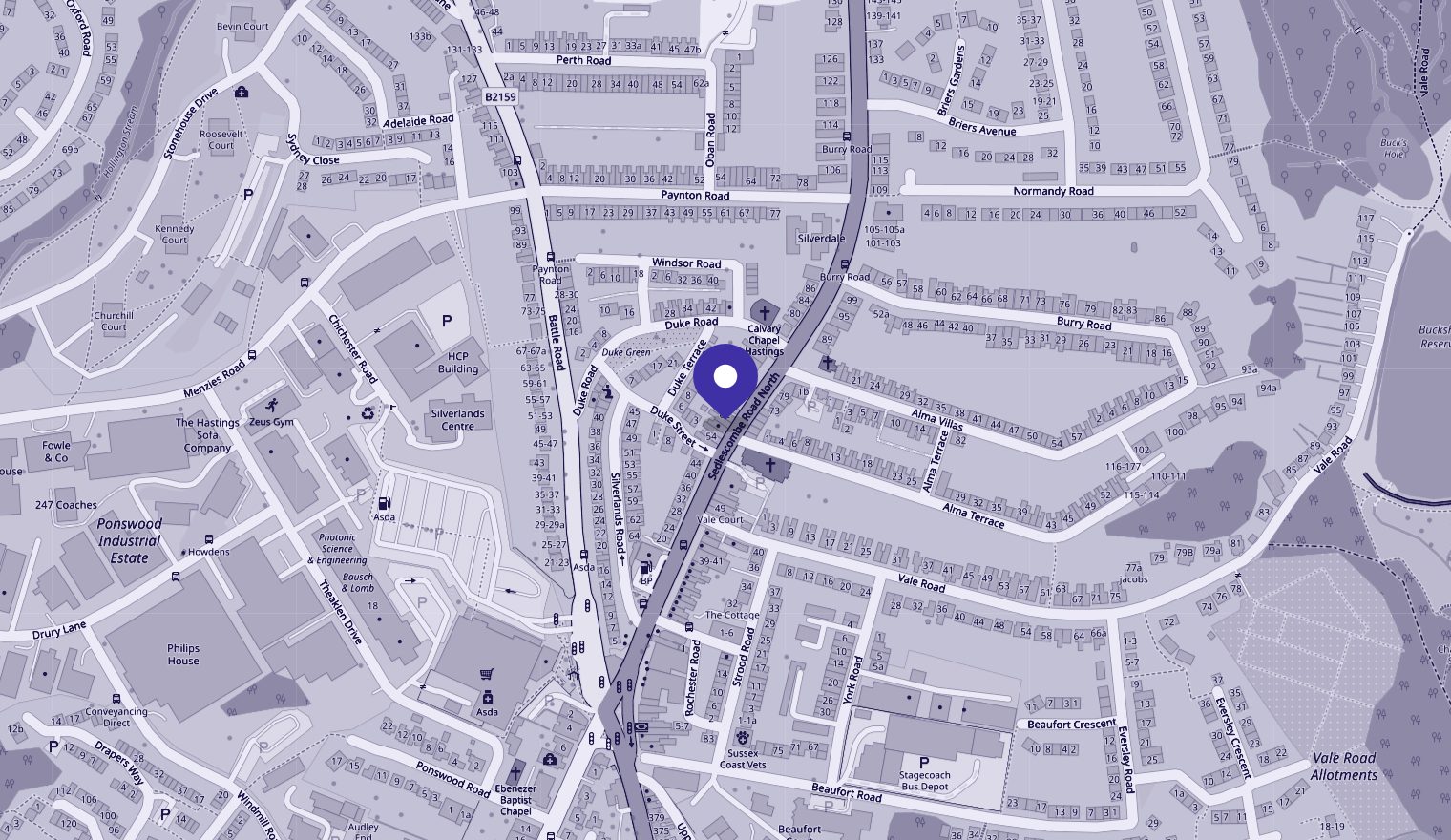
We are based at 60 Sedlescombe Road North, St. Leonards-on-Sea, and we are available to help clients in Hastings, Eastbourne, Hailsham, Bexhill-on-Sea and across East Sussex, as well as the rest of the UK. We work with first-time buyers, home movers, homeowners, the self-employed, CIS subcontractors and company directors.

If you want to know where you stand, we can run a mortgage affordability assessment and capacity report for £199 one-off. For general advice, see our whole-of-market mortgage advice or our remortgage services.
FAQ
Can I get a mortgage with a CCJ?
Often yes, but your options will be narrower. Lenders look at the CCJ’s age, amount and whether it is satisfied, along with your income and deposit. Some lenders decline all recent CCJs, while specialist lenders may consider them.
Can I remortgage with a CCJ?
It can be possible, depending on your equity, payment history and the lender’s criteria. A product transfer with your current lender may be an alternative. A broker can tell you which route is realistic for your case.
Should I pay off a CCJ before applying?
Paying it and getting it marked as satisfied usually helps, and paying within one month lets you ask for it to be removed. Check the details on the GOV.UK CCJ page and take advice if the amount is large.
How long after a CCJ can I apply for a mortgage?
There is no fixed waiting time. A CCJ stays on your record for six years, but some lenders consider applicants sooner, depending on the amount and your recent conduct. The longer ago it was, the more options you generally have.
Sources
- HMRC Debt Management manual: CCJ action after judgment
- MoneyHelper: how to improve your credit score
- FCA Handbook: MCOB 11.6
- GOV.UK: CCJs and your credit rating
- Scottish Courts and Tribunals Service: money judgments FAQs
- Mansfield Building Society specialist lending criteria
- Co-operative Bank intermediary lending criteria
- Pepper Money First Homes product guide
- Coventry Building Society buy-to-let criteria
- Newspage: mortgage with a CCJ
- MoneyHelper: how to check your credit report
- What Mortgage: can you get a mortgage with a CCJ
- MoneyHelper: should you use a mortgage adviser
- Goldenline: mortgage pre-approval guide
Recommended
- Debt Consolidation Mortgage With a CCJ: Local Help for UK Homeowners
- Homeowner Loan After an IVA: Your Options and Risks
- Secured Loan After Bankruptcy: What UK Lenders Look At
This article provides general information and is not a personal mortgage recommendation. Mortgage availability and eligibility depend on your circumstances and lender criteria. Rates and criteria can change. We will explain any applicable fees before you commit. Think carefully before securing other debts against your home. Consolidating debts over a longer term may reduce your monthly payments but increase the total amount you repay. Your home may be repossessed if you do not keep up repayments
