Debt Consolidation Mortgage With a CCJ: Local Help for UK Homeowners

Yes, in some cases you can remortgage or take out a mortgage to consolidate debts with a County Court Judgment (CCJ) against your name, but lenders will look closely at affordability and when the CCJ was registered. Rules under MCOB and oversight from the FCA shape how lenders treat consolidation applications, and Gov governs how long a judgment stays visible. The sensible first step is independent mortgage advice alongside free debt advice before you secure anything against your home.
TL;DR:
- A CCJ paid in full within one month stays off the register; later payment marks it satisfied, but it remains listed for six years.
- A second charge can preserve a favorable mortgage rate, but usually costs more than remortgaging and makes previously unsecured debt a claim against your home.
- Lower monthly payments can hide higher total interest when card debt is spread across a mortgage term; compare the full repayment cost before deciding.
- Lenders assess affordability, the CCJ’s cause and status, and income evidence; they may repay creditors directly or count unpaid balances as committed spending.
- A broker can check lender acceptance before a hard search, while free debt advice can assess whether a debt management plan or IVA is safer.
Table of Contents
- How CCJs appear on credit files and the six year rule
- Which mortgage routes lenders use to consolidate unsecured debt
- How lenders assess applications with CCJs: affordability and evidence
- Practical steps to improve your chances if you have a CCJ
- Costs and trade-offs of consolidating unsecured debt onto your mortgage
- Alternatives and where to get free debt advice before deciding
- How an independent mortgage adviser helps homeowners with CCJs
- Where this leaves homeowners weighing up their options
- How we can help if you’re considering a debt consolidation mortgage
- FAQ
- Sources
How CCJs appear on credit files and the six year rule
A County Court Judgment is a court order confirming you owe money that has not been repaid. Once issued, it goes onto the Register of Judgments, Orders and Fines, and mortgage lenders check this register as part of their credit assessment.
Timing matters more than most homeowners realise. If you pay the CCJ in full within one calendar month of the judgment, it is not recorded on the register at all, as if it never happened from a credit file perspective. Miss that window and pay later, and the record shows as “satisfied”, but it remains visible for a full six years regardless of when you actually cleared the debt, according to GOV.UK.
A few points worth holding onto as you plan your application:
- A CCJ stays on the register for six years from the judgment date, not from when it was paid.
- “Satisfied” CCJs are generally viewed more favourably by lenders than unsatisfied ones, though they still factor into the decision, as Experian notes.
- Applying jointly links your financial record with your partner’s, so their CCJs or credit history can affect your mortgage chances too.
This last point catches people out. If you are applying with a partner who has a clean record but you have a CCJ, or vice versa, the lender assesses both of you together. That financial association can work against an otherwise strong application, which is one reason some couples consider structuring ownership or borrowing differently before they apply.
Which mortgage routes lenders use to consolidate unsecured debt
Homeowners generally have three routes available when they want to fold credit card balances, loans or other unsecured debt into something secured against the property.
Remortgaging with debt added is the most familiar option. You replace your existing mortgage with a new, larger one, and the extra amount clears your unsecured debts. The appeal is a single monthly payment, often at a lower interest rate than credit cards or personal loans charge, but you are spreading that debt over a mortgage term that could run for many more years. MoneyHelper points out that while monthly outgoings may fall, total interest paid over the life of the loan can end up higher than if you had kept the debt unsecured and paid it off faster.
A second charge mortgage sits behind your existing mortgage rather than replacing it. You keep your current deal and its rate, and take out a separate loan secured on the same property. These are commonly used specifically for consolidation purposes. The FCA reports that second charge mortgages make up less than 4% of regulated mortgage sales in the UK, and typically carry higher interest rates than a first charge remortgage because the lender takes second priority if the property is repossessed.
Homeowner loans, sometimes marketed as secured loans, work similarly to second charge mortgages and are often arranged through specialist lenders rather than high street banks. The practical distinctions between the three routes come down to:
- Remortgage: replaces your existing deal entirely, usually the cheapest rate if you qualify.
- Second charge mortgage: keeps your current mortgage intact, useful if you are tied into a good existing rate or early repayment charges make remortgaging expensive.
- Homeowner loan: similar structure to a second charge, often used when speed or flexibility matters more than rate.
We’ve set out worked figures on exactly what adding card debt to a mortgage can cost over time in our guide to consolidating credit card debt, which is worth reading alongside this one.
How lenders assess applications with CCJs: affordability and evidence
Lenders don’t just check whether a CCJ exists, they look at what caused it, how it was handled, and whether consolidating debt into your mortgage actually solves the underlying problem. This is where regulation shapes the conversation directly.
Under MCOB 11, when debt consolidation is the stated purpose of a mortgage and the borrower is credit-impaired, firms must take reasonable steps to ensure existing debts are actually repaid on completion, or they must factor those debts into the affordability assessment as committed expenditure. In practice, this sometimes means the lender repays your creditors directly rather than handing you the funds, closing off the risk that the debts remain alongside the new borrowing.
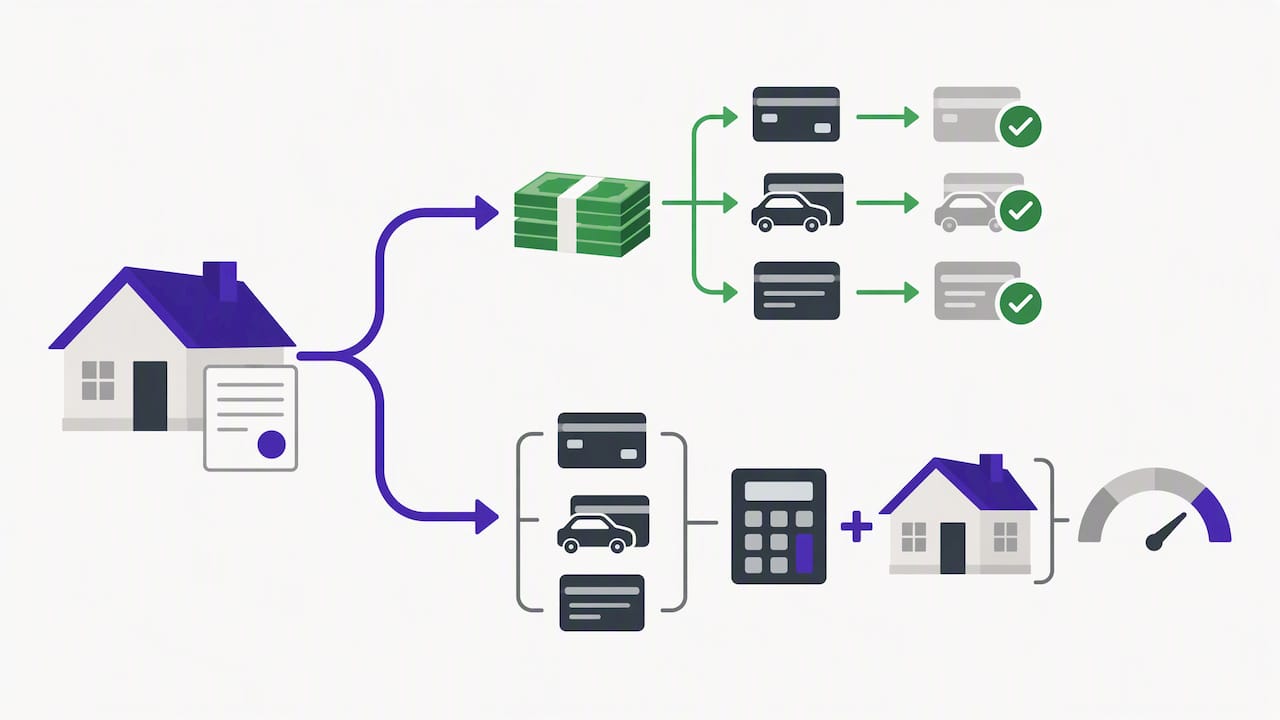
The FCA has also been explicit that affordability checks need to reflect real living costs. Its review found some firms using unrealistic expenditure assumptions when assessing second charge consolidation applications, and it told firms to raise standards around how rigorously they test whether a borrower can actually afford repayments once debts are consolidated. That scrutiny benefits you as the borrower, because it reduces the chance of being approved for something you cannot sustain.
Expect to be asked for a reasonably thorough evidence pack:
- Confirmation that the CCJ has been satisfied, ideally with a certificate of satisfaction from the court.
- Full statements for every debt you want to consolidate, showing current balances.
- Payslips, or for contractors, CIS vouchers and recent self-assessment returns as income evidence.
- Recent bank statements showing how you’ve managed money since the CCJ.
If you work under the Construction Industry Scheme, your CIS vouchers are often the clearest way to demonstrate consistent income to a lender who is already treating your application with extra caution because of the CCJ.
Pro Tip: Request your CCJ satisfaction certificate from the court well before you apply, since processing it can take several weeks and lenders will usually want to see it rather than take your word for it.
Practical steps to improve your chances if you have a CCJ
A CCJ doesn’t close the door on a debt consolidation mortgage, but a bit of preparation changes the odds considerably. Here’s a sensible order to work through:
- Check the CCJ’s status and age. A satisfied CCJ is viewed differently to an unsatisfied one, even though both remain on the register for six years from registration.
- Settle it if you haven’t already. Getting a CCJ marked satisfied, even outside the one month window, generally improves how lenders view your application compared with leaving it unsatisfied.
- Build your evidence pack early. Court paperwork, proof of payments, complete debt statements and income evidence, including CIS vouchers if you’re a contractor, all speed up underwriting and reduce back and forth.
- Think about who applies. A joint application links both applicants’ credit histories, so if one of you has a significantly stronger file, it’s worth discussing with an adviser whether a sole application changes your options.
- Go through a whole of market broker rather than approaching lenders directly. Each hard credit search can affect your score, and an independent adviser can identify which lenders are more likely to accept your circumstances before any search takes place.
Self-employed contractors sometimes assume a CCJ rules them out entirely, but day rate evidence and CIS vouchers can carry real weight when a lender is weighing up the whole picture rather than a single black mark. We’ve covered this in more detail in our piece on contractor mortgages with bad credit.
Pro Tip: Avoid applying to several lenders simultaneously “just to see.” Multiple applications in a short window can look like financial distress and may do more harm than the CCJ itself.
Costs and trade-offs of consolidating unsecured debt onto your mortgage
Rolling unsecured debt into a mortgage changes the shape of what you owe, not just the size of your monthly payment, and it’s worth being clear eyed about that before you commit.
The immediate appeal is usually lower monthly outgoings. Spreading £8,000 of credit card debt over a 25 year mortgage term rather than paying it off over three or four years will almost always reduce what leaves your account each month. But MoneyHelper is direct about the trade-off: extending the repayment period usually means paying more interest overall, sometimes substantially more, even at a lower rate. We’ve broken down how this arithmetic plays out, including why the monthly saving can mask a much higher lifetime cost, in our article on consolidation and monthly payments.
The more serious consideration is security. Credit card debt and personal loans are unsecured, meaning a lender cannot take your home if you stop paying, though your credit file and ability to borrow will suffer. Once that debt sits within your mortgage or a second charge loan, your home becomes the security. MoneyHelper is clear that this is not a step to take lightly and recommends weighing alternatives first, particularly if you’re already struggling with the cost of living.
There are also upfront costs to factor in:
- Arrangement or product fees charged by the lender for the new mortgage or second charge loan.
- Valuation fees to confirm the property’s worth supports the borrowing.
- Broker fees, where applicable, for arranging the deal.
These costs are sometimes added to the loan itself rather than paid upfront, which means they too accrue interest over the mortgage term.
Alternatives and where to get free debt advice before deciding
Before you secure unsecured debt against your home, it’s worth knowing what else is available, because a mortgage isn’t always the right tool even when it’s technically possible.
MoneyHelper runs a free debt advice locator and helpline, connecting you with impartial advisers by phone, online or face to face at no cost. Getting this advice before you remortgage or take a secured loan matters because an adviser will look at your whole financial picture, not just the mortgage option, and can flag whether consolidation genuinely improves your situation or simply delays a bigger problem.
Common non-mortgage routes that a debt adviser might discuss include:
- Debt management plans (DMPs), informal arrangements to repay creditors over an extended period at a reduced monthly amount.
- Individual voluntary arrangements (IVAs), formal agreements that can write off a portion of debt in exchange for fixed payments.
- Debt relief orders (DROs) and bankruptcy, for more severe situations where other routes aren’t viable.
MoneyHelper’s guide sets out which tends to suit which circumstances. We’ve also written a plain English explanation of how a debt management plan works if you want to understand that option before speaking to an adviser.
The FCA has consistently pushed back on firms that steer struggling borrowers toward securing debt without first establishing it’s genuinely the most appropriate option, rather than simply the one that helps an application pass an affordability test.
How an independent mortgage adviser helps homeowners with CCJs
An independent mortgage adviser’s job is to search the whole market rather than a single lender’s product range, which matters considerably more when you have a CCJ, since lender appetite varies widely.
Mortgage advisers must hold a CeMAP qualification to give regulated advice, and MoneyHelper confirms that an adviser should provide a formal illustration and a written rationale explaining why a particular recommendation suits your circumstances. That rationale has to stand up under MCOB rules, meaning the adviser needs to demonstrate the recommendation is genuinely suitable, not simply the first lender willing to say yes.
A first conversation with an adviser typically covers a fact find of your income, debts and the CCJ itself, followed by a list of documents to gather, which for contractors often includes CIS vouchers alongside standard payslips or self-assessment returns. From there, timelines vary depending on how quickly evidence comes together, but having the CCJ satisfaction certificate and full debt statements ready from the outset tends to be the biggest factor in how smoothly things move.
- Advisers compare remortgage, second charge and homeowner loan routes side by side rather than pushing one product.
- They flag where a lender is likely to decline before you apply, protecting your credit file from unnecessary searches.
- They can explain how fees and any commission are structured before you commit to anything.
Where this leaves homeowners weighing up their options
A CCJ complicates a mortgage application, but it rarely closes off every route, and the biggest mistake we see isn’t the CCJ itself, it’s homeowners either giving up too early or rushing into securing debt without checking whether it’s genuinely the right move. Affordability, not the CCJ alone, tends to decide the outcome, and that’s exactly what a careful adviser and a free debt adviser will both test before anything is signed. Satisfy the judgment if you can, gather your evidence, and get both forms of advice before you put your home behind debt that currently isn’t.
— Paul
How we can help if you’re considering a debt consolidation mortgage
We offer independent, whole of market mortgage advice to clients in Hastings, Eastbourne, Hailsham and Bexhill-on-Sea across East Sussex, and we’re available to talk through your situation locally rather than leaving you to navigate lender criteria alone. Where a CCJ is part of your picture, we look across remortgaging, second charge and homeowner loan routes, and we have experience working with contractors who rely on CIS vouchers to evidence income.

A first conversation with us covers your CCJ status, current debts and income evidence, and we’ll explain how any fees or lender commission apply before you commit to anything, in line with the fee information we publish. Bring your CCJ paperwork, recent debt statements and, if you’re self-employed, your CIS vouchers or self-assessment returns, and we’ll take it from there.
If you want to see whether remortgaging or a secured loan makes sense for your circumstances, get in touch through our remortgaging and secured loans page to arrange a conversation.
This article is general information, not a substitute for advice from a qualified financial advisor. Consult a qualified financial professional about your own circumstances before acting on anything here.
FAQ
Does a CCJ affect getting a mortgage?
Yes, a CCJ can affect a mortgage application, as lenders check the Register of Judgments, Orders and Fines and will assess the judgment’s age, amount and whether it’s satisfied. A satisfied CCJ is generally viewed more favourably than an unsatisfied one, though both remain visible for six years under the GOV.UK rule.
What type of mortgage has the highest debt to income ratio?
There isn’t a single mortgage type defined by having the highest debt to income allowance, since this depends on individual lender criteria and the borrower’s overall circumstances rather than the product category itself. An independent adviser can identify which lenders are likely to stretch further for your specific income and debt profile.
Are second charge mortgages more expensive?
Second charge mortgages typically carry higher interest rates than a first charge remortgage, reflecting the lender’s second priority position if the property is repossessed. They make up less than 4% of regulated mortgage sales in the UK, according to the FCA, and tend to suit homeowners who want to keep an existing favourable first mortgage rate in place.
Can I get a mortgage with a low income relative to the loan size?
Affordability depends on your full financial picture, including existing debts, committed expenditure and, where relevant, any CCJs, rather than income alone. Lenders run detailed affordability assessments under MCOB rules, so speaking with an independent adviser is the most reliable way to understand what’s realistically achievable for your circumstances.
What should I check before securing debt against my home?
Before securing previously unsecured debt, check whether free debt advice options such as a debt management plan or IVA might resolve the situation without putting your home at risk, as MoneyHelper recommends. It’s also worth comparing the total interest you’d pay over an extended mortgage term against your current unsecured debt costs before deciding.
Sources
- Gov
- Second charge mortgages – improving outcomes for consumers | FCA
- FCA Handbook - MCOB 11 Responsible lending, and responsible financing of home purchase plans
- Help with the cost of living
Recommended
