Interest-Only vs Repayment Mortgages: Which Suits You?

With a repayment mortgage, each monthly payment covers the interest and pays off some of the loan, so the debt is cleared by the end of the term. With an interest-only mortgage you pay just the interest, so the full loan is still owed at the end and you need a separate plan to repay it. Repayment costs more each month but is the usual route for a home. Interest-only costs less each month but carries real risk.
We are a local mortgage broker in Hastings, serving Eastbourne, Hailsham, Bexhill-on-Sea and the rest of East Sussex. Below we explain how the two work, what they cost, and who each may suit.
TL;DR
- Repayment: higher monthly payments, but the balance falls and the loan is cleared by the end of the term.
- Interest-only: lower monthly payments, but the whole loan is still owed at the end and total interest is higher.
- Lenders need evidence of a credible plan to repay the capital before they lend on interest-only.
- Offset mortgages are a third route: your savings reduce the balance you pay interest on.
- Which is suitable depends on your circumstances and lender criteria, so speak to an adviser first.
Table of Contents
- How the two mortgages work
- What the difference costs you
- Repaying the capital on interest-only
- Part and part, and offset mortgages
- Landlords and buy-to-let
- Self-employed, CIS and contractor borrowers
- Our view
- Switching between the two
- Talk to a local adviser
- FAQ
- Sources
How the two mortgages work
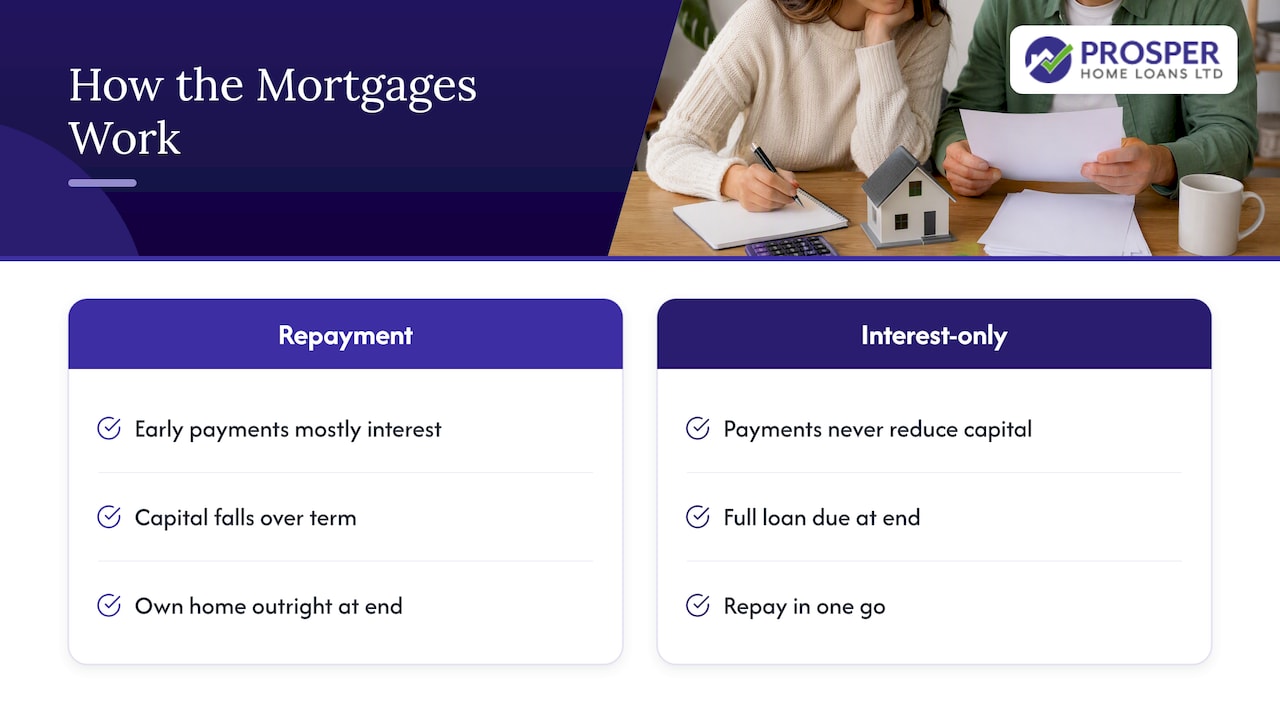
On a repayment mortgage, early payments are mostly interest. Nearer the end of the term, more of each payment goes towards the capital. Keep up the payments and you own the home outright at the end.
On an interest-only mortgage, your payments never reduce the amount borrowed. At the end of the term you must repay the full loan in one go. MoneyHelper advises anyone who cannot do so to contact their lender as soon as possible.
What the difference costs you
Here is an illustration, not a quote. Take a £150,000 loan over 25 years at a fixed 5% (our own arithmetic, rates vary by lender and borrower).
| Repayment | Interest-only | |
|---|---|---|
| Monthly payment | about £877 | £625 |
| Paid over 25 years | about £263,000 | about £187,500 |
| Still owed at the end | £0 | £150,000 |
| Total including the capital | about £263,000 | about £337,500 |
The monthly saving of roughly £250 is real. But the interest-only borrower has paid more in interest overall and still owes the original £150,000. Nationwide explains the same pattern: lower monthly payments, higher total interest over the life of the loan.
If rates change when a fixed deal ends, both figures will move. That is why we always stress-test the numbers with you before you commit.
Repaying the capital on interest-only
This is where interest-only goes wrong. Under FCA rules in MCOB 11.6, a lender may only offer interest-only if there is evidence of a clearly understood and credible repayment strategy. Acceptable strategies can include:
- regular deposits into savings or investments;
- repaying capital from irregular income;
- selling an asset such as another property.
None is risk-free. The Open University notes that if investments underperform, borrowers may be left short of the sum owed. The FCA warns that borrowers may need to sell their home if the money is not there.
The FCA proposed in June 2026 giving lenders more flexibility on interest-only, while most borrowers would still need a clear repayment plan. These are proposals, so lender criteria today are what count.
Part and part, and offset mortgages
Some borrowers split the loan: part repayment, part interest-only. This lowers payments compared with full repayment while still reducing the debt. Lender availability varies.
An offset mortgage links your mortgage to a savings account. You pay no interest on a portion of the mortgage equal to your savings balance. MoneyHelper’s example: a £200,000 mortgage at 3% with £10,000 in the offset account means interest on £190,000. The linked savings usually earn no interest, and you can still withdraw them.
Offset is not a rival to repayment so much as a way of structuring it. You can have a repayment offset mortgage, where savings cut the interest while you still pay the loan down. It can suit people with meaningful savings or lumpy income, but offset rates can be higher than standard deals, so the comparison needs doing properly.

Landlords and buy-to-let
Interest-only is common on buy-to-let because rent can cover the interest and the landlord plans to sell or refinance later. MoneyHelper cautions against relying only on a sale to repay, since a fall in prices could leave a shortfall. Reading about property investor financing options can help you think through how flexible lending fits an investment plan. Lender income rules also apply, as we cover in our guide to buy-to-let minimum income. For more on residential interest-only, see our adviser checklist.

Self-employed, CIS and contractor borrowers
Irregular income makes a lower monthly payment tempting. But a repayment plan built on uncertain earnings is exactly what lenders examine. UK Finance has said interest-only flexibility could improve access for self-employed people, while lenders worry about future consumer harm if strategy requirements loosen.
For most self-employed buyers, repayment is the simpler, safer route. What matters first is how lenders assess your income. Some lenders may use gross CIS earnings, evidenced through CIS vouchers or statements, when assessing affordability, subject to their criteria. This does not increase your actual income and does not guarantee higher borrowing. Our guides cover self-employed versus subcontractor mortgages and common mistakes self-employed buyers make.
Our view
We meet many subcontractors, contractors and company directors whose first question is how to get the monthly payment down. We understand why. Our view is that the cheapest monthly figure is not always the best outcome.
We start with what you can comfortably afford on repayment, including a quiet few months. Then we look at whether another structure, such as a longer term, part and part or offset, fits better. A longer term also lowers payments but raises total interest, and we show you that figure plainly.
If interest-only is being considered, we ask for the repayment plan first, not last. We never promise approval or savings, because outcomes depend on your circumstances and lender criteria.
— Paul McMath CeMAP CeRER
Switching between the two
Many lenders allow changes mid-term. Nationwide says existing customers may be able to switch from repayment to interest-only or the reverse, depending on circumstances. Before asking, check:
- whether the lender will reassess your affordability;
- any change to your rate or product terms;
- how much higher your payments become if you move to repayment;
- what remains owed and over what term.
When a deal ends, a remortgage or product transfer is a natural time to review the structure. Our remortgage service and product transfer service cover both.
Talk to a local adviser
We are a local, independent firm in St. Leonards-on-Sea, available to clients across East Sussex and the UK. We can compare structures from the whole market, including contractor and CIS cases, and explain costs and risks clearly. An affordability assessment and capacity report is available for £199.00 one-off. Start with our CIS subcontractor mortgage page or the main site.

FAQ
Is interest-only cheaper than repayment?
Only month to month. The payments are lower, but you pay interest on the full loan for the whole term and still owe the capital at the end. Overall it usually costs more.
Can I get an interest-only mortgage on my home?
Possibly, but lenders need evidence of a credible repayment strategy before lending. Criteria differ between lenders, and some will only offer part and part. An adviser can check what is realistic for you.
What happens if I cannot repay at the end of an interest-only term?
Contact your lender as soon as possible to discuss options. You may need to sell the home to repay the loan, so plan well before the term ends.
Can I change from interest-only to repayment?
Often, subject to your lender’s rules and a fresh look at affordability. Payments will rise because you are now paying off capital as well as interest.
Sources
- MoneyHelper: interest only and repayment mortgages explained
- MoneyHelper: understanding mortgages and interest rates
- MoneyHelper: buy-to-let mortgages explained
- Nationwide: interest only mortgage
- FCA Handbook: MCOB 11.6
- FCA: interest-only mortgages, act now
- FCA: proposals to help more people access mortgages
- UK Finance: response on the FCA mortgage rule review
- Open University: repayment or interest-only
Recommended
- 2026–26 UK Data: Interest-Only Residential Mortgages and Adviser Checklist
- Home Reversion vs Lifetime Mortgage: Key Differences Explained
- Decreasing vs Level Term Cover: Which Suits Your Mortgage?
- UK JBSP Mortgages: Who Owns the Home, Who Owes the Debt?
This article provides general information and is not a personal mortgage recommendation. Mortgage availability and eligibility depend on your circumstances and lender criteria. Rates and criteria can change. We will explain any applicable fees before you commit. Think carefully before securing other debts against your home. Consolidating debts over a longer term may reduce your monthly payments but increase the total amount you repay. Your home may be repossessed if you do not keep up repayments
