Homeowner Loan After an IVA: Your Options and Risks

Yes, some homeowners can get a secured loan or remortgage after an IVA, but not every lender will consider it, and the choice of lenders usually widens the further you are from the arrangement. Whether it is sensible depends on your equity, your income and what the borrowing is for. We are a local Hastings broker, and this guide explains what to check before you apply.
TL;DR
- An IVA stays on your credit file for 6 years from the date it starts, even if it finishes earlier.
- Lenders set their own rules on IVAs, so how long you have been out of one and how your credit has behaved since both matter.
- A homeowner loan is secured on your property. If you cannot keep up repayments, your home is at risk.
- Lower monthly payments often mean a longer term and a higher total cost.
- Get regulated advice before applying, because each declined application can leave a mark on your credit file.
Table of Contents
- What lenders look at after an IVA
- How long an IVA affects your credit file
- Secured loan, remortgage or something else?
- The cost of lower monthly payments
- The risks of securing debt against your home
- Alternatives to consider first
- Our view as local brokers
- Speak to a local East Sussex adviser
- FAQ
- Sources
What lenders look at after an IVA
There is no single rule across the market. Each lender sets its own criteria, and we do not promise any outcome. In our experience, the questions that come up most often are:
- When the IVA started and when it was completed. The start date matters for your credit file. The completion date shows lenders you finished what you agreed.
- Your credit history since. Missed payments after completion count for more than the IVA itself.
- Your income and how stable it is. This is especially relevant if you are self-employed or a CIS subcontractor.
- Your equity. The loan-to-value ratio shows how much of the property’s value would be borrowed against.
- What the money is for. Lenders and advisers must be able to show the borrowing is suitable for you.
Some lenders also ask whether you have ever been insolvent, even if the IVA has dropped off your file. Being open about it from the start usually saves time.
How long an IVA affects your credit file
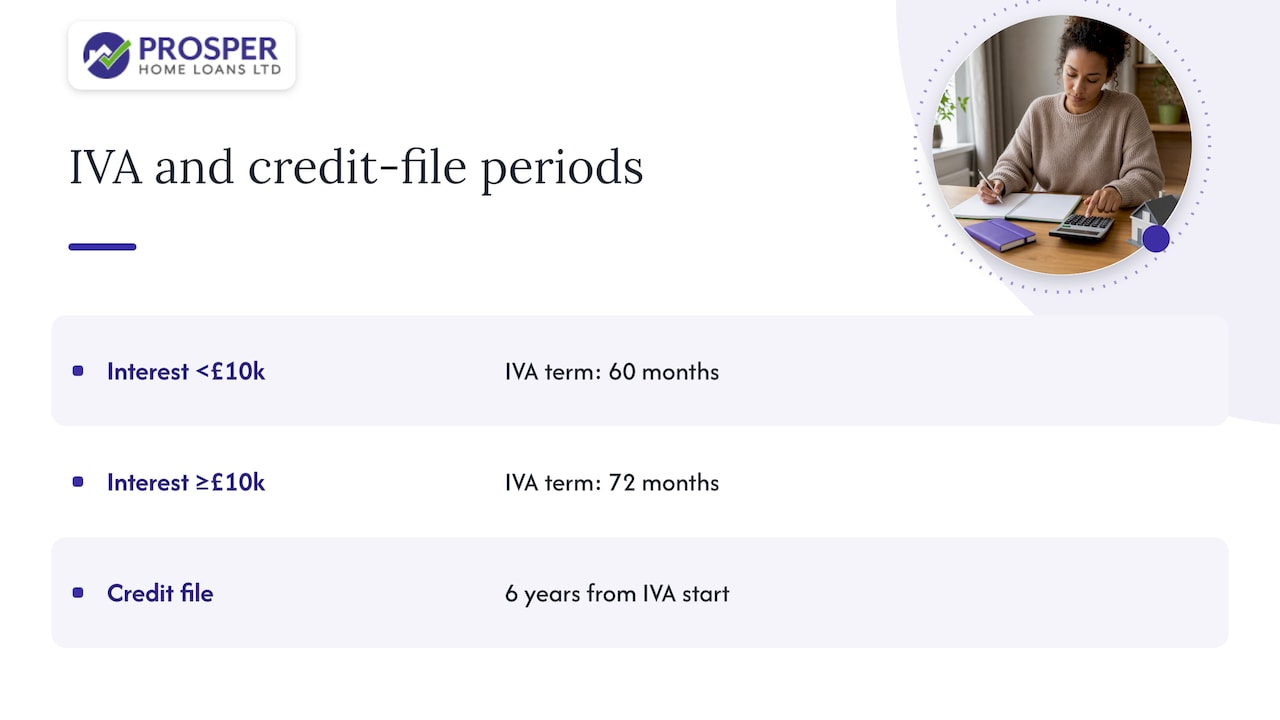
The Insolvency Service says an IVA stays on your credit report for 6 years from the start date, regardless of when it is completed. A protocol IVA usually runs for five or six years, so for many people it comes off the file at about the time it ends.
The length of your IVA can depend on your home. Under the 2025 IVA protocol, the term is 60 months where your interest in the family home is below £10,000 and 72 months where it is £10,000 or more. That interest is calculated from 85% of the property’s value minus secured borrowing such as your mortgage.
The same protocol says a protocol IVA will not require you to sell or release your interest in the family home to pay into the arrangement. Depending on your equity, you may be asked for extra payments instead.
Secured loan, remortgage or something else?
There are two main ways a homeowner borrows against property.
Second charge loan
A second charge loan sits behind your existing mortgage, so your main mortgage stays as it is. This can matter if your current rate is good. The FCA notes that second charge mortgages are a small part of the market, typically less than 4% of regulated mortgage sales. Its March 2026 review told lenders and brokers to raise standards on advice, affordability and fees.
Second charge loans tend to cost more than a first charge mortgage, so work out the full cost before you commit. Our guide to secured loans during a UK IVA covers the extra rules that apply if you are still in the arrangement.
Remortgage
A remortgage replaces your main mortgage, and you may borrow more on top. That can mean one payment and, depending on the deal, a lower rate than a second charge. It can also mean leaving a good existing rate and paying early repayment charges. Our comparison of a secured loan versus a remortgage sets out the trade-offs.
Before choosing either, look at what the money is for. If the aim is to clear debts, our article on the checks that decide whether a homeowner loan to clear debt is right explains what an adviser must consider.
The cost of lower monthly payments
Consolidating debt into a mortgage or secured loan can reduce what you pay each month. The reason is usually that the debt is spread over a much longer term. A longer term generally means more interest paid overall.
MoneyHelper warns that these products can cost more in the long run, particularly if they stretch repayments or swap lower-interest unsecured debt for secured debt. Our article on why debt consolidation reduces monthly payments shows how the term drives this, and our piece on consolidating credit cards into your mortgage works through the figures.
A simple test: compare the total you would repay on your current debts with the total on the new loan, not just the monthly figure. If the new total is higher, ask yourself whether the lower payment is worth the extra cost.

The risks of securing debt against your home
Unsecured debts such as credit cards and loans cannot be taken from your home without a court process. Once those debts are moved into a loan secured on the property, missed payments can lead to repossession. That is the central risk, and it should shape your decision.
Other points to weigh:
- Cost. Secured borrowing may carry arrangement fees and valuation or legal costs, so ask for the full figures in writing.
- Equity. Borrowing more reduces the equity you hold, which can limit future choices.
- Repeat borrowing. The FCA has stressed that debt consolidation is not a guaranteed fix. Firms must check that the arrangement is sustainable and not just something that passes an affordability test.
- Regulation. Under the FCA’s Consumer Duty, firms are expected to explain risks and total costs clearly, and to record why a recommendation is right for you.
If you are still in your IVA, the standard terms require you to tell your supervisor about changes in income or new assets. Speak to your insolvency practitioner before you apply for any new borrowing.
Alternatives to consider first
A homeowner loan is not the only route. Depending on your circumstances, look at:
- Paying the most expensive debts first. MoneyHelper suggests clearing the costliest borrowing first, such as credit cards, store cards and payday loans.
- A debt management plan. Our guide to what a debt management plan is explains how it differs from an IVA.
- Waiting. If your IVA has only just ended, waiting while your credit record rebuilds may widen your choices.
- Free debt advice. If you are struggling now, a free, impartial debt adviser can look at the whole picture before you borrow against your home.
Our view as local brokers
People who come to us after an IVA are often worried they will be turned away. Sometimes the right answer is not to borrow at all, or to wait. We would rather say so than arrange something that does not fit.
We work with self-employed people, company directors and CIS subcontractors, whose income can look uneven on paper after an IVA. Some lenders may use gross CIS earnings when assessing affordability, subject to their criteria. That does not change what you actually earn, and it does not guarantee you can borrow more. We look at how a lender will see your whole file before any application goes in.
A search that leads to a decline can leave a mark on your record. That is why we prefer to check suitability first, explain costs and risks plainly, and only then proceed. MoneyHelper also notes that when you get regulated advice, the adviser recommends a mortgage suited to your needs and circumstances.
— Paul McMath CeMAP CeRER
Speak to a local East Sussex adviser
We are based in St. Leonards-on-Sea and help clients in Hastings, Bexhill-on-Sea, Eastbourne, Hailsham and across East Sussex, and we are available to clients across the UK too. If you are weighing a remortgage or a second charge loan after an IVA, see our second charge and secured loan advice or our remortgage service. If you are self-employed, our self-employed and company director mortgage advice is a good place to start. Contact Prosper Home Loans for a no-pressure conversation about where you stand.
FAQ
Can I get a mortgage or homeowner loan straight after my IVA ends?
Some lenders will consider an application soon after completion, but many prefer more time and a clean record since. Your choice of lenders and the terms offered are likely to be more limited than for someone with no IVA. An adviser can tell you which lenders suit your history before you apply.
Will my current lender offer me a new deal after an IVA?
Often a current lender may still offer a product transfer, but the choice of deals can be narrower. Whether that is the best route depends on your rate, balance and equity. We can compare it with a remortgage.
Do I have to sell my home to get an IVA?
Not necessarily. The Insolvency Service says an IVA generally allows you to keep your home, and your insolvency practitioner will discuss your options with you. Depending on your equity, you may be asked to pay in for longer.
Is a secured loan better than a remortgage after an IVA?
Neither is better in every case. A second charge leaves your main mortgage untouched but usually costs more, while a remortgage may change your whole mortgage and bring early repayment charges. The right choice depends on your rate, equity, income and the amount you need.
Sources
- Key facts: Protocol Individual Voluntary Arrangements (IVA), GOV.UK
- IVA protocol 2025, GOV.UK
- Annex 1: IVA Protocol 2025 standard terms and conditions, GOV.UK
- Second charge mortgages: improving outcomes for consumers, FCA
- Second charge mortgage firms told to raise standards, FCA
- What is an Individual Voluntary Arrangement (IVA)? MoneyHelper
- How to reduce your borrowing, MoneyHelper
- Mortgage advice: should you use a mortgage adviser? MoneyHelper
- What am I expected to do when I’m in an IVA? Insolvency Service
Recommended
- Secured Loans During a UK IVA: The £500 Rule and 2026 Protocol
- MCOB Checks That Decide If a Homeowner Loan to Clear Debt Is Right
- Secured Loan vs Remortgage: A UK Homeowner Guide
- Debt Consolidation Mortgage With a CCJ: Local Help for UK Homeowners
This article provides general information and is not a personal mortgage recommendation. Mortgage availability and eligibility depend on your circumstances and lender criteria. Rates and criteria can change. We will explain any applicable fees before you commit. Think carefully before securing other debts against your home. Consolidating debts over a longer term may reduce your monthly payments but increase the total amount you repay. Your home may be repossessed if you do not keep up repayments
