Gilts and bonds: what UK investors need to know

Gilts are a subset of bonds. Specifically, they are UK Government bonds, and they share the same mechanics as any other bond: a fixed coupon, a maturity date, and a price that moves in the opposite direction to yield. What sets gilts apart is who issues them and what protection is available. Here’s what you need to know before you go further:
- Credit safety: gilts carry the backing of HM Treasury via the Debt Management Office (DMO), which most investors treat as close to the safest sterling-denominated debt available.
- Inflation protection: index-linked gilts adjust coupons and principal in line with RPI, though a lag means payments trail actual inflation.
- Tax treatment: capital gains on gilts are exempt from UK capital gains tax, while coupon income is taxable, so the wrapper you hold them in matters.
The rest of this guide walks through the types, the pricing mechanics, the risks, and exactly how to buy them.
Key Takeaways
Gilts are UK Government bonds that share standard bond mechanics but offer sovereign backing, RPI-linked protection, and a capital gains tax exemption unavailable on most other assets.
| Point | Details |
|---|---|
| Gilts are a bond subset | They follow standard bond mechanics but carry HM Treasury backing via the DMO. |
| Price and yield move inversely | A falling gilt price pushes running yield up, and a rising price pushes it down. |
| Index-linking has a lag | RPI adjustments trail actual inflation by three months on newer index-linked gilts. |
| Capital gains are tax-exempt | Gilt coupon income is taxable, but capital gains are exempt from UK capital gains tax. |
| Match instrument to goal | Use single gilts for a known future date, funds for diversified ongoing exposure. |
Table of Contents
- What is a bond, and what makes a gilt different?
- What types of gilts and bonds should you know?
- How do price, coupon and yield actually relate?
- What are the main risks with gilts and bonds?
- How do you actually buy gilts?
- Where do gilts fit in a portfolio?
- An adviser’s view on gilts versus funds
- Should you speak to an adviser about your investment mix?
- Frequently asked questions
- Sources
What is a bond, and what makes a gilt different?
A bond is essentially an IOU. You lend money to a government or company, they pay you a coupon at regular intervals, and they return your capital (the principal) when the bond matures. That’s the whole mechanism, whether you’re holding a corporate bond, a supranational bond, or a gilt.
A gilt is a bond issued by the UK Government through the DMO, denominated in sterling and typically listed on the London Stock Exchange. The name comes from the gilt-edged paper certificates once used, a nod to the perceived safety of the debt. HM Treasury sets the borrowing need; the DMO executes the issuance.
Where gilts sit against the alternatives, in practical terms:
- Gilts: sovereign credit risk (very low for sterling investors), generally strong liquidity, capital gains exempt from tax.
- Corporate bonds: issuer-specific credit risk that varies enormously between a blue-chip company and a smaller issuer, often less liquid, coupon and gains both potentially taxable depending on structure.
- Bond funds: pooled exposure across many issues, no fixed maturity date for the fund itself, convenient inside an ISA or SIPP, but you lose the certainty of a single bond’s redemption date.
Understanding this hierarchy matters before you compare specific instruments, because the “same risk, different reward” assumption between gilts and corporate paper simply doesn’t hold.
What types of gilts and bonds should you know?
Two main categories dominate the gilts market: conventional gilts and index-linked gilts.
Conventional gilts pay a fixed coupon twice a year until maturity, then repay the face value. They’re named for their coupon and maturity year, so a “1½% Treasury Gilt 2047” pays 1.5% annually (in two instalments) and matures in 2047. Once you can decode that naming convention, reading a gilts price list stops being intimidating.
Index-linked gilts adjust both coupon and principal in line with the Retail Prices Index, giving investors a hedge against inflation that fixed-coupon gilts don’t offer. Newer issues use a three-month indexation lag; older ones ran on an eight-month lag.
Pro Tip: That lag means your inflation adjustment reflects RPI from months ago, not today. During a period when inflation is moving fast, your real return can lag the headline rate considerably, so don’t assume index-linked gilts track inflation in real time.
Beyond gilts, the wider bonds and fixed income securities universe includes corporate bonds, supranational bonds (issued by bodies like the World Bank), Treasury bills (short-dated government debt), and zero-coupon bonds that pay no interest but are sold at a discount. Bond funds and ETFs hold baskets of these rather than single issues.

How do price, coupon and yield actually relate?
The coupon is fixed at issue and never changes. The price moves constantly as it trades in the secondary market, and this is where most confusion sets in. When the price falls, the yield rises, and vice versa. This inverse relationship is the single most important thing to understand about bond investment strategies.
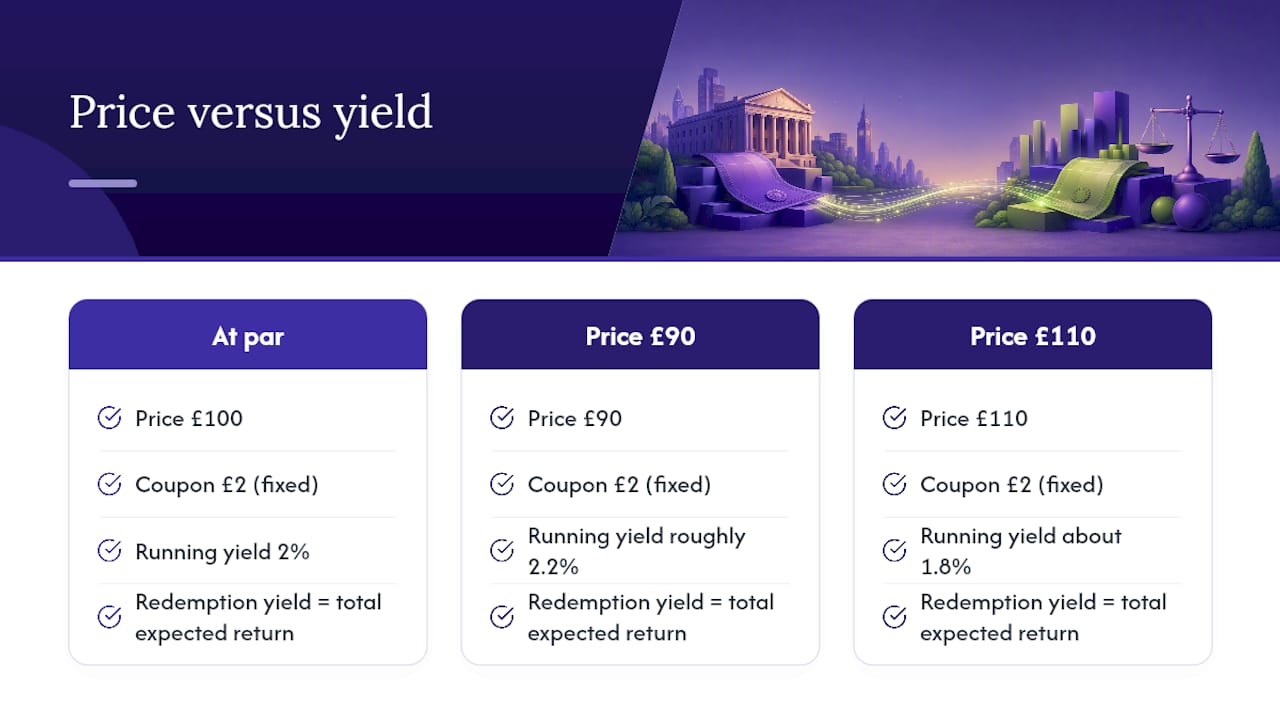
Here’s a worked example. Say a gilt has a £100 face value and a 2% coupon, paying £2 a year. If you buy it at par (£100), your running yield is 2%. If demand falls and the price drops to £90, that same £2 coupon now represents a running yield of roughly 2.2%. Buy at a premium of £110, and your running yield drops to about 1.8%.
Redemption yield, also called yield-to-maturity, goes further: it accounts for the coupon, the price you paid, and any capital gain or loss you’ll realise at maturity, assuming coupons are reinvested at the same rate. It’s the figure serious bond investors quote because it captures total expected return, not just income.
Index-linked gilts complicate this slightly further. Their quoted yield is a real yield, already stripped of expected inflation, which is why it often looks lower or even negative compared with a conventional gilt’s nominal yield. A glossary explainer on yield on cost is worth a read if you want to see how yield measures diverge depending on your original purchase price versus current market value.
What are the main risks with gilts and bonds?
Gilts are often described as “risk-free,” which oversimplifies things considerably.
- Credit/default risk: sovereign backing makes gilts safer than most corporate alternatives, but “safer” isn’t “risk-free.”
- Interest-rate risk: longer-dated gilts see much bigger price swings when interest rates move than short-dated ones do.
- Inflation risk: conventional gilts pay a fixed coupon that inflation quietly erodes over time; index-linked gilts help, but the lag means protection isn’t instant.
- Liquidity risk: gilts are generally liquid, but selling when rates have risen can crystallise a real capital loss even though the issuer never misses a payment.
- Tax and wrapper risk: coupon income is taxable outside an ISA or SIPP, so holding gilts in the wrong account leaves money on the table unnecessarily.
Pro Tip: If you’re holding gilts specifically for income, check whether the coupon income pushes you into a higher tax band before you commit outside a wrapper.
How do you actually buy gilts?
Retail investors have three realistic routes, each suited to a different kind of investor.
- Direct via the DMO: the DMO Purchase and Sale Service lets private investors buy and sell gilts directly, subject to Approved Group membership and minimum investment thresholds. It’s straightforward but less flexible than a broker platform.
- Secondary market via a broker or platform: most execution-only platforms let you buy and sell gilts like shares, typically settling on a T+1 basis through CREST, with prices set by Gilt-edged Market Makers.
- Pooled exposure via funds or ETFs: rather than owning a single issue, a fund spreads your money across many gilts, which suits investors who want diversification without tracking individual maturity dates.
Before choosing a platform, compare:
- Dealing costs and any custody fees.
- Whether the account is ISA or SIPP eligible.
- Minimum investment size.
- Whether you can see live prices or only end-of-day valuations.
- Whether you can hold an individual gilt to maturity rather than being forced to sell.
If you need income at a specific date, a single held-to-maturity gilt via a whole of market broker gives certainty a fund can’t. If you simply want diversified fixed income exposure, a fund or ETF usually wins on convenience and lower minimums. Capital gains on gilts remain exempt from UK capital gains tax, which is a meaningful advantage over most other assets held outside a wrapper.
Where do gilts fit in a portfolio?
Gilts traditionally do three jobs: dampen volatility, deliver predictable income, and act as ballast when equities fall. The classic 60:40 portfolio, 60% equities and 40% bonds, is still widely cited as a starting framework, though commentary from Goldman Sachs notes that lower credit risk doesn’t remove exposure to inflation or interest-rate swings.
For most retail investors, a diversified gilts market fund or ETF is more practical than assembling a portfolio of single issues, unless you specifically need a laddered set of maturity dates to match future spending. If income certainty matters, match the gilt’s maturity to when you’ll need the cash. As a rough starting point, shorter and medium-dated gilts, or a fund blending both, suit investors with a moderate risk tolerance better than concentrating in long-dated issues alone.
An adviser’s view on gilts versus funds
We regularly see clients default to a gilt fund without asking whether a single-issue gilt held to maturity would actually suit their goal better. If you need a known sum on a known date, say for a house deposit in three years, a specific gilt maturing then removes reinvestment risk that a fund doesn’t. Funds win when you want diversification and don’t want to manage individual maturity dates yourself.
The mistake we see most often is holding coupon-paying gilts outside an ISA or SIPP, then being surprised at the tax bill. Always check platform execution costs too. A wide bid-ask spread on a smaller platform can quietly erode the return you thought you’d locked in. For a broader look at how bonds and gilts fit alongside other fixed income choices, our guide on bonds in the UK is worth a read.
Should you speak to an adviser about your investment mix?
Gilts and bonds rarely sit in isolation from the rest of your financial plan, particularly when a mortgage, remortgage, or protection review is also on your mind. Prosperhomeloans works with clients across the UK, from first-time buyers to property investors, to make sure investment decisions and borrowing decisions don’t pull in opposite directions. If you’re weighing up how much to hold in cash, gilts, or property against your mortgage plans, Prosperhomeloans can help you see the full picture rather than one piece of it.
Frequently asked questions
What’s the difference between gilts and bonds? Gilts are a specific type of bond issued by the UK Government. All gilts are bonds, but not all bonds are gilts, corporate bonds, for instance, carry issuer-specific credit risk that gilts largely avoid.
What are the disadvantages of gilts? Yields have historically been lower than corporate bonds to reflect lower credit risk, long-dated gilts carry meaningful interest-rate risk, and conventional gilts offer no built-in inflation protection.
How do you buy gilts as a retail investor? You can buy directly through the DMO Purchase and Sale Service, via an execution-only broker on the secondary market, or indirectly through a gilts fund or ETF.
This article is general information, not a substitute for advice from a qualified financial advisor. Consult a qualified financial professional about your own circumstances before acting on anything here.
Sources
For live prices and issuance data, check the DMO’s gilts overview directly. For indexation mechanics, see the DMO’s index-linked gilts page. For market scale and fiscal context, the House of Commons Library’s gilts explainer and the Institute for Government’s explainer both offer clear background. For buying mechanics, refer to the DMO private investor guide.
- About gilts
Recommended
