Ex Council Flat Mortgages for UK Buyers: How Discounts Affect Lenders

Yes, you can get a mortgage on an ex council flat, and most mainstream lenders will consider one without hesitation. Approval hinges on three checks: how long is left on the lease, whether the building has satisfactory safety and insurance arrangements, and whether your affordability still works once any Right to Buy or First Homes discount is factored in. Lenders vary on how they treat these, so the sensible next step is an eligibility check with a broker before you spend money on legal fees.
TL;DR:
- Most ex council flats qualify for standard residential mortgages if they have a long lease, no cladding issues, and a straightforward building history, but short leases or safety concerns may require specialist lenders.
- Lenders become increasingly cautious once the remaining lease drops below 80 years, with some declining outright below approximately 70 years, making lease extensions important before purchase.
- Right to Buy discounts can sometimes be used as part of the deposit, but lenders’ valuation and caps may limit how much mortgage you can get based on the property’s discounted value.
- Building safety documentation like the EWS1 form and recent fire risk assessments are essential, especially for blocks over four or five storeys, since many lenders won’t proceed without these certificates.
- Engaging a whole-of-market broker early for eligibility checks, lease review, and safety documentation can save time and avoid failed applications or unnecessary survey costs.
Table of Contents
- Which mortgage products accept ex council flats?
- What do lenders check on leasehold flats?
- How do Right to Buy and First Homes discounts affect your mortgage?
- Preparing your deposit and affordability evidence
- Building safety, cladding and insurance: the hidden mortgage blocker
- Lease extension and enfranchisement: timing matters
- Why a specialist broker matters for ex council flats
- Why local, specialist advice matters for East Sussex buyers
- Get a free mortgage eligibility check with Prosperhomeloans
- Sources
- FAQ
Which mortgage products accept ex council flats?
Most ex council flats sit comfortably within standard residential mortgage lending. High street lenders assess them the same way they assess any leasehold flat: lease length, building type, number of storeys, and the proportion of commercial or non-residential space in the block. Where things get trickier, specialist lenders step in.
You will typically encounter three routes:
- Standard residential mortgages from mainstream lenders, suited to ex council flats with a long lease, no cladding issues, and a straightforward tenure history.
- Specialist lender products for flats with shorter leases, unusual construction (steel frame, high-rise, or system-built blocks common in the 1960s and 1970s council stock), or where the borrower’s income is non-standard, such as CIS subcontractors.
- Buy-to-let mortgages, relevant if you plan to rent the flat out rather than live in it, which brings its own rental cover calculations and often a bigger deposit requirement.
Deposit and loan-to-value (LTV) expectations differ between flats and houses too. Flats generally attract slightly tighter LTV limits than houses in the same price bracket, particularly above the fourth floor or in blocks without a lift. One practical quirk worth knowing early: some lenders will accept a Right to Buy discount as part of your deposit, effectively reducing the cash you need to find, while others insist on a separate deposit on top of the discount. That single difference can change which lender is right for you, which is exactly the kind of detail a broker checks before you commit to an application.
What do lenders check on leasehold flats?
Nearly every ex council flat is sold leasehold, and the lease itself drives much of the lender’s decision. Lenders look closely at how many years remain, the ground rent structure, and whether the title contains restrictive or unusual clauses.
As a broad rule, lenders become noticeably more cautious once the remaining term drops toward 80 years, because that is the point at which extending the lease later becomes significantly more expensive (more on that below). Below roughly 70 years remaining, your choice of lender narrows sharply, and some will decline outright.
Steps worth taking before you get too far into a purchase:
- Ask the seller’s solicitor for a lease summary as early as possible, ideally before you instruct your own conveyancer.
- Check the ground rent clause for escalation terms. Some older council leases have fixed peppercorn rents, but others include review periods that can worry lenders.
- If the lease is approaching the 80 year mark, get a premium estimate for a statutory extension before exchange, not after.
Pro Tip: Ask for the lease summary at the same time you request the property information forms. It costs the seller nothing and can save you weeks if the lease turns out to be a problem.
How do Right to Buy and First Homes discounts affect your mortgage?
Statutory discount schemes change the sums lenders run, not just the price you pay. Regional cash caps introduced by the 2024 Order now limit the maximum cash discount to between £16,000 and £38,000 depending on where you live, which caps how far the percentage discount actually stretches in higher-value areas.
First Homes works differently: it offers first-time buyers a minimum 30% discount against market value, with local authorities able to set tighter price caps on top.
A few points worth flagging before you apply:
- GOV.UK guidance confirms there is no legal requirement dictating how a Right to Buy purchase must be financed, but the lender will still value the property in the usual way and may treat the discount as effective deposit or ignore it entirely.
- The lender’s own valuation can act as a de facto price cap. If the surveyor values the flat below the discounted price you agreed, the mortgage offer shrinks to match.
- First Homes buyers should confirm local price caps with the council before instructing a valuer, since caps vary by borough and can shift the numbers substantially.
Preparing your deposit and affordability evidence
Deposit requirements on ex council flats broadly mirror the wider leasehold market.
Lenders will want a fairly standard evidence pack, though the detail matters:
- Proof of the Right to Buy or First Homes discount, usually the council’s offer letter.
- Recent payslips, your P60, or, for CIS subcontractors, CIS vouchers covering the period the lender requests.
- Three to six months of bank statements showing income patterns and outgoings.
- Evidence of savings or a gifted deposit, with a letter confirming the gift is not repayable.
Contractor and CIS income is where a broker earns their fee. A CIS voucher mortgage lets self-employed contractors present enhanced, verified income rather than relying on a single year’s tax return, which can materially change how much you are offered. If you are also carrying existing debt, a debt consolidation mortgage can roll higher-interest borrowing into the new mortgage, easing monthly outgoings before the lender even runs its affordability stress test.
Building safety, cladding and insurance: the hidden mortgage blocker
Building safety documentation has become one of the most common reasons ex council flat applications stall, particularly for blocks over four or five storeys. Lenders ask for an EWS1 form or equivalent certification when cladding is present, and without it, many lenders simply won’t offer terms, regardless of how strong the applicant’s income looks.

Insurance costs feed directly into affordability too. The FCA has reported rising insurance premiums and added complexity for multi-occupancy buildings, and those costs often show up as higher service charges, which lenders factor into their affordability calculations alongside your mortgage payment.
Before you commit to a purchase:
- Ask for the EWS1 form (or the freeholder’s confirmation that none is required) in writing, not verbally.
- Request a recent building survey or fire risk assessment if the block has more than four storeys.
- Get written confirmation of any remediation funding in place, or the expected timeline and cost if remediation is still needed.
Pro Tip: Request these documents before you pay for a survey or valuation. Discovering a missing EWS1 after you’ve paid £500 for a survey is a common and avoidable frustration.
Lease extension and enfranchisement: timing matters
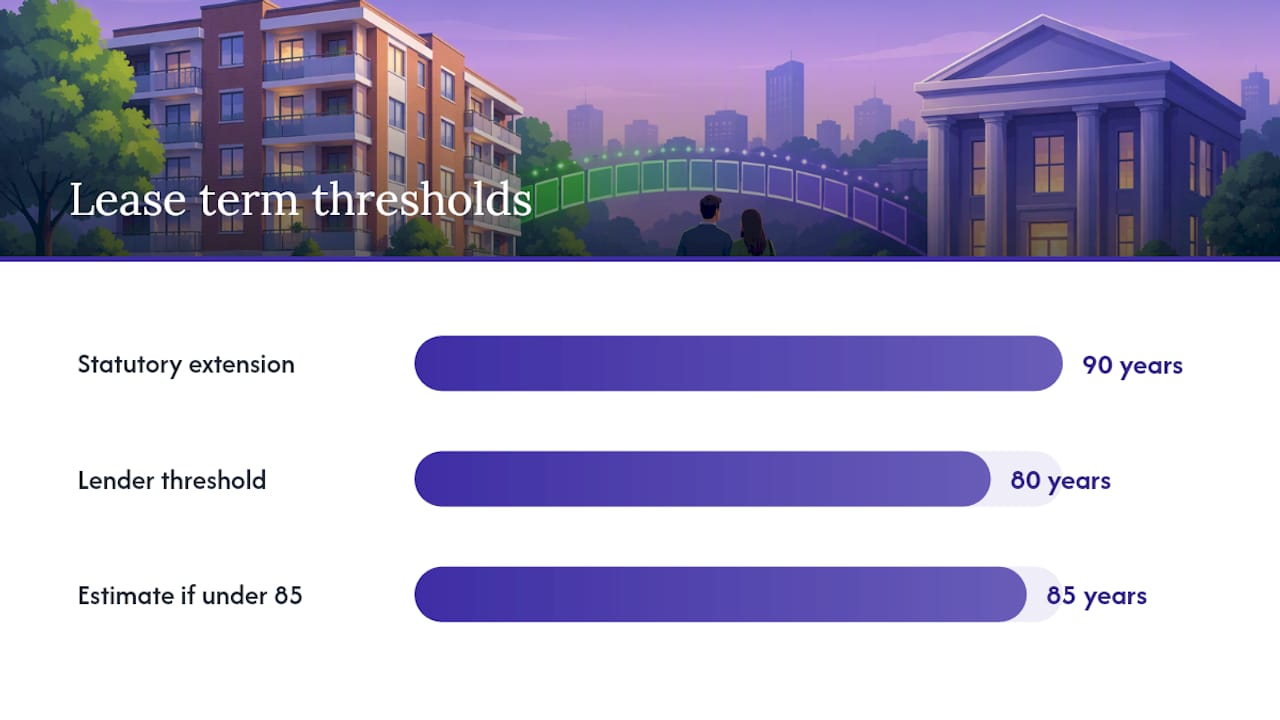
A statutory lease extension adds 90 years to the existing term and removes ground rent entirely, which is why extending before the lease drops too low is worth planning for rather than leaving until a sale forces the issue.
The reason lenders watch the 80-year threshold so closely is marriage value. Once a lease falls to 80 years or fewer remaining, the leaseholder typically owes a share of the “marriage value”, the jump in property value created by combining a longer lease with the freehold interest, and that can add thousands to the extension premium.
- If your target flat has a lease under 85 years, get a premium estimate before you exchange contracts, not after.
- Instruct a chartered valuer experienced in lease extension valuations rather than a general estate agent, since small changes in the assumptions used can shift the premium by thousands.
- A specialist solicitor handles the Section 42 notice that formally starts the statutory extension process.
Why a specialist broker matters for ex council flats
Mortgage availability on ex council flats is genuinely lender-specific. One lender will happily accept a 75-year lease on a low-rise 1960s block; another will decline the same property outright. A broker with whole-of-market access spends their working week tracking which lenders accept which lease lengths, which buildings, and which safety documentation, and that knowledge routinely saves clients from failed applications and wasted survey fees.
This focus is common among brokers working with clients buying ex council flats in Hastings, Eastbourne, Hailsham and Bexhill-on-Sea.
- Affordability calculations and written confirmation before you make an offer.
- CIS voucher mortgage packaging for self-employed contractors with enhanced or variable income.
- Debt consolidation mortgages for buyers who want to simplify existing borrowing alongside the purchase.
- Liaison with your solicitor and valuer on lease length, ground rent and building safety evidence.
Pro Tip: Get your eligibility checked before you pay for a solicitor or survey. It costs nothing and tells you which lenders will actually consider the flat you have your eye on.
Why local, specialist advice matters for East Sussex buyers
We’re based across Hastings, Eastbourne, Hailsham and Bexhill-on-Sea, and ex council flats with short leases or unclear building safety records come up constantly in this part of East Sussex. Our advice: run an eligibility check early, request building safety documents before instructing a surveyor, and get a solicitor to review the lease before you fall in love with the flat. It’s regulated, personalised advice, and it costs you nothing to start the conversation.
— Paul
Get a free mortgage eligibility check with Prosperhomeloans
An independent mortgage broker can provide ex council flat buyers access to a wider range of lenders beyond those available at high street branches. That matters enormously on non-standard leasehold flats, where the right lender for your exact lease length and building type might be one you’ve never heard of.

Whether you’re buying under Right to Buy, First Homes, or on the open market, and whether your income comes from PAYE, CIS vouchers, or self-employment, our independent mortgage advice covers the full picture, including debt consolidation options and support tailored to self-employed and contractor applicants. We’re FCA regulated, our advice fees are set out clearly before you commit to anything, and our advisers hold CeMAP and CeRER qualifications. Book a free eligibility check with our team, available seven days a week across Hastings, Eastbourne, Hailsham and Bexhill-on-Sea, and find out exactly which lenders will consider your ex council flat before you spend a penny on legal fees.
This article is general information, not a substitute for advice from a qualified financial advisor. Consult a qualified financial professional about your own circumstances before acting on anything here.
Sources
- Your Right to Buy your home: a guide
- The Housing (Right to Buy) (Limits on Discount) (England) Order 2024
FAQ
Can I get a mortgage on an ex council house or flat?
Yes, most mainstream and specialist lenders will mortgage ex council properties, provided the lease length, building safety evidence and affordability all check out. The main sticking points tend to be short leases and cladding-related documentation rather than the ex council status itself.
Is it a good idea to buy an ex council house or flat?
Ex council flats often offer more space and lower prices per square foot than comparable new-build flats, but the value depends heavily on lease length, service charges and the building’s condition. Getting a lease summary and building safety documents early helps you judge whether a specific flat is a sound buy, not just a cheap one.
How much deposit do I need to buy a council flat?
If you qualify for a Right to Buy discount, some lenders will count part of that discount toward your deposit, which can reduce the cash you need upfront.
What is the government’s 40% loan scheme for buying a house?
There isn’t a general government loan scheme currently running for homebuyers, but First Homes offers qualifying first-time buyers a minimum 30% discount against market value, with local authorities able to set the discount higher in some areas.
Does Prosperhomeloans help with ex council flat mortgages specifically?
Yes, Prosperhomeloans arranges whole-of-market mortgage advice for ex council flat buyers across East Sussex, including Right to Buy and First Homes purchases. Advisers also handle CIS voucher mortgage packaging for contractors and debt consolidation options where relevant.
Recommended
