When Offset Mortgages Pay: Tax and Cash Rules for UK Landlords

Yes, offset buy-to-let mortgages exist in the UK and a handful of specialist lenders still offer them. They tend to suit landlords who hold meaningful cash reserves and whose tax position lets them keep most of the benefit, rather than every portfolio owner. The trade-off that matters most is interest savings against tax treatment and lender eligibility, so the sensible first step is to check your tax status and speak to a whole-of-market broker before you commit.
TL;DR:
- Offset mortgages benefit landlords with substantial cash reserves, especially those holding reserves in accounts that remain accessible and tax-efficient.
- The interest savings from offsetting are reduced or eliminated for higher-rate taxpayers due to HMRC’s basic-rate tax credit on mortgage interest.
- Offset products are mainly offered by specialist lenders and tend to have higher rates and fees, making market-wide advice essential.
- Affordability is assessed using an interest coverage ratio, which does not consider offset savings, so cash in offset does not improve borrowing capacity.
- Proper documentation of income, reservations, and existing mortgages is critical for a smooth application process, especially with limited lender options.
Table of Contents
- How an offset buy-to-let mortgage actually works
- What offset actually saves once tax is taken into account
- Which landlords offset suits, and which it usually doesn’t
- How lenders test affordability and what it means for offset
- Getting ready to apply: documents, timing, and the right questions
- How a whole-of-market broker weighs up offset for your portfolio
- What the offset conversation usually gets wrong
- Local, specialist help arranging your buy-to-let offset mortgage
- Where to check the rules yourself
- Sources
- FAQ
How an offset buy-to-let mortgage actually works
An offset mortgage links your savings account to your mortgage balance. Instead of earning interest on your savings separately, the lender treats that cash as if it had already paid down part of your loan, so you’re only charged interest on the net figure: mortgage balance minus savings balance. For a landlord sitting on rental surplus or a maintenance reserve, that can mean a real reduction in monthly interest without giving up access to the money.
There are two ways lenders apply the saving, and which one suits you depends on what you’re trying to achieve.
- Payment reduction: your monthly payment falls immediately, while the term and capital repayment schedule stay as originally agreed.
- Balance reduction: your monthly payment stays the same, but more of it goes towards capital each month, so a repayment mortgage clears faster (this route doesn’t apply to interest-only loans, which most buy-to-let mortgages are).
Specialist lenders including the Family Building Society describe both structures for their buy-to-let offset range, and the choice is usually set at the outset rather than switched later.
A worked example makes the mechanics clearer. Without offset, you’d pay interest on the full £200,000. The exact figure depends on the lender’s rate and how often interest is calculated, but the principle holds: every pound held against the mortgage stops earning savings interest and starts cutting borrowing cost instead.
The saving scales with reserves held, not with income. A landlord holding £50,000 against the same £200,000 loan would see interest calculated on £150,000, a bigger proportional cut, which is why offset tends to reward landlords who already run with healthy cash buffers rather than those borrowing to the limit.
Crucially, the money in the offset account isn’t locked away. It remains accessible for voids, unexpected repairs or a boiler replacement between tenancies, which is precisely why many landlords use offset as a cashflow tool rather than a pure interest play. The lenders that currently offer buy-to-let offset products in the UK tend to be specialist building societies and niche lenders working through intermediaries rather than the mainstream high street names, and availability can change, so checking current lender appetite with a broker before applying saves wasted time.
What offset actually saves once tax is taken into account
Offset genuinely cuts your interest bill, but what lands in your pocket after tax depends heavily on how you’re taxed as a landlord, and this is where many landlords overestimate the benefit.
The benefits are straightforward on paper:
- Lower interest charged on the net balance, which improves monthly cashflow.
- Savings remain liquid and accessible rather than tied into a fixed-term bond.
- On a repayment mortgage, balance reduction offset can shorten the effective term.
- A cash buffer sitting in offset still works for you even while it waits to be spent on the property.
The complication is tax. For individual landlords, residential finance costs, including mortgage interest, are no longer deducted in full against rental profits. HMRC’s property income manual confirms that relief is instead given as a basic-rate tax credit, applied after profit has been calculated. In practice, that means a landlord paying tax at the higher or additional rate only gets relief at the basic rate, regardless of their actual tax bracket, so the real value of any interest saving, offset included, is squeezed for higher-rate taxpayers compared with someone taxed at the basic rate. HMRC’s guidance also notes that what counts as allowable interest depends on how the borrowing is used and the “wholly and exclusively” rule, which is a detail worth checking with an adviser rather than assuming.
There are product-level drawbacks too. Offset mortgages often carry a higher headline rate than a comparable non-offset deal, arrangement fees can be steep, and the pool of lenders is small, so you may have less room to negotiate. There’s also an opportunity cost: cash sitting in offset isn’t available to invest elsewhere, so landlords who could get a notably higher return on that capital need to weigh the comparison properly rather than defaulting to offset because it “feels safer.”
The table below sets out a simplified comparison using the £30,000 reserve from our earlier example, held either in a notice savings account paying 4% or applied to the same £200,000 mortgage via offset at 5.5%.

The comparison shows why offset can look attractive at any tax band: an interest saving isn’t taxed as income the way savings interest is, so the basic-rate and higher-rate columns are identical in this illustrative case. What changes between taxpayers is the comparison with the mortgage interest you’d otherwise claim relief on, since a higher-rate landlord only gets basic-rate relief on the interest they didn’t save, which narrows the gap between offset and simply overpaying the mortgage.
Pro Tip: Before applying savings to an offset account, ask your accountant whether the interest you’d be avoiding is the same interest currently qualifying for the basic-rate tax credit, since offsetting reduces the deductible interest figure too.
Which landlords offset suits, and which it usually doesn’t
Offset isn’t a universal upgrade. It tends to reward a specific kind of landlord and does little, or actively costs more, for others.
- Basic-rate taxpayers typically keep more of the relative benefit, since their interest relief position doesn’t shrink the comparison the way a higher-rate taxpayer’s does.
- Portfolio landlords holding contingency cash across several properties often prefer offset to spreading reserves across ordinary savings accounts, since it reduces interest on a mortgage rather than earning taxed interest on deposits.
- Landlords who want liquidity without giving up interest savings are a natural fit, particularly those managing seasonal voids or planned refurbishment costs.
Offset is usually a poorer fit for:
- Higher-rate and additional-rate taxpayers, where the basic-rate tax credit already limits the value of interest relief, narrowing the gap offset can close.
- Landlords using a limited company structure, where mortgage interest is deducted as a normal business expense before corporation tax rather than restricted to a basic-rate credit, which changes the maths entirely and often reduces the relative appeal of offset.
- Accidental landlords with modest reserves, since the interest saving on a small offset balance may not outweigh a higher headline rate or arrangement fee on the product.
The limited company point matters enough to repeat in its own terms: a company structure deducts interest costs before calculating corporation tax, so the basic-rate restriction that applies to individual landlords simply doesn’t exist in the same form. That single difference changes whether offset is worth chasing at all, which is exactly the kind of structural question a broker familiar with expat and specialist buy-to-let lending would normally raise early in a conversation.
How lenders test affordability and what it means for offset
Buy-to-let lending isn’t assessed the way a residential mortgage is. Lenders use an Interest Coverage Ratio, commonly called ICR, which checks whether the rental income covers the mortgage payment by a set margin once a stressed interest rate is applied rather than the actual pay rate.
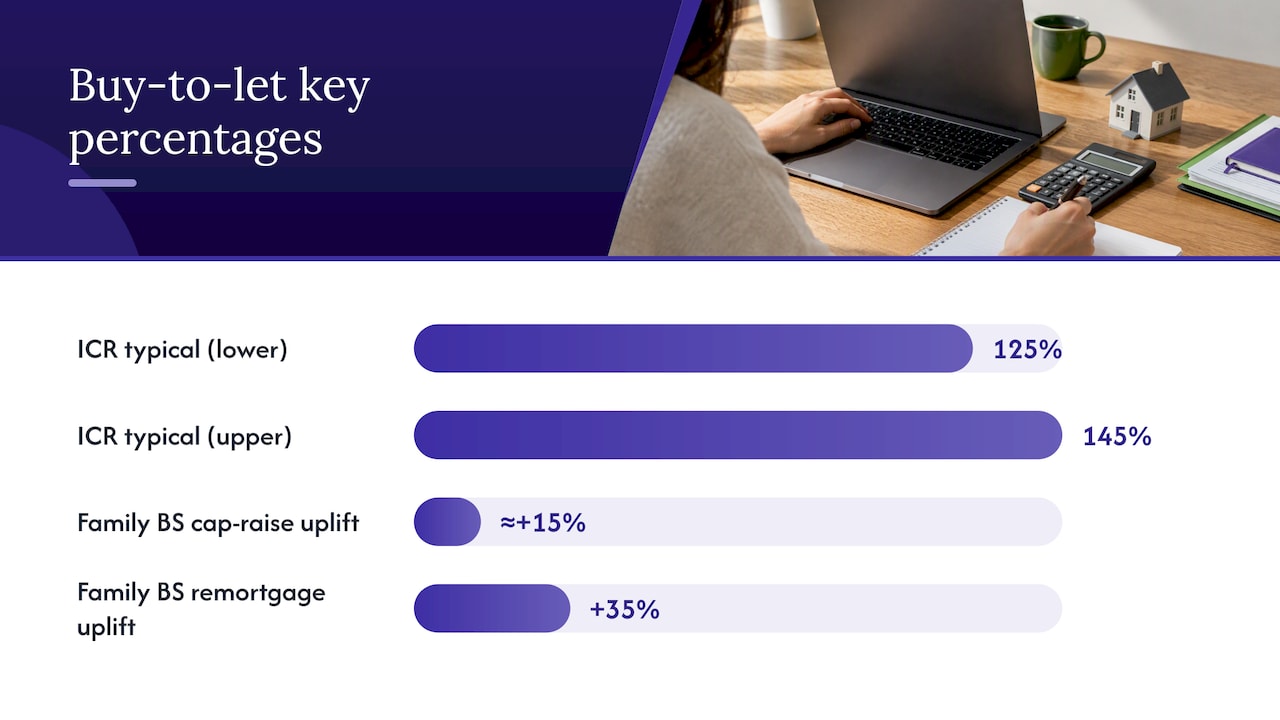
Lenders typically test at a stressed rate with an ICR threshold of around 125%, which is often set somewhat higher for borrowers taxed at the higher rate. The Bank of England’s analysis of how lenders account for tax when assessing buy-to-let affordability confirms this pattern: because higher-rate taxpayers keep less of their rental profit after tax, lenders often apply a tougher stress test to compensate. MoneyHelper’s own buy-to-let guidance puts the typical ICR range at 125% to 145%, alongside the usual deposit and loan-to-value expectations.
A point many landlords miss: offset savings don’t normally count towards rental income in the ICR calculation. The lender is testing whether rent covers the stressed mortgage payment, not whether you have cash sitting alongside it, so holding £30,000 in offset won’t itself increase how much you can borrow. It reduces the interest you pay once the mortgage is in place, but it isn’t a lever for affordability at application stage.
- Specialist lenders offering offset products tend to use human underwriters rather than automated scoring, which gives more room to discuss complex income, including contractor and CIS earnings.
- A whole-of-market broker can usually identify which of the smaller number of offset lenders will look favourably at your specific portfolio and income type.
- Bringing full details of every property you own, including rents, existing mortgage balances and lease terms, speeds up the underwriting conversation considerably.
- For self-employed or CIS contractor landlords, having clear CIS vouchers and recent self-assessment returns ready avoids delays caused by lenders asking for clarification later.
Some lenders have also recently widened what they’ll lend. Family Building Society announced changes in early 2026 to its affordability calculations that can increase borrowing power by around 15% for capital-raising cases and up to 35% for pound-for-pound remortgages, a reminder that lender criteria shift and it’s worth revisiting the market at remortgage time rather than assuming last year’s terms still apply.
Getting ready to apply: documents, timing, and the right questions
Preparation makes the biggest difference to how smoothly an offset buy-to-let application runs, particularly because the pool of lenders is smaller and underwriters will want a complete picture before they commit.
- Gather proof of identity and address along with standard anti-money-laundering documents any lender will ask for.
- Pull together evidence of your savings, including recent statements showing the balance you intend to hold in the offset account.
- Collect rental statements and current tenancy agreements for every property in your portfolio, not just the one being refinanced.
- Prepare two to three years of accounts or self-assessment returns if you’re self-employed, and have CIS vouchers ready if contractor income forms part of your earnings.
- Locate your existing mortgage deeds and recent statements, since lenders will want to see your current balance, rate and any early repayment charge position.
If you’re remortgaging rather than buying, timing matters. Most lenders let you secure a Decision in Principle around three to six months before your current deal ends, and checking your existing mortgage for early repayment charges before you apply avoids an unwelcome surprise. Our guide to beating remortgage delays covers the typical timeline in more detail if you’re working towards a renewal date.
When you do speak to a broker, a short list of questions saves time: which lenders currently offer buy-to-let offset, how the offset is structured (payment reduction or balance reduction), what fees apply, whether your savings need to be held with the same lender as the mortgage, and whether they’d recommend separate tax advice given your personal circumstances.
Pro Tip: If part of your income comes through CIS vouchers, present a full twelve months of vouchers alongside your self-assessment return rather than a partial run, since underwriters often ask for the complete picture before they’ll confirm income.
For contractor and CIS income specifically, lenders vary considerably in how they treat irregular payments. Some will average the last two years’ gross CIS income, others want a accountant’s certificate confirming ongoing contract work. A broker who already knows which lenders accept CIS evidence without extra conditions can cut weeks off the process.
How a whole-of-market broker weighs up offset for your portfolio
Working out whether offset genuinely helps a specific landlord means running the numbers against their actual tax position, not applying a general rule. We start by searching the whole market rather than a single panel of lenders, since most high-street names don’t offer buy-to-let offset at all and the ones that do vary significantly in rate and structure, as MoneyHelper notes when explaining why an adviser’s market access matters.
From there, we look at the landlord’s tax status, whether they hold property personally or through a limited company, and how much liquid reserve they realistically want to keep accessible. A landlord with £40,000 in reserve, taxed at the basic rate and holding two properties personally, might see a clear net benefit from offset. A higher-rate taxpayer with the same reserve held through a limited company usually finds the comparison much closer, and sometimes offset isn’t the right tool at all once the full tax picture is factored in.
Offset only earns its higher rate and fees when the interest saved genuinely outweighs what the same cash could do elsewhere, once tax is properly accounted for.
That’s the test we apply before recommending it, rather than presenting offset as a default upgrade for every portfolio landlord who asks about it.
What the offset conversation usually gets wrong
Offset mortgages get marketed as a simple upgrade: keep your savings, cut your interest, best of both worlds. The reality for landlords is narrower than that. The product rewards a specific combination of circumstances, reasonable cash reserves, a tax position that doesn’t erode the benefit, and a genuine need for liquidity, and it does little for landlords outside that combination.
The conventional advice often skips the limited company question entirely, treating offset as a tax-neutral decision when it plainly isn’t. A landlord who incorporated specifically to avoid the basic-rate interest restriction may find offset adds complexity without adding much benefit, since the company already deducts interest in full.
What should come first isn’t the mortgage product at all. It’s an honest look at your tax position and how much cash you can genuinely afford to tie up against a mortgage rather than hold elsewhere. Get that right first, and the choice between offset and a standard buy-to-let deal usually becomes obvious rather than a close call.
— Paul
Local, specialist help arranging your buy-to-let offset mortgage
Finding a lender that offers buy-to-let offset is only half the job. Matching it to your tax position, your portfolio structure and your income type, particularly if you’re a contractor paid through CIS vouchers or a self-employed landlord with variable income, takes someone searching the whole market rather than a single lender’s product range.

Prosper Home Loans provides independent, whole-of-market mortgage advice for landlords across Hastings, Eastbourne, Hailsham, Bexhill-on-Sea and the wider East Sussex area, including contractor mortgages, CIS voucher mortgages for enhanced self-employed income, and debt consolidation mortgages where a landlord needs to restructure existing borrowing. We handle buy-to-let mortgage deals day to day, including the smaller lender panel that offers offset, and our remortgaging service is built around the timing questions landlords usually ask when their current deal is coming to an end.
Before your first appointment, it helps to have:
- Recent statements for your current mortgage and any savings you’d consider offsetting.
- Rental income details and tenancy agreements for each property you own.
- Self-assessment returns or CIS vouchers if contractor or self-employed income forms part of your earnings.
| What we do at first appointment | What it gives you |
|---|---|
| Review your tax status and portfolio structure | Clarity on whether offset suits your circumstances |
| Search whole-of-market lenders including offset specialists | A realistic shortlist rather than one lender’s view |
| Arrange a Decision in Principle | A firm position before you commit to an application |
Our fees are set out clearly on our mortgage advice fees page before you commit to anything. Where your tax position needs deeper review, particularly around limited company ownership or finance cost restrictions, we’ll recommend speaking with an accountant alongside us rather than guessing at the answer.
To find out whether an offset buy-to-let mortgage would work for your portfolio, get in touch and we’ll talk through your reserves, your tax status and the lenders currently offering it.
Where to check the rules yourself
A few official sources back up the detail in this guide, worth bookmarking if your circumstances change:
- HMRC’s property income manual (PIM2052) on finance cost restrictions and the basic-rate tax credit.
- The Bank of England’s overview of how lenders factor tax into affordability testing.
- MoneyHelper’s guidance on when and why to use a mortgage adviser.
- A tax credit explainer with worked examples for landlords wanting more detail on the mortgage interest tax credit.
This article is general information, not a substitute for advice from a qualified financial advisor. Consult a qualified financial professional about your own circumstances before acting on anything here.
Sources
- Buy to Let - Portfolio landlords, Offset, Expats, and no minimum income
- PIM2052 - Deductions: interest: overview - HMRC internal manual
- Mortgage advice: should you use a mortgage adviser? | MoneyHelper
- Buy-to-let mortgages: how do lenders account for tax when assessing affordability - Bank of England
FAQ
Do offset mortgages still exist in the UK?
Yes, offset mortgages still exist, including a smaller number of buy-to-let offset products offered by specialist lenders such as building societies working through brokers. Most mainstream high-street lenders don’t offer offset for buy-to-let, which is why whole-of-market advice helps when searching for one.
What is the 28/36 rule in the UK?
UK buy-to-let lenders test affordability using an Interest Coverage Ratio, typically around 125% at a stressed interest rate, often higher for higher-rate taxpayers.
What are the disadvantages of an offset mortgage?
Offset mortgages often carry higher headline interest rates and arrangement fees than standard deals, and the pool of lenders offering them for buy-to-let is small. For higher-rate taxpayers, the basic-rate tax credit on finance costs can narrow the real-world benefit considerably.
Which banks have offset mortgages?
Offset buy-to-let mortgages tend to come from specialist building societies and niche lenders rather than the major high-street banks, with availability changing over time. A whole-of-market broker can confirm which lenders currently offer offset products suited to your portfolio and tax status.
Recommended
