Win Mortgage Approval with 3–12 Months' NHS Bank Pay

Yes, NHS bank staff can get a mortgage, provided the variable income is evidenced and demonstrably sustainable. There is no special “NHS bank staff mortgage” product on the market; lenders simply assess your bank shift earnings under their ordinary affordability rules. The immediate next step is straightforward: gather your payslips and bank statements, then request a lender-specific affordability check or speak to a broker who can review your case properly.
TL;DR:
- Bank income from NHS shifts is assessed through standard affordability rules, with lenders averaging or verifying income over a specified period, often three to twelve months.
- Applicants with consistent, well-documented bank earnings are more likely to succeed, especially if their income pattern is clearly evidenced and stable.
- Combining NHS bank pay with other income sources, such as substantive employment or self-employment, can strengthen an application, but requires thorough documentation and clear labelling of income streams.
- The borrowing multiple typically ranges from 3.5 to 5 times annual income, but the actual limit depends on an affordability stress test that considers expenses and debt.
- Preparing a complete, reconciled set of payslips, bank statements, and supporting documents beforehand accelerates the application process and reduces delays.
Table of Contents
- What lenders mean by bank, variable and unsocial-hours income
- Who qualifies: eligibility patterns for bank-shift NHS staff
- Documentation checklist: what to prepare before you apply
- How much can you borrow? Understanding affordability multiples
- Common underwriting questions and how to avoid delays
- How Prosperhomeloans helps NHS bank staff get approved
- What to expect: timeline and next steps for bank-shift applicants
- Ready to talk to a broker who understands NHS bank pay?
- Sources
- FAQ
What lenders mean by bank, variable and unsocial-hours income
Lenders sort NHS pay into different buckets, and understanding these categories matters more than most applicants realise. Substantive pay is your contracted salary, the steady figure that appears on your payslip whether you work one shift or ten. Bank or locum income is what you earn from additional shifts booked through NHS Professionals or a trust’s own bank, and it fluctuates by design. Then there’s overtime and unsocial-hours enhancements, the extra payments for nights, weekends, and bank holidays that many bank workers rely on for a meaningful chunk of their take-home pay.
Underwriters don’t dismiss bank income outright, but they do test it differently to a fixed salary. They want to see that the pattern is sustainable, not a one-off spike from a busy winter on the wards.
- Substantive pay is treated much like standard employed income and usually needs the least extra evidence.
- Bank and locum income is typically averaged over a set period, often the last three, six, or twelve months, to smooth out irregular weeks.
- Overtime and unsocial-hours enhancements are usually included only where they show a consistent pattern rather than a single unusually busy month.
- Some lenders apply a percentage haircut to variable elements as a caution against future volatility.
This approach follows the FCA’s mortgage rule review, which confirms there’s no separate regulatory category for NHS bank workers. Instead, lenders apply the responsible lending principles under FCA MCOB 11, assessing net income against committed expenditure on a case-by-case basis. That means the same bank shift pattern might be accepted readily by one lender and viewed more cautiously by another, purely down to each lender’s internal policy on variable income. This is exactly where knowing which lenders favour which evidence types becomes valuable, and it’s one of the clearest reasons bank staff benefit from specialist guidance rather than a generic online calculator.
Who qualifies: eligibility patterns for bank-shift NHS staff
Most lenders ask for a defined evidence window before they’ll count bank income towards affordability, and the length of that window varies more than people expect. Some accept three months of consistent bank pay if the pattern looks stable; others insist on six or even twelve months, particularly if bank shifts make up a large share of your total income. The shorter the track record, the more scrutiny you’ll face on regularity.
- Weekly-paid bank staff often need to show a longer run of statements simply because weekly pay produces more data points to reconcile, which can work in your favour if the pattern is consistent.
- Staff working across multiple trusts face extra questions, since underwriters need to verify each income source separately rather than treating it as one employer.
- Bank-only staff with no substantive contract are assessed purely on their bank earnings history, so a longer, well-documented track record carries more weight than it would for someone with a permanent post alongside bank shifts.
- Locum doctors are frequently treated closer to self-employed applicants, especially where they invoice through an agency or operate via a limited company, which brings in a different documentation standard.
- Nurses and allied health professionals on bank contracts alongside a substantive role generally find their case easiest, because the fixed salary anchors affordability while bank pay adds a supplementary boost.
The decisive factor across every one of these cases isn’t your job title. It’s whether your income pattern is evidenced clearly enough for an underwriter to trust it. A well-documented run of modest bank shifts can be more persuasive than a single exceptional month of overtime that looks like an outlier. If your situation involves overseas qualifications or residency questions on top of variable pay, our guide on what documents foreign nationals need for a mortgage covers the additional paperwork lenders typically request.
Documentation checklist: what to prepare before you apply
Getting your paperwork in order before you approach a lender saves weeks of back-and-forth later. Underwriters move fastest when everything reconciles cleanly, so treat this checklist as your preparation order, not an afterthought.
- Full payslip run covering the lender’s required window, ideally three to twelve months depending on how much of your income comes from bank shifts.
- Bank statements showing salary credits that match your payslips exactly, including any separate bank-pay deposits from a different trust or agency.
- Employment contract or bank-worker terms, confirming your substantive role, your bank registration status, or both if you hold each simultaneously.
- P60 for the most recent tax year, giving underwriters a annual summary that cross-checks against your monthly figures.
- Photo ID and proof of deposit, standard requirements for any mortgage application regardless of income type.
Where you have more than one income stream, label each one clearly in a short covering note. State what’s substantive pay, what’s bank income, and what’s overtime, and flag anything unusual, such as a quiet month during annual leave or a spike from covering a colleague’s shifts. MoneyHelper’s guidance on applying for a mortgage makes clear that payslips showing hours worked alongside earnings give underwriters far more confidence than a bare net-pay figure.
Pro Tip: Download your full payroll portal history before you start the application, not after a lender asks for it. NHS Professionals’ bank-worker guidance notes that portal access can change when you move between trust assignments, so save PDFs with clear date ranges while you still have access.
If you’re combining NHS bank income with contractor or self-employed earnings elsewhere, our article on what documents subcontractors need for a mortgage breaks down what lenders expect for that side of a mixed-income case.
How much can you borrow? Understanding affordability multiples
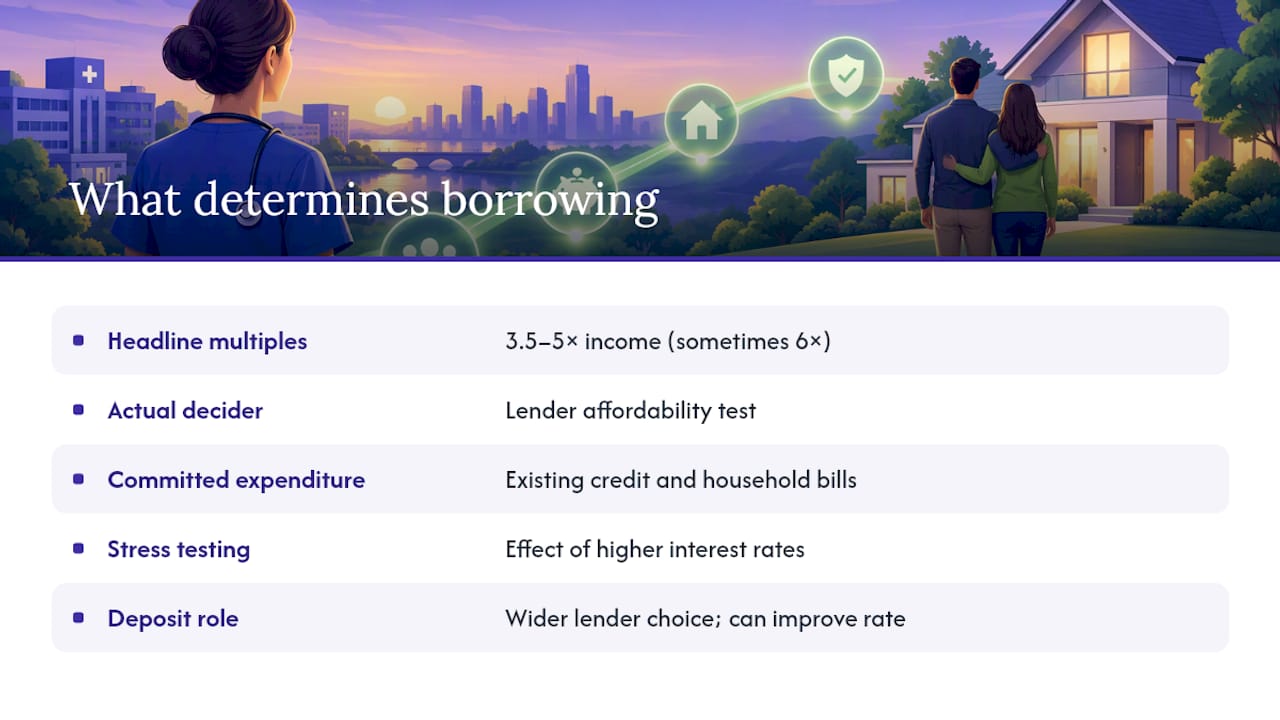
Headline income multiples are the least reliable figure in mortgage planning, yet they’re the one number everyone fixates on. Market reporting suggests lenders commonly offer somewhere between 3.5 and 5 times annual income, with some cases stretching to 5 or 6 times for applicants with larger deposits or lower existing debt. That range is a starting point for a conversation, not a promise.
What actually decides your borrowing limit: it’s not the multiple, it’s the affordability test behind it. Lenders model your committed expenditure, from existing credit to household bills, then stress-test what happens if interest rates rise. A bank worker on £38,000 with no debt and a clean six-month bank-pay history can comfortably out-borrow a colleague earning £45,000 with a car loan and irregular shift documentation.
Deposit size plays a role too, but not the one many applicants assume. A larger deposit widens your choice of lender and can improve the rate you’re offered, but as the FCA’s consultation on mortgage rule changes makes clear, it doesn’t override the need to demonstrate affordability.
This is precisely why a generic online mortgage calculator tells you almost nothing useful if you’re a bank worker. It applies a flat multiple to your last payslip and ignores every nuance of how your specific lender treats variable pay. A lender-specific assessment, run by someone who knows which providers are comfortable with NHS bank income, gives you a borrowing figure you can actually plan around.
Common underwriting questions and how to avoid delays
Underwriters ask predictable questions when reviewing bank-shift income, and knowing them in advance lets you head off delays before they happen.
- They’ll check that every payslip figure reconciles against a matching bank credit, so any mismatch between gross and net figures needs a clear explanation.
- Unexplained spikes or gaps in your bank statements trigger follow-up queries, even when the explanation is entirely benign, such as annual leave or a temporary reduction in shifts.
- Pension deductions and other payslip lines sometimes confuse underwriters unfamiliar with NHS pay structures, particularly where auto-enrolment contributions vary month to month.
The most common mistakes are avoidable. Submitting a partial payslip run, mixing bank and substantive income together without labelling them separately, or simply not reconciling your own bank statements before you apply all slow things down. Each one invites a request for further information, and every request adds days, sometimes weeks, to your timeline.
Pro Tip: Write a one-page reconciliation memo before you submit anything. List each income stream, the payslip lines that support it, and the corresponding bank credits. Underwriters told us, through the guidance NHS Professionals provides for bank workers, that clearly separated payslip lines for hours worked, enhancements, and deductions reduce confusion and speed up decisions considerably.
If you’re organising paperwork for the first time, this piece on ways to organise mortgage documents offers a sensible structure for keeping everything in order before submission.
How Prosperhomeloans helps NHS bank staff get approved
Matching an NHS bank worker to the right lender is a large part of what we do at Prosperhomeloans. Not every lender treats bank shift income the same way, and going in blind to the wrong provider can mean a declined application, a hit to your credit file, and a delay you didn’t need.
- We identify lenders whose criteria genuinely fit your evidence pattern, rather than chasing whichever rate looks best on a comparison site.
- We help you prepare a clean evidence pack, including the reconciliation memo underwriters respond to fastest.
- We obtain a Mortgage in Principle with a suitable lender before you commit to a property search, so you know your realistic budget upfront.
- We manage underwriting queries directly, dealing with follow-up requests so you’re not fielding calls between shifts.
Beyond straightforward NHS bank cases, some brokers also work with staff who have contractor income alongside their NHS role, including those using CIS vouchers for enhanced self-employed income, and with anyone seeking debt consolidation mortgages to manage existing credit. Adviser fees vary across the market, with different charging models, and clients should always be informed upfront about fees and lender recommendations.
If your circumstances touch on specialist property types too, our article on winning a non-standard construction mortgage shows the kind of case complexity we handle regularly.
What to expect: timeline and next steps for bank-shift applicants
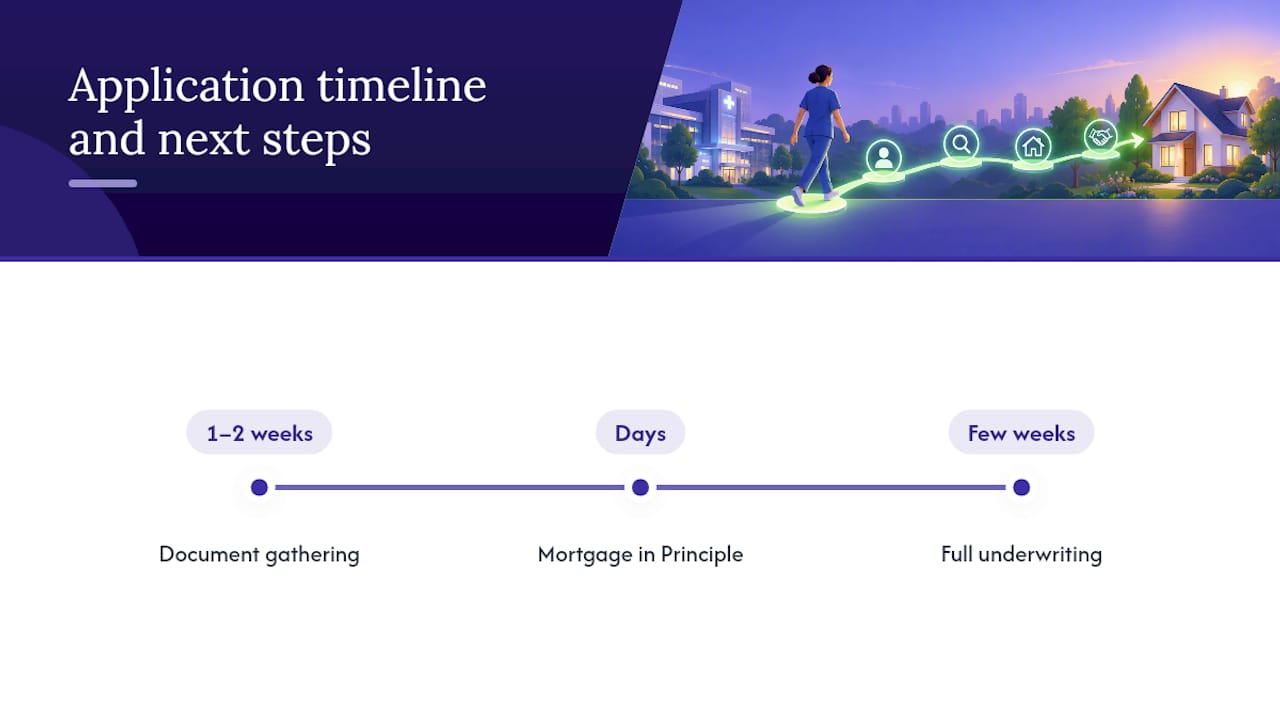
In my experience reviewing how these applications actually unfold, the timeline for a bank-shift NHS applicant runs longer than for a straightforward salaried case, but not dramatically so. Document gathering typically takes a week or two if you already have payslips organised, longer if you need to chase historic payroll records. A Mortgage in Principle can often follow within days of submitting clean paperwork, and the full application, once underwriting begins, usually moves within a few weeks provided nothing needs re-explaining.
What speeds things up most consistently is preparation done before the application starts, not during it. Applicants who arrive with a reconciled income summary and a covering note explaining their pay pattern move through underwriting noticeably faster than those who submit payslips piecemeal and answer queries as they arise. The difference isn’t the strength of the income; it’s the clarity of the story that income tells.
If you’re at the early stages, the practical move is simple: get your last six to twelve months of payslips and matching bank statements together now, even before you’ve found a property. A broker review or Mortgage in Principle at that stage tells you where you actually stand, rather than where a generic calculator guesses you might.
— Paul
Ready to talk to a broker who understands NHS bank pay?
There are brokers who specialise in understanding how bank shift income gets assessed and who offer whole-of-market advice in Hastings, Eastbourne, Hailsham, and Bexhill-on-Sea in East Sussex. These firms work with NHS staff whose pay doesn’t fit neatly into a standard salary box and are familiar with lenders comfortable with that income pattern.

Whether you need help building an evidence pack for bank income, want advice on a debt consolidation mortgage to bring existing borrowing under control, or you’re a self-employed contractor exploring a CIS voucher mortgage for enhanced income, we can talk you through the options in plain terms. We’re local, available seven days a week, and happy to explain exactly how our mortgage advice fees work before you commit to anything.
The next step is simple. Get in touch through our main advice page for a free initial review, or ask about a soft-check Mortgage in Principle so you know exactly where you stand before you start viewing properties.
Sources
This article is general information, not a substitute for advice from a qualified financial advisor. Consult a qualified financial professional about your own circumstances before acting on anything here.
FAQ
Do NHS staff get better mortgage rates?
No, there’s no special discounted rate reserved for NHS staff generally. Some lenders offer schemes with lower deposit requirements for key workers in certain areas, and it’s always worth asking a broker which local schemes, such as First Homes discounts in East Sussex, might apply to your situation.
How much can NHS bank staff borrow for a mortgage?
Borrowing typically falls somewhere between 3.5 and 5 times annual income, though this depends heavily on how your bank income is evidenced and your existing committed expenditure. A lender-specific affordability check gives a far more accurate figure than any generic multiple.
What are the best mortgage options for NHS bank staff?
There’s no single “best” option, since it depends on how your bank income pattern looks and how much of your total pay it represents. Working with a broker who knows which lenders accept variable NHS pay readily, rather than applying blind, usually produces the strongest result.
What discounts can NHS workers get on mortgages?
Discounts tend to come from location-specific schemes rather than blanket NHS pricing, such as First Homes discounts available in some parts of East Sussex. Speaking to a broker familiar with local NHS mortgage schemes is the quickest way to find out what applies to your postcode.
Can locum doctors or agency NHS staff get a mortgage?
Yes, though locums and agency staff are often assessed closer to self-employed applicants, particularly if they invoice through a limited company. Expect to provide invoices, contracts, and typically a longer earnings history than a substantive-contract colleague would need.
Recommended
