Act Fast: UK Chain Break Bridging With an FCA Checked Broker Plan

Bridging finance can be a practical short-term fix for a broken property chain, but only when you have a clear exit plan and can absorb higher interest costs for a limited period. We see it work well for buyers facing a delayed sale or a withdrawn buyer, less well when the exit relies on hope rather than evidence. The sections below cover regulation, costs, timescales and how a broker can help.
TL;DR:
- Bridging loans are short-term solutions typically lasting up to 18 months, used to cover a gap in property transactions when a chain breaks.
- They require a credible, evidence-backed exit plan such as sale, refinancing, or long-term mortgage, before approval.
- Regulated bridging loans offer consumer protections, but many structures, like second charges, may fall outside regulation and affect eligibility.
- Costs include arrangement fees, valuation, legal, extension, and exit fees, and borrowers should model total expenses, especially if the exit is delayed.
- Early, rapid application through a whole-market broker can secure faster approval, but improper or uncertain exit strategies risk credit damage and higher costs.
Table of Contents
- What bridging finance is and how it works for a chain break
- Regulated vs unregulated bridging loans: what UK buyers must know
- When bridging helps a chain break: scenarios and quick tests
- Costs, interest types and planning a credible exit strategy
- How to apply quickly: timeline, documents and what brokers ask for
- Broker perspective: structuring a chain-break bridging solution
- Tax implications of using chain break bridging finance
- Impact on credit score and credit eligibility
- Case studies illustrating chain break bridging scenarios
- A broker’s honest view on chain-break bridging
- How Prosper Home Loans can help if your chain breaks
- FAQ
- Sources
What bridging finance is and how it works for a chain break
A bridging loan is short-term finance secured against property, usually taken out to cover a gap between buying one home and selling another. When your chain breaks, part way through a purchase, a bridge lets you complete on your new home while you wait for your existing sale to go through or find an alternative buyer.
Most bridges run for a few months up to around 12 to 18 months, and lenders expect you to repay through one of three routes: selling the stalled property, refinancing onto a standard mortgage, or moving to a longer-term loan once your finances allow it. Loan-to-value limits typically sit well below those for a standard mortgage, which affects how much you can borrow against your existing equity.
Before approving anything, lenders will want:
- A clear, evidenced route to repayment, not just an intention to sell.
- Confirmation of the property’s value through a formal valuation.
- Proof of your income or assets to show you can service the loan if interest is not rolled up.
Regulated vs unregulated bridging loans: what UK buyers must know
Whether your bridge is a regulated mortgage contract depends on how the loan is structured and secured. The FCA’s PERG 4.4 guidance sets out specific exclusions, including limited payment second charges and exempt equitable mortgages, that determine whether a particular bridging loan falls under regulation or sits outside it.
For owner-occupiers borrowing against their main home, regulated bridging is the more common route because it brings standard mortgage conduct protections with it. The FCA’s MCOB 11.6 rules require lenders to assess your repayment strategy properly and to act in your best interests if you need to extend the term.
Key points to understand:
- Regulated bridging loans carry consumer protections that unregulated ones do not.
- A widely discussed 12 month term limit has shaped how lenders structure these loans, though the regulator is reviewing whether more flexibility is warranted.
- Exempt structures, such as certain second charges, may fall outside full regulation even on a residential property.
More than half of buyers and sellers (54%) have experienced a property chain collapse, yet only 11% say they would consider using bridging finance to resolve it, according to research reported by Mortgage Solutions. That gap suggests many buyers are not aware this option exists when their purchase is at risk.
When bridging helps a chain break: scenarios and quick tests
A bridge tends to make sense in specific situations rather than as a general safety net.
- Your buyer pulls out late, after you have already exchanged or are close to exchanging on your onward purchase.
- Your sale is delayed by conveyancing problems on the buyer’s side, but you still have a confirmed buyer and price.
- You need to complete on a new purchase before your existing sale finishes, and the delay is measured in weeks or months rather than open-ended.
Before approaching a lender, run through a short checklist: do you have a realistic, evidenced exit within the loan term, can you cover the monthly shortfall or rolled-up interest without strain, and is the gap you are bridging likely to close within typical lender limits.
If any of those answers is uncertain, consider alternatives first, such as searching for a chain-free buyer, renegotiating your completion date, or drawing on contingency savings before taking on bridging debt.
Costs, interest types and planning a credible exit strategy
Bridging loans charge interest monthly, usually in one of two ways: serviced interest, where you pay it each month, or rolled-up (retained) interest, where it is added to the loan and settled at the end. Rolled-up interest feels easier day to day, but it compounds the total you owe, and any extension to the loan term amplifies that cost quickly.
Typical costs to budget for include:
- Arrangement fees, often charged as a percentage of the loan.
- Valuation and legal fees, sometimes higher than a standard mortgage due to the shorter timescale.
- Extension fees if your exit is delayed beyond the agreed term.
- Exit fees, charged by some lenders when the loan is repaid.
The FCA’s FS25/6 feedback document confirms that regulated bridging finance is treated as a genuine short-term solution only where there is a clear exit strategy, and the regulator continues to weigh whether current term limits strike the right balance between flexibility and consumer protection. Lenders may ask for evidence such as a signed sale agreement, mortgage offer in principle, or probate confirmation before approving your loan.
Pro Tip: Model the total cost of your bridge, including every fee and the worst-case interest scenario if your exit slips by a month or two, and ask your lender for written confirmation of the conditions attached to any refinance.
For current pricing context, our guide to UK bridging loan rates in 2026 sets out what a competitive deal looks like this year.
How to apply quickly: timeline, documents and what brokers ask for
Speed matters once a chain breaks, so acting within days rather than weeks protects your position.
- Call your solicitor and broker immediately to confirm what has actually happened and what options remain open on your existing transaction, and consider getting a financial remedy order (ancillary relief order) support from a McKenzie Friend to assist with court-related matters, if necessary (ancillary relief order support from a McKenzie Friend).
- Get a valuation booked on the security property, since this drives how much you can borrow and how quickly a lender can commit.
- Gather your documents: photo ID, proof of income or assets, details of your exit route (sale agreement, mortgage offer, or refinance plan), and the property particulars for both sides of the transaction.
- Brief your broker on priorities, asking which lenders can move fastest, whether the loan will be regulated, and what the realistic completion date looks like.
A whole-of-market broker can compare regulated bridging options from several lenders at once, which often shortens the sourcing stage considerably. Our article on brokered regulated bridging loans explains the typical process and timescales in more detail.
Broker perspective: structuring a chain-break bridging solution
We check three things first when a client’s chain breaks: whether the proposed exit is credible and evidenced, whether there is enough headroom in the loan-to-value, and whether the timescale is realistic rather than optimistic. The most common red flag is a repayment plan built on a sale that has not yet been agreed in writing.
A bridge should always have a clear, evidenced way out before the first pound is drawn down.
— Paul
Tax implications of using chain break bridging finance
Bridging finance itself is a loan, not income, so drawing one down to cover a chain break does not create an immediate tax charge. The tax questions that arise are usually linked to the property transactions either side of the bridge rather than to the bridge itself.
If you end up owning two residential properties at once while you wait for your original home to sell, you may be liable for the higher rate of Stamp Duty Land Tax on the new purchase, with a refund available once the original property is sold within the time limit set by HMRC. This is a common feature of chain-break situations, since completing on a new home before an old one sells is often exactly why a bridge is needed in the first place.
Interest paid on a bridging loan secured against your main residence is not generally tax-deductible for a private individual, unlike interest on some buy-to-let finance. If the bridge relates to a rental or investment property rather than your own home, the tax treatment can differ, and this is worth checking with an accountant before you commit.
Because every household’s position varies, including whether you are a first-time buyer, a landlord, or moving between two main residences, we always recommend getting specific tax advice from a qualified accountant alongside your mortgage advice. We can talk you through the mortgage and bridging side; the tax side needs a specialist who knows your full financial picture.

Impact on credit score and credit eligibility
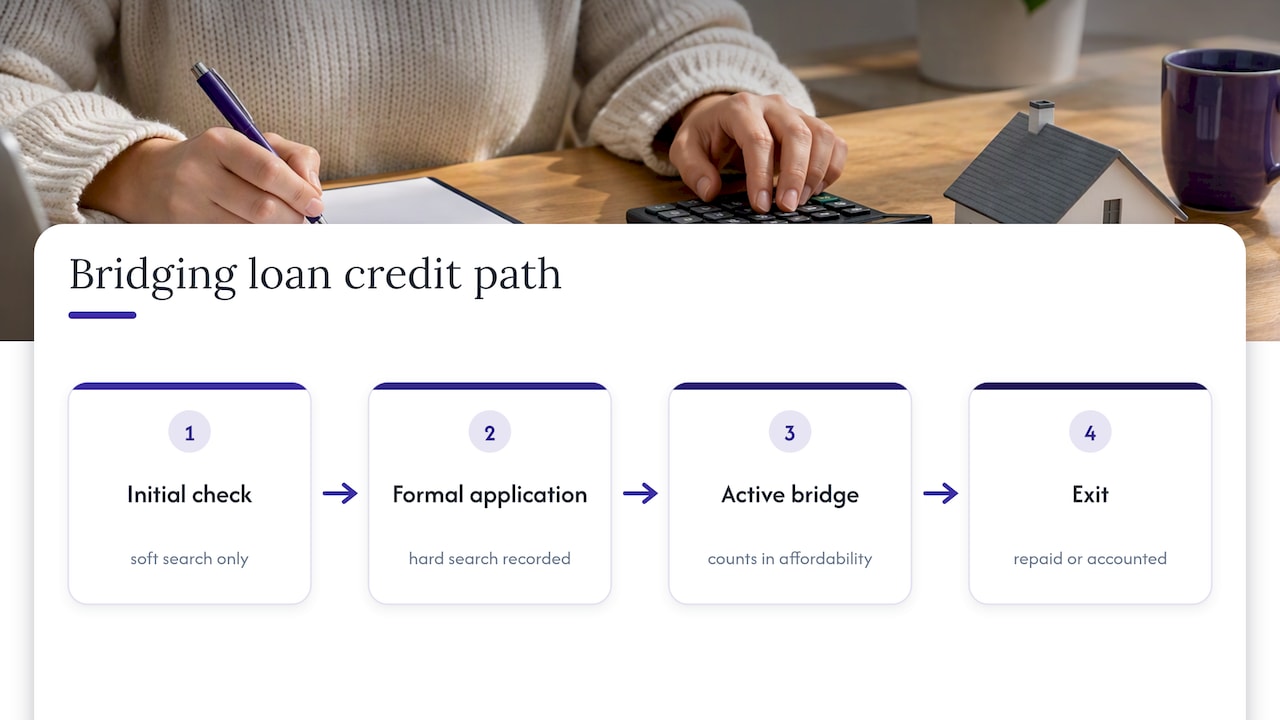
Applying for a bridging loan involves a credit check, and most lenders will run both a soft search during initial discussions and a hard search once you formally apply. A hard search leaves a mark on your credit file, though a single well-spaced application has a limited effect for most borrowers.
Where bridging can affect your eligibility is less about the credit score itself and more about how the loan interacts with your overall borrowing picture. A bridging loan sits on your credit file as an active commitment, which lenders assessing a later mortgage application will see and factor into their affordability calculations. If your exit strategy involves refinancing onto a standard mortgage, the bridge needs to be fully repaid or accounted for before that new lender will lend.
Missed payments on a serviced bridge, or failing to repay at the end of the term, can damage your credit score significantly, since bridging lenders report to credit reference agencies in the same way as other secured lenders. This is one reason a credible, evidenced exit matters so much: a bridge that overruns without a repayment plan in place can leave a lasting mark on your file at exactly the point you need good credit standing to secure your next mortgage.
If your chain break happens alongside other financial pressure, such as existing unsecured debt, a debt consolidation mortgage arranged alongside your move may be worth exploring rather than taking on a separate bridge on top of existing commitments.
Case studies illustrating chain break bridging scenarios
Say a couple exchange contracts on a new family home with a completion date six weeks away, expecting their existing flat to sell in parallel. Their buyer withdraws ten days before completion after a survey issue. With exchange already signed on the new purchase, they cannot simply delay: a short-term bridge secured against the flat, repaid once a new buyer is found, lets them complete on time rather than losing their position in the chain.
Consider a self-employed contractor selling a terraced house to buy a larger property, who the week of completion is told the buyer’s own chain has collapsed further down the line. Their mortgage offer on the new home remains valid for a limited window. A bridging loan, assessed using proof of contract income and CIS voucher evidence rather than standard payslips, covers the gap until the house sale can be relaunched with a new buyer.
Or take a situation where probate on an inherited property is taking longer than expected, delaying funds a buyer needs to complete on their own purchase. A bridge secured against the property they are buying, with the probate property as the confirmed future source of repayment, keeps the purchase on track without forcing a renegotiation of price.
Each of these examples shares the same feature: a specific, dated reason the money will become available, not an open-ended hope that a buyer will eventually appear.
A broker’s honest view on chain-break bridging
We would use a bridge where the exit is dated and evidenced, a signed buyer, a mortgage offer, confirmed probate. We would advise against one where the plan is simply “the house will sell eventually.” Get proper advice before you commit, not after you’ve exchanged.
— Paul
How Prosper Home Loans can help if your chain breaks
We are an independent, whole-of-market broker available to talk through a chain break quickly when timing matters most. We source regulated bridging options from across the market, and we also support CIS subcontractors needing a mortgage based on enhanced income, self-employed buyers, and anyone exploring a debt consolidation mortgage alongside their move.

On a first call, we’ll ask about your exit route, your timescale and your existing mortgage or sale position, then let you know realistically which lenders can move at the pace you need.
- We check exit credibility before recommending any lender.
- We compare regulated bridging options across the whole market, not a single panel.
- We support contractor, self-employed and debt consolidation cases alongside standard chain-break bridging.
| What you get | Detail |
|---|---|
| Advice scope | Whole-of-market bridging and mortgage advice |
| Local coverage | Hastings, Eastbourne, Hailsham, Bexhill-on-Sea, East Sussex |
| Specialist support | CIS contractors, self-employed, debt consolidation |
Pro Tip: Call us as soon as your chain shows signs of trouble, before you exchange on anything, so we can check your exit plan stands up before a lender does.
Awareness of bridging as a chain-break solution remains low, with only 11% of buyers and sellers saying they would consider it according to Mortgage Solutions, so getting the right advice early puts you ahead of most buyers in the same position.
Get in touch through our mortgage advice services to talk through your options.
This article is general information, not a substitute for advice from a qualified financial advisor. Consult a qualified financial professional about your own circumstances before acting on anything here.
FAQ
Is bridging finance commonly used to fix a broken property chain?
Yes, bridging finance is a recognised short-term solution for chain breaks in the UK, though awareness among buyers and sellers remains low. Industry reporting notes that brokers increasingly use bridging for chain-break cases, provided the borrower has a clear, evidenced exit strategy.
How long can I have a bridging loan for?
Bridging loans are typically arranged for a few months up to around 12 to 18 months, with the exact limit depending on the lender and whether the loan is regulated. The FCA continues to review whether current term limits should be adjusted while keeping consumer protections in place.
What happens if I cannot repay my bridging loan on time?
If your exit is delayed, most lenders will consider an extension, though this usually comes with additional fees and more interest. Under MCOB rules, regulated lenders must assess your situation fairly and act in your best interests when agreeing any extension.
Does a chain-break bridging loan need to be regulated?
It depends on how the loan is secured and structured; the FCA’s PERG guidance sets out specific exclusions, such as certain second charges, that can fall outside full regulation even on a residential property. For most owner-occupiers borrowing against their main home, a regulated bridging loan is the more common and more protected route.
Will a bridging loan affect my ability to get a mortgage later?
A bridging loan appears on your credit file as an active commitment, and lenders assessing a later mortgage application will factor it into affordability. Repaying it on time and within the agreed term, rather than letting it overrun, keeps your credit position clean for your next application.
Sources
- FCA Handbook - PERG 4.4 What is a regulated mortgage contract?
- FS25/6: Mortgage Rule Review: Feedback to DP25/2 and Roadmap — FCA
- FCA Handbook - MCOB 11.6 Responsible lending and financing
- Over half of buyers and sellers have had property chain collapse but bridging awareness low — Mortgage Solutions
Recommended
