Whole of Life vs Term Life Insurance: Which Suits You?

Term life insurance covers you for a set number of years and is usually the cheaper way to protect a mortgage and a young family. Whole of life cover lasts until you die, so a payout is expected, but it costs more. Which suits you depends on what you are protecting and for how long.
TL;DR
- Term cover pays out only if you die within the policy period. Whole of life pays whenever you die, provided premiums are kept up.
- Term is usually much cheaper, which is why it is commonly used to protect a mortgage or children’s upbringing.
- Whole of life is often used for Inheritance Tax planning or leaving a guaranteed legacy.
- Family income benefit is a form of term cover that pays monthly rather than as a lump sum.
- Self-employed people and CIS subcontractors often have no workplace cover, so it is worth arranging your own.
Table of Contents
- How the two types work
- Cost: what you might pay
- Types of term cover
- Term vs family income benefit
- When each one tends to fit
- Self-employed, CIS and contractors
- What to check before you buy
- Our view
- Talk to a local adviser
- FAQ
- Sources
How the two types work
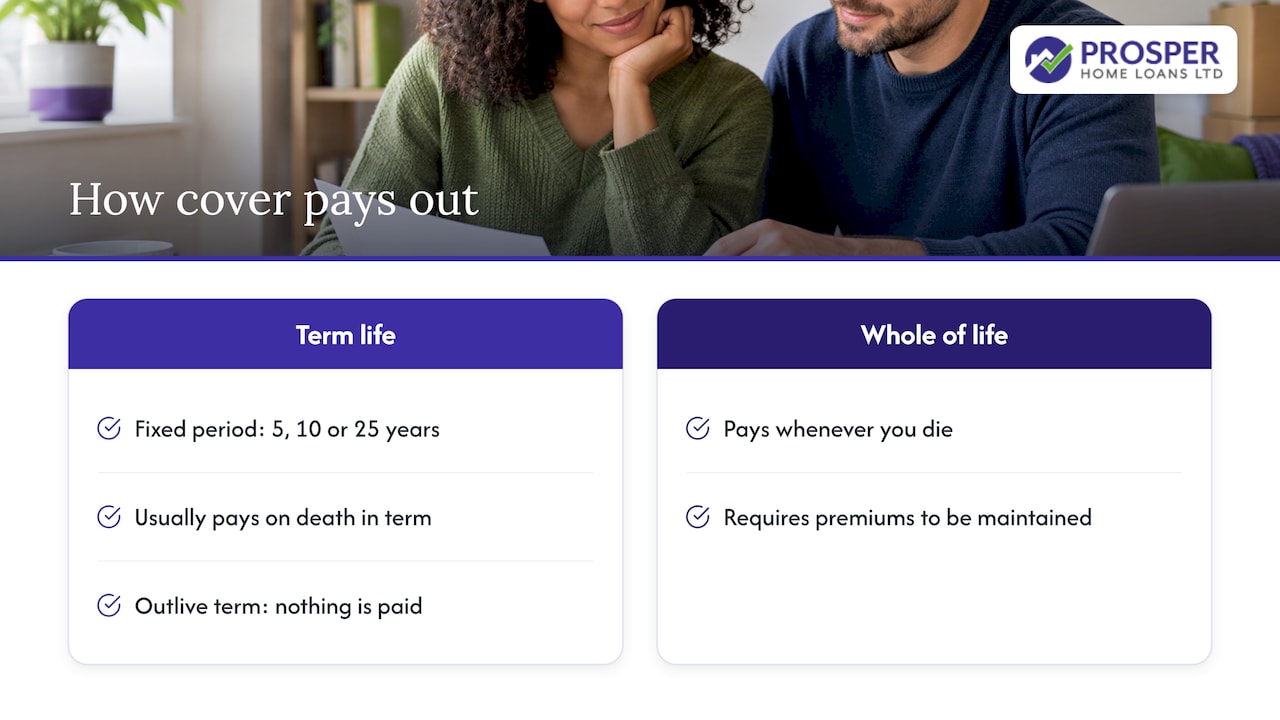
According to MoneyHelper, term life insurance runs for a fixed period, such as five, ten or 25 years, and usually pays out on death within that period. Whole of life pays out whenever you die, as long as you keep up with premiums.
If you outlive a term policy, it ends and nothing is paid. That is the reason it costs less: the insurer is covering a limited window rather than a certainty.
Cost: what you might pay
Whole of life is typically more expensive than shorter-term cover. MoneyHelper also notes that whole of life premiums are reviewed every five or ten years and can rise, and that you could end up paying in more than is paid out if you live a long time.
For a sense of scale, one UK guide illustrates that a 25-year level term policy of £300,000 costs roughly £20 to £30 a month, while underwritten whole of life cover for the same sum costs around £180 to £250 a month at age 40. These are illustrations, not quotes. Your price depends on age, health, smoking status and the amount of cover.

Vitality’s guide states that term cover can usually only be bought up to age 74, while the maximum entry age for whole of life ranges between 70 and 85.
Types of term cover
MoneyHelper describes three kinds of term policy:
- Level term: pays a lump sum if you die within the term. It is the simplest and most affordable option.
- Decreasing term: cover falls each year, designed to sit alongside a repayment mortgage as the loan reduces.
- Increasing term: cover rises over the term so the payout keeps pace with inflation.
LV= points out that a level sum does not account for inflation, so the amount chosen at the start may be worth significantly less by the end. For a closer look at matching cover to a home loan, see our guide to decreasing vs level term cover.

Term vs family income benefit
Family income benefit is also term cover, but it pays differently. Aviva’s technical guide explains that level cover pays a lump sum, while family income cover pays monthly instalments from the point a claim is accepted until the policy ends. More is paid in total if a claim is made early than late in the term.
An example from RBC Wealth Management: on a 20-year policy, if you died after 15 years, payments would run for the remaining five. It suits families who want a surviving partner to have a steady income for school costs and bills.
| Level term | Family income benefit | Whole of life | |
|---|---|---|---|
| Payout | Lump sum | Monthly instalments | Lump sum |
| Length | Fixed term | Fixed term | Your whole life |
| Pays out | Only if you die in the term | Only if you die in the term | Whenever you die |
| Typical use | Mortgage, debts, family | Replacing income | Legacy, Inheritance Tax |
When each one tends to fit
The Post Office notes that term cover is often taken out to cover a loan such as a mortgage or the years of raising children, while whole of life ensures beneficiaries are paid whenever you pass away.
In practice:
- Term suits a homeowner with a 25-year repayment mortgage and young children.
- Family income benefit suits a household that would struggle with monthly bills rather than a single large debt.
- Whole of life suits someone who wants to leave a sum regardless of when they die, for example to help meet an Inheritance Tax bill. If you are planning that kind of estate, correctly witnessed legal documents matter as much as the policy itself.
For how a policy differs from cover tied to the loan itself, read mortgage protection vs life insurance.
Self-employed, CIS and contractors
If you are a CIS subcontractor, sole trader or contractor, you may not have a workplace scheme. Recent analysis reported by the Daily Record warns that some contractors, freelancers and people on zero-hours contracts may be left out of death in service cover, which can leave a gap against an average mortgage.
Because your income can vary, it is sensible to think about both a lump sum for the mortgage and how your household would meet monthly costs. Income protection and critical illness are separate covers; our comparison of income protection vs critical illness explains the difference. If you run a limited company, a relevant life policy may be worth discussing.
What to check before you buy
- Whether the amount and length match your mortgage term and your children’s ages.
- Whether premiums are guaranteed or reviewable, which matters most with whole of life.
- Whether you want the cover to protect against inflation.
- Whether the policy is written in trust, which can help keep a payout outside your estate. Ask an adviser how this applies to you.
- Exclusions and how health and lifestyle questions must be answered. Answer them accurately, as mistakes can affect a claim.
Our view
Most of the people we speak to are protecting a mortgage and a family, and for that a term policy, sometimes combined with family income benefit, is a sensible starting point. Whole of life has a clear place where the aim is a legacy or an Inheritance Tax plan.
What matters is matching the cover to your circumstances, especially if your income is self-employed or varies. We explain the costs and options plainly, and we are local to Hastings, Eastbourne, Hailsham and Bexhill-on-Sea, so we are available to talk it through.
Paul McMath CeMAP CeRER
Talk to a local adviser
We arrange life insurance, critical illness cover and income protection alongside mortgages, for employed and self-employed clients across East Sussex and the UK. We can look at your mortgage, your dependants and your budget together, and explain the options and costs before you decide.

See our life insurance and protection page or get in touch with Prosper Home Loans to start the conversation.
FAQ
Is whole of life or term life cheaper?
Term life is cheaper. MoneyHelper says whole of life is typically more expensive than shorter-term policies. Exact prices depend on your age, health, smoking status and the sum insured.
Which is better, term or whole of life?
Neither is better for everyone. Term usually fits protecting a mortgage or dependent children for a set period, while whole of life fits a legacy or Inheritance Tax plan. An adviser can help you weigh up your own situation.
What is the difference between family income benefit and level term?
Level term pays one lump sum on a successful claim. Family income benefit pays monthly instalments until the policy ends, so the total paid falls the later you claim.
Do I need life insurance if I am self-employed?
If anyone relies on your income or you have a mortgage, it is worth considering. Self-employed people and contractors often have no death in service cover, so cover usually has to be arranged individually.
Sources
- MoneyHelper: What is life insurance?
- Freedom Isn’t Free: Term vs Whole-Life Insurance UK
- Vitality: Whole of life insurance explained
- LV=: What life insurance should you get?
- Aviva: Your technical guide to protection
- RBC Wealth Management: What’s financial protection?
- Post Office: Types of life insurance
- Daily Record: Life cover linked to workplace
- UK witness rules for wills and deeds
Recommended
- Decreasing vs Level Term Cover: Which Suits Your Mortgage?
- Mortgage Protection vs Life Insurance: What’s the Difference?
- Income Protection vs Critical Illness: Which Cover Fits?
This article provides general information and is not a personal mortgage recommendation. Mortgage availability and eligibility depend on your circumstances and lender criteria. Rates and criteria can change. We will explain any applicable fees before you commit. Think carefully before securing other debts against your home. Consolidating debts over a longer term may reduce your monthly payments but increase the total amount you repay. Your home may be repossessed if you do not keep up repayments
