What is a consent to let mortgage: UK homeowner guide

A consent to let is written lender permission to rent your home temporarily while keeping your existing residential mortgage in place. It is not a new product, not a separate loan, and not a long-term solution. If you are planning to rent your property, even briefly, you must obtain this written consent before you advertise the property or sign a tenancy agreement.
- What it is: A temporary amendment to your residential mortgage, granted in writing by your lender.
- What it is not: A buy-to-let mortgage or a permanent change to your loan.
- What you must do first: Contact your lender or a mortgage adviser before listing the property or agreeing any tenancy terms.
Pro Tip: Pause any property listings right now if you have not yet received written consent. Letting without it breaches your mortgage contract and can have serious financial consequences.
Table of Contents
- What is a consent to let mortgage, and how does it differ from buy-to-let?
- When do lenders grant consent, and are you likely to qualify?
- How long does consent to let usually last?
- What does consent to let cost, and how might your mortgage terms change?
- How to apply for consent to let: step-by-step
- What happens if you rent out without consent?
- Tax and landlord responsibilities while letting under consent to let
- When should you convert to a buy-to-let mortgage?
- How a mortgage adviser can help you through this process
- Key takeaways
- Why consent to let is misunderstood more often than it should be
- Prosperhomeloans: independent advice for consent to let and remortgage
- Useful sources and further reading
What is a consent to let mortgage, and how does it differ from buy-to-let?
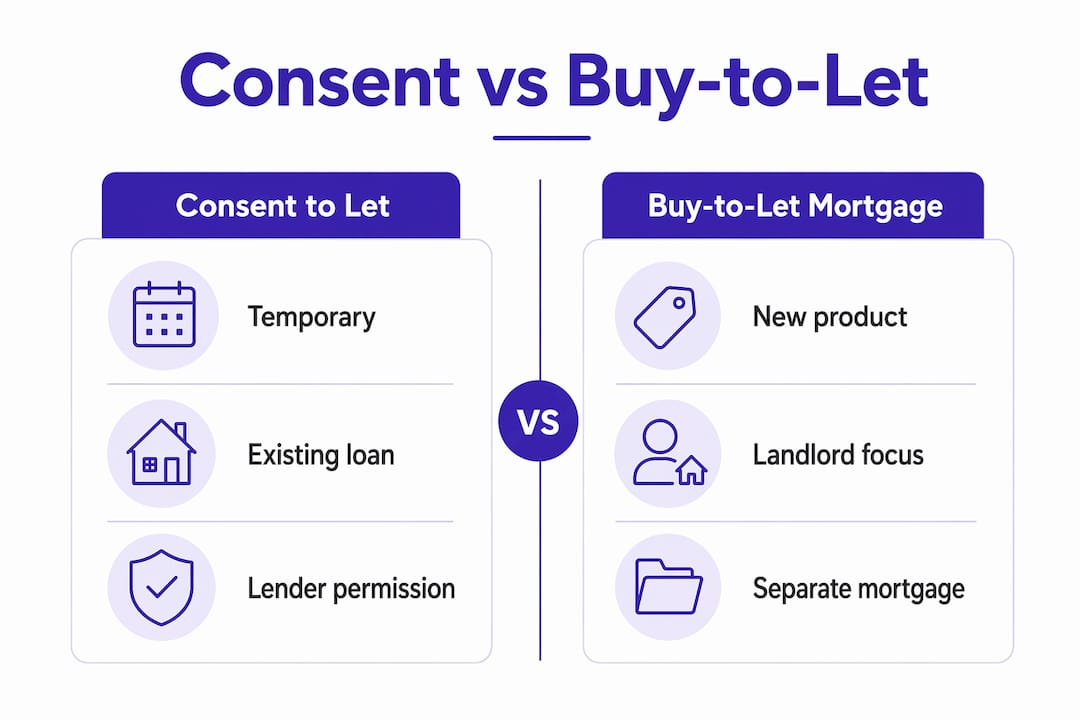
Consent to let is a temporary permission attached to your existing residential mortgage. Your loan does not change; the lender simply agrees, in writing, that you may rent the property for a defined period. The moment that period ends, the permission lapses unless you renew it or switch products.
A buy-to-let mortgage is a different product entirely, designed from the outset for landlords who intend to rent a property long-term. Lenders price it differently, assess affordability differently (usually against projected rental income rather than personal salary), and apply different regulatory rules.
| Feature | Consent to let | Buy-to-let mortgage |
|---|---|---|
| Product type | Temporary permission on existing loan | Separate mortgage product |
| Purpose | Short-term letting while away or during a sale delay | Long-term rental investment |
| Affordability basis | Your personal income | Projected rental income |
| Duration | Fixed short term (often 6–24 months) | Ongoing |
| Typical cost | Admin fee plus possible rate premium | Higher arrangement fees and rates |
Renting without consent breaches your mortgage contract. Lenders can respond with penalty fees, interest-rate increases, or in serious cases demand full repayment of the loan. The risk is real and the consequences are not easily reversed.
When do lenders grant consent, and are you likely to qualify?
Lenders expect a clear, temporary reason for letting. The most commonly accepted circumstances include:
- Temporary job relocation, including secondments or postings abroad
- Moving in with a partner or family member while keeping the property
- Extended travel or study
- Delayed sale where the property is on the market but not yet sold
- Short-term financial need where rental income bridges a gap
Most lenders also apply eligibility criteria before granting consent. Typical checks include your current mortgage status, the reason for letting, and the proposed tenancy type.
| Eligibility criterion | What lenders typically look for |
|---|---|
| Mortgage status | No arrears; account in good standing |
| Ownership period | Minimum six months held (commonly required) |
| Reason for letting | Clear, temporary, and evidenced |
| Tenancy type | Assured Shorthold Tenancy (AST); single occupancy |
| LTV / equity | Some lenders set a maximum loan-to-value threshold |

Many lenders require a minimum ownership period of six months before they will consider an application. This is their way of confirming you originally bought the property to live in, not to let from day one.
Documents lenders commonly request:
- Written explanation of your reason for letting
- Draft or signed tenancy agreement (AST)
- Proposed monthly rent figure
- Confirmation of updated buildings insurance or landlord cover
- Evidence of your alternative address during the letting period
Pro Tip: Gather these documents before you call your lender. A complete submission speeds up the process and reduces the chance of a request for further information delaying your application.
How long does consent to let usually last?
Consent to let is intended as a stopgap, not a permanent letting arrangement. Most lenders grant it for a fixed short period, and the duration varies considerably between providers.
Typical duration: 6–24 months. Most lenders grant consent for six to twelve months initially, with some allowing up to 24 months in total. After that, they generally expect you to either return to owner-occupation, remortgage to a buy-to-let product, or sell the property.
At expiry, your options are:
- Apply to renew: Some lenders will extend consent, but repeated renewals are not guaranteed and may come with additional conditions or a rate review.
- Remortgage to buy-to-let: If letting is becoming long-term, this is usually the appropriate route.
- Return to owner-occupation: Move back in and revert to standard residential mortgage terms.
- Sell the property: Particularly relevant if the letting was covering a delayed sale.
Repeated renewals can affect your mortgage terms. Some lenders treat a pattern of renewals as evidence that the letting is no longer temporary and may insist on a product switch. Plan ahead rather than assume renewal will always be available.
What does consent to let cost, and how might your mortgage terms change?
The financial impact of consent to let is often underestimated. Lenders commonly charge a one-off administration fee, with typical ranges reported between roughly £75 and £300, though this varies by lender. Some also add a recurring annual fee or apply an interest-rate premium for the duration of the consent period.
Typical costs to budget for:
- One-off administration fee (often £75–£300)
- Possible annual renewal fee if consent is extended
- Interest-rate premium added to your existing rate while consent is active
- Possible valuation fee if the lender requires a current property assessment
Rate premium: Some lenders add a margin to your existing interest rate while consent is active. Even a modest increase on a large mortgage balance adds up over twelve months.
The key question is whether the short-term cost of consent to let is lower than the cost of remortgaging to a buy-to-let product. Buy-to-let mortgages typically carry higher arrangement fees and rates, so for a letting period of six to twelve months, consent to let is usually cheaper overall. Beyond that, the calculation shifts.
Pro Tip: Ask your lender for a full written breakdown of all fees and any rate changes before you accept consent. Compare this against a buy-to-let remortgage quote from an independent adviser, particularly if you expect to let for more than twelve months.

How to apply for consent to let: step-by-step
The application process can take several weeks, so start well before you need the property tenanted. Never sign a tenancy agreement before you have written consent in hand.
- Read your mortgage terms. Check your original mortgage offer for any clauses about letting or occupancy. Some lenders have specific consent-to-let sections.
- Contact your lender’s consent team. Call or write to the dedicated team (not the general helpline) and ask for the consent-to-let application form and fee schedule.
- Complete the application form. Provide your reason for letting, proposed tenancy start date, rent amount, and tenancy type (AST).
- Supply supporting documents. Include your draft tenancy agreement, insurer details or confirmation of landlord cover, and evidence of your alternative address.
- Pay the administration fee. This is usually required upfront or on submission.
- Wait for written confirmation. Do not proceed until you have the lender’s written consent in your hands.
Before you submit, check:
- Your mortgage account is in good standing with no arrears
- Your proposed tenancy is an AST (not an HMO or multi-occupancy arrangement)
- Your insurer has been notified and has confirmed cover
Apply early. The approval process typically takes several weeks, and you should never sign a tenancy or allow a tenant to move in before written permission is received. Doing so puts you in immediate breach of your mortgage contract.
What happens if you rent out without consent?
Letting your property without lender permission is a breach of your mortgage contract. The consequences range from financial penalties to, in serious cases, the lender demanding full repayment of the loan.
Possible lender responses include:
- Administration penalties and back-dated fees
- An immediate increase to your interest rate
- A formal demand to repay the mortgage in full
- Repossession proceedings in the most serious cases
Beyond the mortgage itself, your buildings and contents insurance is likely to become invalid once tenants occupy the property without the insurer being notified. A residential policy does not cover tenant-related damage, and a claim made while the property is let without proper cover will almost certainly be rejected.
If you are already letting without consent: Stop advertising the property for further tenancies, contact your lender immediately, and speak to a mortgage adviser before taking any further steps. Seeking retrospective permission is possible in some cases, but it is not guaranteed and should be treated as a last resort.
Tax and landlord responsibilities while letting under consent to let
Holding consent to let does not exempt you from landlord obligations or HMRC reporting. From the moment a tenant moves in, you take on legal duties as a landlord.
HMRC and tax:
- Rental income is taxable. You must declare it to HMRC, either through Self Assessment or by notifying HMRC if you do not normally file a return.
- You can deduct allowable expenses such as letting agent fees, repairs, and landlord insurance premiums.
- Keep dedicated records of all rental income and expenses from day one. This simplifies your tax return and supports any future remortgage affordability assessment.
Landlord legal obligations:
- Protect the tenant’s deposit in a government-approved tenancy deposit scheme within 30 days of receipt.
- Carry out a Right to Rent check to confirm the tenant has the legal right to rent in England.
- Provide a valid Energy Performance Certificate (EPC) rated E or above.
- Arrange an annual gas safety check and provide the certificate to the tenant.
- Ensure electrical installations meet current safety standards.
- Check whether your local authority requires a landlord licence for your property type or area.
Insurance: A standard residential buildings and contents policy will frequently be invalid once tenants are in occupation. Notify your insurer before the tenancy starts and arrange a landlord endorsement or switch to a dedicated landlord policy.
Pro Tip: Open a separate bank account for rental income and expenses from day one. It makes HMRC reporting straightforward and gives you a clean record if a lender asks for rental income evidence during a future remortgage application.
When should you convert to a buy-to-let mortgage?
Consent to let is the right tool for a short, defined letting period. When the situation changes, so should the mortgage.
Signs it is time to switch to buy-to-let:
- Your lender has declined to renew consent or is signalling that it will not
- The letting period has extended beyond 12–24 months
- You are generating significant rental income and treating the property as an investment
- You want to let to multiple occupants (HMO), which most lenders do not permit under a residential consent
- You are planning further property investment and need a product designed for landlords
Steps to convert:
- Obtain a current market valuation to establish your loan-to-value ratio on a buy-to-let basis.
- Check the tax implications of becoming a landlord long-term, including mortgage interest relief restrictions.
- Confirm any local licensing requirements for your property type.
- Speak to an independent mortgage adviser to compare buy-to-let products and assess affordability.
- Apply for a buy-to-let mortgage or remortgage through your adviser, who will manage the lender submission.
Timing matters. Converting before your consent expires avoids a gap in permission and keeps the tenancy legally sound. An adviser can also help you understand how rental income is treated in affordability calculations, which differs significantly from residential mortgage assessments.
How a mortgage adviser can help you through this process
Navigating consent to let is straightforward in principle but can become complicated quickly, particularly if your lender is slow to respond, your circumstances are unusual, or you are approaching the point where a buy-to-let remortgage makes more sense.
Where an adviser adds real value:
- Reviewing your mortgage terms and identifying any lender-specific consent conditions before you apply
- Preparing a complete, lender-ready submission to reduce back-and-forth delays
- Checking your LTV and affordability position if a buy-to-let remortgage is on the horizon
- Advising on the right timing to switch products so you avoid a gap in permission
- Liaising directly with lenders on your behalf, which can significantly speed up the process
- Confirming insurer requirements so your cover is valid from day one of the tenancy
When to contact an adviser:
- Before you apply, to check your eligibility and prepare your documents
- If your lender has declined consent or is requesting information you are unsure how to provide
- When you are planning a letting period longer than twelve months and want to understand your remortgage options
Pro Tip: An adviser with experience in consent-to-let cases will know which lenders are more flexible on duration and eligibility criteria. That knowledge alone can save you weeks of back-and-forth with the wrong lender.
Prosperhomeloans works with residential mortgage holders at exactly this point: whether you need help submitting a consent application, understanding your lender’s policy, or planning a move to a buy-to-let product. Using rate-monitoring tools alongside adviser guidance also helps you track whether a rate premium under consent is becoming more expensive than remortgaging.
Key takeaways
Consent to let is written lender permission to rent your home temporarily on a residential mortgage, and you must obtain it in writing before any tenancy begins.
| Point | Details |
|---|---|
| Get written consent first | Never advertise or sign a tenancy without written lender permission — it breaches your mortgage contract. |
| Consent is temporary | Most lenders grant 6–24 months; plan for renewal or a buy-to-let remortgage if letting continues. |
| Costs vary by lender | Expect an admin fee of roughly £75–£300 plus a possible rate premium; always ask for a full written breakdown. |
| Tax and legal duties apply | Declare rental income to HMRC, protect the deposit, and update your insurance before the tenancy starts. |
| Prosperhomeloans can help | Prosperhomeloans offers independent adviser support for consent applications, lender submissions, and buy-to-let remortgage planning. |
Why consent to let is misunderstood more often than it should be
Most homeowners who contact us about consent to let have already done one of two things: they have either listed the property without telling their lender, or they have assumed that because they own the home, they are free to rent it out. Both assumptions are understandable. Neither is correct.
What surprises people most is how straightforward the process actually is when you approach it in the right order. The lender is not trying to prevent you from renting. They want to know about it, record it, and apply the appropriate conditions. The paperwork is manageable, the fees are usually modest, and most lenders will grant consent for a genuine temporary reason without much difficulty.
The problems arise when people skip the step, assume consent is automatic, or let the tenancy run well beyond the agreed period without renewing. At that point, what started as a simple administrative process becomes a compliance issue, and the options narrow considerably.
Our advice is always the same: start the conversation with your lender or adviser before you do anything else. The earlier you apply, the more options you have, and the less likely you are to find yourself in a position where the lender is setting the terms rather than you.
Prosperhomeloans: independent advice for consent to let and remortgage
Sorting out consent to let is faster and less stressful with an adviser who knows the process. Prosperhomeloans provides independent mortgage and protection advice to UK homeowners, including those navigating consent to let applications, lender submissions, and the decision of whether to remortgage to a buy-to-let product.

We review your lender’s specific policy, prepare a complete application on your behalf, and advise on the right timing if a buy-to-let remortgage is the better long-term route. We also check your insurer requirements and help you understand your tax position before the tenancy starts, so there are no surprises later.
Prosperhomeloans is paid by commission from lenders or product providers when a mortgage or protection product completes. There is no upfront fee for advice, and we will always explain how we are paid before you proceed.
Get in touch with Prosperhomeloans today to discuss your consent to let situation and find out what your options are.
Useful sources and further reading
The following authoritative sources are worth checking directly for current policy details, fees, and legal obligations:
- Your own lender’s consent-to-let page. Every lender has its own policy, fees, and application form. Search your lender’s name alongside “consent to let” to find the specific page and contact details.
- GOV.UK: private renting guidance. Covers landlord obligations including Right to Rent checks, deposit protection, and property standards.
- HMRC: rental income and tax. Explains how rental income is taxed, which expenses are deductible, and how to report income through Self Assessment.
- GOV.UK: private rented property minimum standards. Landlord guidance on EPC ratings, electrical safety, and property condition requirements.
- Housing Act 1985. Primary legislation relevant to residential tenancies and landlord obligations in England and Wales.
- Immigration Act 2014 / Right to Rent. Governs the Right to Rent checks landlords must carry out before a tenancy begins.
This article is general information, not financial or legal advice. Fees, eligibility criteria, and lender policies change regularly. Always confirm the current rules with your lender, HMRC, or a qualified mortgage adviser before proceeding.
