What documents do subcontractors need for a mortgage?

What documents subcontractors need for a mortgage in the UK
As a subcontractor, you can absolutely get a mortgage. The key is knowing exactly what paperwork lenders expect, and having it ready before you apply. The standard requirement in 2026 is two years of HMRC SA302 tax calculations with matching Tax Year Overviews, but that is just the starting point.
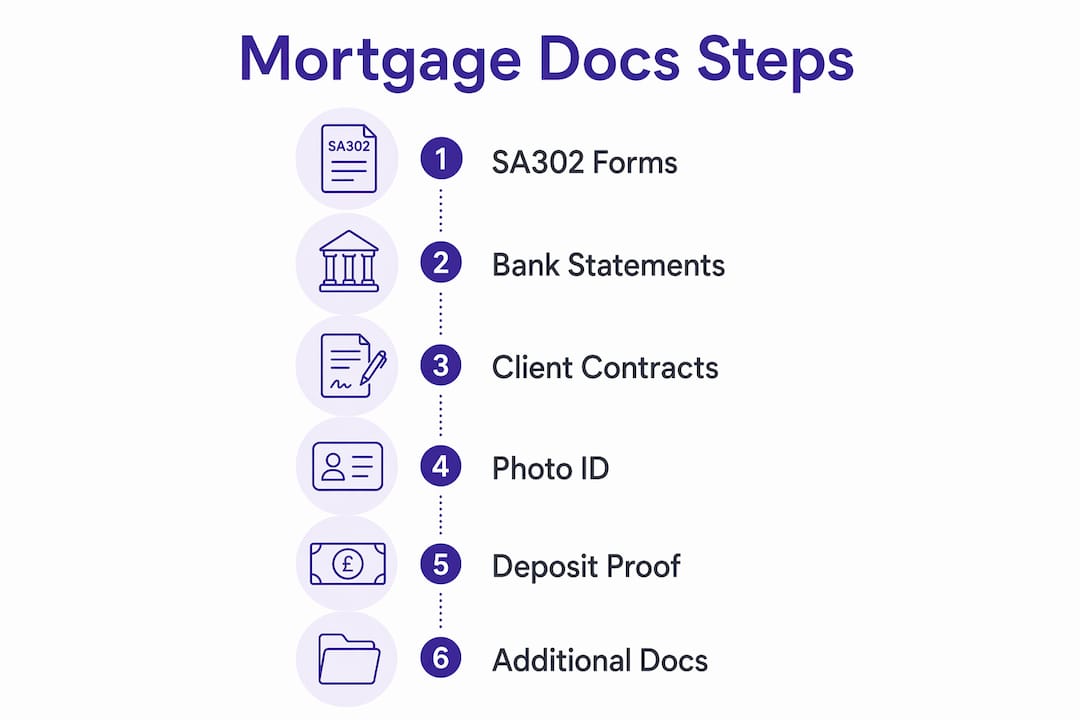
Here is the core document checklist for subcontractor mortgage applications:
- HMRC SA302 forms for the last two tax years, confirming your declared income
- Matching Tax Year Overviews from your HMRC online account, which lenders cross-check against your SA302s to confirm figures were actually filed
- Business and personal bank statements covering the most recent 3–6 months
- Proof of trading activity, such as client contracts, invoices, or CIS payment and deduction statements
- Photo ID, typically a valid passport or driving licence
- Proof of address, such as a utility bill or council tax statement dated within three months
- Deposit source evidence, including savings statements or a gift letter where applicable
- For limited company directors: last two years of full company accounts, dividend vouchers, and a Companies House extract; some lenders also request corporation tax computations and management accounts
Lender requirements do vary. Some specialist lenders accept records covering a shorter period, though this typically comes with a higher interest rate. Getting your paperwork aligned with HMRC records from the outset puts you in the strongest possible position.
Why each document matters to your lender
Understanding what lenders actually do with your paperwork makes it far easier to prepare it properly. Each document serves a specific purpose in their assessment, and gaps or inconsistencies can slow down or derail an application.
1. SA302 forms and Tax Year Overviews
The SA302 is your official HMRC tax calculation, produced after you file a Self Assessment return. It shows your total taxable income for that year. Lenders use it to assess affordability, so the figure on your SA302 is the income they will lend against. The Tax Year Overview sits alongside it, confirming that the return was actually submitted and the tax paid. Lenders cross-check both documents, so you need them as a pair for each year.
2. Bank statements
Your bank statements must cover the most recent 3–6 months and clearly show income credits alongside regular outgoings. Lenders use them to verify that your declared profits are reflected in your actual cash flow. Unexplained large deposits or erratic income patterns will prompt questions, so clean, consistent statements genuinely help.
3. Client contracts and CIS statements
Proof of ongoing work is one of the most persuasive documents you can provide. Contracts with end clients carry more weight than umbrella company agreements, as they demonstrate direct business relationships. If you work under the Construction Industry Scheme, CIS payment and deduction statements serve a similar purpose. Some specialist lenders will use your gross CIS income before the 20% deduction for affordability calculations, which can meaningfully increase how much you can borrow.

4. Photo ID and proof of address
These are mandatory for identity verification. A valid passport or driving licence satisfies the photo ID requirement, and a utility bill or council tax statement dated within three months covers proof of address. There is no flexibility here; every lender requires both.
5. Deposit source evidence
Lenders need to confirm where your deposit has come from. Savings statements showing the funds building over time are the clearest evidence. If part of your deposit is a gift, a signed gift letter from the donor is required, confirming the money is not a loan.
6. Limited company directors: additional documents
If you operate through a limited company, the documentation requirement expands. Lenders typically ask for the last two years of full company accounts, copies of dividend vouchers, and a Companies House extract. Some will also request corporation tax computations and management accounts for the most recent period. Your personal SA302s remain required alongside all of this.
7. What happens with fewer than two years of records?
Providing only one year of accounts or SA302s is possible with certain specialist lenders, but it does carry a cost. A 0.3–0.7% interest rate premium is typical in this scenario, reflecting the higher perceived risk. If you are approaching the end of your second year of trading, it is often worth waiting until you can file that second return before applying.
How to gather and submit your documents effectively
Timing and organisation make a real difference to how smoothly your application progresses. Rushing to pull paperwork together at the last minute is one of the most common reasons applications stall.
- Start at least three to six months before you plan to apply. This gives you time to file any outstanding Self Assessment returns and request documents from HMRC without pressure.
- Download your SA302s and Tax Year Overviews directly from your HMRC online account. Log in, navigate to Self Assessment, and download the PDFs for each relevant tax year. HMRC holds these going back several years, so access is straightforward.
- Check that your bank statements clearly show income credits. If you use multiple accounts, gather statements for all of them. Lenders want to see the full picture, not a partial one.
- Organise your CIS statements or client contracts chronologically. A clear, ordered bundle signals professionalism and makes the underwriter’s job easier.
- Keep your photo ID and proof of address current. An expired passport or a utility bill from eight months ago will be rejected outright.
- File your Self Assessment on time, every year. Late filings are a red flag for lenders and can result in an outright rejection, regardless of how strong your income looks.
- Check the specific lender’s document list early. Requirements vary, and knowing what a particular lender wants before you apply saves time and avoids last-minute scrambles.
Pro Tip: If you use an accountant, ask them to prepare a formal certificate of accounts alongside your SA302s. Accountant-certified accounts, particularly from a qualified professional holding ACCA, ICAEW, or CIMA membership, carry additional weight with lenders and can strengthen your application considerably.
Good year-end tax planning also plays a role here. Subcontractors who claim aggressive expenses to reduce their tax bill sometimes find that their declared profit falls below the threshold lenders need to approve the loan they want. Balancing tax efficiency with a healthy declared income is something worth discussing with your accountant well before you apply.
Expert guidance from Prosperhomeloans on subcontractor mortgage applications
At Prosperhomeloans, we work with subcontractors and self-employed borrowers every day, and the pattern we see most often is straightforward: the applications that succeed are the ones where the paperwork tells a clear, consistent story.
Lenders are not trying to catch you out. They want to lend. What they need is confidence that your income is real, stable, and verifiable. When your SA302s, Tax Year Overviews, and bank statements all align, that confidence comes quickly. When they do not, the process slows down and questions multiply.
- Comprehensive, accurate paperwork reduces processing time. An underwriter who can verify your income in one pass is far more likely to approve quickly than one who has to send repeated requests for clarification.
- Specialist lenders matter for CIS subcontractors. Not every high-street lender understands how CIS income works. We identify lenders who assess gross CIS income for affordability, which can significantly increase your borrowing capacity compared with lenders who only look at net figures.
- Your financial records should be maintained year-round, not just at tax time. Keeping invoices, contracts, and CIS statements organised throughout the year means you are always ready to apply, without a frantic search through old emails.
Pro Tip: Before approaching any lender, use an income and tax calculator to understand how your declared profit translates into borrowing capacity. A self-employed tax calculator can help you model different income scenarios and see how your figures are likely to be assessed.
We tailor our advice to your specific trading structure, whether you are a sole trader, a CIS subcontractor, or a limited company director. Our role is to match you with the right lender for your circumstances and make sure your application goes in complete, accurate, and well-presented. If you are ready to take the next step, speak to our team about your mortgage options.

Key takeaways
Subcontractors need two years of HMRC SA302s with matching Tax Year Overviews as the core requirement, supported by bank statements, trading evidence, and standard identity documents.
| Point | Details |
|---|---|
| Core tax documents | Two years of SA302 forms and Tax Year Overviews are the standard requirement for all self-employed mortgage applicants. |
| Bank statements | Statements covering the most recent 3–6 months must clearly show income credits and align with declared profits. |
| One-year applications cost more | Specialist lenders accepting one year of records typically charge a 0.3–0.7% interest rate premium. |
| CIS gross income advantage | Some specialist lenders assess gross CIS income before the 20% deduction, increasing your borrowing capacity. |
| Late filings risk rejection | Late Self Assessment submissions are a common cause of mortgage rejection, regardless of income level. |
