What documents do foreign nationals need for a mortgage?

Securing a UK mortgage as a foreign national is entirely achievable, but the documentation requirements are more involved than for a standard application. You will need to provide valid identity proof, evidence of your visa or immigration status, recent payslips or tax returns, bank statements covering at least six months, and proof of address. Any document not in English must be accompanied by a certified translation on headed paper from a recognised translation service. Lenders also require all paperwork to be current, so expired documents will cause delays regardless of how strong the rest of your application looks.
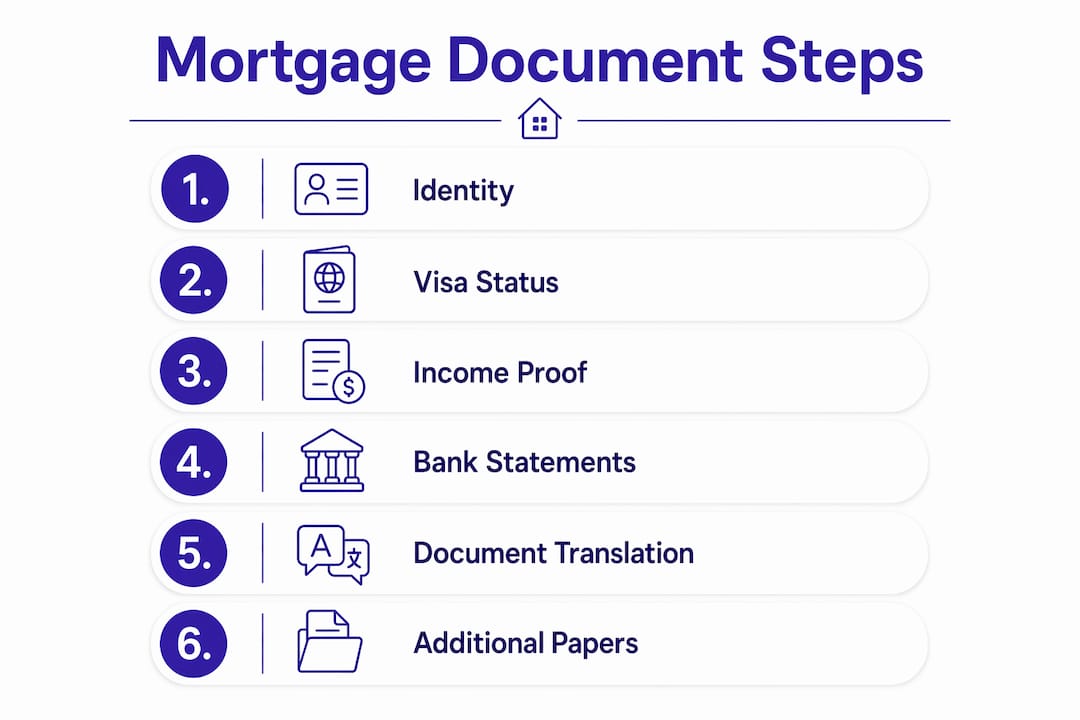
The core document categories are:
- Identity: Valid passport, Biometric Residence Permit (BRP), Biometric Residence Card (BRC), Frontier Worker Permit (FWP), or eVisa share code
- Visa and immigration status: Current document confirming your right to reside and, where relevant, work in the UK
- Proof of income: Recent payslips, employment contract, tax returns (UK and overseas), or certified accounts if self-employed
- Bank statements: Three to six months of statements showing consistent income deposits
- Proof of address: Utility bill, council tax statement, or bank statement dated within the last three months
Pro Tip: Engage a specialist broker before you start gathering documents. They will tell you exactly which lenders accept your visa type and flag any gaps in your paperwork before you submit, protecting your credit profile from unnecessary hard searches.
Table of Contents
- What documents do foreign nationals need for a UK mortgage?
- How specialist brokers help foreign nationals get approved
- Common challenges and how to overcome them
- Key things to remember before you apply
- How foreign nationals can build or substitute a UK credit history
- Additional documents for students, workers, and investors
- Do you need a UK-based guarantor or co-signer?
- Dealing with foreign income and non-UK financial institutions
- Key takeaways
- Prosperhomeloans makes the mortgage process clearer for foreign nationals
What documents do foreign nationals need for a UK mortgage?
Identity verification is the starting point for every lender. A valid passport is the most universally accepted form of ID, but foreign nationals granted immigration status in the UK can also use their BRP, BRC, FWP, or eVisa. Those with an eVisa can generate a time-limited share code via the government’s online status service, which allows the lender to verify identity and immigration status directly from Home Office records without physical documents changing hands. Refugees who hold only a BRP as their sole identity document are still able to proceed on that basis.
Visa and immigration status
Your visa or residency document must be current and clearly show your right to remain in the UK. Lenders treat the remaining validity on your visa as a key risk factor. A Skilled Worker visa with several years left will generally be viewed more favourably than one expiring in six months, and some lenders set a minimum remaining visa term as a condition of lending.
Proof of income
Employed applicants should provide their three most recent payslips alongside their employment contract. Where salary arrives via a third-party payroll provider, lenders may request additional employer confirmation to verify that the income is genuine. Self-employed foreign nationals typically need two to three years of certified accounts plus a letter from their accountant confirming current trading. If any of your income is earned overseas, you will also need foreign tax returns, and those documents must be translated into English by a recognised service.

Bank statements and proof of address
Six months of bank statements are standard, and lenders scrutinise them to confirm that income deposits match your declared salary. For proof of address, a utility bill, council tax statement, or bank statement dated within the last three months is normally sufficient. Foreign nationals who are not yet resident in the UK can provide equivalent overseas address documentation, though this will need a certified English translation.
Document translation and legalisation
All foreign language documents must be translated by a recognised service and presented on headed paper. Documents originating outside the EU often require apostille certification under the Hague Convention before a UK lender will accept them. Common examples include foreign tax certificates, gift letters, inheritance documents, and employer confirmation letters.
| Document type | Purpose | Validity requirement |
|---|---|---|
| Passport | Primary identity verification | Must be current and unexpired |
| BRP / BRC / FWP / eVisa | Immigration status and right to reside | Must reflect current leave to remain |
| Payslips | Proof of employed income | Three most recent months |
| Employment contract | Confirms employment terms and salary | Current and signed |
| Certified accounts | Proof of self-employed income | Two to three years |
| Bank statements | Income pattern and spending behaviour | Six months |
| Proof of address | UK or overseas address confirmation | Dated within three months |
| Foreign tax returns | Overseas income verification | Most recent tax year |
| Apostille-certified documents | Legalisation of non-EU documents | As required by issuing country |
How specialist brokers help foreign nationals get approved
Specialist brokers understand which lenders will accept specific visa types and foreign income sources, and that knowledge alone can be the difference between approval and rejection. Not every lender on the high street will consider an applicant on a Skilled Worker visa, a Student visa, or with income paid in a foreign currency. A broker who works regularly with foreign national applications knows exactly where to place your case.
Protecting your credit profile is another practical reason to use a broker. Each declined application leaves a mark on your credit file, and multiple hard searches in a short period can make subsequent applications harder. Brokers pre-screen your documentation against lender criteria before any formal application is submitted.
- Verify that your visa type is accepted by the target lender before applying
- Confirm that foreign income documents are translated and, where needed, apostille-certified
- Prepare a clear source-of-funds trail covering at least six months for your deposit
- Obtain a letter from your accountant if any income is self-employed or overseas
- Check whether your deposit originates from a foreign currency account, as lenders may apply a discount to the sterling equivalent
Pro Tip: Ask your broker to review your documents at least four to six weeks before your target application date. Apostille certification and certified translations can take longer than expected, and a short delay at that stage can push back your whole timeline.
Common challenges and how to overcome them
Verifying foreign income is the obstacle that catches most applicants off guard. Lenders apply a discount to income paid in a foreign currency to account for exchange rate movement, which means your borrowing capacity may be lower than you expect when calculated in sterling. Currencies from countries with high inflation or significant volatility may be discounted more heavily, and a small number of lenders exclude certain currencies altogether.
Document delays are the second most common problem. Apostille certification, certified translations, and obtaining official copies of overseas financial records all take time. Starting this process early, ideally before you have found a property, removes the pressure of working to a conveyancing deadline.
Proving a strong UK credit history is a genuine difficulty for recent arrivals. Many foreign nationals have an excellent financial record in their home country but no UK credit footprint at all. Lenders who specialise in foreign national applications understand this and will consider alternative evidence such as overseas credit reports, a history of on-time rental payments, or a longer period of UK bank account activity. You can also check your eligibility early in the process to understand where you stand before approaching lenders.
Anti-money laundering rules require lenders to verify the source of your deposit funds with a documented paper trail going back at least six months. For foreign nationals whose savings are held overseas, this means providing clear evidence of how those funds were accumulated, including bank statements, sale proceeds documents, or inheritance records, all translated into English.
Key things to remember before you apply
Getting your documentation right before you approach a lender saves time and reduces the risk of a declined application. The points below cover what foreign nationals most commonly overlook.
- All identity and immigration documents must be current; an expired BRP or visa will stop an application immediately
- Bank statements must show a consistent income pattern, not just a balance; unexplained large deposits will prompt questions
- Foreign language documents need certified translation on headed paper from a recognised service, not a bilingual friend or a free online tool
- Source-of-funds evidence for your deposit must cover at least six months and trace the origin of the money clearly
- Self-employed applicants need two to three years of certified accounts, not just recent invoices or bank credits
- Engage a specialist broker early; they will identify the right lenders and flag documentation gaps before any formal application is made
How foreign nationals can build or substitute a UK credit history
Most foreign nationals arrive in the UK with no credit footprint here, even if they have an excellent financial record at home. UK lenders rely on credit reference agencies such as Experian, Equifax, and TransUnion to assess risk, and a blank file reads as an unknown quantity rather than a clean slate.
The practical steps to build a UK credit profile include registering on the electoral roll, opening a UK bank account and using it regularly, taking out a credit card and paying it in full each month, and ensuring any rental payments are reported to a credit agency. Some letting agents and platforms now offer rent reporting as a standard service.
Where a UK credit history simply does not exist yet, some lenders will accept an overseas credit report as a substitute, provided it is translated and certified. A letter from your home country bank confirming a long-standing account with no defaults can also carry weight. A specialist broker will know which lenders take this approach and can position your application accordingly, rather than sending it to lenders who require a minimum period of UK credit activity.
Additional documents for students, workers, and investors
The base document list applies to all foreign nationals, but your visa category determines what else you will need.
Skilled Workers and employees on a Tier 2 or Skilled Worker visa should provide their Certificate of Sponsorship reference number alongside their visa, as some lenders want to confirm the sponsoring employer. A letter from the employer confirming the role is permanent or long-term also helps.
Students face the most restrictions. Most lenders will not offer a residential mortgage to someone on a Student visa, though a small number of specialist lenders will consider applications where the student has a confirmed graduate job offer or is close to completing their course. Additional documents in this case include the university enrolment letter and the graduate job offer letter.
Investors and high-net-worth individuals applying under an Investor visa or with significant overseas assets will need to provide detailed evidence of their asset base, including overseas property valuations, investment portfolio statements, and company accounts if the funds originate from a business. Buy-to-let mortgages for non-residents typically cap at a 70–75% loan-to-value ratio, and lenders will want evidence of any existing UK landlord experience.
Do you need a UK-based guarantor or co-signer?
A UK guarantor is not a standard requirement for foreign national mortgage applications, but some lenders will ask for one in specific circumstances. These include applicants with no UK credit history, those on short-term visas, or cases where the income evidence is considered borderline. A guarantor must typically be a UK resident with a strong credit profile and sufficient income or assets to cover the mortgage if the primary borrower cannot.
Co-signing, where a second person is named on the mortgage and shares legal responsibility for the debt, is a different arrangement. Some foreign nationals apply jointly with a UK-based partner or family member, which can improve the application by adding a UK credit history and a second income. Lenders will assess both applicants fully, so the co-signer’s financial position needs to be solid.
If a guarantor or co-signer is suggested by a lender, take specialist advice before agreeing. The financial and legal obligations for the guarantor are significant, and not all lenders structure these arrangements in the same way.
Dealing with foreign income and non-UK financial institutions
Income paid by a non-UK employer or held in an overseas bank account requires additional documentation. The employer’s letter confirming salary should be on company headed paper, signed by a senior HR or finance contact, and translated into English if the original is in another language. Payslips from overseas employers follow the same rule.

Lenders apply a discount to foreign currency income when calculating how much they will lend in sterling. The size of that discount varies by lender and by currency. Currencies considered stable and widely traded tend to attract a smaller reduction, while income in less common or more volatile currencies may be discounted more significantly. A specialist broker can identify lenders who apply the most favourable treatment to your specific currency.
Overseas bank statements must show a clear, consistent income pattern. Where the account is held at a non-UK institution, a secured loan specialist or mortgage broker familiar with international documentation can advise on the format lenders expect. Some lenders also require a reference letter from the overseas bank confirming the account history and confirming there are no defaults or adverse entries.
Key takeaways
Foreign nationals applying for a UK mortgage need valid identity documents, current visa or residency evidence, certified proof of income, translated bank statements, and a clear source-of-funds trail covering at least six months.
| Point | Details |
|---|---|
| Identity and immigration documents | Passport, BRP, BRC, FWP, or eVisa share code must all be current and valid. |
| Certified translations required | All non-English documents must be translated by a recognised service on headed paper. |
| Source-of-funds evidence | Deposit funds must be traceable over at least six months to satisfy AML requirements. |
| Credit history alternatives | Overseas credit reports and bank references can substitute for a UK credit footprint with the right lender. |
| Prosperhomeloans specialist support | Prosperhomeloans matches foreign nationals with lenders suited to their visa type and income structure. |
Prosperhomeloans makes the mortgage process clearer for foreign nationals
Pulling together the right documents for a foreign national mortgage application takes time, and a single gap can delay or derail the whole process. Prosperhomeloans works with foreign nationals every day, matching applicants to lenders who accept their visa type, understand overseas income, and take a practical view of non-UK credit histories.

We know which lenders apply the most favourable treatment to foreign currency income, which ones will consider a Student or Skilled Worker visa, and how to present your source-of-funds evidence in a way that satisfies underwriting. You do not need to work this out alone. Speak to the team at Prosperhomeloans today and get clear, straightforward advice on exactly what your application needs.
