Umbrella company mortgage: a contractor's guide

An umbrella company mortgage is a residential mortgage for contractors who receive their pay through an umbrella company as PAYE employees. Most contractors assume their working arrangement makes mortgage applications harder than they actually are. The reality is that PAYE employment status gives lenders a cleaner, more recognisable income picture than sole trader or limited company routes. Umbrella contractors do not need SA302 tax returns or years of company accounts. They need payslips, a current contract, and the right lender. Prosperhomeloans works with contractors every day to make this process straightforward.
What is an umbrella company mortgage and how does it work?
An umbrella company mortgage is not a specialist product with its own rulebook. It is a standard residential mortgage assessed using the PAYE income that umbrella contractors receive. The term describes the application process rather than a distinct mortgage type, and understanding that distinction matters when you approach lenders.
Umbrella contractors sit in a genuinely advantageous position compared to limited company directors or sole traders. Regulated PAYE tax and National Insurance deducted at source give lenders confidence that income is consistent and verifiable. A sole trader must produce two or three years of self-assessment returns. An umbrella contractor produces payslips. That is a meaningful difference in both simplicity and speed.

The industry term lenders use internally is “contractor mortgage,” but the umbrella variant specifically refers to applicants whose income flows through an umbrella company rather than a personal limited company. Both fall under the broader category of mortgages for contractors, yet the income verification routes differ significantly. Knowing which category you fall into shapes every step of the application.
How do lenders assess mortgage applications from umbrella company contractors?
Lenders treat umbrella contractors as PAYE employees for underwriting purposes. That classification simplifies the income assessment considerably. Rather than reconstructing profit from company accounts, lenders work directly from payslips and bank statements.
The standard document set lenders request includes:
- Three to six months of consecutive umbrella company payslips
- Proof of your current contract or assignment
- Three to six months of personal bank statements
- A P60 from the most recent tax year
- Occasionally, an employment status letter from your umbrella company
Lenders require 3–6 months of consecutive payslips and proof of a current contract as their baseline evidence. That requirement exists because umbrella income can vary week to week depending on hours worked and assignment rates.
How lenders calculate your borrowing power
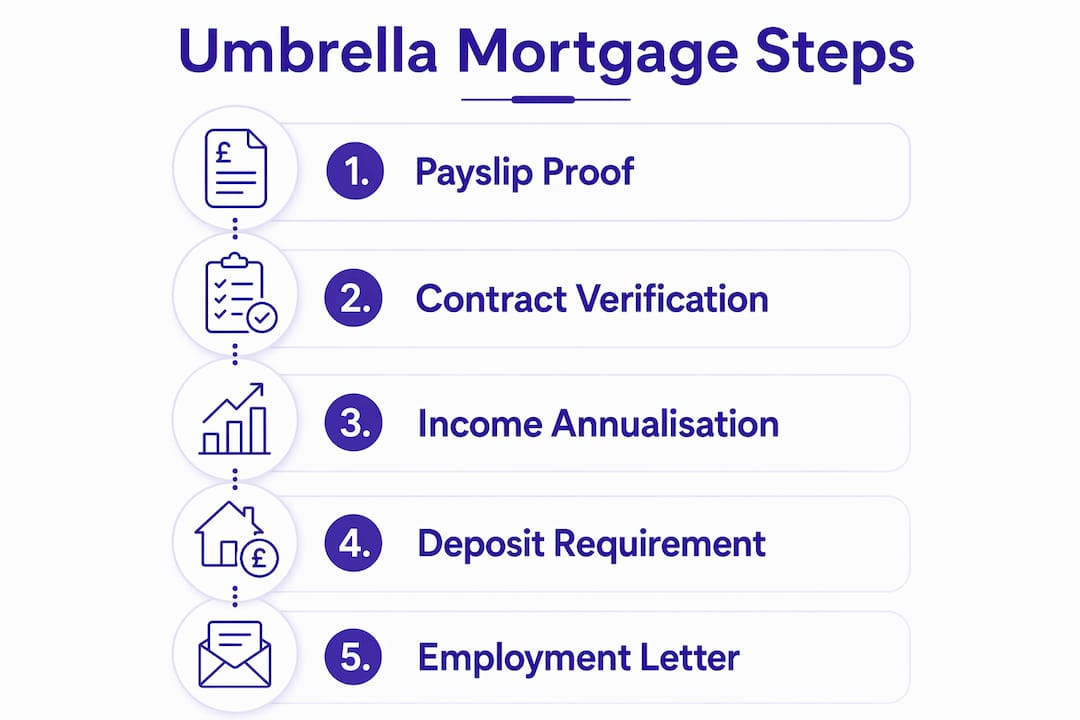
The income figure lenders use is not simply your highest monthly payslip multiplied by twelve. Lenders annualise contractor day rates over 46–48 working weeks rather than 52, accounting for assignment gaps and holidays. That calculation produces a more conservative annual income figure, which directly affects your maximum borrowing amount.
For example, a contractor earning £500 per day on a five-day week would show a gross annual rate of £130,000 on a 52-week basis. Using a 46-week annualisation, that figure drops to approximately £115,000. The difference affects how much a lender will offer, so you should factor this into your planning before you apply.
Income variability between assignments is the primary risk factor lenders examine. Gaps in payslips or a sudden drop in weekly earnings reduce the average income figure used in the assessment. Lenders want to see a consistent pattern, not a single strong month surrounded by quieter periods.
Pro Tip: Ask your umbrella company for a formal employment status letter before you apply. Some lenders request this as standard, and having it ready avoids delays.
Specialist contractor lenders use day rate annualisation and are better placed to handle umbrella contractor applications than mainstream high-street lenders. A broker who understands contractor profiles can match you to the right lender from the outset, rather than after a declined application has marked your credit file.
What documentation do umbrella company contractors need for a mortgage?
Preparing your documentation set thoroughly is the single most effective thing you can do before applying. Incomplete submissions are the most common reason applications stall or fail at the underwriting stage.
The typical documentation checklist for an umbrella contractor mortgage application runs as follows:
- Consecutive payslips. Provide three to six months of payslips from your umbrella company. They must be consecutive, not cherry-picked from your best-earning months.
- Current contract or assignment letter. Lenders want to see that you have active work. A contract showing the assignment end date, day rate, and client name gives them confidence in your near-term income.
- Bank statements. Three to six months of personal bank statements showing the umbrella payments landing in your account. These must match the payslip figures.
- P60. Your most recent P60 confirms your total PAYE earnings for the tax year. It provides a useful cross-reference against your payslips.
- Employment status letter. Typical documentation sometimes includes an employment status letter from your umbrella company confirming your engagement terms. Not every lender requests this, but having it prepared saves time.
- Proof of identity and address. Standard requirements: passport or driving licence, plus a utility bill or council tax statement dated within three months.
Lenders vary in exactly what they ask for. Some are satisfied with three months of payslips if your contract is strong and your bank statements are clean. Others want six months regardless. Working with a broker who knows individual lender criteria means you submit the right documents to the right lender first time.
What are the benefits and challenges of a mortgage as an umbrella contractor?
Umbrella contractors hold a genuine advantage over other self-employed applicants when it comes to mortgage applications. Understanding both the strengths and the friction points helps you plan effectively.
Benefits of PAYE status for mortgage applications
Umbrella contractors are treated more favourably than limited company directors or sole traders because their tax and National Insurance are deducted at source through PAYE. Lenders see this as a regulated, verifiable income stream. You do not need to produce self-assessment tax returns or two years of company accounts. That removes a significant barrier that catches many self-employed applicants off guard.
The absence of SA302 requirements is a practical time-saver. Umbrella PAYE status simplifies evidence requirements compared to limited company directors, who must reconcile salary, dividends, and retained profit to present a coherent income picture. For an umbrella contractor, the payslip is the income proof.
Pro Tip: If you are considering switching from a limited company to an umbrella arrangement, factor in the mortgage timing. Lenders want to see established PAYE history, so switching shortly before applying can create a documentation gap.
Common challenges to plan around
| Challenge | Impact | How to address it |
|---|---|---|
| Variable weekly income | Reduces average income figure used by lender | Maintain consistent hours across assignments |
| Assignment gaps | Breaks payslip continuity | Minimise gaps; explain any breaks in writing |
| Higher deposit requirements | Some specialist deals require 25% deposit | Deposit requirements vary by lender; shop with a broker |
| Short contract duration | Lenders prefer contracts with months remaining | Renew contracts before applying where possible |
| Mainstream lender unfamiliarity | Application declined or misassessed | Use a specialist contractor mortgage broker |
Specialist deals may require a 25% deposit, while some lenders accept as low as 5% when treating contractors like permanent employees. The range is wide, which is why lender selection matters as much as the application itself.
How can contractors improve their chances of mortgage approval?
Approval rates for umbrella contractor mortgages improve significantly with preparation. The contractors who struggle are usually those who approach a mainstream lender without specialist guidance and receive a decline that then affects their credit profile.
- Maintain continuous assignments. Gaps between contracts are the most common reason income averages fall. Where possible, line up your next assignment before the current one ends.
- Use a specialist broker. Brokers who understand contractor profiles improve approval chances by matching applications to lenders who actively want contractor business. This is not a minor advantage. It is often the difference between approval and decline.
- Keep organised income records. Store every payslip, bank statement, and contract document as you receive it. Reconstructing six months of records at application time is stressful and sometimes impossible if your umbrella company has changed systems.
- Check your credit file before applying. Errors on credit reports are common. Review your file with Experian, Equifax, or TransUnion at least three months before you plan to apply, so you have time to correct any mistakes.
- Save a larger deposit if your income is variable. A bigger deposit reduces lender risk and opens access to better rates. If your payslips show inconsistent earnings, a 15–20% deposit strengthens your position considerably.
- Explain income fluctuations in writing. A brief, factual letter explaining any gaps or income changes gives underwriters context. Lenders respond well to transparency.
- Apply to the right lender first. Every declined application leaves a mark on your credit file. Getting the lender selection right from the start protects your credit score and your options.
Key takeaways
Umbrella company contractors hold a clear advantage in mortgage applications because their PAYE status provides lenders with regulated, verifiable income that requires no self-assessment returns or company accounts.
| Point | Details |
|---|---|
| PAYE status simplifies applications | Umbrella contractors avoid SA302 returns; payslips serve as direct income proof. |
| Income is annualised over 46–48 weeks | Lenders use a conservative annual figure, so factor this into your borrowing estimate. |
| Documentation must be consecutive | Payslips must run without gaps; cherry-picked months will not satisfy underwriters. |
| Deposit requirements vary widely | Some lenders accept 5%, others require 25%; specialist lenders offer the best terms. |
| Specialist brokers improve outcomes | Matching your application to the right lender first protects your credit file and approval chances. |
What I have learned working with umbrella contractors
Most umbrella contractors I speak with are surprised to discover their position is stronger than they assumed. The persistent myth is that any form of contracting makes mortgage applications harder. For umbrella contractors, the opposite is often true.
The contractors who face real difficulties are usually those who have applied to a mainstream lender without guidance, received a decline, and then come to us with a marked credit file and fewer options. That sequence is almost entirely avoidable. The lender landscape has shifted noticeably over the past few years. More lenders now have dedicated contractor underwriting criteria, and the ones who use day rate annualisation properly can offer genuinely competitive terms.
What I find contractors consistently underestimate is the importance of contract continuity. A single month without a payslip, even if your earnings are otherwise strong, can reduce the income average a lender will use. Keeping assignments continuous is not just good financial practice. It is a direct factor in how much you can borrow.
The other area where I see unnecessary problems is documentation preparation. Contractors who arrive at application with three months of payslips, a current contract, and clean bank statements move through underwriting quickly. Those who need to chase their umbrella company for historical records, or who cannot explain a gap in their statements, face delays that sometimes cost them a property. Preparation is not optional. It is the foundation of a successful application.
My honest view is that umbrella contractors in 2026 have better mortgage access than at any point in the past decade. Lenders understand the model. The documentation requirements are clear. The main variable is whether you approach the process with the right broker and the right preparation.
— Paul
How Prosperhomeloans helps umbrella contractors secure the right mortgage
Umbrella contractors have real mortgage options, and Prosperhomeloans exists to help you find the best one for your circumstances.

We work with umbrella company contractors every day, and we understand how lenders assess PAYE contractor income. Our advisors know which lenders use day rate annualisation, which accept shorter contract histories, and which offer the most competitive terms for your deposit level. We handle the paperwork, the lender matching, and the application process so you can focus on your work. If you are ready to explore your options, visit Prosperhomeloans to speak with an advisor who knows contractor mortgages inside out.
FAQ
What is an umbrella company mortgage?
An umbrella company mortgage is a standard residential mortgage assessed using the PAYE income of a contractor employed through an umbrella company. It is not a separate product but a specific application route that uses payslips rather than self-assessment returns as income proof.
Do umbrella contractors need SA302 tax returns for a mortgage?
No. Umbrella contractors are PAYE employees, so lenders accept payslips and bank statements as income evidence. SA302 returns are required for sole traders and limited company directors, not umbrella workers.
How many payslips do I need for an umbrella contractor mortgage?
Lenders typically require 3–6 months of consecutive payslips alongside proof of your current contract and matching bank statements.
How do lenders calculate income for umbrella contractors?
Lenders annualise day rates over 46–48 working weeks rather than 52, producing a conservative annual income figure that accounts for holidays and assignment gaps.
Can I get a mortgage with a small deposit as an umbrella contractor?
Yes. Some lenders accept deposits as low as 5% for umbrella contractors treated similarly to permanent employees, while specialist deals may require up to 25%. A broker can identify which lenders offer the best terms for your deposit level.
