Tracker vs Variable Mortgage: What Is the Difference?

A tracker mortgage is a type of variable-rate mortgage. Its rate follows the Bank of England base rate at a fixed gap, so it moves only when the base rate moves. A standard variable rate (SVR) is different: your lender sets it and can change it at any time. Which suits you depends on how much your payments can flex, which matters most if your income comes from CIS work, contracts or your own company.
We are a local mortgage broker serving Hastings, Eastbourne, Hailsham, Bexhill-on-Sea and the rest of East Sussex, and we advise clients across the UK. Below we explain the difference in plain terms, with a worked comparison.
TL;DR
- A tracker follows the Bank of England base rate plus a set margin, usually for two to five years. An SVR is your lender’s own rate and can change whenever the lender decides.
- Which? reported the base rate at 4% in its 2026 guide, and said average SVRs were above 7%. Check the latest figures before you decide.
- Trackers often have no tie-in, so you can usually switch early. Your payments will rise if the base rate rises.
- A discount mortgage is a third option: a reduction off the lender’s SVR, not off the base rate.
- Variable payments are harder to budget for if your income already moves around. A broker can compare all of these for your circumstances.
Table of Contents
- How a tracker mortgage works
- How a standard variable rate works
- Tracker vs SVR side by side
- Where a discount mortgage fits
- What a base rate change does to your payments
- What to compare beyond the headline rate
- Tracker, SVR or fixed if your income varies
- Why use a broker for this choice
- Our view
- FAQ
- Sources
How a tracker mortgage works
A tracker rate follows another interest rate, usually the Bank of England base rate, plus a margin. MoneyHelper, the government-backed guidance service, gives the example that if the base rate rises by 0.5%, your rate rises by 0.5%. Tracker deals usually last two to five years, and some lenders offer them for the whole term.
So a tracker at base rate plus 1% moves in step with every base rate change. The base rate is set by the Bank of England’s Monetary Policy Committee at scheduled meetings through the year. The Bank publishes the dates and decisions on its website.
What moves your payment: only the base rate. The margin stays as agreed for the deal period.
MoneyHelper lists these tracker advantages:
- Payments fall when the tracked rate falls.
- There is usually no tie-in, so you can often switch deals early.
- There are usually fewer or no limits on overpayments.
The main downside is that payments rise when the tracked rate rises. MoneyHelper also advises reading the small print, so you know the lender cannot raise your rate when the rate it tracks has not changed.
How a standard variable rate works
The SVR is the rate a lender sets for its standard loan. MoneyHelper says it can change at any time and is usually higher than the lender’s other products. Most people land on it when a fixed or tracker deal ends and they have not arranged a new one.
An SVR does not have to follow the base rate. Which? explains that a lender can raise its SVR even if it does not pass on a full base rate rise. The Financial Ombudsman Service has set out the reasons a lender may lawfully raise an SVR. They include changes in its cost of funds, in rates charged by other lenders, and in administration costs (decision DRN-4110452).
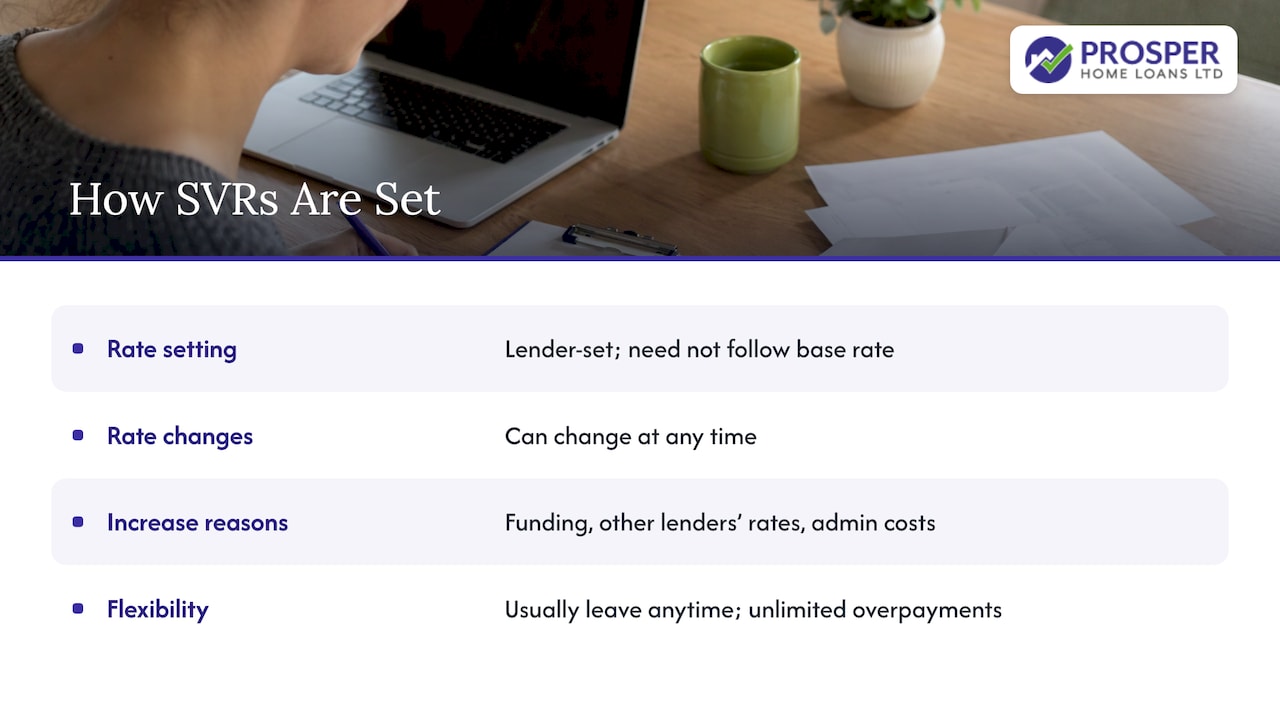
The SVR does have one useful feature: you can usually leave at any time and overpay without limit, as MoneyHelper notes. Because it is usually the costlier option, it works best as a short stop before you move to a new deal.
Tracker vs SVR side by side
| Tracker | Standard variable rate | |
|---|---|---|
| What sets the rate | Base rate plus a fixed margin | Your lender’s own decision |
| Typical length | Two to five years, sometimes the full term | Ongoing until you switch |
| Predictability | You can see the cause of any change | Can change at any time |
| Early exit | Usually no tie-in | Usually free to leave |
| Usual cost | Depends on the margin | Usually higher than the lender’s other deals |
Where a discount mortgage fits
Some readers searching this topic are really comparing a tracker with a discount deal. A discount mortgage takes a set amount off the lender’s SVR for a period, typically two or three years, according to MoneyHelper. It moves with the lender’s SVR, not the base rate.
MoneyHelper also gives a worked example. A 2% discount off a 6% SVR gives 4%. A 1.5% discount off a 5% SVR gives 3.5%, which is cheaper despite the smaller discount. Always compare the final rate and the fees, not the size of the discount.
Which? adds that a base rate rise can prompt lenders to lift their SVRs, which eats into the benefit of a discount.
What a base rate change does to your payments
The 4% base rate quoted by Which? is a snapshot. The rate changes at Bank of England decisions, and Which? notes it was cut four times in 2025, by 0.25 percentage points each time. Look up the latest decision on the Bank of England’s site before you compare deals.
Here is what a change means for each type, per Which?:
- Tracker at base rate plus 1%: a 0.25 percentage point rise lifts your rate by 0.25 points.
- SVR: your lender decides how much of any rise to pass on, and the effect can still be significant.
- Fixed rate: no change until the fixed term ends, then you move to the SVR unless you arrange a new deal.
Which? also says that with average SVRs above 7%, it is important to remortgage before a fixed term ends unless you are about to move house. Our guide to remortgaging before your fix ends covers the timing and early repayment charges.
What to compare beyond the headline rate
Two deals with the same rate can cost different amounts. Check:
- The APRC. Lenders must state it, and MoneyHelper says it shows the yearly total cost including fees and charges over the full term.
- Fees. Look for arrangement and admin fees, and any fee for leaving a discount deal early.
- Early repayment charges. Lenders must describe the conditions for early repayment in their pre-contract information (FCA MCOB 3B).
- Any rate cap or floor. Some contracts limit how far a variable rate can move.
- What happens when the deal ends. Most moves onto the SVR.
Tracker, SVR or fixed if your income varies
If you are a CIS subcontractor, a contractor or a company director, your income may change from month to month. That makes the budgeting side of this choice matter as much as the rate.
A tracker can suit you if you have a cash buffer, want to overpay in strong months and value being able to switch without a tie-in. MoneyHelper says variable rates make repayments harder to budget. A fixed rate gives a known payment for the term, but you must switch before it ends and you will not benefit if rates fall during the fix.
There is no single right answer. It depends on your margin for error, your plans for the next few years and the deals available. Our fixed vs tracker guide goes deeper on that decision.
Self-employed and CIS workers
Lenders assess self-employed and CIS income differently from a payslip. Some lenders may use gross CIS earnings when assessing affordability, subject to their own criteria. That does not increase your actual income and does not guarantee you can borrow more. We arrange CIS voucher mortgages for subcontractors, and you can read more on our CIS subcontractor mortgages page or our page for self-employed and company director mortgages.
Buy-to-let landlords
Buy-to-let mortgages also come as fixed or tracker deals, and Lloyds notes that lenders may set higher rates for them. The choice is usually payment certainty against flexibility. If a rise in rates would squeeze your rental cover, certainty tends to count for more. Our buy-to-let remortgage plan sets out how to prepare.
Why use a broker for this choice
The right deal depends on your income evidence, your deposit or equity, your plans and your cash buffer. Margins, fees and early repayment terms vary between lenders, and so do their rules on how they treat self-employed and CIS income.
We offer whole-of-market advice from our base in St. Leonards-on-Sea, and we are available to clients across Hastings, Eastbourne, Hailsham, Bexhill-on-Sea and East Sussex. We explain the options, costs and risks, then support you from your first enquiry through to completion and future reviews. If your fix is ending, our remortgage service and product transfer service cover both routes.
If you want to know how much you could borrow before you commit to a deal, we offer a mortgage affordability assessment and capacity report for a one-off £199.

Talk to us at Prosper Home Loans and we will compare tracker, discount and fixed deals against your situation.
Our view
Most people who ask us about trackers and SVRs are really asking how much uncertainty their household can handle. We start there, not with a rate forecast.
For self-employed clients and CIS subcontractors, we look at how the income is evidenced, how it varies and what cash buffer sits behind it. Then we compare deals across the market, including the fees and the early repayment terms.
We would rather you know the costs and the risks before you apply than find them in the small print later. Whatever you choose, we help you plan the date your deal ends, so you are not moved onto the SVR by default.
Paul McMath CeMAP CeRER
FAQ
Is a tracker mortgage the same as a variable rate mortgage?
A tracker is one kind of variable-rate mortgage. Its rate follows the Bank of England base rate plus a set margin. An SVR and a discount deal are the other main variable types, and both depend on the lender’s own SVR.
Is a tracker cheaper than the SVR?
Trackers are usually priced below the lender’s SVR, which MoneyHelper says is usually higher than its other products. The gap depends on the lender and the margin, so compare actual deals and fees.
Can I leave a tracker early?
Often yes. MoneyHelper says tracker deals usually have no tie-in, but some do carry early repayment charges. Read the offer terms before you apply.
Does a tracker work for a self-employed borrower?
It can, if your budget can absorb payment changes and your lender accepts your income evidence. A broker can check both before you apply.
Sources
- Understanding mortgages and interest rates, MoneyHelper
- Bank of England base rate and your mortgage, Which?
- Financial Ombudsman Service decision DRN-4110452
- FCA Handbook, MCOB 3B
- Compare the different types of mortgages, Lloyds
Recommended
- Fixed vs tracker mortgage: which is right for you in 2026?
- Interest-Only vs Repayment Mortgages: Which Suits You?
This article provides general information and is not a personal mortgage recommendation. Mortgage availability and eligibility depend on your circumstances and lender criteria. Rates and criteria can change. We will explain any applicable fees before you commit. Think carefully before securing other debts against your home. Consolidating debts over a longer term may reduce your monthly payments but increase the total amount you repay. Your home may be repossessed if you do not keep up repayments
