SA302 for a Mortgage: What Lenders Need and How to Get It

If you are self-employed, a CIS subcontractor or a contractor, a lender will usually want proof of your earnings, and the SA302 is the document most often asked for. It is your tax calculation from HMRC, produced once you have submitted a Self Assessment return. You can print it from your HMRC online account, and some lenders will take an accountant’s certificate instead. We are a local mortgage broker in Hastings and St Leonards-on-Sea, and this guide covers what we see applicants need.
TL;DR
- An SA302 is the tax calculation from your submitted Self Assessment return. Lenders use it as evidence of your self-employed income.
- You can get it online from HMRC about 72 hours after filing, then print or save it.
- Many lenders also want the matching Tax Year Overview. Some accept an accountant’s certificate or full trading accounts instead.
- Lender rules differ, so check what your chosen lender accepts before you apply.
- We can tell you which evidence suits your situation, whether you work under CIS, through a limited company or as a sole trader.
Table of Contents
- What an SA302 is and why lenders ask for it
- How to get your SA302 from HMRC
- SA302 versus Tax Year Overview
- Other ways to evidence self-employed income
- How lenders treat contractors and CIS income
- A worked example
- Perspective
- Protecting your income once you have the mortgage
- If you are looking at debt consolidation
- Talk to a local mortgage broker
- FAQ
- Sources
What an SA302 is and why lenders ask for it
An SA302 is evidence of your earnings taken from a Self Assessment return you have submitted. HMRC’s guidance says a lender may request it as income evidence if you are self-employed.
The reason is simple. An employed person has payslips. If you are self-employed, your income is declared through your tax return, so the lender looks there to see what you earned and what tax you paid.
For CIS subcontractors, the figures on the return are what count. Your CIS vouchers or statements show what was deducted along the way, and they support the picture your return gives.
How to get your SA302 from HMRC
You need to have filed your return first. Then follow these steps, which come from HMRC’s own instructions:
- Wait 72 hours after filing.
- Sign in to your HMRC online account.
- Choose Self Assessment, then “More details about your Self Assessment returns and payments”.
- Select the tax year you need.
- Print or save the tax calculation.
A UK tax year runs from 6 April to 5 April the following year, so a lender asking for “the last two years” means two complete tax years.
If you filed using commercial software, the process differs. HMRC says to get the tax computation from that software and print the Tax Year Overview separately from your HMRC account. Check that your lender accepts that format before you send it.
If your accountant files for you, ask them to send both documents for each year. It saves time later.
SA302 versus Tax Year Overview
They are two different documents. The SA302 is the tax calculation worked out from your return. The Tax Year Overview shows your tax position and payments on your HMRC account.
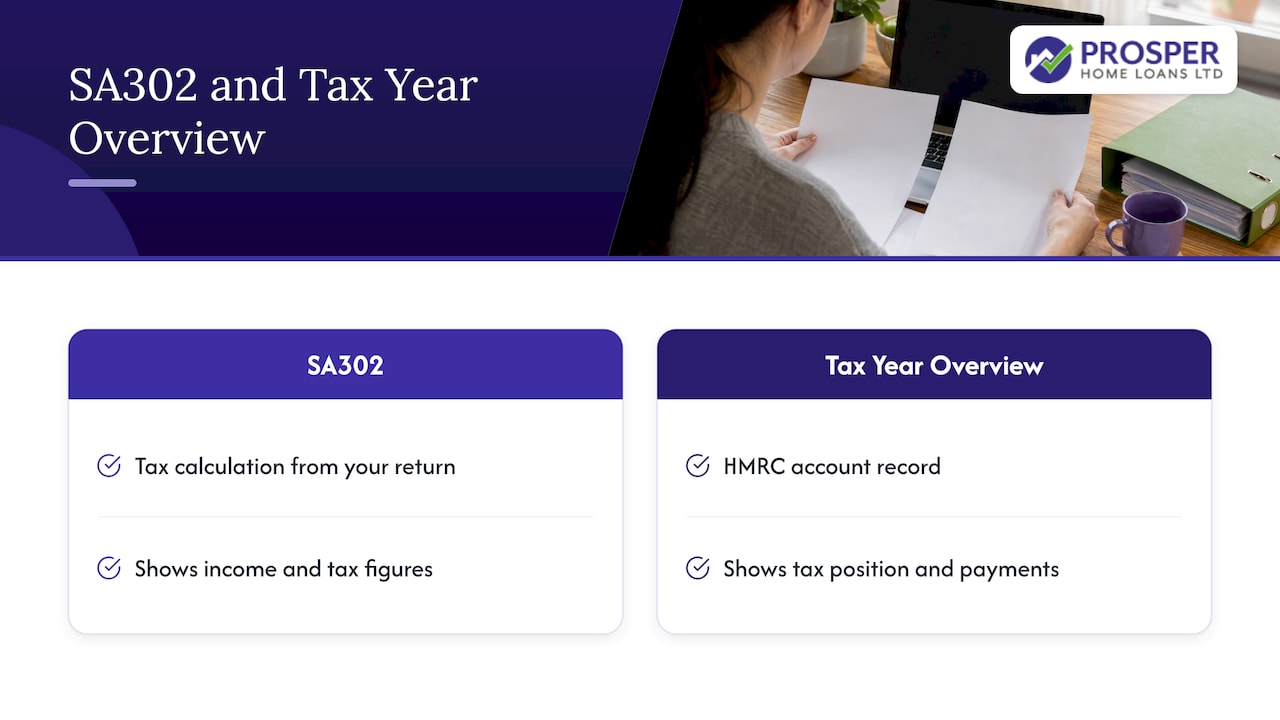
Lenders often want them as a pair. For example, Santander’s guidance for brokers lists two years of SA302s with matching Tax Year Overviews, plus the latest business bank statement, as one acceptable route for some self-employed applications.
The two should tell the same story. If the income or tax figures do not match, do not send them off and hope. Ask your accountant to explain the difference, which can come from things like timing of payments or an amended return. Then let us see both before the application goes in, so we can explain any difference upfront to the lender.
Other ways to evidence self-employed income
An SA302 is not the only route. Depending on the lender, the options may include:
- An accountant’s certificate. Nationwide accepts one covering at least the latest two years’ accounts. It must be prepared and signed by a professionally qualified Associate or Fellow with suitable indemnity insurance. A Chartered Accountant cannot certify their own self-employed income.
- Full trading accounts. Some lenders accept at least two years of them.
- SA302s with Tax Year Overviews, as above.
The same Santander guide says the latest year-end must not be more than 18 months before the application date. Nationwide applies the same limit to accountant’s certificates.
This matters if you have been putting off your return. An out-of-date year-end can hold up an application, so file on time if you are planning to buy or remortgage.
How lenders treat contractors and CIS income
Lenders look at self-employed income differently, and criteria change. A few examples from published lender criteria:
- Nationwide says a fixed-term contractor trading self-employed for at least two years may be considered self-employed. It uses the lower of the latest year’s income or the two-year average.
- Other lenders weigh the latest year, an average, or the lower figure, so the same income can lead to different results.
For CIS subcontractors, some lenders may use gross CIS earnings, before deductions, when they assess affordability. That depends entirely on their criteria. It does not raise your actual income, and it does not guarantee you can borrow more. It simply means the choice of lender matters. This is what a CIS voucher mortgage approach is about: matching your evidence to a lender whose rules suit how you are paid.
If you work through an umbrella company you are treated as employed, and payslips are the evidence instead. Our guide on umbrella company payslips for mortgages covers it. If you are unsure which category you fall into, read our self-employed versus subcontractor mortgage guide.
A worked example
Say you are a CIS bricklayer in Bexhill-on-Sea with two filed returns. Your documents might be:
- SA302s for the last two tax years
- Matching Tax Year Overviews
- CIS payment and deduction statements
- Recent business and personal bank statements
- Proof of your deposit
The figures are illustrative only. Which of them a lender uses, and how, is up to that lender. Our job is to compare lender approaches and put forward the one that fits your paperwork. On deposits, see how self-employed buyers can prove their deposit.
Perspective
Most self-employed clients we meet worry about the wrong thing. They fear their income looks too irregular, when the bigger issue is usually the paperwork: returns not yet filed, documents that do not match, or an application sent to a lender whose rules do not fit how they earn.
We start with your evidence, then look at the market for lenders whose criteria suit it. We explain the costs and risks plainly, and we never promise an approval or a particular rate. What we can promise is that you will know what is needed, and why, before anything is submitted.
For subcontractors and contractors in East Sussex, being local helps. We can sit down with you, go through your CIS statements and returns, and support you from first enquiry through to completion and later reviews.
Paul McMath CeMAP CeRER
Protecting your income once you have the mortgage
When you are self-employed there is no employer sick pay behind you. Two types of cover come up most often with contractors.
Income protection pays a regular monthly amount if illness or injury stops you working, subject to the policy terms and a successful claim. Aviva explains that the wait before the first payment, the deferred period, can range from four to 104 weeks depending on the policy. A longer wait usually suits people with savings to fall back on.
Life insurance for contractors depends on how you trade. A relevant life plan is a death-in-service benefit for an employee, including a company director. Legal & General says it is not available where there is no employer-employee relationship, which includes sole traders. Sole traders and CIS subcontractors would normally look at personal life insurance, and critical illness cover can sit alongside it.
The right mix depends on your dependants, your mortgage and your finances. We can talk it through when we arrange your mortgage.

If you are looking at debt consolidation
Some homeowners ask whether they can roll credit cards or loans into a mortgage or a secured loan. It can lower monthly payments, but spreading debt over a longer term can mean you pay more in total. The debts also become secured against your home, so missed payments could put the property at risk.
It is worth comparing alternatives first, such as speaking to a free debt advice charity or looking at other repayment options. We can explain how a debt consolidation remortgage or second charge loan would work for you, and whether it is suitable at all.
Talk to a local mortgage broker
We are a mortgage broker based in Hastings and St Leonards-on-Sea, helping clients in Eastbourne, Hailsham, Bexhill-on-Sea and across East Sussex and the UK. We are available to review your documents and explain your options.

See our CIS subcontractor mortgage service or our self-employed and company director mortgages. For protection, see our life insurance, critical illness and income protection page. We also offer a mortgage affordability assessment and capacity report for £199.00, one-off. If you are remortgaging, our guide to what lenders need to see for a self-employed remortgage may help.
FAQ
How long does it take to get an SA302?
HMRC says to wait 72 hours after you file your return. After that you can sign in to your online account and print or save it. If your return was filed through commercial software, get the computation from the software instead.
Can I use an accountant’s certificate instead of an SA302?
Some lenders accept one. For example, Nationwide takes a certificate covering at least two years’ accounts from a suitably qualified accountant. Others prefer SA302s with Tax Year Overviews, so check the lender’s rules first.
Do lenders want a Tax Year Overview as well?
Often they do. Some accept SA302s together with the matching Tax Year Overviews as one evidence route. We can confirm what your chosen lender needs.
What if my SA302 shows low income?
The figure on your return is what lenders generally work from, so it may affect how much you can borrow. Lender approaches vary, and we can look at which suit your income pattern. We cannot promise any outcome.
Sources
- Get your SA302 tax calculation, GOV.UK
- Self-employed income and accountant’s certificate guide, Santander for Intermediaries
- Self-employment income, Nationwide for Intermediaries
- Income protection for the self-employed, Aviva
- Relevant Life Plan, Legal & General
Recommended
- What documents do subcontractors need for a mortgage?
- East Sussex Contractors: What to Package for a Day Rate Mortgage
- Spouse Visa Mortgages UK: What Lenders Need and When to Call an Adviser
- Self-employed vs subcontractor mortgage: 2026 guide
This article provides general information and is not a personal mortgage recommendation. Mortgage availability and eligibility depend on your circumstances and lender criteria. Rates and criteria can change. We will explain any applicable fees before you commit. Think carefully before securing other debts against your home. Consolidating debts over a longer term may reduce your monthly payments but increase the total amount you repay. Your home may be repossessed if you do not keep up repayments
