Probation Period Mortgage: Can You Apply in a New Job?

Yes, you can get a mortgage while you are still on probation, but it depends on the lender, the type of contract and how well your case is prepared. Some lenders accept probation as long as the job is permanent. Others wait for a reference or the end of the probation. Knowing which is which before you apply is the difference between a smooth case and a declined one. We are a local mortgage broker in St. Leonards-on-Sea, serving Hastings, Eastbourne, Hailsham, Bexhill-on-Sea and the rest of East Sussex, and we can check lender criteria with you before anything goes on your credit file.
TL;DR
- Probation alone does not rule you out. Many lenders look at whether the contract is permanent, how long you have been in the job and whether you have a payslip.
- Some lenders will not make an offer until probation is confirmed as passed, particularly if you have been in the role under six months.
- Expect to provide your contract, recent payslips, bank statements and, in some cases, an employer’s reference.
- If you change jobs mid-application, tell your broker and lender straight away. An offer is not final until completion.
- Nothing here guarantees approval. Each lender decides on its own criteria and your circumstances.
Table of Contents
- What lenders mean by probation
- Can you get a mortgage during probation?
- What evidence you should have ready
- Apply now or wait until probation ends?
- Worked example
- If you are a CIS subcontractor or self-employed
- Changing jobs during a mortgage application
- Our view on probation and mortgages
- Talk to a local mortgage broker
- FAQ
- Sources
What lenders mean by probation
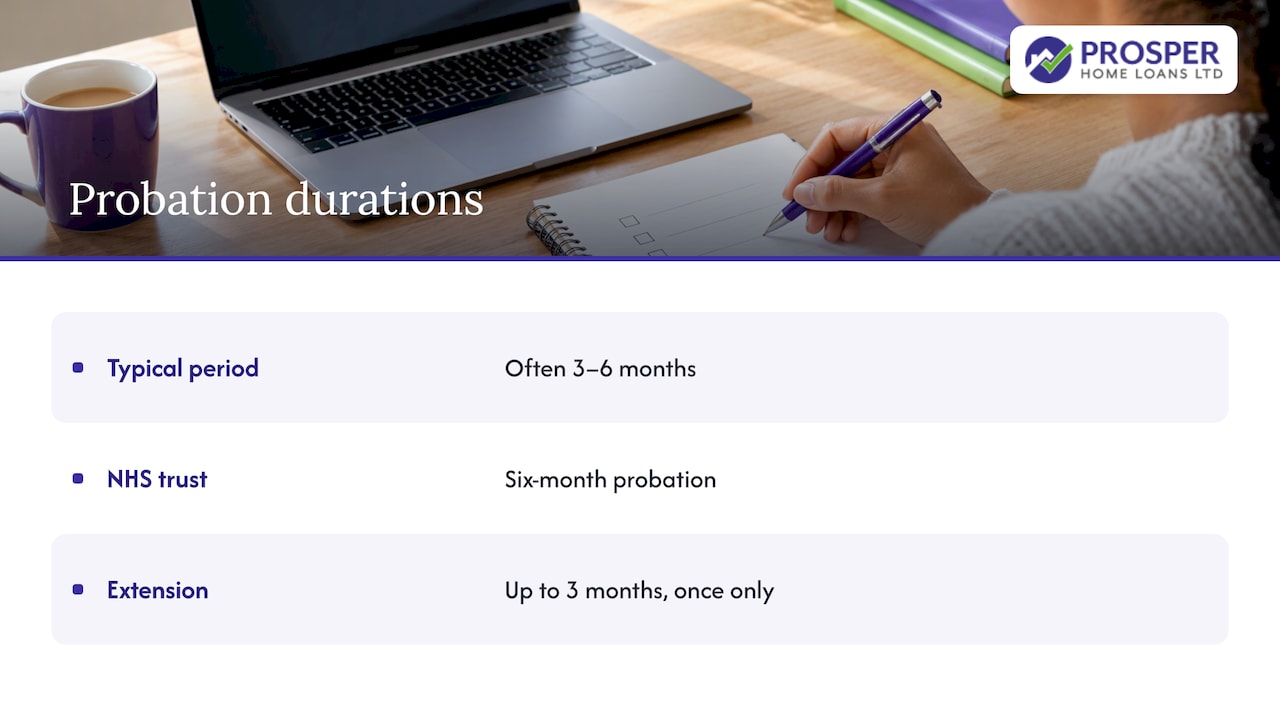
A probation period is an initial stretch in a new job, often three to six months, during which the employer assesses whether you suit the role. Public sector examples show how it works: one NHS trust’s probationary policy sets six months, which may be extended, usually by no more than three months and only once.
Lenders care because probation is the point at which an employer can still end the job more easily. Their worry is not you personally. It is whether your income will carry on for the length of the loan. The Acas view that probation should suit the job also means the length varies, so a lender may ask for your actual contract rather than assuming six months.
Can you get a mortgage during probation?
It is possible, though it can be harder. Mortgage guidance published in March 2026 explains that approval depends on your overall financial profile, the type of mortgage and the lender’s criteria, and that preparation and supporting evidence help.
Lender policies genuinely differ. To show the range:
- One lender’s published residential criteria accept probation, or under six months in the job, provided the contract is permanent rather than short-term and you have received your first payslip.
- A building society’s lending manual accepts probation where you have a track record in a similar position. Where you are new to the role and under six months in, it asks for an employer’s reference and will not make an offer until that confirms probation has been passed and the job is permanent.
Those are two lenders out of many, and criteria change. The point is that the same applicant can be acceptable to one and told to wait by another. That is why choosing the lender before applying matters.
What evidence you should have ready
Lenders check job type and contract, probation, income stability, employment history, credit history, deposit and affordability. To support that, you will usually be asked for:
- Your employment contract or an appointment letter, showing the job is permanent and the salary.
- Recent payslips, usually the last three months or all you have if you started more recently.
- Bank statements, typically three to six months.
- A P60 from your previous employer, if you have one.
The exact list varies. One lender’s income criteria for someone one month or less into a new job include the latest payslip (basic income only) and a signed open-ended contract or appointment letter. Another asks for the two most recent payslips, an employer’s reference if you have been there under six months, and three months’ bank statements.
Payslip dating matters too. One lender’s intermediary guidance says it can use a contract to verify future income with a covering letter or email from the employer, and that the latest payslip must be dated within six weeks of the application, with your name matching the application exactly. Small mismatches like that cause delays that are easy to avoid.

Apply now or wait until probation ends?
There is no single answer. These are the factors we weigh with clients:
- Contract type. A permanent contract with a probation clause is viewed differently from a fixed-term or zero-hours one. If your hours vary, see our guide to zero hours mortgages.
- Similar previous role. Moving within the same line of work, with a track record, usually reads better to a lender than a complete change of career.
- Time in the job. Some lenders look for a first payslip only. Others draw the line at six months.
- Your deposit and spare income. A larger deposit and comfortable affordability give a lender more reason to be flexible. Our blog explains how deposit requirements change with job type.
- Timing of the purchase. If you have found a property and have a deadline, waiting may not be an option. A lender that accepts probation now may be better than a better-priced one that will only lend later.
Waiting can make sense, but applying early with the right lender can also work. It comes down to your own paperwork and the property timetable.
Worked example
Say you have moved to a new employer in the same trade, your contract is permanent with a six-month probation clause, and you have had one payslip. A lender that accepts probation with a first payslip may consider the case. A lender that requires a reference confirming probation has been passed would not make an offer yet. Both are normal policies. The outcome of an application is never certain, but sending it to the first kind of lender is the sensible route.
If you are a CIS subcontractor or self-employed
Probation is an employee idea. If you are a CIS subcontractor, the question is usually how long you have been working in the trade, how your income is evidenced and how a new contractor relationship affects things. Some lenders may use gross CIS earnings when assessing affordability, subject to their criteria. That does not increase your actual income and does not guarantee higher borrowing. Our CIS subcontractor mortgage service and self-employed and company director mortgages look at your case on that basis. Umbrella company workers may find our guide to payslips for umbrella contractors useful.
If you are a first-time buyer in a new job, our first-time buyer mortgages page explains how we help.
Changing jobs during a mortgage application
This catches people out. A mortgage application is checked more than once. Lenders assess your employment when you apply and can ask for confirmation again before completion, and your solicitor may ask you to confirm nothing has changed. So if you are thinking of changing jobs after applying, or after an offer, do this:
- Tell your broker before you hand in notice. Do not wait. We can check how the lender is likely to treat the new role before you commit.
- Be honest with the lender. Giving inaccurate information on an application can lead to an offer being withdrawn. An offer is not final until completion.
- Gather the new paperwork early. That means the new contract, the offer letter, and any reference the lender asks for.
- Expect questions about probation. A higher-paid role in the same field is often easier to explain than a move into a different industry on a lower salary, but each lender decides for itself.
- Consider the timing. If you can, delay the job move until after completion. If you cannot, we can look at whether the lender will reassess the case or whether another lender suits the new role better.
If you already hold a mortgage and your fixed rate is ending, a job change affects a remortgage in a similar way. See our guide to remortgaging before your fix ends.
Our view on probation and mortgages
We are asked about probation more than almost anything else from people changing jobs. Our approach is simple: look at the contract, the payslips and the lender criteria first, then decide whether to apply now or time it differently.
Lenders are not all the same. Some are comfortable with probation once the first payslip has arrived. Others want a reference first. Placing a case with a lender whose criteria match your situation is the part we can do for you. We also explain costs and risks clearly, so you know where you stand before you commit, and we support you from first enquiry through to completion and future reviews.
We never promise approval, and we will say so if the timing is not right. If it is not, we can tell you what would change that.
Paul McMath CeMAP CeRER
Talk to a local mortgage broker
We are an independent mortgage and protection advice firm in St. Leonards-on-Sea, with whole-of-market advice for people in Hastings, Eastbourne, Hailsham, Bexhill-on-Sea and across East Sussex and the UK. If you are in a probation period or about to change jobs, tell us the contract terms and your timetable and we will explain your options.

You can start with our whole-of-market mortgage advice. If you want to understand your borrowing capacity first, we also offer mortgage affordability assessments and capacity reports for £199.00 one-off.
FAQ
Can I get a mortgage in my first month in a new job?
Some lenders will consider it, usually if the contract is permanent and you have a first payslip. Others want a longer track record or a reference. It depends on the lender and your circumstances, so check criteria before applying.
Does a mortgage in principle cover me if I change jobs?
A mortgage in principle is an early indication from a lender, not a final offer. It is based on the information you gave at the time, so if your job or income changes, tell your broker so the position can be reviewed.
What happens if I fail probation after an offer?
An offer is not final until completion, and lenders can reassess if the facts change. If your employment is at risk before completion, speak to your broker and solicitor immediately, so you understand your options.
Do I need my employer to confirm my probation has finished?
Sometimes. Where you have been in the job under six months and have no similar track record, some lenders ask for an employer’s reference and will not offer until it confirms the job is permanent. Other lenders do not need this.
Sources
- Can I get a mortgage during my probation period?
- Probation lending criteria, residential
- A-Z lending criteria manual, September 2024
- Employment income lending criteria
- Speed up your applications guide
- NHS trust probationary policy, November 2025
- Acas on probation periods and the Employment Rights Act 2025
Recommended
- Get a Zero Hours Mortgage in the UK: 12–24 Months’ Proof and a Broker
- Mortgage Deposits by Job Type: What to Expect
- Win Mortgage Approval with 3–12 Months’ NHS Bank Pay
This article provides general information and is not a personal mortgage recommendation. Mortgage availability and eligibility depend on your circumstances and lender criteria. Rates and criteria can change. We will explain any applicable fees before you commit. Think carefully before securing other debts against your home. Consolidating debts over a longer term may reduce your monthly payments but increase the total amount you repay. Your home may be repossessed if you do not keep up repayments
