Mortgage Protection vs Life Insurance: What's the Difference?

In the UK, “mortgage protection” usually means one of two things: mortgage life insurance, which pays a lump sum towards your mortgage if you die, or payment protection, which helps with monthly repayments if you cannot work. Standard life insurance is wider. It pays a sum to your family to use however they need. Which one suits you depends on your income, your dependants and how your mortgage is structured.
TL;DR
- Mortgage life insurance is normally a decreasing term policy, built to clear a repayment mortgage if you die during the term.
- Standard life insurance is not tied to your mortgage. Your family can spend the payout on the loan, bills or anything else.
- Payment protection and income protection cover a different risk: being unable to work through illness or injury.
- You do not legally need life insurance to get a mortgage, but it can matter a great deal if others rely on your income.
- If you are self-employed or a CIS subcontractor, you have no employer sick pay behind you, so the income side deserves real thought.
Table of Contents
- What each type of cover actually does
- Is mortgage life insurance necessary?
- Decreasing or level: matching cover to your mortgage
- Joint policies and single policies
- Why self-employed workers and CIS subcontractors should look at income cover
- Before you buy: what to check
- Getting advice from a local broker
- FAQ
- Sources
What each type of cover actually does
The names are used loosely, so start with what each policy pays and when.
| Type of cover | Pays out when | What you get | Typical fit |
|---|---|---|---|
| Mortgage life insurance (decreasing term) | You die during the term | A lump sum that falls over time, in line with a repayment mortgage | Clearing the mortgage for your family |
| Level term life insurance | You die during the term | A fixed lump sum for the whole term | Covering the mortgage plus other needs, or an interest-only loan |
| Mortgage payment protection or income protection | You cannot work through illness or injury | A monthly income for a set period | Keeping repayments going while you recover |
| Critical illness cover | You are diagnosed with a listed condition | A lump sum | Paying down debt or covering lost earnings |
Mortgage life insurance
This is the policy most people mean by “mortgage protection”. It is usually decreasing term cover. The amount insured falls broadly as your repayment mortgage balance falls, so it is often cheaper than a level policy. If you die within the term, the money is intended to clear what you owe. It does nothing if you are ill but alive.
Standard life insurance
A standard policy is not linked to your mortgage contract. You choose the amount and the term. Your family receives the payout and decides how to use it. That flexibility is the main difference. Many people use a level term policy if they want to cover the mortgage and also leave something for living costs or childcare.
Payment protection and income protection
These pay a monthly income rather than a lump sum. According to the Association of British Insurers, income protection typically pays up to half your gross earnings after an agreed waiting period, commonly three or six months, until you return to work or the policy ends. A longer waiting period usually means a lower premium, so it is worth matching it to how long you could manage on savings.

Is mortgage life insurance necessary?
No, not legally. Your lender cannot make you buy life insurance to get a mortgage. What the lender will normally require is buildings insurance. MoneyHelper explains that buildings cover is not a legal requirement, but it is a standard condition of mortgage lending because it protects the lender’s interest in the property. If you are weighing up different kinds of property cover, this comparison of home warranty versus insurance shows how the two differ.
Whether you need life cover is a personal decision. The ABI says it is particularly worth considering for the main earner if dependants would struggle with the payments after a death. If you are single with no dependants and nobody shares the loan, the case is weaker.
A few questions help:
- Who would have to keep paying the mortgage if you died?
- Could they manage on one income, or on savings?
- Is the mortgage on a repayment or interest-only basis?
- Do you already have cover through work or an existing policy?
Decreasing or level: matching cover to your mortgage
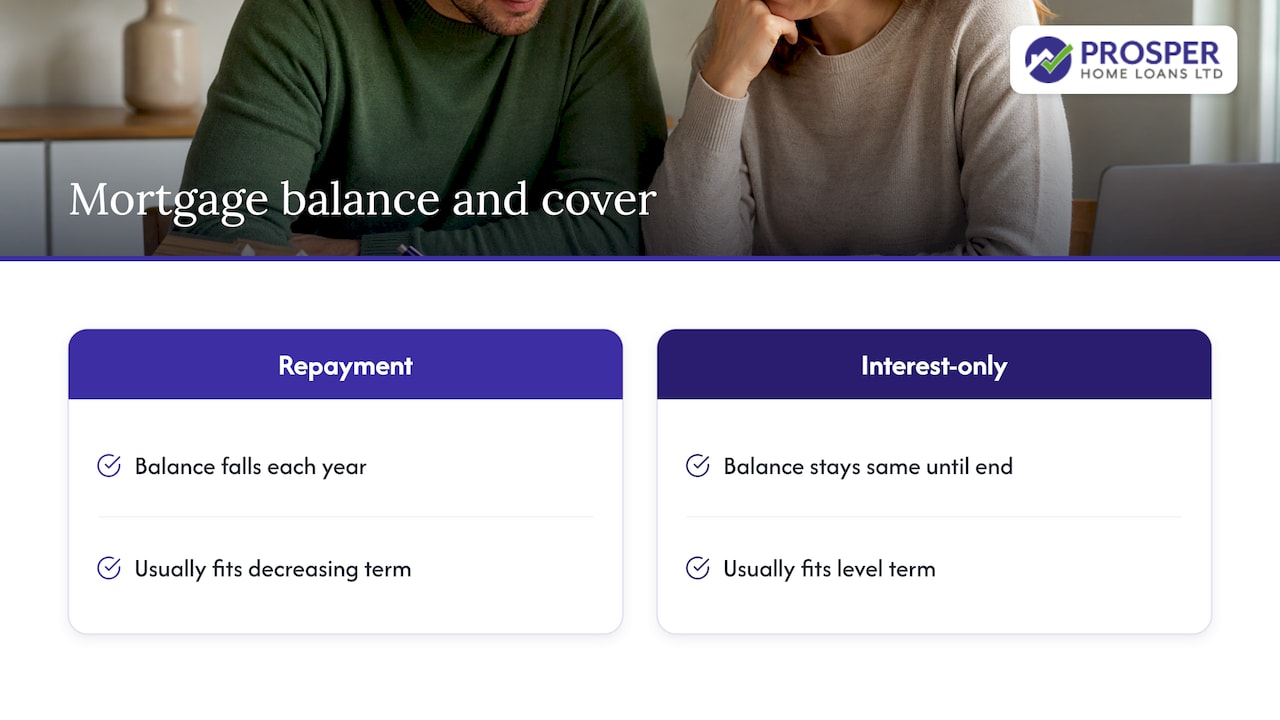
The type of mortgage changes the answer. With a repayment mortgage, the balance falls each year, so decreasing cover can track it closely. With an interest-only mortgage the balance stays the same until the end, so a level term policy usually fits better. Our guide to interest-only versus repayment mortgages covers that choice, and we compare the two cover types in decreasing versus level term cover.
It is also worth thinking about the term. Cover should normally run at least as long as the mortgage, and longer if you want your family protected beyond it.
Joint policies and single policies
If you buy with a partner, you can take a joint policy or two single ones. A joint policy typically pays out once, on the first death, and then ends. Two single policies each pay on the death of the person insured, so the surviving partner could still hold cover. Two single policies may cost more, but they can give more flexibility if circumstances change.
Why self-employed workers and CIS subcontractors should look at income cover
Most people think about death first, because it feels like the bigger risk. For a working-age person, a spell of illness or injury that stops earnings is often the more likely problem. If you are a CIS subcontractor or self-employed, there is typically no employer sick pay, so a few months off site can put the mortgage under pressure quickly.
That is why we often talk through income protection alongside life cover with self-employed clients. It is also worth knowing that limited company directors may have other options, which we explain in our guide to a relevant life policy for directors.
Before you buy: what to check
- Read the policy summary. The ABI advises checking the key facts document for the benefits and the significant exclusions.
- Answer health and lifestyle questions accurately. If you do not, the insurer may refuse to pay a claim later.
- Check whether premiums are guaranteed or reviewable. Guaranteed premiums stay fixed for the term. Reviewable ones can change.
- Look at the waiting period on any income cover, and compare it with your savings.
- Think before cancelling. MoneyHelper notes you can usually cancel without a fee, but a replacement policy may cost more because you are older, and new conditions might not be covered.
Our view on protecting a mortgage
When we arrange a mortgage, we look at protection as part of the same conversation, not an add-on at the end. The question we ask is simple: what would need to keep happening for your home to stay affordable if your income stopped?
For many of our self-employed and CIS clients, the answer is not only life cover. It is a mix of life cover for the mortgage and income protection for the months when work stops. We would rather explain the options and costs plainly and let you decide than push a single product.
Your circumstances, health and lender requirements all affect what is available, so we tailor the advice to you.
Paul McMath CeMAP CeRER
Getting advice from a local broker
We are a mortgage and protection advice firm based in St. Leonards-on-Sea, and we help clients across Hastings, Bexhill-on-Sea, Eastbourne, Hailsham and the rest of East Sussex, as well as UK-wide. We can look at your mortgage and your protection needs together, and explain the costs and risks before you commit.

If you are self-employed, a contractor or work under CIS, our CIS subcontractor mortgage advice looks at how your income is assessed, and our life insurance, critical illness and income protection page explains the cover we can help arrange. Availability and terms depend on your circumstances and on insurer and lender criteria.
FAQ
Do you need life insurance to get a mortgage?
No. There is no legal requirement, and lenders do not normally make it a condition. They will usually require buildings insurance, though. Life cover is a choice based on who depends on your income.
Is mortgage life insurance the same as life insurance?
Not quite. Mortgage life insurance is typically decreasing term cover designed to clear a repayment mortgage. Standard life insurance is not tied to the loan, so your family can use the payout as they see fit.
What does mortgage payment protection cover?
It pays a monthly income if you cannot work because of illness or injury, depending on the policy. It does not pay out on death. Check the waiting period, the length of payments and the exclusions before you buy.
Can I cancel my policy later?
Yes, usually. Income protection can normally be cancelled at any time without a fee, but you will not usually get premiums back. A new policy later may cost more, and conditions you develop in the meantime might be excluded.
Sources
- What insurance do I need when buying a house? | MoneyHelper
- What is income protection insurance? | MoneyHelper
- What insurance do I need if I get a mortgage? | ABI
- Protection and health insurance: when and how much does it pay out? | ABI
- Home Warranty vs Insurance
Recommended
- Home Reversion vs Lifetime Mortgage: Key Differences Explained
- Decreasing vs Level Term Cover: Which Suits Your Mortgage?
This article provides general information and is not a personal mortgage recommendation. Mortgage availability and eligibility depend on your circumstances and lender criteria. Rates and criteria can change. We will explain any applicable fees before you commit. Think carefully before securing other debts against your home. Consolidating debts over a longer term may reduce your monthly payments but increase the total amount you repay. Your home may be repossessed if you do not keep up repayments
