Limited Company Director Mortgages: How Lenders Assess You

Yes, a limited company director can get a mortgage. The difference is in how lenders work out your income. Many directors pay themselves a modest salary and take dividends, and leave other profit in the company. Each lender treats that mix in its own way, so the right lender for you depends on how your income is made up.
We are a local mortgage broker serving Hastings, Eastbourne, Hailsham, Bexhill-on-Sea and across East Sussex, and we help directors with this every week. This guide explains what lenders look at and what to prepare.
TL;DR
- Lenders usually assess directors as self-employed, often once you own a set share of the company. NatWest, for example, uses 20% or more.
- Most lenders use salary plus dividends, averaged over two years or based on the latest year, depending on the lender.
- Retained profits are generally left out of the standard salary-plus-dividend route, so some lenders use a different method, such as salary plus net profit.
- Expect to provide accounts or an accountant’s certificate, and keep them recent.
- Every lender’s criteria differ, so whole-of-market advice matters. Nothing here guarantees approval or a particular amount.
Table of Contents
- Why directors are assessed differently
- How lenders count salary and dividends
- Retained profits: can they count?
- Documents and trading history
- Perspective: what we see with directors
- Steps to prepare before you apply
- Speak to a local broker about your company mortgage
- FAQ
- Sources
Why directors are assessed differently
An employee shows a payslip. A director’s income is often split across salary, dividends and profit left in the business, and that is where lenders need to look closer.
It is common for tax-efficient pay to mean the income on paper looks lower than the business’s real performance. One commentator describes this as a mismatch between tax planning that retains profits and the visible income mainstream lenders use. That is not a problem with your business. It is a question of finding a lender whose method fits how you are paid.
How lenders count salary and dividends
The most common method adds your salary (or directors’ remuneration) and your dividends. Lenders then differ on which years they use:
- Average of two years. NatWest averages the last two years of salary and dividends when income is stable or increasing, and uses the latest year when it has fallen.
- Latest year. Coventry asks for two years of proof but uses the latest year’s figures unless the two years differ significantly.
- Dividend caps. Some lenders may cap the dividend amount at your share of net profit after tax.
So the same director can look quite different from one lender to the next. For a deeper look at dividends, see our guide to what lenders count as dividend income.
A simple example
Imagine a director who takes a salary of £12,570 and dividends that rose from one year to the next. A lender that averages two years will use a figure between the two years. A lender that uses the latest year will use the higher, more recent one. If the dividends had fallen, the latest and lower year is the more likely starting point. This is an illustration of method only, not a lending decision or a quote.

Retained profits: can they count?
Profit you leave in the company is where directors most often ask us questions. The honest answer is that it depends on the lender.
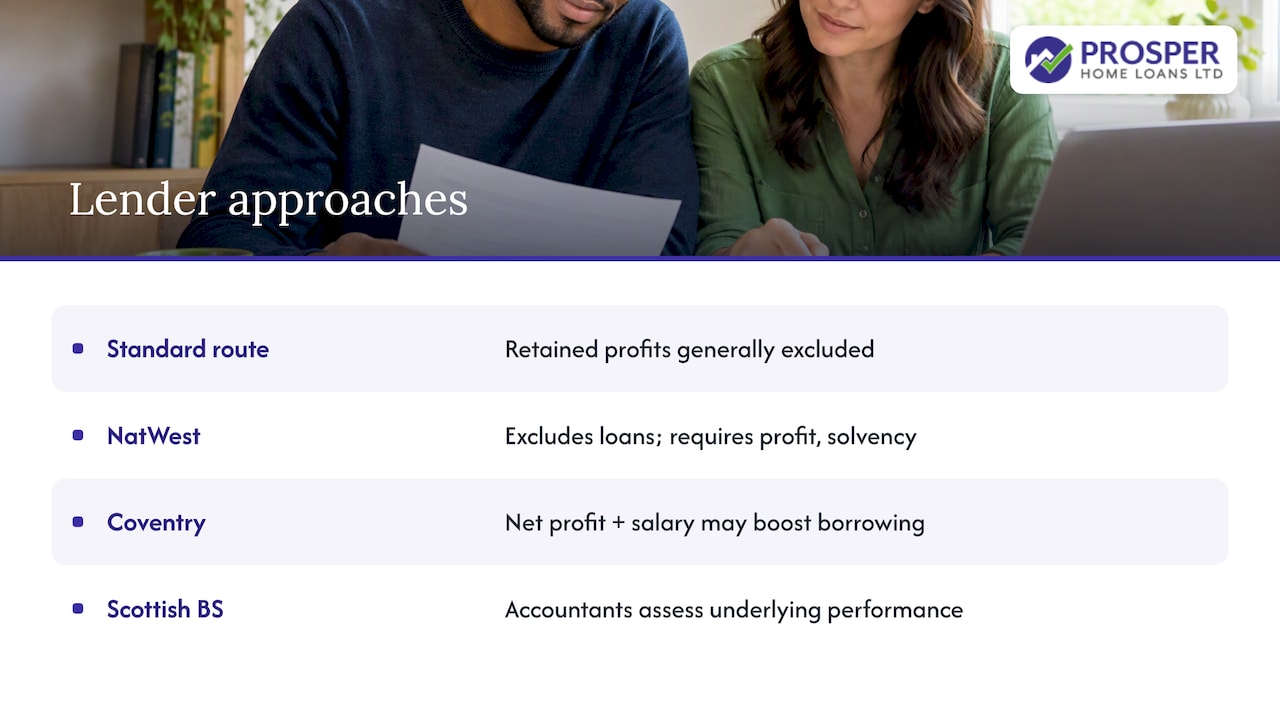
Lenders generally do not accept retained profits within the standard salary-plus-dividend route, and NatWest also excludes directors’ loans from its assessment. It also requires the business to be profitable and solvent.
Some lenders take a different view. Coventry notes that using net profit plus salary instead of dividends can allow a director to borrow more, because you do not have to draw everything out of the business. Scottish Building Society says it works with accountants to understand the underlying performance of a business rather than relying only on dividend calculations.
That does not mean retained profits will be accepted for you, or that you will borrow more. It means the choice of lender can matter a great deal, and it is worth asking before you change how you pay yourself.
Documents and trading history
Lenders want evidence that your income is real and sustainable. Typical requirements include:
- Two years of finalised accounts. HSBC asks for these from directors holding 25% or more of the shares. If the salary split is unclear, it may also ask for P60s or SA302s and tax year overviews.
- An accountant’s certificate. Coventry requires one covering the latest two accounting periods, with documents no older than 12 months, or 15 months with supporting bank statements.
- Recent year-end dates. HSBC says the latest year-end generally should not be more than 18 months before your application date.
Limited companies must file accounts at Companies House, and most must do so within nine months of the accounting reference date. Filing on time keeps your paperwork fresh for a lender.
Trading for less than two years is not always a barrier. HSBC, for example, considers one year’s accounts plus three months of business statements. Scottish Building Society looks at at least one year of history and a projection for the coming year. Your accountant plays a big part here, and our guide to the role of an accountant in a mortgage explains how.

Perspective: what we see with directors
We often meet directors who have run a healthy business for years and are surprised to find their mortgage options look narrow. Usually nothing is wrong with the business. The income has simply been structured for tax efficiency, and the first lender they approached uses a method that does not suit it.
Our approach is to look at the full picture first: salary, dividends, net profit, shareholding and how long you have traded. Then we compare how different lenders would treat it before anything is submitted. That avoids unnecessary applications and keeps the process calmer.
We also explain costs and risks plainly, and we never promise approval or a particular amount. Lender criteria change, and every case depends on your circumstances.
Paul McMath CeMAP CeRER
Steps to prepare before you apply
- Speak to your accountant. Ask for your latest accounts, a breakdown of salary and dividends, and a view on whether a certificate will be needed.
- Check your shareholding. Lender definitions of a self-employed director depend on your share of the company, so know your percentage.
- Review your credit file. Correct errors and keep personal and business borrowing in order.
- Think about timing. If you plan to change how you draw income, discuss it with a broker and your accountant first.
- Plan the deposit and costs. Include legal fees, valuation and any broker or lender fees in your budget.
If you also work as a subcontractor through your company, our article on limited company subcontractor mortgage differences may help. Buying to let through a company is a separate route, and the minimum income guide for buy to let covers it.
Speak to a local broker about your company mortgage
We are based in St. Leonards-on-Sea and work with directors, self-employed clients and contractors across Hastings, Eastbourne, Hailsham, Bexhill-on-Sea and the rest of East Sussex, as well as clients elsewhere in the UK. We are available to talk through how your income would look to different lenders and what is realistic for you.

See our self-employed and company director mortgage service, or start from our main mortgage advice page. Your home may be repossessed if you do not keep up repayments on your mortgage.
FAQ
Can a limited company director get a residential mortgage?
Yes. Lenders generally treat directors with a meaningful shareholding as self-employed and ask for evidence of income from accounts or an accountant’s certificate. Whether you are accepted, and how much you can borrow, depends on each lender’s criteria and your circumstances.
Can I use retained profits for a mortgage?
Often not. Lenders using the standard salary-plus-dividend method generally exclude retained profits. A few use salary plus net profit instead, so the lender you choose matters. A broker can check this before you apply.
How many years of accounts do I need?
Many lenders ask for two years, but some will consider one year plus supporting evidence. HSBC, for instance, looks at one year’s accounts and three months of business statements for newer companies. Always check the current lender policy with your adviser.
Does my accountant need to be involved?
Usually yes. Some lenders ask for an accountant’s certificate, and an accountant can also explain your figures clearly. It is best to involve them early, before you submit an application.
Sources
- Self Employed Hub, NatWest Intermediary Solutions
- Self-employed income and accountant’s certificate guide, Santander for Intermediaries
- Self Employment Lending, Coventry for Intermediaries
- Documents Needed For Mortgage Application, HSBC UK
- Mortgages for Entrepreneurs, Scottish Building Society
- Self-Employed Mortgage UK 2026
Recommended
- Subcontractor limited company mortgage differences explained
- Dividend Income Mortgages in the UK: What Lenders Count
- Mortgage With a CCJ: What Lenders Look At and Your Options
- Get a UK Contractor Mortgage With Bad Credit: Use Day Rate Evidence
This article provides general information and is not a personal mortgage recommendation. Mortgage availability and eligibility depend on your circumstances and lender criteria. Rates and criteria can change. We will explain any applicable fees before you commit. Think carefully before securing other debts against your home. Consolidating debts over a longer term may reduce your monthly payments but increase the total amount you repay. Your home may be repossessed if you do not keep up repayments
