Help to Buy Repayment: How to Repay Your Equity Loan

You repay a Help to Buy equity loan as a percentage of your home’s value on the day you repay, not as the amount you first borrowed. You can repay in full or in part at any time, from savings, from a sale or by remortgaging. You apply through the Help to Buy service and use a conveyancer to complete it. We are a local East Sussex mortgage broker, and when the repayment route is a remortgage, that is the part we handle with you.
This guide covers the English scheme, which no longer accepts new applications. Wales runs its own equity loan, according to GOV.UK, with its own repayment rules.
TL;DR
- Your repayment is the percentage you borrowed (for example 20%) multiplied by your home’s current market value, so it rises and falls with the property.
- You pay no interest for the first five years. From year six, interest starts at 1.75% of the original loan and rises each April.
- Part repayments must be at least 10% of the current market value, and must leave at least 5% still owing.
- The administration fee for repaying in full or in part was £200 as of June 2025, plus surveyor and legal costs.
- Most people repay by selling or remortgaging. If you are self-employed or a CIS subcontractor, the remortgage needs careful preparation.
Table of Contents
- How much you will repay
- What happens after five years
- When you must repay
- Repaying part of the loan
- What it costs to repay
- The repayment process, step by step
- Repaying from savings or an inheritance
- Repaying when you sell
- Repaying by remortgaging
- Where we come in
- Our view on repaying a Help to Buy loan
- FAQ
- Sources
How much you will repay
The equity loan is a share of your home, not a fixed sum. GOV.UK’s repayment guide says the amount is the percentage being repaid multiplied by the current market value. If you sell, it is based on the sale price when that is higher.
A worked example. You bought a home for £200,000 with a 20% equity loan, so you borrowed £40,000. Years later the home is valued at £250,000. Repaying the loan in full costs 20% of £250,000, which is £50,000. If the home had fallen to £180,000, you would repay £36,000.
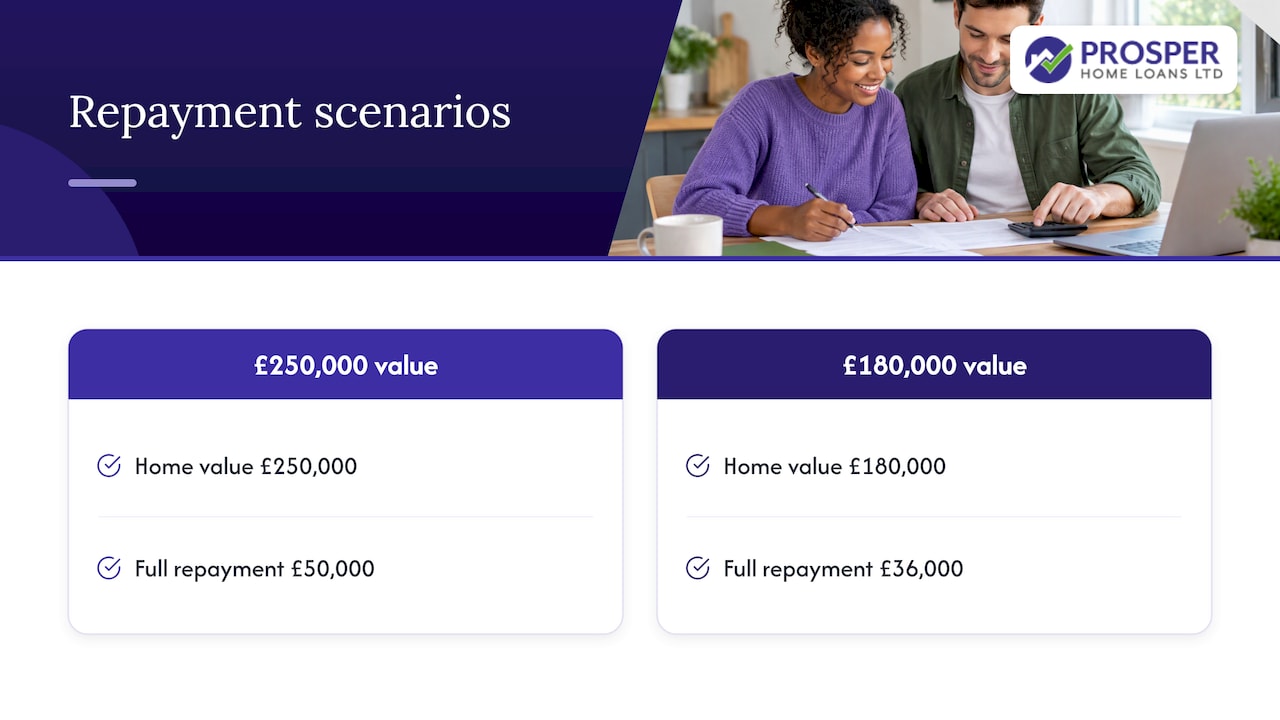
The figures above are an illustration only. Your valuation, not the example, sets your own number.
What happens after five years
GOV.UK says you pay no interest for the first five years. In the sixth year the rate is 1.75%, applied to the equity loan you originally borrowed. On a £40,000 loan that is £700 a year, or £58.33 a month.
The rate then rises every April by the Consumer Price Index plus 2%. Earlier Help to Buy loans (2013 to 2021) use the Retail Price Index plus 1%. Paying interest does not reduce the loan itself.
There is also a £1 monthly management fee until the loan is fully repaid. Interest and fees are paid by Direct Debit.
When you must repay
You can repay whenever you choose. Some events make repayment compulsory. The official repayment guide lists these:
- The loan term ends, normally after 25 years.
- You pay off your first-charge repayment mortgage without replacing it.
- You sell your home.
- You are told to repay because of non-compliance.
- You breach the terms of your repayment mortgage.
- You become bankrupt or enter an Individual Voluntary Arrangement.
If you are a subcontractor with uneven earnings, the last point matters. Talk to a debt adviser early if money is tight, rather than waiting for a missed payment to become a bigger problem.
Repaying part of the loan
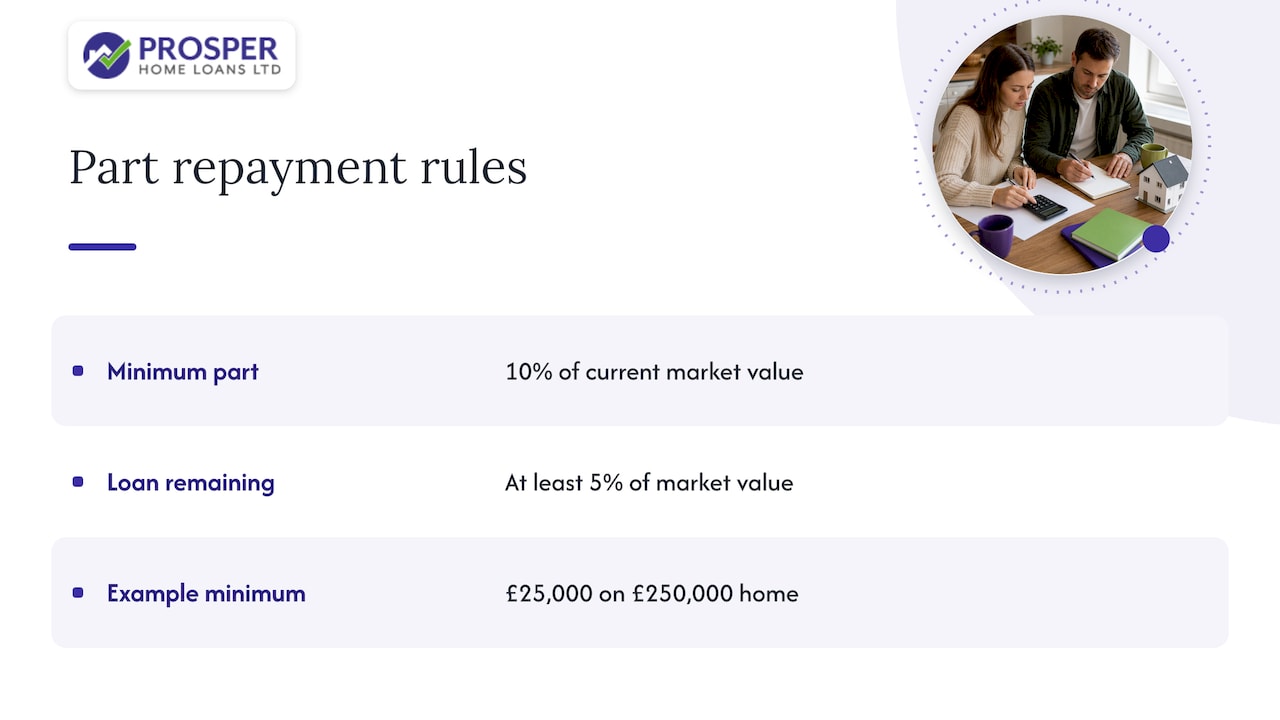
You do not have to clear the whole loan at once. A part repayment must be at least 10% of your home’s current market value. It also cannot leave less than 5% of the market value still to repay, according to the repayment guide.
Using the earlier example, with a home worth £250,000, the smallest part repayment is £25,000. Your loan percentage falls, and so does the monthly interest from year six. A later full repayment is then worked out on the smaller percentage and the market value at that time.
There are no early repayment charges on the loan. You still pay an administration fee, plus third-party costs such as surveyors and legal fees. That is different from your main mortgage, which may carry its own charges, so see our guide to early repayment charges.
What it costs to repay
| Cost | Amount | Notes |
|---|---|---|
| Administration fee, full or part repayment | £200 | GOV.UK, June 2025 |
| Remortgage alone, no equity loan repaid | £115 | GOV.UK |
| Remortgage while repaying all or part of the loan | £200 | GOV.UK |
| RICS valuation, conveyancer and lender fees | Varies | Ask each for an estimate before you apply |
Fees can change, so check the official fees page before you apply.
The repayment process, step by step
- Decide how you will pay. The three routes are your own money, a sale or a remortgage. Each needs different proof, covered below.
- Get a RICS valuation. The application needs a valuation from a Royal Institution of Chartered Surveyors member, and it must be valid for three months, says the application checklist.
- Instruct a conveyancer. You need one to give the legal undertaking, which is a formal legal promise, and to deal with the paperwork.
- Send your application. Include the form, the valuation, the administration fee and proof of funding.
- Wait for the confirmation. Once approved, the service sends your conveyancer a confirmation of the payment date and amount, known as an ATC.
- Complete. The conveyancer pays, and sends a DS1 form that removes the equity loan’s charge from your title at the Land Registry.
The valuation lasts three months, so line up your funding before you commission it. A valuation that expires while you wait for a mortgage offer means paying for another.
Repaying from savings or an inheritance
You can use your own money, such as savings or an inheritance. GOV.UK’s repayment page says a bank statement showing you hold the funds is the proof.
Before you commit, work out three things:
- The figure at today’s valuation, with a margin in case the valuation comes in higher.
- Whether you still have enough set aside for tax. Self-employed people and CIS subcontractors who pay tax through self-assessment should keep their tax money separate.
- Whether you can keep an emergency reserve after the repayment.
Repaying when you sell
If you sell, the equity loan is repaid from the sale proceeds. If the sale money does not cover everything you owe, you must make an additional payment. Ask for a figure before you accept an offer, so you know what is left for your next deposit.
If you are moving, our home mover mortgage advice looks at how the repayment and your next borrowing fit together.
Repaying by remortgaging
Many owners reach the end of the fixed rate on their main mortgage and want to clear the equity loan at the same time. A new mortgage can fund the repayment. The lender and your conveyancer handle the legal undertaking, and the service issues the ATC afterwards, as GOV.UK explains. You need a new mortgage offer as proof of funds.
Your new mortgage is likely to be larger, because it replaces the equity loan share. Lenders assess affordability on the bigger sum, and the choice of term and rate affects your monthly payment and total cost. A longer term can lower the payment while raising the total interest.
If you are self-employed, a company director or a CIS subcontractor, affordability is assessed on your tax returns, SA302s or accounts. Some lenders may use gross CIS earnings, subject to their own criteria. That does not raise your real income and does not guarantee a higher loan. Our guide on Help to Buy for subcontractors covers this for the trade.
If you are borrowing against the extra value in your home as well, our guide to remortgaging to release equity explains how loan-to-value works.
Where we come in
We are a local mortgage broker for Hastings, Eastbourne, Hailsham, Bexhill-on-Sea and across East Sussex, and we are available to talk through your repayment. We look at remortgages with you, and if you are a subcontractor, our CIS subcontractor mortgage advice covers how lenders treat your income. We can also arrange a mortgage affordability assessment and capacity report for £199.00 one-off.

No one can promise approval, and the options depend on your circumstances and each lender’s criteria.
Our view on repaying a Help to Buy loan
Most people ask us one question first: can I afford to clear this loan? The better question is which route leaves you in a sound position afterwards.
The equity loan share moves with your home’s value, so timing matters. We would rather you know your likely figure, your credit position and your income evidence months before you apply than discover a problem when a valuation is about to expire.
For self-employed clients and CIS subcontractors, preparation is the difference between a smooth remortgage and a stressful one. We explain the costs and risks plainly, and we stay with you from first enquiry through completion and future reviews.
Paul McMath CeMAP CeRER
FAQ
How much do you pay back on Help to Buy after five years?
You pay back the percentage you borrowed, applied to the current market value, so there is no fixed amount. From year six you also pay interest of 1.75% on the original loan, rising each April. Interest does not reduce the loan.
Do I need a solicitor to repay Help to Buy?
You need a conveyancer, who can be a solicitor or a licensed conveyancer. They give the legal undertaking and handle the DS1 form that removes the charge from your home. Ask for a fee estimate before you apply.
Can I repay Help to Buy in instalments?
Yes, in part repayments. Each must be at least 10% of the current market value, and you must leave at least 5% of the market value still owing. An administration fee applies each time.
What is the downside of Help to Buy?
The loan stays tied to your home’s value, so it costs more to clear if the property rises in value. Interest starts in year six, and you pay fees when you repay. Planning early helps you choose the route that suits you.
Sources
- Help to Buy: Equity Loan, GOV.UK
- Help to Buy: Equity Loan repayment guide, GOV.UK
- Help to Buy: Equity Loan repayment application checklist, GOV.UK
- Help to Buy administration fees, GOV.UK
- How to repay your equity loan when you remortgage, GOV.UK
- How to remortgage your Help to Buy home and borrow more money, GOV.UK
- How to repay your equity loan when you sell your home, GOV.UK
- Repay your Help to Buy: Equity Loan, GOV.UK
- Set up a Direct Debit to pay your Help to Buy fees, GOV.UK
Recommended
- 80% LTV: How Remortgaging to Release Equity Works in the UK
- Equity Release With a Mortgage: How It Works and What to Check
- Interest-Only vs Repayment Mortgages: Which Suits You?
- Buying Out a Partner on a Mortgage: How It Works in the UK
This article provides general information and is not a personal mortgage recommendation. Mortgage availability and eligibility depend on your circumstances and lender criteria. Rates and criteria can change. We will explain any applicable fees before you commit. Think carefully before securing other debts against your home. Consolidating debts over a longer term may reduce your monthly payments but increase the total amount you repay. Your home may be repossessed if you do not keep up repayments
