Gaps in contracts: mortgage application guide 2026

Gaps in contracts during a mortgage application are defined as periods between employment or contracting assignments where no active income was being earned, and UK lenders assess these periods through documented evidence of income continuity rather than rejecting applications outright. The good news is that preparation, not perfection, determines your outcome. If you have experienced breaks between contracts, understanding exactly what lenders look for, and what Prosperhomeloans can help you prepare, puts you in a far stronger position than most applicants realise.
How do UK lenders assess gaps in contracts during mortgage applications?
Lenders do not treat all contract gaps equally. The assessment process is built around affordability and evidence, not a simple pass or fail based on employment history alone.
Mortgage affordability assessment in the UK follows FCA responsible lending rules, which require lenders to verify income and committed outgoings over time, not just at a single point. This means your recent payslips, bank statements, and tax records collectively tell a story about your financial reliability.
A 6-week gap in contracts is commonly accepted by many mainstream lenders. Gaps beyond this threshold usually trigger manual underwriting, where an underwriter reviews your file individually rather than relying on automated scoring. Manual underwriting is not a rejection. It is an opportunity to present your case properly.
Here is what lenders typically examine when a gap appears on your application:
- Income continuity: Are your payslips and bank statements showing consistent salary credits before and after the gap?
- Gap length: Is the break within the lender’s acceptable window, typically three to six weeks for high-street lenders?
- Reason for the gap: Project breaks, seasonal work patterns, or personal circumstances are all considered, provided you can document them.
- Current contract status: Lenders want confirmation that you are actively earning at the time of application, not simply that you were earning previously.
- Affordability under stress: The FCA requires lenders to stress test affordability by assuming interest rate increases over the first five years of a mortgage, so your income must support repayments even if rates rise.
The critical point here is that gaps in contracts trigger scrutiny, not automatic refusal. Your documentation package is what determines the outcome.
What documentation do you need to prove income stability?

Preparing the right documents before you apply removes the most common source of delay and rejection. Lenders verify income through a specific cluster of documents, and missing even one can cause your application to stall.
Lenders typically verify income by matching three months of payslips with bank statement salary credits and the latest P60 if the application crosses a tax year. This triangulation confirms that the income declared on paper actually arrived in your account.
| Document | Purpose | When required |
|---|---|---|
| Three months of payslips | Confirms current income level and employment status | Always required |
| Corresponding bank statements | Verifies salary credits match payslip figures | Always required |
| P60 | Confirms annual earnings and tax paid | Required if application crosses a tax year |
| SA302 tax calculation | Confirms self-assessed income for contractors and directors | Required for self-employed or limited company applicants |
| Company filed accounts | Demonstrates business profitability and retained profit | Required for sole-director limited company contractors |
| HMRC Personal Tax Account printout | Alternative to P60 where original is unavailable | Accepted by most lenders as substitute |
Lenders also verify PAYE references, tax codes, and year-to-date figures across payslips and P60s. Any inconsistency, such as a tax code change or a year-to-date figure that does not reconcile, flags your file for deeper scrutiny and can cause delays even when your income is perfectly legitimate.
Pro Tip: Never submit self-issued payslips. Use only official payroll documents generated through your employer’s payroll system or a registered payroll provider. Self-issued documents are one of the fastest ways to trigger a fraud check, regardless of how accurate the figures are.
For contractors applying through a limited company, specialist lenders may accept longer gaps but typically require SA302 tax calculations and company accounts alongside retained profit evidence or accountant certification. This is standard practice and not a sign of a weak application.
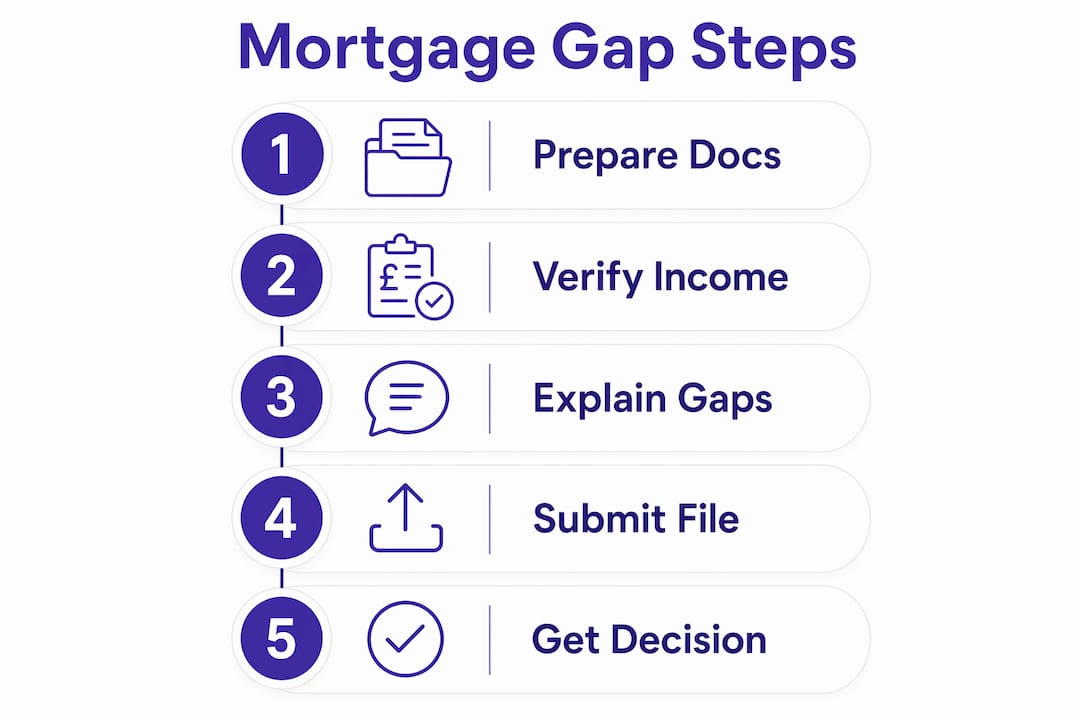
Step-by-step: how to address contract gaps when applying for a mortgage
A structured approach to your application significantly reduces the risk of delays or refusals. Follow these steps before you submit anything to a lender.
-
Gather your complete income evidence first. Collect three months of payslips, the corresponding bank statements, your most recent P60, and your SA302 if you are a contractor or director. Do not begin an application until this set is complete.
-
Reconcile your figures before the lender does. Check that your payslip income matches your bank credits exactly. Confirm your tax code is consistent across documents. Verify that your year-to-date figures align with your P60. Mismatches between payslip income and bank statement credits cause manual review requests and delays even when the gap itself is minor.
-
Write a clear, factual explanation for each gap. A brief written statement explaining the reason for any break, whether a project ended, you took time for personal reasons, or you were between assignments, gives the underwriter context. Pair this with any supporting evidence you have, such as a letter from a previous client confirming the contract end date.
-
Calculate your committed outgoings honestly. Lenders assess affordability against your monthly outgoings, including loan repayments, credit card minimums, childcare costs, and any other regular commitments. The Bank of England emphasises that affordability testing remains central to lender frameworks, so underestimating your outgoings will not help your application and may cause problems later.
-
Speak to a mortgage adviser before approaching lenders directly. An adviser experienced with contractor and variable-income applicants knows which lenders are most likely to accept your profile. Applying to the wrong lender wastes time and leaves a footprint on your credit file.
-
Consider specialist lenders if high-street lenders decline. Not every lender uses the same criteria. Specialist lenders often have more flexible policies around gap lengths and income types, provided your overall affordability is strong.
Pro Tip: Ask your mortgage adviser to request a Decision in Principle before submitting a full application. This gives you a clear indication of lender appetite without triggering a hard credit search.
Mortgage income is assessed over time and in the context of monthly committed payments, so contract gaps must be framed with evidence of stability rather than treated as a standalone issue. A gap six months ago matters far less if your current contract is active and your bank statements show consistent credits.
Common mistakes that complicate mortgage applications with contract gaps
Several avoidable errors consistently cause delays or refusals for applicants with gaps in their contract history. Knowing these in advance lets you sidestep them entirely.
- Submitting mismatched documents. If your payslip shows £3,500 per month but your bank statement shows £3,200 credited, the lender will flag this immediately. Always reconcile figures before submission.
- Leaving gaps unexplained. An unexplained gap is treated as a risk. A documented gap with a clear reason is treated as context. The difference in outcome can be significant.
- Ignoring the stress test. The FCA’s affordability rules mean lenders must assess whether you can afford repayments if interest rates rise. Applying for the maximum you can afford today, without accounting for rate increases, often leads to rejection.
- Overlooking tax code anomalies. A change in tax code between payslips, such as moving from 1257L to BR, signals a secondary income or a tax debt to an underwriter. Explain any code changes proactively.
- Assuming all lenders use the same gap policy. High-street lenders such as Halifax, Nationwide, and Barclays each have different thresholds for acceptable gap lengths. What one lender declines, a specialist lender may approve without hesitation.
- Applying to multiple lenders simultaneously. Each full application leaves a hard search on your credit file. Multiple hard searches in a short period reduce your credit score and signal financial distress to subsequent lenders.
How do contract discrepancies affect mortgage approval?
Contract discrepancies in a mortgage context refer to differences between the documents you signed and the documents submitted to or held by the lender. These are distinct from employment gaps but can cause equally serious problems if left unresolved.
Discrepancies between the signed contract and lender-submitted documents such as APR, term length, or financed amount can cause mortgage funding delays and require formal reconciliation. The most common areas where mismatches occur are the interest rate applied, the loan term, any add-on products included without consent, and the total amount financed.
| Discrepancy type | Potential impact | Resolution step |
|---|---|---|
| APR or interest rate mismatch | Higher monthly payments than agreed | Request funded contract package from lender in writing |
| Term length difference | Longer repayment period, more total interest | Compare signed copy against lender records directly |
| Unauthorised add-ons | Inflated loan amount | Submit written reconciliation request to lender |
| Financed amount discrepancy | Affordability calculation based on wrong figure | Escalate to the Financial Ombudsman Service if unresolved |
The first step when you suspect a discrepancy is to request the exact funded contract package from your lender. Compare this line by line against your signed copy. If differences exist, submit a written reconciliation request. If the lender does not resolve the issue within eight weeks, you have the right to escalate to the Financial Ombudsman Service.
Pro Tip: Keep a dated copy of every document you sign during a mortgage application. This single habit eliminates most disputes about what was agreed, and it costs nothing.
The FCA’s evolving mortgage market reforms in 2026 aim to improve access for non-standard borrowers through more sophisticated affordability modelling, including open banking data and AI-assisted payment capacity assessments. This is genuinely good news for contractors and variable-income applicants who have historically found high-street lenders inflexible.
Key takeaways
Gaps in contracts do not prevent mortgage approval. Thorough documentation, honest affordability evidence, and the right lender match are what determine the outcome.
| Point | Details |
|---|---|
| Six-week gap threshold | Most mainstream lenders accept gaps up to six weeks; longer gaps require manual underwriting with supporting evidence. |
| Document triangulation | Match payslips, bank statements, and P60s precisely before submission to avoid triggering manual review. |
| Stress test preparation | Demonstrate affordability under future rate increases, not just current repayment levels, to satisfy FCA requirements. |
| Discrepancy resolution | Request the funded contract package from your lender and submit a written reconciliation request if figures differ from your signed copy. |
| Specialist lenders exist | If high-street lenders decline due to gap length or income type, specialist lenders often have more flexible criteria for contractors. |
What I have learned from working with contract applicants
From my experience working with contractors and self-employed borrowers at Prosperhomeloans, the single biggest factor separating successful applications from declined ones is not the gap itself. It is how prepared the applicant is when they first speak to a lender.
Most people come to us having already applied to one or two high-street lenders and received a decline. In almost every case, the decline was not inevitable. It was the result of submitting incomplete documentation, leaving gaps unexplained, or applying to a lender whose criteria simply did not fit the applicant’s profile. None of those problems are permanent.
What I advocate for every applicant with a contract gap is this: treat your application as a presentation, not a form. You are making a case for your financial reliability. The underwriter on the other side of that application is looking for reasons to approve you, not just reasons to decline. Give them the evidence they need.
The 2026 FCA reforms are also worth noting here. The shift towards open banking data and more nuanced affordability modelling genuinely improves the outlook for non-standard borrowers. Lenders are increasingly able to assess real payment behaviour rather than relying solely on payslip snapshots. If your bank account shows consistent, responsible financial management, that now carries more weight than it did even two years ago.
My honest advice is to consult a specialist broker before you apply anywhere. The cost of a declined application, both to your credit file and your timeline, is far higher than the cost of getting proper advice upfront.
— Paul
How Prosperhomeloans can help with your mortgage application
If you have gaps in your contract history and you are unsure how a lender will view your application, Prosperhomeloans is here to help. We work with contractors, subcontractors, and self-employed borrowers every day, and we understand exactly how to present your income evidence in the strongest possible light.

We guide you through gathering the right documentation, reconciling your figures, and identifying which lenders are most likely to approve your specific profile. Where high-street lenders apply rigid criteria, we know the specialist lenders who take a more considered view of contract history. Our goal is to save you time, reduce stress, and give you the best possible chance of approval. Speak to our team at Prosperhomeloans to get started with a no-obligation consultation today.
FAQ
How long a gap in contracts will a mortgage lender accept?
Most mainstream lenders accept gaps of up to six weeks between contracts without requiring additional explanation. Gaps beyond this typically trigger manual underwriting, where you will need to provide supporting documentation and a written explanation.
What documents do I need if I have contract gaps on my mortgage application?
You need three months of payslips matched to bank statement salary credits, your most recent P60, and, if you are a contractor or limited company director, SA302 tax calculations and company accounts. All figures must reconcile precisely before submission.
Will a contract gap automatically lead to a mortgage rejection?
A contract gap does not automatically result in rejection. Lenders assess affordability and income stability over time, so a well-documented gap with a clear explanation and consistent recent income is treated very differently from an unexplained or ongoing gap.
What should I do if I find a discrepancy in my mortgage contract?
Request the funded contract package from your lender in writing and compare it line by line against your signed copy. If discrepancies exist, submit a formal written reconciliation request. If the lender does not resolve the issue within eight weeks, escalate to the Financial Ombudsman Service.
Can a specialist lender help if a high-street lender has declined my application?
Yes. Specialist lenders often apply more flexible criteria around gap lengths and income types, particularly for contractors and self-employed applicants. They typically require stronger supporting evidence such as accountant certification or retained profit records, but they are a genuine option where mainstream lenders have declined.
